
AML Case Management Software in Singapore
Ready to Defeat Your AML Compliance Obstacles?
Citadel Brings Revolution with Secure Solutions to AML Compliance Problems
Key Takeaways: Case Management Software in Singapore
- AML case management software helps compliance teams manage, organise and prioritise alerts, investigations, evidence and decisions in one place.
- For Singapore-regulated entities, it keeps cases organised, tracks each case from alert to decision and maintains the audit trail that supervisors expect to see.
- In Singapore, STRs are filed with STRO through SONAR, and MAS expects the institutions it regulates to file within five business days of suspicion, or one business day for sanctioned-party cases.
What is AML Case Management Software?
AML case management software, also called a case management system, is a compliance tool that helps regulated entities in Singapore centralise, manage and prioritise alerts, investigations and escalations in one place. It manages the full lifecycle of an AML alert: alert generation, investigation, escalation and suspicious transaction report (STR) filing. It records evidence and decisions in an audit trail that supports STR filing with STRO through SONAR and stands up to supervisory inspection.
For regulated entities in Singapore, the STR obligations are set under the Corruption, Drug Trafficking and Other Serious Crimes (Confiscation of Benefits) Act 1992 (CDSA) and, for terrorism financing, the Terrorism (Suppression of Financing) Act 2002. Under section 45 of the CDSA, a person who knows or has reasonable grounds to suspect that property is connected with criminal conduct must file an STR with the Suspicious Transaction Reporting Office (STRO), part of the Singapore Police Force’s Commercial Affairs Department. Case management software helps compliance teams document, investigate, track, and manage suspicious transaction cases before filing the STR with STRO.
Why Case Management Software Matters in Singapore
Case management software matters in Singapore because it helps regulated entities meet STR deadlines, show supervisors a complete audit trail and prevent tipping off.
Meeting STR Filing Deadlines in Singapore
MAS-regulated financial institutions in Singapore work to tight STR timelines. Under the MAS Guidelines to the AML/CFT Notices, revised with effect from 1 July 2025, an STR should be filed no later than five business days after suspicion is first established, unless the circumstances are exceptional or extraordinary. Where a case involves a sanctioned party, or a party acting on behalf of or under the direction of one, the STR should be filed as soon as possible and no later than one business day after suspicion is first established. Handling suspicious cases through email threads, spreadsheets and verbal escalations makes these deadlines hard to meet. Case management software creates and ranks cases by priority, so teams lose less time and file STRs on time.
Audit Trails for MAS Inspections
Supervisors such as MAS may examine not only whether STRs were filed but also how each case was investigated. Where an entity cannot show a structured trail from alert to final decision, inspectors are likely to treat this as a weakness in its STR controls. Case management software timestamps each review, escalation and decision, so the full trail is ready when inspectors ask for it.
Preventing Tipping Off Under the CDSA
Tipping off is an offence under section 57 of the CDSA, so entities must not disclose the filing of an STR or any suspicious case investigation to the client or a third party. Case management software uses role-based access controls, so only authorised staff can see case details, which reduces the risk of tipping off.
How Does Case Management Software Work in Singapore?
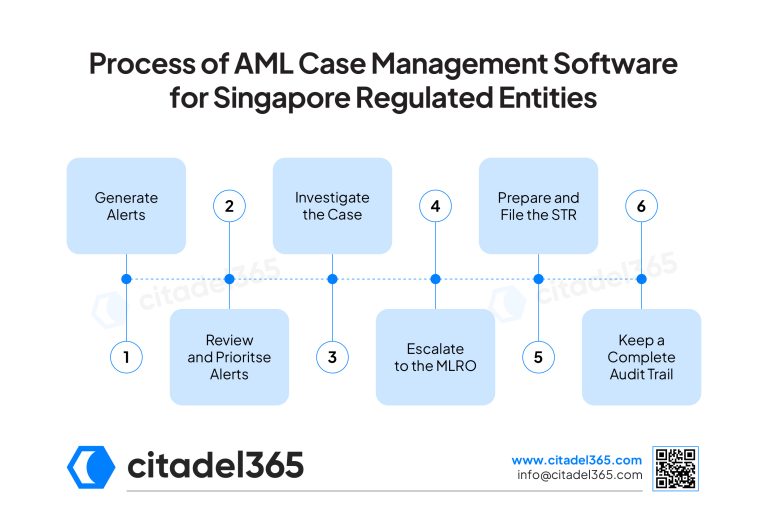
AML case management software works in six steps: alert generation, review and prioritisation, investigation, escalation, STR filing through SONAR, and audit trail retention. Each step is recorded so the case can be rebuilt for MAS or other supervisors.
Step 1: Alert Generation and Case Creation
A case starts when transaction monitoring or name screening software raises an alert, or when staff report suspicious activity. Case management software turns each alert or internal report into a case with its own reference.
Step 2: Alert Review and Risk-Based Prioritisation
Case management software helps review alerts based on their risk level. It flags high-risk cases, ranks them by risk score and records who reviewed each alert and why it was closed or escalated.
Step 3: Case Investigation and Evidence Collection
Case management software allows compliance teams to investigate cases, add notes, upload supporting documents and record their findings.
Step 4: Escalation to the AML/CFT Compliance Officer
Analysts can reassign cases between team members or escalate them to the AML/CFT compliance officer, often called the MLRO, for further review. The MLRO then records the decision in the case: file an STR, close the case or investigate further.
Step 5: STR Preparation and Filing Through SONAR
When the decision is to file, case management software compiles the case facts, parties and transactions needed for the STR, ready for submission to STRO through SONAR.
Step 6: Audit Trail and Record Retention
The case management system records case history, including investigation notes, alerts, evidence, decisions and filing records. Regulated entities keep these records for at least five years and can produce them for MAS or other supervisors during inspections.
Worked Example: A Sanctioned-Party Alert in Singapore
This example is illustrative. On Monday at 10:00, name screening flags a payment beneficiary as a possible match to a designated party under the MAS sanctions regulations, and the system opens a case. By 11:30, an analyst confirms the match using date of birth and address, uploads the evidence and escalates the case. At 15:00, the AML/CFT compliance officer records the decision to file, which establishes suspicion. Under the MAS Guidelines, the STR should then reach STRO through SONAR no later than close of business on Tuesday, one business day later, and every step carries a timestamp for later inspection.
Key Features of Case Management Software for Singapore
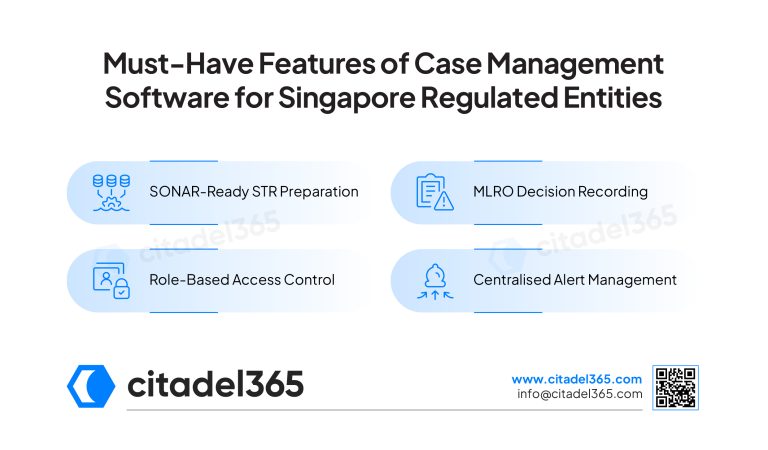
The right case management software helps Singapore-regulated entities manage alerts and investigations and prepare STRs in one place, so they can meet STR deadlines with proper documentation and access controls.
SONAR-Ready STR Preparation
SONAR-ready STR preparation pulls case information into the STR, so analysts re-key less data and make fewer errors when filing with STRO.
MLRO Decision Recording
Case management software lets the MLRO record each decision, whether to file an STR, not file or investigate further, along with the reason.
Role-Based Access Controls to Prevent Tipping Off
Role-based access controls stop front-line staff from seeing case status, which reduces the risk of unauthorised disclosure and tipping off.
Centralised Alert Management
Centralised alert management brings transaction monitoring and screening alerts into one queue, so investigation and escalation follow a single process.
Case Management Software vs Transaction Monitoring Software
Transaction monitoring software detects unusual activity and raises alerts. Case management software takes over once an alert exists: it holds the investigation, evidence, MLRO decision and STR record. Most Singapore-regulated entities use both, with alerts from monitoring and screening tools flowing into the case management system.
Who Needs Case Management Software in Singapore?
No Singapore law requires a specific software tool, but financial institutions and DNFBPs in Singapore use case management software to centralise investigations, maintain audit trails and meet STR timelines. The main need differs by sector.
Entity Type | Primary Case Management Requirement |
Banks | High-volume alert triage, risk-weighted prioritisation, SONAR STR, one-business-day sanctions timeline |
Payment service providers | Transaction alert management, sanctions hit escalation, SONAR filing |
DPT service providers | Travel rule non-compliance cases, wallet-linked sanctions alerts, PF case handling |
Capital markets intermediaries | AML/CFT cases kept separate from market misconduct cases, which follow different reporting routes |
Corporate service providers | STR filing to STRO for suspicious corporate structure activity |
Precious metals and stones dealers | STRs for suspicious transactions of any value, tracked separately from cash transaction reports (CTRs) above SGD 20,000 |
Real estate agencies and salespersons | STRs on suspicious property buyers or sellers, CDD records for each transaction, tipping-off controls |
Law practices | STRs on suspicious client matters, with a legal privilege review before filing and matter-level access controls |
Public accountants and accounting entities | STRs on suspicious client activity found during engagements, with escalation records kept by engagement |
How Citadel365 Case Management Software Supports Singapore Compliance
Citadel365 helps Singapore-regulated entities create and manage AML cases. It acts as both a task tracker and a record-keeper, holding every review and compliance decision in one place. Case management is one module of Citadel365’s AML software in Singapore, alongside customer onboarding, name screening and customer risk assessment.
The case management software supports risk-based alert prioritisation, investigation, MLRO review and decision recording. It also helps prepare STRs for every suspicious case, with priority handling for sanctioned-party cases that carry the one-business-day timeline.
Citadel365 uses role-based access controls to protect sensitive case information and avoid tipping off. It also timestamps every case action, creating an audit trail for regulatory reviews.
With Citadel365, regulated entities in Singapore can record cases and retrieve past investigations and supporting documents, supporting the five-year record retention obligation.
Struggling to Manage AML Cases in Singapore?
Citadel365 keeps your alerts, investigations and MLRO decisions organised and ready through a centralised platform.
FAQs About Case Management Software in Singapore
Case management software in Singapore is a digital tool that helps financial institutions and DNFBPs create, track, investigate and manage compliance cases and maintain secure audit trails.
Tipping off means telling a client or third party that an STR has been filed or that a suspicious case is under investigation, which is an offence under section 57 of the CDSA. Case management software uses role-based access controls, restricting unauthorised persons from viewing sensitive information and helping prevent tipping off.
Case management software keeps a timestamped audit trail of alerts, investigations and decisions, which shows MAS or other supervisors how each case was handled.
Records relating to suspicious transaction reports (STRs) must be retained for at least five years under the MAS AML/CFT Notices, with comparable rules for DNFBPs. Citadel365 helps entities comply with record-keeping obligations by storing investigation records, decision history and supporting documents securely, making them available for supervisory review when required.
For MAS-regulated financial institutions, an STR should be filed no later than five business days after suspicion is first established, unless the circumstances are exceptional or extraordinary. Cases involving sanctioned parties, or parties acting for them, should be filed no later than one business day after suspicion is first established.
No. Singapore law does not require a specific software tool. Regulated entities must, however, report suspicious transactions, prevent tipping off and keep records for at least five years, and case management software makes these duties easier to evidence.

Arjun is the Co-founder and CEO of Citadel, where he leads the company’s vision across technology, business, and regulations. He brings over a decade of experience in building and scaling technology ventures. Arjun holds a B.Tech. in Information Technology and a Master’s in Management, supported by his certification as a Financial Crime Specialist, an uncommon combination that allows him to balance innovation with regulatory requirements.
Having advised leading banks and financial institutions on digital solutions and compliance technology, Citadel continues to grow with an ambition.