
What Does an AML Compliance Officer Do? Roles, Responsibilities & Compliance Duties
Ready to Defeat Your AML Compliance Obstacles?
Citadel Brings Revolution with Secure Solutions to AML Compliance Problems
Key Takeaways: AML Compliance Officer
- An AML Compliance Officer is a professional responsible for helping regulated entities meet AML obligations and prevent financial crime.
- Regulated entities require a compliance officer to manage day-to-day compliance operations and mitigate ML/TF risks.
- Appointing a compliance officer is a regulatory obligation under UAE AML laws for financial institutions, DNFBPs and VASPs.
- Citadel365’s external compliance officer provides expert AML support and helps regulated entities meet their AML obligations.
What Is an AML Compliance Officer?
An AML compliance officer is a designated professional who manages compliance functions to prevent financial crime. They ensure the business adheres to AML/CFT rules and regulations by developing and implementing an AML compliance framework to prevent money laundering, terrorist financing, and other financial crimes.
Regulated entities are required to appoint a compliance officer to avoid regulatory penalties, meet AML regulations and prevent financial crime. These include fintech, real estate, banking, legal professionals, VASPs, DPMS, accounting firms, TCSPs, insurance, exchange houses and the gaming sector.
What Does an AML Compliance Officer Do?
AML compliance officer handles compliance issues; however, the roles and responsibilities vary depending on the size of the organisation. These include:
- Developing, implementing, and updating policies and procedures.
- Managing customer due diligence (CDD) and enhanced due diligence procedures.
- Conducting enterprise risk assessments to draft effective policies.
- Performing ongoing transaction monitoring and reviewing alerts.
- Identifying suspicious activities and timely filing of suspicious activity reports (SARs) and suspicious transaction reports (STRs).
- Delivering AML training to staff on financial crime risks.
- Maintaining audit-ready documents for regulatory inspections.
- Advising senior management on changes in law and emerging risks to ensure regulatory compliance.
- Briefing and reporting to senior management and the Board on AML compliance matters.
AML Compliance Officer vs MLRO
The following table demonstrates the meaning, role, and key differences between a compliance officer and a Money Laundering Reporting Officer (MLRO).
Basis | Compliance Officer | MLRO |
Role | Manages the overall compliance framework. | Oversees AML/CFT compliance related to suspicious activity reporting. |
Key responsibilities | Develop policies and procedures, staff training, monitor controls, and report to senior management. | Reviews alerts, assess whether suspicion occurs, submit STR/SAR to the FIU and maintain reports confidentiality. |
Scope | Ensures the business meets day-to-day regulatory compliance requirements. | Handles STR/SAR reporting and decides whether to report suspicious activity. |
Regulatory contact | Manages internal audits and routing inquiries. | Acts as a key contact for regulatory reporting. |
However, one person can perform both roles, especially in small and medium-sized organisations. Regulators require such individuals to have the appropriate knowledge, independence, authority and resources to manage both functions effectively.
Strengthen Your AML Framework with Expert Support
From developing AML policies to reporting to senior management, we help ensure compliance.
AML Compliance Officer Skills and Qualifications
An independent natural person can be appointed as an AML compliance officer when they have the necessary skills and experience. This includes:
- Strong professional background in financial regulation or compliance, including topics such as AML laws, KYC, CDD/EDD, transaction monitoring, and sanctions screening.
- Investigation, communication and analytical skills to protect the company from regulatory penalties and ensure reporting.
- Attention to detail to detect hidden patterns and leadership skills to train staff.
- Certified with CAMS (Certified Anti-Money Laundering Specialist) or ICA (International Compliance Association) qualifications.
AML Compliance Officer Responsibilities Under UAE Regulations
Appointing an AML compliance officer is a regulatory obligation for regulated entities in the UAE. Under Cabinet Resolution 134 of 2025, an AML compliance officer must be a senior person with the right skills and experience who can make independent decisions. The core responsibilities for an AML compliance officer under UAE regulations include:
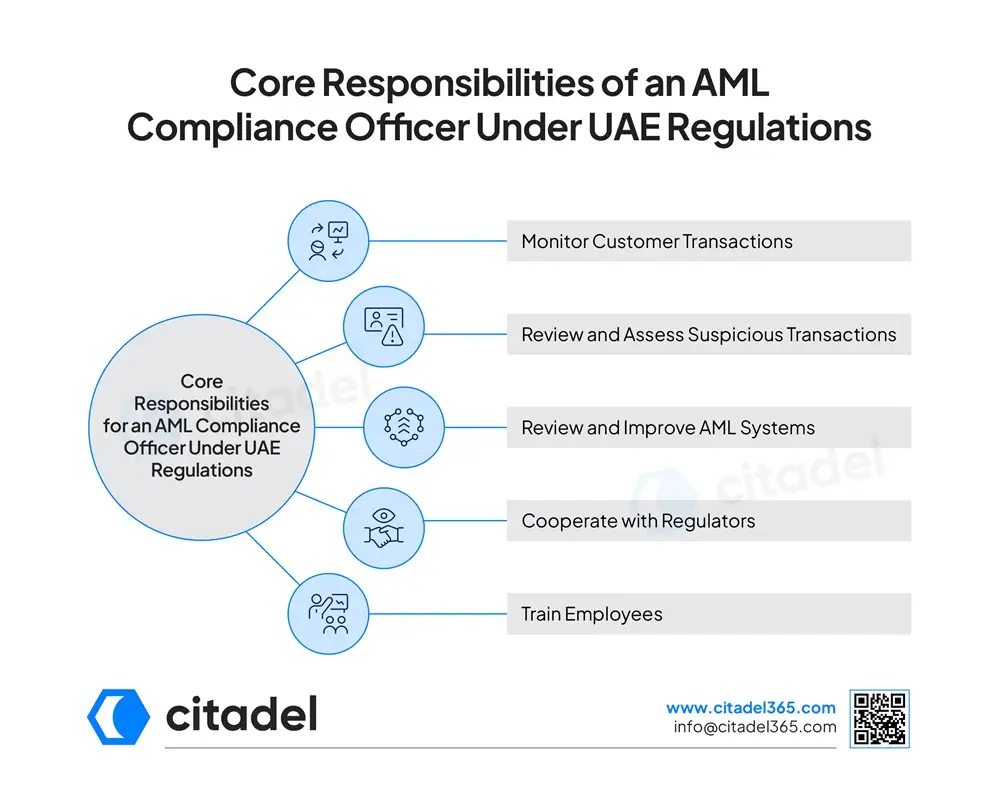
Monitor Customer Transactions
The compliance officer must monitor transactions to detect unusual patterns or suspicious activities related to money laundering, terrorist financing, or other financial crime.
Review and Assess Suspicious Transactions
The compliance officer must review customer records and information related to suspicion. The process also includes assessing whether to report it to the FIU and documenting it.
Review and Improve AML Systems
Another key responsibility is checking whether AML/CFT/CPF policies, procedures, and systems meet UAE AML requirements. The compliance officer identifies gaps, suggests improvements, and prepares reports for senior management.
Cooperate with Regulators
The compliance officer must cooperate with the relevant supervisory authority and FIU by providing requested information and helping them access the required records and documents.
Train Employees
The appointed compliance officer should provide ongoing AML training to help employees understand & prevent financial crime, their responsibilities, and how to detect suspicious activities.
Common Challenges AML Compliance Officers Face
Compliance officers may face the following challenges while balancing strict regulations with operational efficiency:
Rapidly Changing Regulations
AML rules and requirements change regularly, requiring compliance officers to track updates and adjust policies and procedures accordingly.
False Positive Alerts
Screening and transaction monitoring systems may generate wrong alerts, flagging an innocent customer or transaction as suspicious. Compliance officers need to review all these alerts, increasing workload.
Resource Constraints
Entities with limited resources make it harder for compliance officers to manage monitoring, training, reporting and other responsibilities effectively.
Cross-Border Transactions
Compliance officers may struggle to monitor cross-border transactions because they involve different countries, rules and regulations, privacy laws, currencies, and financial crime risks.
Technology Integration
Using old legacy systems integrated with new tools may create data privacy risks and require technical skills which compliance officers may lack.
Maintaining Staff Awareness
Compliance officers provide AML training to staff to help them understand their roles, responsibilities, and warning signs. Regularly training staff on evolving laws, regulations, and ML/TF typologies can be challenging.
Your AML Framework Requires Dedicated Attention
Our external compliance officer support ensures policy updates, staff training, risk assessments, ongoing monitoring and record-keeping.
Best Practices for Effective AML Compliance
Compliance officers should build a risk-based AML programme, use automation, conduct regular AML audits, update policies frequently, regularly train employees and review alerts independently to ensure effective AML compliance.
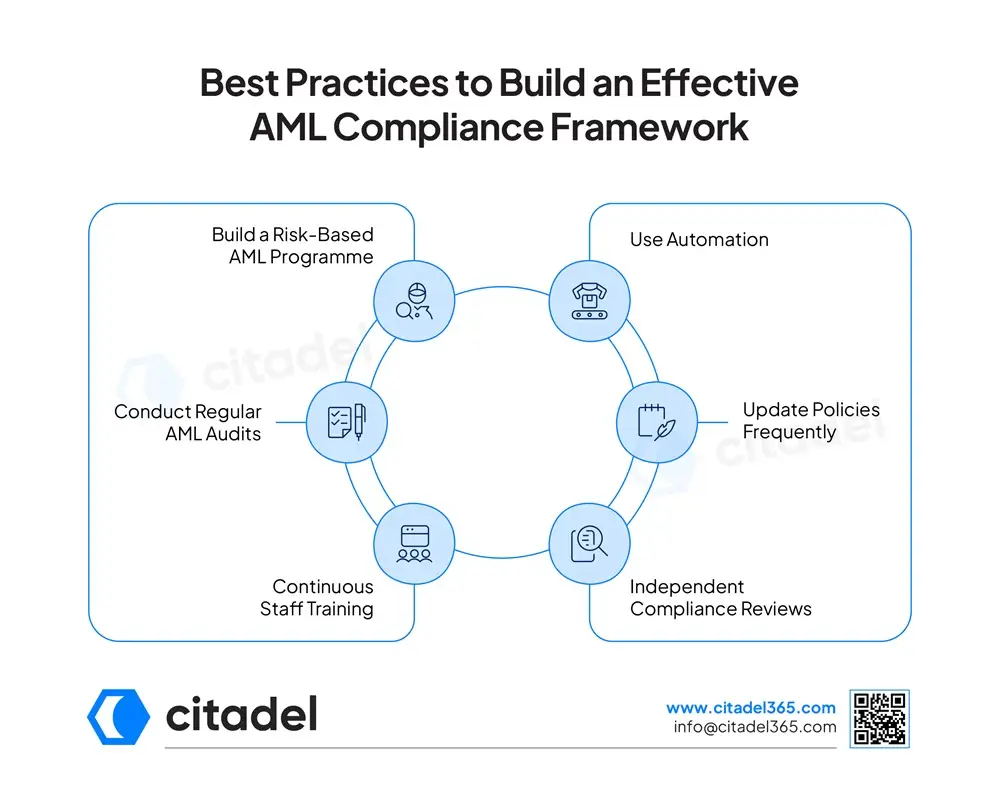
Build a Risk-Based AML Programme
The compliance officer should identify and assess ML/TF risk areas and apply controls to high-risk areas, including customers, transactions or countries.
Use Automation
They should use automated tools for AML compliance that support customer screening, transaction monitoring, and record-keeping, which reduces manual work and helps identify red flags efficiently.
Conduct Regular AML Audits
The compliance officer should assess whether the policies, procedures and controls are effective. If any gaps are found, they must address them promptly.
Update Policies Frequently
When enterprise risk assessments change, or regulations update, those changes must be reflected in policies. The compliance officer must review and update policies to ensure AML compliance.
Continuous Staff Training
The compliance officer should provide regular training to employees that helps them understand their responsibilities, detect red flags, and escalate suspicious activity for further investigations.
Independent Compliance Reviews
The compliance officer should review the AML program and controls to identify gaps and measure control effectiveness.
When Should Businesses Outsource an AML Compliance Officer?
Regulated entities may consider outsourcing AML Compliance Officer responsibilities when they need temporary help during rapid growth, face high costs to hire a full-time expert, and operate in a complex global market.
Outsourcing provides adequate compliance support without requiring businesses to build a large internal team as they grow. It helps startups manage costs who require AML expertise to ensure compliance. Further, an outsourced compliance officer provides support to entities handling high-risk customers, countries, transactions, or industries, with access to professionals who have relevant AML knowledge and experience.
Moreover, an outsourced compliance officer allows scalability to increase or reduce support as business needs change. They also help fulfil applicable AML requirements and ensure faster implementation.
How Citadel365 Supports AML Compliance
Citadel365 helps regulated entities strengthen their AML compliance by managing AML responsibilities through external compliance officer support. Citadel365, with experienced professionals provide guidance on AML requirements and helps regulated entities meet their regulatory obligations.
The outsourced compliance officer supports day-to-day compliance and helps regulated entities design and update AML policies and procedures. Further, Citadel365 helps identify and assess ML/TF risks by performing an enterprise-wide risk assessment, considering factors such as customers, products, geographies, transactions, and delivery channels.
Citadel365’s external compliance officer also supports regular health checks to help identify gaps and suggest improvements. Further, the outsourced compliance officer provides AML training to help staff detect red flags, understand their responsibilities and ensure AML/CFT compliance.
Need an AML Compliance Officer?
Citadel365 helps keep your business prepared without hiring an in-house compliance team.
Frequently Asked Questions About Identity Verification
AML compliance officer is a professional appointed to help regulated entities meet regulatory obligations and prevent financial crime. The compliance officer develops and implements an effective AML/CFT framework and oversees day-to-day compliance operations.
Yes, regulated entities in the UAE, including Financial Institutions, DNFBPs, and VASPs, are required to appoint an AML compliance officer under the UAE AML laws.
Yes, regulated entities can outsource AML compliance officer responsibilities to a qualified external professional. It helps businesses with limited resources to ensure AML compliance.
Industries such as banking, fintech, payment service providers, gaming, real estate, DPMS, accounting firms, TCSPs, legal professionals, and cryptocurrency require AML compliance officers to fulfil AML regulations.

Vasantha holds a Master’s in Law specialising in Banking Laws and Anti-Money Laundering and is CAMS and CGSS certified. With over 35 years of experience, she has worked closely with regulators and international financial institutions, building financial crime risk frameworks, sanctions monitoring programmes, and compliance systems across multiple jurisdictions.