
Name Screening Software for Fintechs and Payment Service Providers in Singapore: Real-Time Screening at Digital Scale
Ready to Defeat Your AML Compliance Obstacles?
Citadel365 Brings Revolution with Secure Solutions to AML Compliance Problems
Key Takeaways: Name Screening Software for Fintechs and Payment Service Providers
- Screening must be done in real time, not in batches, to identify potential matches and act quickly to prevent financial crime.
- Under MAS Notice PSN01, payment service providers in Singapore must screen customers, connected parties, beneficial owners and wire transfer parties, irrespective of the customer’s risk profile.
- Configurable thresholds help manage false-positive volume and reduce alert fatigue, while daily rescreening helps detect matches early and file reports on time.
- Citadel365 name screening software supports fintech compliance teams with automated real-time screening, configurable rules and timestamped, exportable records.
What is Name Screening Software for Fintechs in Singapore?
Name screening software for fintechs and payment service providers in Singapore is a digital platform that checks customer and counterparty names against relevant global sanctions lists, PEP lists and adverse media data. Under MAS Notice PSN01, payment service providers licensed under the Payment Services Act 2019 must screen customers, persons acting on their behalf, connected parties and beneficial owners, irrespective of the customer’s risk profile. Digital payment token service providers have equivalent screening obligations under MAS Notice PSN02.
The screening software checks against designated individuals and companies on the UN Consolidated List, OFAC SDN list, and other global lists. It also conducts real-time checks with configurable thresholds to manage false positives and keep customer profiles updated.
Singapore fintechs and payment service providers onboard customers through app-based journeys at high volume, so screening has to keep pace with onboarding. MAS guidance warns that screening only after business relations are established could breach Singapore laws relating to sanctioned parties. Batch screening once a day can leave a sanctioned individual with an active account for several hours.
Name screening software automates real-time screening, alert generation, and provides timestamped records for MAS inspections and regulatory reporting.
Who Must be Screened at a Singapore Fintech or Payment Service Provider?
Singapore fintechs and payment service providers must screen individual customers, business owners of corporate customers and counterparties to prevent financial crime risks.
Individual Customers at Application
Fintechs and payment service providers should screen individuals during onboarding before activating their accounts.
Merchant and Business Customers
Fintechs that serve corporate entity customers or merchants should identify and screen the ultimate beneficial owners (UBOs) as well.
Transaction Parties Involving Sender and Receiver
MAS Notice PSN01 requires payment service providers to screen all wire transfer originators and beneficiaries against lists and information provided by MAS and other relevant Singapore authorities. Even if the customer doesn’t identify as a match, sending or receiving money to/from a sanctioned individual is a compliance failure.
How Does Name Screening Software Help Singapore Fintechs?
Name screening software automates real-time screening of clients and all related parties to check against global sanctions, PEPs, local watchlists and negative news. The table below maps each screening requirement to the fintech challenge, the software feature that addresses it, and the evidence it produces for MAS inspections.
Screening Requirement | Sector Challenge | Name Screening Feature | Evidence Generated |
Real-time application screening | Screening at the point of digital application, before activation | Real-time sanctions and PEP screening at application | Application screening record, match result, timestamp |
Transaction party screening | Screening both sender and receiver on every payment | Transaction-level screening on all parties to a payment | Transaction screening record, match results, alert notes |
Configurable thresholds | Managing false-positive volume at high application scale | Tunable fuzzy matching thresholds by customer segment | Threshold settings, false-positive rate records |
Daily rescreening | Monitoring the active customer book for new listings | Automated daily rescreening of the full customer base | Daily rescreening logs, new hit alerts, timestamps |
Merchant and entity screening | Screening business customers and their beneficial owners | Entity screening for merchant and SME customers | Business screening records, BO match results |
Alert triage | Prioritising genuine hits from high alert volumes | Risk-weighted alert prioritisation with automated triage | Alert triage records, investigation notes, decision logs |
Don’t Let Screening Wait
Citadel365 automates screening for Singapore fintechs, reducing manual checks and enabling faster onboarding.
Fintech Screening Red Flags Name Screening Software Can Help Detect
Name screening software detects the following red flags for fintechs and payment service providers during screening:
- An applicant’s name is a close variant of a designated person’s name, such as a spelling or transliteration difference, that exact-match screening would miss but calibrated fuzzy matching catches.
- A customer whose account is activated is added to the sanctions lists, found during ongoing screening.
- A person sending or receiving money to the customer appears on the UN Consolidated List.
- A merchant customer’s beneficial owner is a PEP with a different name used at KYB.
- A director or authorised signatory of a merchant appears on a sanctions list, even though the company name itself returns no hit.
- An applicant’s name returns a possible match to a domestic or foreign PEP, or to a family member or close associate of a PEP.
Essential Features of Name Screening Software for Singapore Fintechs
Name screening software should screen customers in real time, conduct daily rescreening, allow configurable thresholds, screen all parties, allow risk-based alert prioritisation, and support multilingual name matching.
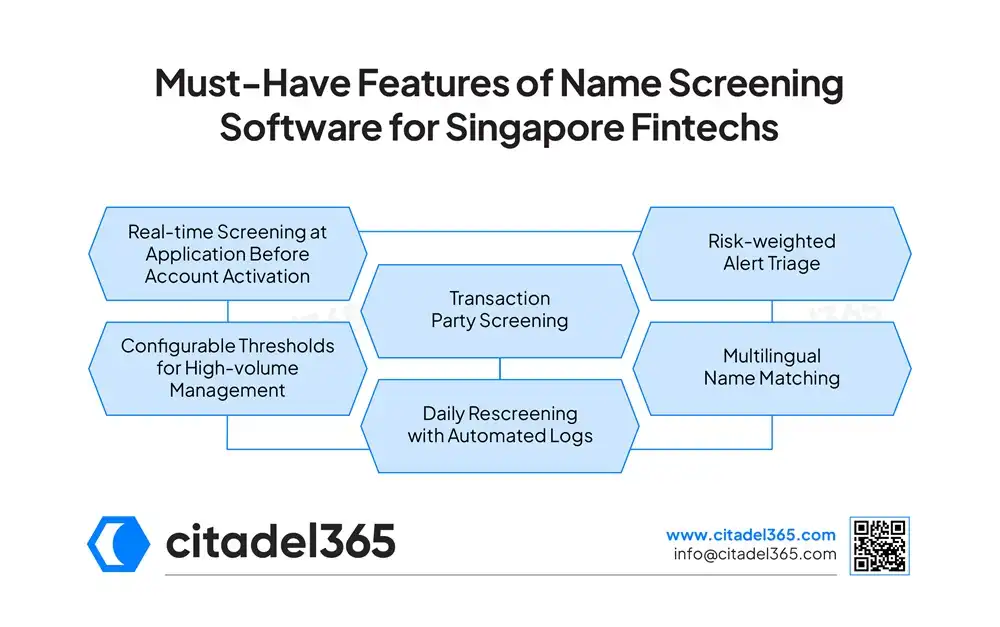
Real-time Screening at Application Before Account Activation
Name screening software should check the customer while establishing the business relationship and also conduct real-time screening to identify matches and take timely action.
Configurable Thresholds for High-volume Management
The platform should allow configured rules and thresholds for fuzzy matching. Strict thresholds may miss similar matches with slight spelling differences. Name screening software helps identify similar matches to sanctions, PEP and other watchlists and reduce false positives. MAS guidelines expect fuzzy matching to be calibrated to the risk profile of the business, and staff reviewing alerts need access to CDD information to separate true hits from false ones.
Transaction Party Screening
Fintechs and payment service providers need to screen both the sender and receiver of payments. Name screening software should screen customers and counterparties involved in the transaction to prevent financial risks.
Daily Rescreening with Automated Logs
The screening software should rescreen the existing customer base whenever sanctions lists or watchlists are updated, so customers designated after onboarding are caught quickly. MAS guidelines ask payment service providers to pay particular attention to changes in customer status, such as a customer becoming subject to sanctions over time. Alongside, the platform should keep timestamped records of screening done, which lists were checked and screening results for fintechs to demonstrate compliance during regulatory reviews.
Risk-weighted Alert Triage
Name screening software should allow alert prioritisation based on risk level. It should prioritise high-risk alerts and potential sanctions matches for timely action.
Multilingual Name Matching
Singapore’s customer base includes Chinese, Malay, Tamil and English names, often with romanisation differences. Tan, Chen and Chan can be dialect spellings of the same Chinese surname, and Muhammad may appear as Mohamed or Mohd. Malay names often use bin or binti followed by the father’s name instead of a family name, so the software should not rely on surname matching alone.
Screen Today and Tomorrow
Perform daily screening to keep customer profiles updated and identify potential matches in real time.
Citadel365 Name Screening Software for Fintechs in Singapore
Citadel365 name screening software for fintechs and payment service providers in Singapore automates sanctions, PEP and adverse media checks. The platform enables real-time screening, helping compliance teams identify potential matches and take timely action.
The name screening software supports fuzzy name matching and configurable settings that help reduce false positives and alert fatigue. It also screens against reliable sources, including relevant watchlists, PEP databases and negative news sources.
Citadel365 supports screening of related parties and facilitates timestamped records of screening activities and results, helping demonstrate compliance during MAS inspections. The software supports e-money issuers, payment aggregators, payment institutions and other fintech businesses to strengthen their screening processes in Singapore.
Fintech Name Screening Software Buyer Checklist
Fintechs and payment service providers should evaluate name screening software that reduces manual work, identifies relevant matches, and ensures compliance with Singapore AML/CFT laws. The following checklist helps:
- Check individual customers in real time, instead of only conducting batch screening.
- Screen names against updated sanctions lists such as the UN Consolidated List, OFAC, EU, UK Sanctions List and other local & global lists.
- Check customers against PEP databases and adverse media sources.
- Screen the relevant parties involved in a payment, not just the customer itself.
- Allow configurable rules and thresholds that support fuzzy matching.
- Rescreen customers daily and keep timestamped records of every screening.
- Handle Malay, Chinese, and Tamil name variations and spellings.
- Help the compliance team focus on high-risk alerts first.
Conclusion: Screen at Application Speed, Not Batch Speed
Name screening for fintechs and payment service providers in Singapore is an ongoing process. Conducting batch screening for all customers may create compliance gaps and delay reporting. Choosing the right name screening software helps fintechs and payment service providers automate regulatory compliance, minimise alert fatigue and prevent financial crime. Citadel365 offers advanced fuzzy logic, real-time screening, audit-ready logs, global sanctions and PEP database coverage, false positive reduction and adverse media monitoring, helping teams meet their AML/CFT screening obligations and reduce the risk of penalties.
Reduce False Positives at Scale
Citadel365 allows flexible name matching to improve screening accuracy for fintechs that handle high volumes.
FAQs on Name Screening Software for Singapore Fintechs
Real-time screening means checking customers against the relevant watchlists instantly to identify potential matches earlier and take timely action. For Singapore fintechs, Citadel365 automates real-time screening against relevant sanctions, PEP and adverse media data, preventing money laundering and other financial crime risks.
Configurable thresholds help fintechs fine-tune matching algorithms to trace close and similar matches, reducing false positives, lowering alert fatigue, and improving detection accuracy instead of relying on static or rigid thresholds.
Citadel365 name screening software helps Singapore fintechs meet regulatory requirements with automated checks that identify sanctions, PEP and adverse media matches, help reduce false positives, and maintain timestamped screening records for inspections.
Yes. MAS Notice PSN01 requires payment service providers to screen customers, persons acting on their behalf, connected parties, beneficial owners, and wire transfer originators and beneficiaries. Screening applies irrespective of the customer’s risk profile, and the results must be documented.
It must freeze the funds or other assets of the designated person without delay and without prior notice, and inform the relevant authorities. Where there is suspicion of money laundering or terrorism financing, it should file a suspicious transaction report with the Suspicious Transaction Reporting Office (STRO) and avoid tipping off the customer.

Arjun is the Co-founder and CEO of Citadel365, where he leads the company’s vision across technology, business, and regulations. He brings over a decade of experience in building and scaling technology ventures. Arjun holds a B.Tech. in Information Technology and a Master’s in Management, supported by his certification as a Financial Crime Specialist, an uncommon combination that allows him to balance innovation with regulatory requirements.
Having advised leading banks and financial institutions on digital solutions and compliance technology, Citadel365 continues to grow with an ambition