
Ready to Defeat Your AML Compliance Obstacles?
Citadel Brings Revolution with Secure Solutions to AML Compliance Problems
Sanctions screening is the process of checking individuals and companies against global watchlists to prevent establishing a relationship with high-risk parties that are linked to financial crime, such as money laundering and terrorist financing (ML/TF). Global sanctions watchlists include the United Nations Security Council (UNSC), UAE Local Terrorist List, UN OFAC Sanctions List, and others. Sanctions screening helps identify sanctioned individuals or entities and helps regulated entities comply with AML requirements.
PEP screening helps identify whether a customer or related party is an individual with a prominent public function, such as senior politicians, senior government officials, judges, or military officials. It covers family members and close associates of Politically Exposed Persons (PEPs). PEP screening indicates exposure to risks such as corruption, bribery, and misuse of public position, requiring enhanced due diligence and ongoing monitoring.
Term | What It Means |
Sanctions | Individuals or entities subject to government or international restrictions as involved in financial crime. |
PEP | Individuals with prominent public functions, or close relative of PEP. |
Adverse Media | Publicly available negative news related to individual or business linked to financial crime. |
Sanctions and PEP screening are an essential part of Customer Due Diligence (CDD) under the AML/CFT framework. Regulated entities in the UAE are required to screen customers, beneficial owners, and counterparties at customer onboarding to identify potential risks and links to financial crime.
UAE regulated entities subject to AML/CFT obligations are required to conduct CDD, including verifying customers and beneficial owners before establishing a relationship with them. Sanctions screening helps comply with TFS requirements, and PEP screening helps apply relevant enhanced due diligence where required.
Sanctions and PEP screening helps identify individuals or entities engaged in money laundering, terrorist financing or fraud, helping prevent financial crime. It also supports compliance, helping avoid regulatory penalties and protect business reputation.
Key steps in the sanctions screening process include:
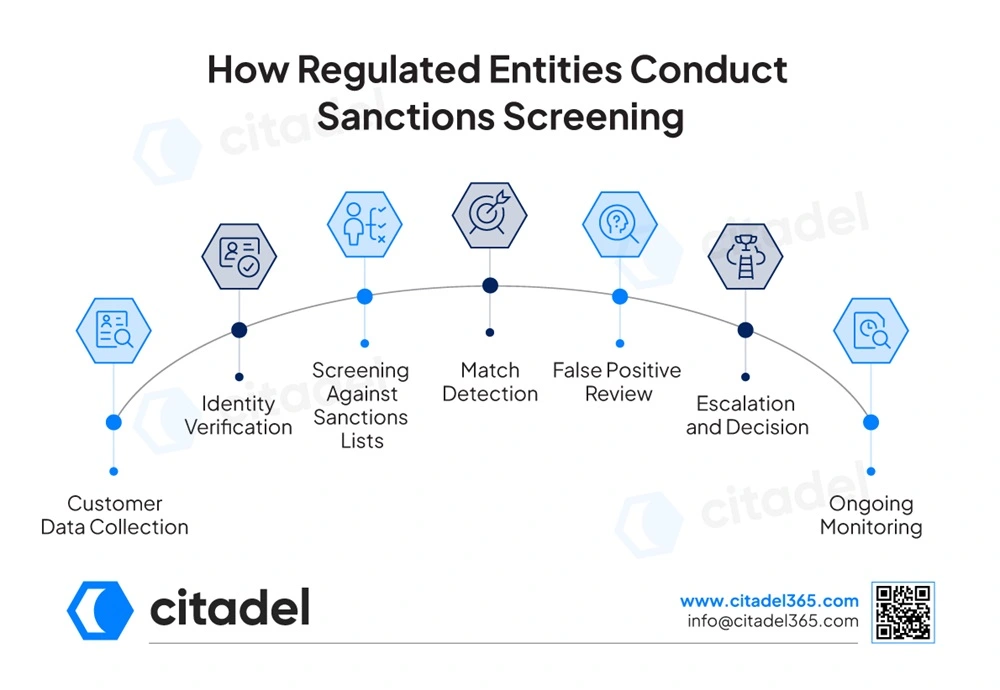
Regulated entities collect customer information including full name, date of birth, nationality, trade license details, beneficial ownership information, country of residence or incorporation and identification or passport details.
The collected information is verified against reliable official records. Regulated entities identify the adequate beneficial owners of corporate clients for screening.
Screen the collected information against the applicable sanctions watchlists, such as the UNSC Consolidated List, UAE Local Terrorist List, UK HM Treasury sanctions lists, US OFAC lists, and others.
Using screening software helps identify potential matches by comparing customer information against global watchlists. The software analyses fuzzy name matches and phonetics to determine exact and partial name matches.
Compliance teams are required to review the potential matches to determine whether a match is true or a false positive. For instance, a customer’s name may match the individual on the sanctions list but may differ in date of birth or nationality.
For a match that requires further investigation, escalate it to the compliance officer or the MLRO. This helps determine whether additional information is required, file CNMR/PNMR reports, discontinue the relationship, or clear the match as a false positive. Entities must also document all decisions and supporting evidence to meet AML compliance requirements.
Regulated entities should also conduct ongoing screening or rescreening to identify matches in real time with the updated sanctions lists and changes in customer information.
The PEP screening process works as follows:
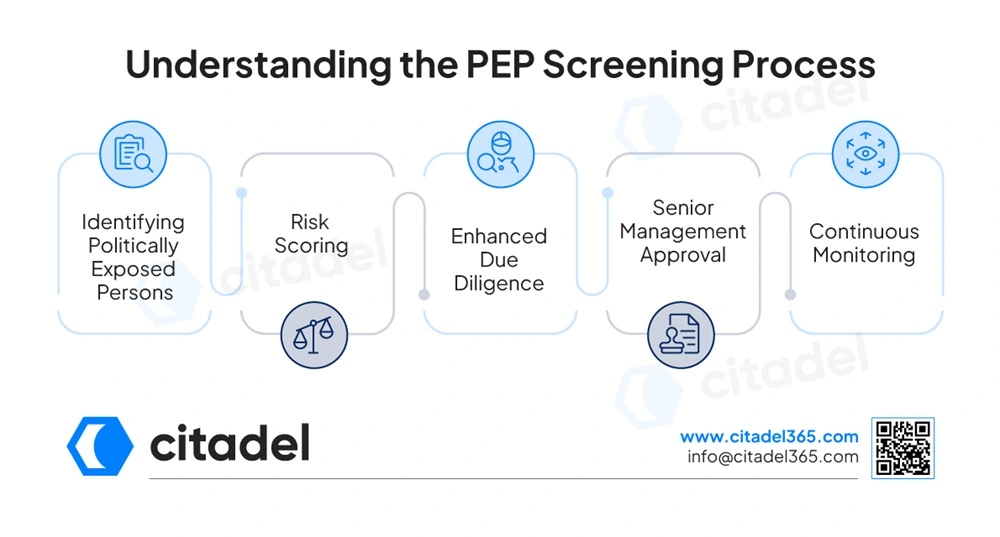
While onboarding customers, regulated entities screen customers, beneficial owners, and counterparties against the PEP databases. It helps identify domestic PEPs, foreign PEPs, international organisation PEPs, and family members or close associates of PEPs.
After identifying PEP customers, determine the level of risk the individual poses to the business. Assess the customer risk based on factors such as geography, position, sector, and network.
Apply enhanced due diligence by requesting additional information, such as source of wealth and source of funds. Maintain adequate records for risk assessment and due diligence.
Establishing or continuing a business relationship with a PEP requires senior management approval. Escalate the customer profile to senior management for approval.
Regulated entities should conduct ongoing screening or rescreening when customer profile changes or other relevant information changes to identify new PEP matches or update the customer profile.
The following table helps compare sanctions and PEP screening. It helps understand why screening is required and measures to comply with screening obligations for UAE regulated entities.
Basis | Sanctions Screening | PEP Screening |
Purpose | It helps identify individuals and entities subject to sanctions and prevent business relationships with them. | It helps identify individuals who hold prominent public functions who may pose high risks. |
Risk | Addresses sanctions, money laundering, terrorist financing, and prohibited-party risks. | Addresses high-risk associated with corruption, bribery, money laundering, and misuse of public position. |
Outcome | To determine a true sanctions match and reject establishing relationship with the sanctioned individual or entity. | Identify a true match and conduct enhanced due diligence. |
Required Action | To collect customer information and screen it against sanctions global lists. For confirm matches, restrict operations, freeze assets and report immediately. For false positives, discard matches. | Conduct risk assessment and enhanced due diligence. Obtain senior management approval and apply ongoing monitoring. |
Frequency | Perform sanctions screening at onboarding and conduct ongoing or rescreening when sanctions lists are updated or customer information changes. | Perform PEP screening at onboarding and ongoing periodic basis to identify newly appointed PEPs or status changes. |
Regulatory Expectation | Regulated entities in UAE subject to AML/CFT obligations must screen customers against sanctions lists, comply with asset freezing and timely reporting requirements, and subscribe to EOCN for real time screening. | Regulated entities in UAE subject to AML/CFT obligations must identify PEP, seek approval from senior management to establish and continue a business relationship with PEP. Further, must conduct EDD, ongoing monitoring and rescreening for compliance. |
Regulated entities in the UAE need to screen customers to identify sanctions and PEP matches. Different types of watchlists and databases for screening include the following:
Global Sanctions Lists
It includes checking individuals and entities against government sanctions lists such as the United Nations Security Council (UNSC) Consolidated List, UAE Local Terrorist List, OFAC SDN list, EU and UK HMT lists. Some regimes also apply secondary sanctions to third parties that continue dealing with designated persons.
Government Watchlists
These lists include those maintained by government authorities covering individuals or entities that present financial crime risks. The lists include terrorist designations, PEPs, and restricted parties.
Regulatory Lists
Lists or notices published by relevant supervisory authorities that include restricted persons or entities that need to be screened.
Internal Watchlists
Regulated entities maintain watchlists based on their risk assessment, past experiences and risk appetite. These include individuals, entities, or counterparties that need to be screened.
Law Enforcement Databases
Law enforcement agencies provide information relating to investigations, criminal activity, and wanted persons, which can be accessed and used to identify high-risk individuals or entities.
Commercial Databases
These include lists provided by commercial screening providers that collect information from various public sources and compile it into searchable databases. They combine information from sanctions lists, PEP databases and adverse media sources into their screening software.
Regulated entities often face the following challenges in screening customers against sanctions and PEP databases. Some of these challenges include:
High Volume of False Positives
A false positive happens when the screening system wrongly flags an innocent person or entity as suspicious. It results from common names, rigid rules, outdated lists, or poor data quality, which may lead to alert fatigue, delayed processes, and wasted time.
Poor Data Quality
Incomplete customer information, use of fake names or spelling variations, or different name formats across databases due to variations in aliases, name order, and abbreviations make it challenging to identify a true match, especially when the system relies only on an exact name match.
Transliteration Issues
Names written in Arabic or other non-Latin scripts may have several possible English spellings when converted, which makes it challenging for compliance teams to identify a true match.
Instant Updates to Databases
Sanctions, PEP and other watchlists may change frequently, requiring regular refreshes. Use of outdated databases may result in compliance failure.
Manual Review Delays
A potential match often requires manual investigation. High volume of alerts may create review backlogs that delay customer onboarding and place pressure on compliance teams.
Regulated entities should adopt a risk-based approach for effective name screening. Core practices include using automated tools, performing ongoing monitoring, maintaining audit trails, enforcing EDD, relying on updated lists, and tuning for false positives.
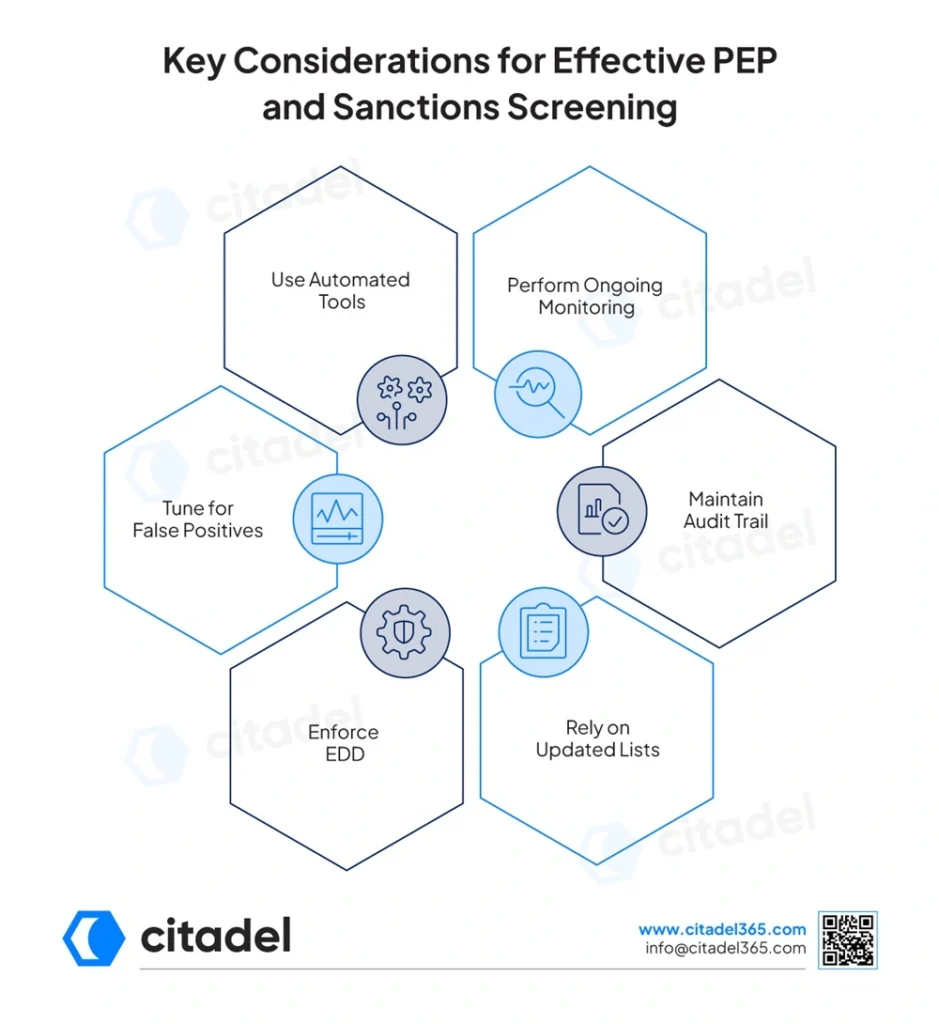
Use Automated Tools
Replace manual checks and use effective AML screening software that screens customers in real time against global watchlists and PEP databases to ensure compliance.
Perform Ongoing Monitoring
Re-screen customers or perform ongoing screening to identify sanctions and PEP matches in real time.
Maintain Audit Trail
Document every step of screening in a timestamped format, including individuals screened, alert review, investigation, and escalation process.
Rely on Updated Lists
Check customers against updated government sanctions watchlists and reputable PEP databases to prevent financial crime.
Enforce EDD
Conduct additional checks for high-risk customers, such as PEPs, asking for source of funds, source of wealth, and other required information.
Tune for False Positives
Adjust the screening thresholds and use more customer details to reduce false alerts and focus attention on genuine matches.
Customer screening is an essential component of customer due diligence that helps prevent financial crime. In the UAE, financial institutions, DNFBPs and VASPs are required to conduct name screening to comply with AML/CFT obligations.
Banking Sector
Banks are highly targeted for financial crime as they deal with large volumes of domestic and international transactions. Banks require customer screening to identify sanctioned and PEP individuals.
FinTech and Payment Service Providers
FinTechs and Payment Service Providers facilitate digital payments and cross-border transactions at high speed. Criminals misuse FinTech and Payment Service Providers’ services to move illegal money across borders. Customer screening helps FinTechs and Payment Service Providers verify customer identities and prevent potential financial crime risks.
Insurance Companies
Customer screening helps insurance companies to prevent criminals from using insurance products such as life insurance policies to launder illegal funds.
Crypto and Virtual Asset Businesses
These businesses facilitate rapid, cross-border transactions and involve businesses from multiple jurisdictions. Screening helps them block sanctioned individuals from transferring funds and comply with AML/CFT laws and global FATF standards.
Trust and Company Service Providers
Name screening helps TCSPs verify customers at onboarding to prevent them from setting up shell companies or facilitating financial crimes. Further, it helps them comply with UAE AML laws, TFS obligations and mandatory reporting requirements.
Real Estate Brokers and Agents
Screening of buyers and sellers helps prevent illicit funds from entering or transacting in the property market. It also helps real estate brokers and agents prevent dealing with blacklisted individuals and avoid regulatory penalties.
Legal Firms
Customer screening helps law firms identify potential financial crime and sanctions risks, and persons who hold prominent public functions requiring EDD to comply with AML/CFT requirements.
Accounting Firms
Customer screening helps accounting firms understand their customers and beneficial owners to assist them with business and financial transactions. It helps them identify potential money laundering and sanctions risks.
Citadel365 automates sanctions and PEP screening against global and local watchlists. The name screening software screens customer information and provides sanctions and PEP match results in seconds. It utilises advanced fuzzy matching and configurable thresholds to reduce false positives.
Further, Citadel365 allows screening of ultimate beneficial owners, along with corporate entities, to understand risks at every layer. It also facilitates PEP categorisation by status, geography, and influence to determine their risk levels.
Moreover, Citadel365 name screening software performs real-time checks daily or periodically to flag newly sanctioned individuals or entities and identify changes in PEP status.
Citadel365 helps UAE regulated entities strengthen their AML compliance, supporting ongoing monitoring to identify changes in customer risk profile. Additionally, it allows audit-ready reporting, providing records of screening activities, alerts, and compliance decisions through effective audit trails, which can be downloaded when required.
Yes, a PEP can become a customer by completing additional due diligence, including establishing source of wealth and source of funds, obtaining senior management approval and applying ongoing monitoring throughout the relationship.
When a customer matches a sanctions list, regulated entities should freeze assets, block transactions, reject onboarding, and report to the relevant authority without delay.
Regulated entities should screen for sanctions during onboarding and conduct ongoing screening to identify new matches against updated sanctions lists to ensure AML compliance.
Yes, Politically Exposed Person (PEP) screening is compulsory in the UAE under AML/CFT laws, requiring FIs, DNFBPs, and VASPs to identify PEPs during customer onboarding and monitor them throughout the business relationship.
PEP and sanction screening is the process of checking customers, beneficial owners and counterparties against sanctions lists and PEP databases to identify designated parties and holders of prominent public functions before onboarding.
AML screening covers sanctions, PEP and adverse media checks carried out as part of customer due diligence. It helps regulated entities identify money laundering and terrorist financing risks at onboarding and on an ongoing basis.

Vasantha holds a Master’s in Law specialising in Banking Laws and Anti-Money Laundering and is CAMS and CGSS certified. With over 35 years of experience, she has worked closely with regulators and international financial institutions, building financial crime risk frameworks, sanctions monitoring programmes, and compliance systems across multiple jurisdictions.