
Name Screening Software for Capital Markets Intermediaries in Singapore
Ready to Defeat Your AML Compliance Obstacles?
Citadel365 Brings Revolution with Secure Solutions to AML Compliance Problems
Name Screening Software for Capital Markets Intermediaries in Singapore- Key Highlights
- Name screening software for capital markets intermediaries in Singapore is a compliance tool that screens individuals, corporate entities, beneficial owners, and counterparties against relevant sanctions, PEP, and other financial crime risk data.
- Key features of name screening software include entity-level counterparty screening, UBO screening linked to KYB, PEP screening with automatic EDD trigger, adverse media screening, Ongoing rescreening, and audit trails.
- Key features for CMIs include entity-level screening, UBO screening linked to KYB, PEP screening with EDD escalation, adverse media screening, ongoing rescreening, and exportable audit trails.
What Is Name Screening Software for Capital Markets Intermediaries in Singapore?
Name screening software for capital markets intermediaries (CMIs) in Singapore is a compliance tool that checks customers and their related parties against sanctions lists, PEP databases, and other financial crime data. It screens individual investors, institutional clients, beneficial owners, and relevant counterparties against applicable Singapore targeted financial sanctions lists, UN sanctions lists, PEP databases, and other relevant financial crime data sources.
It supports screening at account opening and through ongoing rescreening, helping compliance teams identify potential sanctions, PEP, and other financial crime risks, while also maintaining an auditable record of screening activity for regulatory inspections.
Why counterparty screening matters in capital markets
Capital markets transactions can involve a range of counterparties, including corporate entities, investment funds, brokers, and nominee arrangements.
Screening only the individual account holder may therefore not provide a complete view of the parties and beneficial owners associated with a relationship or transactions.
Effective screening should support the identification and assessment of relevant customers, beneficial owners, and counterparties, based on the intermediary’s risk-based AML/CFT framework.
How name screening software supports capital markets compliance teams
Name screening software supports capital markets compliance teams by automating screening of investors and clients, beneficial owners, and counterparties, identifying politically exposed persons and supporting escalation for enhanced due diligence where required.
It also rescreens names against updated data sources and maintains screening records and audit trails to support compliance oversight, reviews, and regulatory inspections.
Who Must Be Screened at a Singapore Capital Markets Firm?
Under paragraph 6.39 of MAS Notice SFA04-N02, a capital markets intermediary (CMI) must screen four groups: the customer, natural persons appointed to act on the customer’s behalf, connected parties of the customer, and beneficial owners of the customer. Screening is done against relevant ML/TF information sources and the lists and information provided by MAS and other relevant authorities in Singapore.
Individual investors
Individual investors should be screened during onboarding and as part of ongoing monitoring for sanctions exposure, PEP status, and other relevant financial crime risks. Where a high-risk customer is identified, the firm may need to apply enhanced due diligence and additional monitoring in accordance with its AML/CFT framework.
Institutional clients and their beneficial owners
For institutional clients such as funds, trusts, and companies, screening should extend beyond the legal entity to relevant beneficial owners. Screening only the named representative or account contact may leave ownership and control risks undetected.
Natural persons appointed to act on the customer's behalf
Authorised signatories, traders, and attorneys who give instructions on an account must be screened in the same way as the customer. A clean customer record offers little protection if the person placing orders is a designated individual.
Connected parties
For customers that are legal persons or legal arrangements, connected parties include directors, partners, and natural persons with executive authority. MAS Notice SFA04-N02 requires the CMI to obtain each connected party’s full name, including any aliases, and a unique identification number, and these details should feed directly into the screening run.
Securities transaction counterparties
CMIs should also assess relevant counterparties involved in securities transactions for sanctions and other financial crime risks, based on their risk-based AML/CFT framework. This goes beyond the minimum scope in paragraph 6.39 of the MAS Notice SFA04-N02, but it is sound practice: dealing with a designated counterparty can still breach Singapore targeted financial sanctions.
How Name Screening Software Helps Capital Markets Firms
Name screening software automates screening of customers, counterparties, and beneficial owners against global sanctions lists, PEPs, and adverse media databases to help detect and manage ML/TF risks.
Screening Requirement | Sector Challenge | Name Screening Feature | Evidence Generated |
Individual investor screening | Screening investors at onboarding and ongoing monitoring | Individual screening at onboarding and ongoing rescreening | Investor screening record, match results, timestamps |
Institutional client entity screening | Screening the fund or corporate entity itself | Entity-level screening for institutional clients | Entity screening record, match results, review history |
UBO screening for institutional clients | Screening beneficial owners behind institutional accounts | UBO screening linked to KYB capture for institutional clients | UBO screening records per tier, match results |
Securities counterparty screening | Assessing relevant entity-level counterparties involved in securities transactions | Entity screening on counterparties named in transaction documents | Counterparty screening record, match results, alert notes |
PEP identification | Identifying PEPs among customers and relevant controllers | PEP database screening on all individuals and entity controllers | PEP match results, EDD trigger, review history |
Adverse media | Detecting negative news on investors and counterparties | Adverse media integrated with sanctions and PEP run | Adverse media hits, alert notes, review trail |
Ongoing rescreening | Monitoring the active client base for new listings | Automated daily rescreening of all client and counterparty populations | Rescreening logs, new hit alerts, timestamps |
Capital Markets Screening Red Flags Name Screening Software Can Help Detect
The key red flags that name screening software helps in detecting include:
- A securities transaction counterparty has a potential connection to a sanctioned entity through its ownership structure.
- An institutional client’s beneficial owner appears on the UN consolidated list under an alternative or previously undisclosed name.
- An adverse media search identifies financial crime concerns involving a fund manager whose relationship with the firm was established two years ago.
- A client passes screening at onboarding but is newly designated under applicable Singapore targeted financial sanctions during the relationship.
- A counterparty’s name closely matches a sanctions-list entry, requiring further review to determine if it is a true match.
Essential Features of Name Screening Software for Capital Markets Firms
The essential features of name screening software for CMIs include:
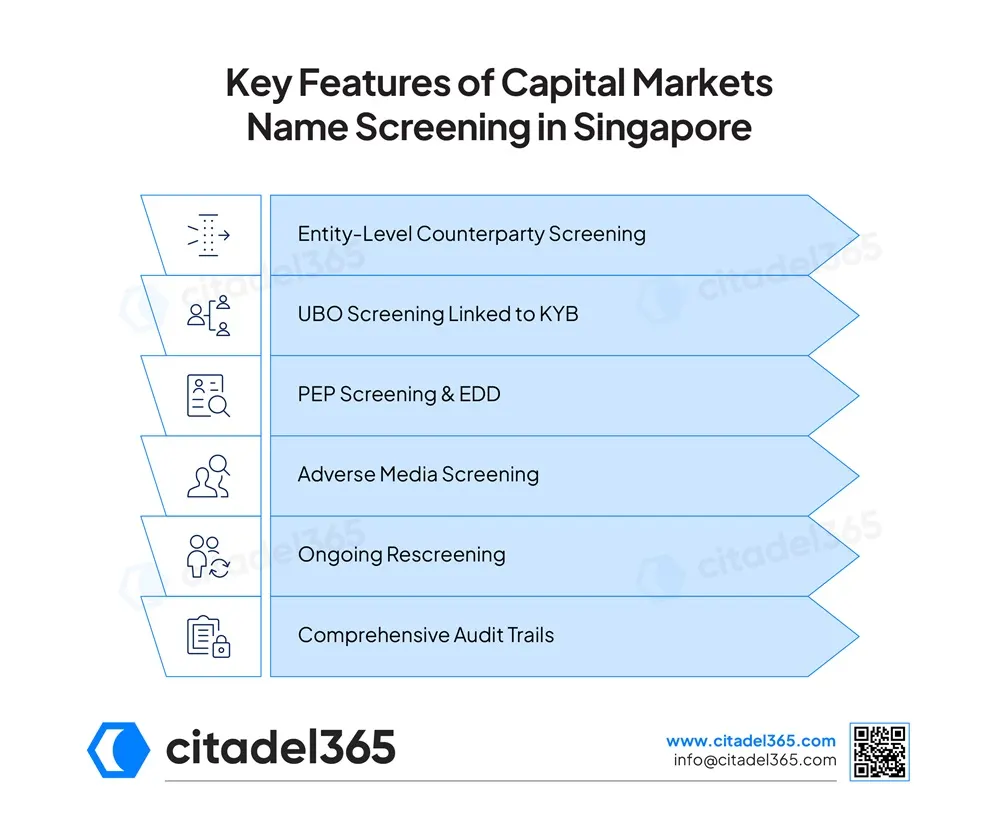
Entity-level counterparty screening
The name screening software should screen corporate entities such as funds, nominees, and corporate counterparties, and not just individuals. Entity screening should support registered names, trading names, aliases, and other relevant key identifiers to improve matching accuracy.
UBO screening linked to KYB
The software should be able to link UBO screening to the KYB records to screen and monitor the identified beneficial owners alongside the institutional client.
PEP screening
It should identify PEPs and route potential matches for risk assessment and appropriate enhanced due diligence; where required, the workflow can support additional information such as source of wealth and source of funds.
Adverse media screening
Monitoring relevant adverse media relating to financial crime, corruption, regulatory action, and other material risks, alongside sanctions and PEP screening.
Ongoing rescreening
It should automatically rescreen active customers, appointed persons, connected parties, and beneficial owners whenever MAS or other Singapore authorities update their lists, and whenever those parties change. MAS Notice SFA04-N02 requires screening on both triggers, so a fixed periodic batch on its own is not enough.
Comprehensive audit trails
The software should record screening results, alerts, review decisions, timestamps, and rescreening history in one accessible record. Paragraph 6.41 of MAS Notice SFA04-N02 requires the results of screening and assessment to be documented, so these records should be easy to retrieve and export for MAS inspections.
Capital Markets Screening Software Buyer Checklist
The name screening software must have:
- Entity-level screening for relevant securities transaction counterparties.
- UBO screening linked to KYB for institutional clients.
- Singapore sanctions screening covering applicable targeted financial sanctions requirements.
- UN sanctions list coverage alongside other relevant international sanctions lists.
- PEP screening with alerts for further review and enhanced due diligence where required.
- Integrated adverse media screening alongside sanctions and PEP checks.
- Ongoing automated rescreening based on the firm’s risk-based monitoring approach.
- Exportable audit trails covering screening results, alerts, review decisions, and screening history to support regulatory examination.
Questions to Ask a Screening Vendor
- Does the screening engine cover corporate entities as well as individuals?
- Can UBO screening be linked directly to the KYB workflow?
- Does a potential PEP match trigger an alert and EDD review workflow?
- Can the system rescreen institutional clients and relevant counterparties, not just individuals?
- Can screening results, alerts, and review history be exported for MAS regulatory examinations?
Citadel365 Name Screening Software for Capital Markets Firms in Singapore
Citadel365 supports AML compliance for capital markets firms in Singapore through its name screening software, which helps in screening individual investors, institutional clients, and their UBOs, and relevant counterparties against sanctions, PEP, and other financial crime risks.
Citadel365 supports PEP identification, enhanced due diligence workflows, ongoing rescreening, and exportable screening records for compliance review.
Citadel365 helps CMIs in Singapore, including securities brokers, fund managers, and other regulated firms that need to manage customer, UBO, and counterparty screening as part of their AML/CFT framework.
Conclusion
Name screening for capital markets firms in Singapore goes beyond the individual investor opening an account. It also includes institutional clients, their beneficial owners, and relevant securities transaction counterparties. A screening approach limited to individual names may leave important ownership, sanctions, and financial crime risks unidentified.
Advancing Name Screening for Singapore Capital Markets
See how Citadel365 name screening software enables deeper screening across clients, UBOs, and counterparties to strengthen your AML framework.
Frequently Asked Questions
Under paragraph 6.39 of MAS Notice SFA04-N02, a CMI must screen the customer, natural persons appointed to act on the customer’s behalf, connected parties of the customer, and beneficial owners of the customer. Many CMIs also screen relevant securities transaction counterparties as part of a risk-based approach.
Entity-level screening checks companies, funds, and other legal entities for sanctions, PEP, and other relevant risks, rather than screening individuals alone.
Paragraph 6.39 of MAS Notice SFA04-N02 focuses on the customer and its related parties, not every trade counterparty. Even so, screening relevant securities transaction counterparties is sound practice under a risk-based approach, because dealing with a designated person can breach Singapore targeted financial sanctions.
Citadel365 name screening software helps screen customers, UBOs, and relevant counterparties, with ongoing monitoring, alert management, and audit trails.

Sridhar is a Certified Anti-Money Laundering Investigator (CAMI) with over 30 years of experience in compliance, risk, and audit, including more than 20 years in AML and financial crime prevention. He has contributed to the development of UAE regulatory standards through the FERG sub-committee and has maintained active engagement with the Central Bank of the UAE on supervisory and compliance matters.