
Ready to Defeat Your AML Compliance Obstacles?
Citadel Brings Revolution with Secure Solutions to AML Compliance Problems
AML software for accounting firms in the UAE is a compliance platform designed to help accounting firms meet anti-money laundering (AML) and counter-terrorism financing (CTF) obligations by automating key compliance processes, including customer due diligence, identification of beneficial owners, screening against sanctions, politically exposed person( PEP), and adverse media, customer risk assessment, case management, and audit-ready record-keeping for accountants and auditors supervised by the Ministry of Economy and Tourism (MoET), when delivering designated professional services.
AML software plays an important role in maintaining financial transparency, and accountancy firms play a trusted role in financial reporting, company formation, and corporate services. However, these services are exposed to money laundering through fabricated accounts, round-tripping, or complex ownership structures that hide the true beneficial owner.
AML software supports accounting compliance teams by automating most compliance processes, including customer onboarding, screening, identification of ultimate beneficial ownership, and risk assessment based on key factors such as customer type, geographic location, and transactional activity, allowing the team to prioritise high-risk cases.
Under the Federal Decree-Law No. 10 of 2025 and Cabinet Resolution No. 134 of 2025, AML obligations are applicable only when accounting firms provide specified services; not all audit or accounting work falls within the scope of AML requirements, a sanctions risk assessment can help firms confirm which mandates trigger them.
1) Buying and selling real estate: purchasing and selling real estate on behalf of a client.
2) Managing funds owned by the customer: managing client money, securities, or other assets held in trust or in an account.
3)Banks and savings accounts: managing bank accounts, savings accounts, or securities accounts on the client’s behalf.
4) Organising contributions: for the establishment, operation, or management of companies, including capital raising and share issuance.
5) Legal persons and arrangements: Establishing, operating, managing legal persons or Legal Arrangements, or selling or purchasing commercial entities.
UAE AML Requirement | Sector Challenge | AML Software Feature | Evidence Generated |
Client Due Diligence | Client acceptance of the specified services | Digital KYC and KYB workflow at client acceptance | Client profile, documents, approval logs |
Beneficial Ownership | UBO verification for corporate clients | KYB and UBO mapping through ownership tiers | UBO records, ownership structure notes |
Sanctions Screening | Screening clients and their UBOs | Sanctions, PEP, and adverse media screening | Match results, alert notes, review history |
Enhanced Due Diligence | High-risk clients or unusual account activity | EDD workflow with senior approval and source of wealth | Source of wealth, approvals, documents |
Risk Assessment | Service-level risk scoring | Configurable risk models by service type and client profile | Risk scores and rationale per client |
Case Management | Suspicious account or transaction concerns | Case management with escalation and STR preparation | Investigation notes, escalation records |
Record Keeping | MoET inspection readiness | Centralised audit trail per client and per service | Timestamped activity logs, exportable profiles |
Staff Training | Fee earner and audit staff awareness | Role-based AML training with completion records | Training completion evidence |
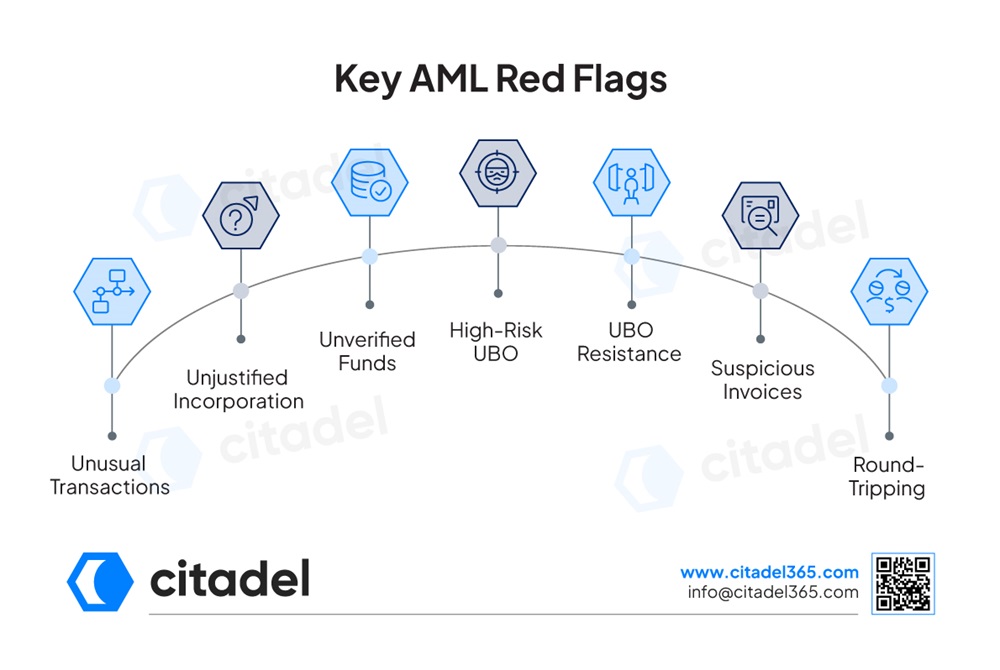
The key AML red flags that AML software helps accounting firms detect include:
Simplify AML Compliance for Your Accounting Firm
Citadel365 automates CDD, KYB, UBO verification, screening, risk assessment, and audit-ready record-keeping
The key essential features of AML software for accounting firms in the UAE include:
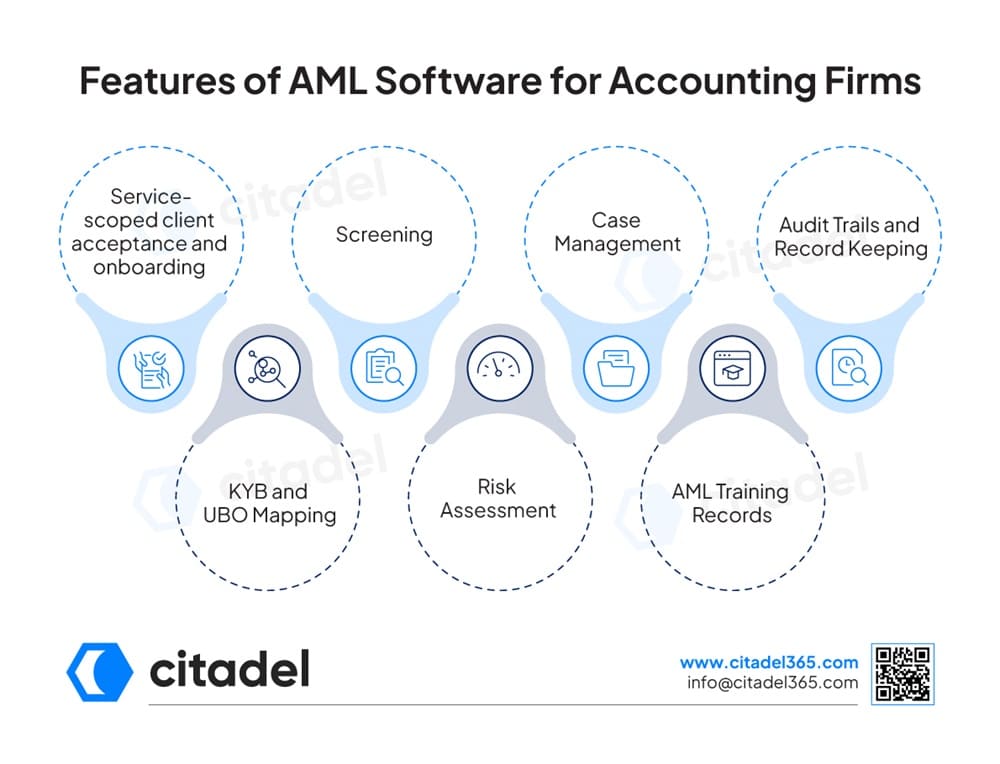
Service-scoped client acceptance and onboarding
KYB and UBO mapping for corporate clients
Sanctions, PEP, and adverse media screening
Customer risk assessment
AML software should apply risk assessment based on the service provided. Higher-risk activities, including company formation, corporate administration services, and trust or escrow account services, require enhanced scrutiny compared with lower-risk activities such as standard audits.
Case management and STR preparation
AML software should also provide structured case management workflows for investigating AML alerts, including case notes, escalation paths, evidence management, decision logs, and closure reasons. It should also support the preparation and documentation of suspicious transaction reports (STRs) for submission through the UAE’s reporting system, where required.
AML training records
The AML software should maintain role-based AML training records for engagement teams, partners, and compliance officers, including completion status, renewal schedules, and supporting documentation for regulatory inspections.
Audit trails and record keeping
The AML software should maintain comprehensive audit trails, including time-stamped decisions, user activity logs, supporting documentation, and client records with a five-year minimum retention period where applicable.
Use this checklist to evaluate AML software for your accounting firm:
Before selecting an AML software solution, ask the vendor the following questions, including:
Built for Modern Accounting Firms
We help accounting firms in the UAE to manage AML compliance with confidence.
– Yes, accountants and auditors are subject to UAE AML obligations when they provide specified services that fall within the scope of the AML legislation
Accounting and audit firms are supervised by the UAE Ministry of Economy and Tourism (MoET) for AML compliance.
Beneficial owners are identified by obtaining ownership information and tracing ownership through all relevant corporate layers.
Citadel365 automates CDD, KYB, UBO verifications, screening, risk assessment, case management, and helps maintain audit-ready record-keeping to help accounting firms to maintain AML compliance with evolving regulatory requirements.

Sridhar is a Certified Anti-Money Laundering Investigator (CAMI) with over 30 years of experience in compliance, risk, and audit, including more than 20 years in AML and financial crime prevention. He has contributed to the development of UAE regulatory standards through the FERG sub-committee and has maintained active engagement with the Central Bank of the UAE on supervisory and compliance matters.