
KYB (Know Your Business)
Ready to Defeat Your AML Compliance Obstacles?
Citadel365 Brings Revolution with Secure Solutions to AML Compliance Problems
KYB Compliance in Brief
- KYB helps verify whether a business is genuine, properly registered, and suitable to onboard.
- It focuses on understanding who owns the business, who controls it, what it does, and whether it presents a higher risk.
- Core KYB checks cover company details, beneficial ownership, nature of business, screening, and risk assessment.
- Many organisations struggle with layered ownership, foreign entities, poor-quality data, and manual compliance workflows.
- Strong KYB controls help reduce exposure to financial crime, fraud, sanctions breaches, and compliance gaps.
- A well-designed KYB framework improves onboarding quality, control effectiveness, and ongoing risk management.
What is KYB?
Regulatory Obligations for KYB
Globally, KYB is mandatory for:
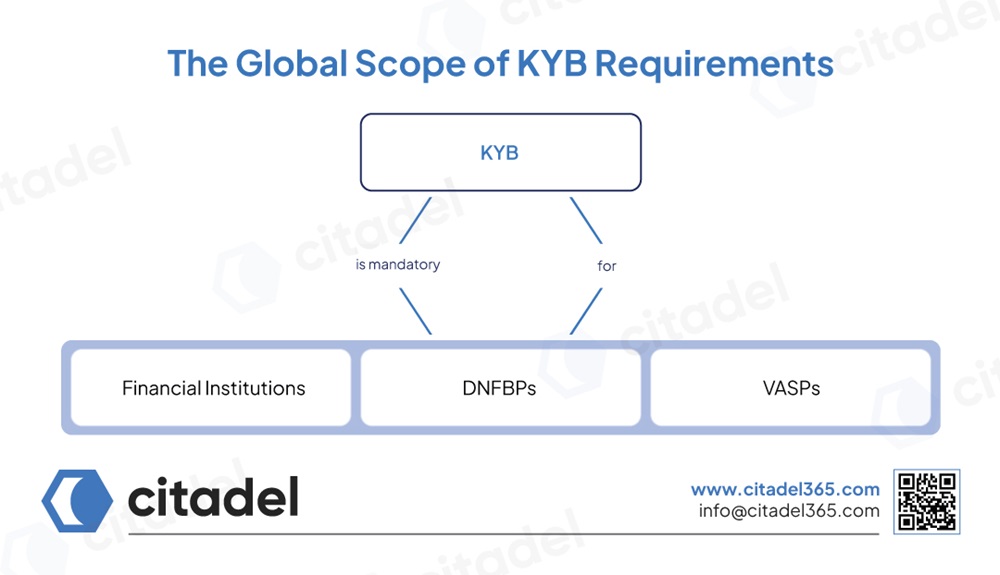
• Financial Institutions (FIs)
• DNFBPs
• Virtual Asset Service Providers (VASPs)
Obligations under these laws also include the verification of trade licenses, corporate documents, UBO identities, authorised signatories, supervisory structures, and confirmation of whether a business belongs to a high-risk sector or jurisdiction and the purpose of the relationship.
Which Business Information Must Be Verified?
| Category | What Must Be Verified | Regulatory Expectations |
| 1. Legal & Corporate Existence | Trade/business license, certificate of incorporation, commercial registration, MOA/AOA etc. | REs are required to make sure that the business is registered with a valid licence and look for expiry dates, activity codes, and amendments made. |
| 2. Ownership & Control Structure | Shareholder registry, partner details, group structure charts, holding company layers | Multi-layered or cross-border structures are to be checked along with ownership vertically and horizontally. REs must determine the percentages of ownership and voting rights, the control rights, and the arrangements of nominees. |
| 3. Ultimate Beneficial Owners (UBOs) | Verification Documents of Individuals with ownership or effective control (direct or indirect) | Confirm identity documents, ownership arrangements, control limits, and offshore jurisdictions, trusts, or bearer-share arrangements. |
| 4. Business Operations & Purpose | Nature of activities, license, offered products/services | Activities listed in the licence must match the activities undertaken by the business. EDD is needed in high-risk sectors (gold, real estate, crypto, legal services, offshore activities, etc.) |
| 5. Cross-Border Exposure | Country of incorporation details, operating jurisdictions | Check whether the business is operating in high-risk countries/ jurisdictions, or sanctioned geographies. Take into account complex trade routes and counterparties. |
| 6. Financial & Tax Details (Risk-Based) | VAT registration, audited financials, banking details, etc. | Confirm financial legitimacy, check the history of operations and economic presence. Enhance verification for high-value or high-risk companies. |
| 7. Activity Consistency & Economic Substance | Office location, number of employees, operational footprint | Helps in identifying shell or dormant companies. Some of the inconsistencies that REs should examine include high-risk activity and no physical office, no staff, or abnormal volume of transactions. |
Step-by-Step Guide for Effective KYB Compliance
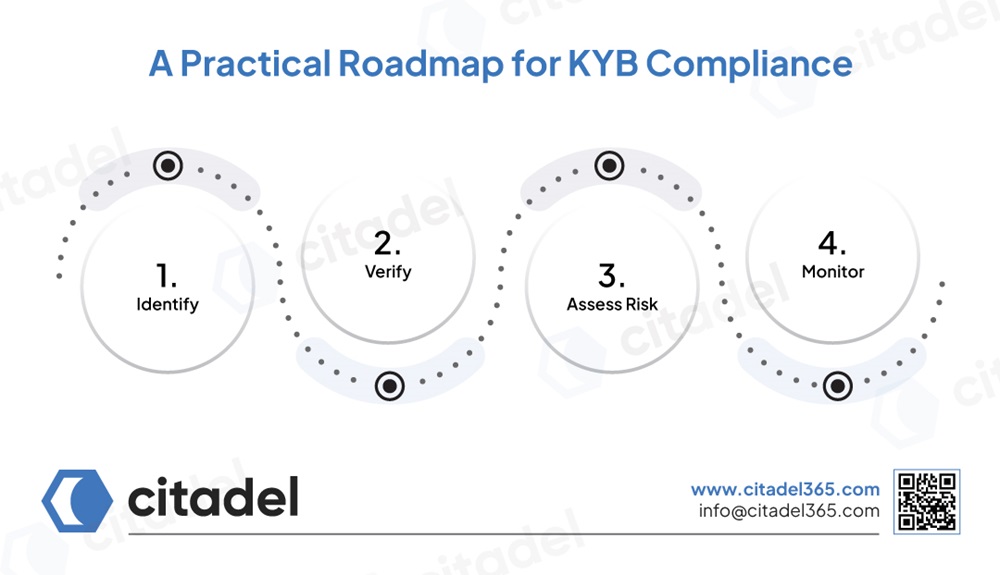
1. Identify
During the identification phase, Regulated Entities (REs) gather all the key corporate documentation necessary to form the legal presence and control structure of the business. It typically involves trade licenses, certificates of incorporation, MOA/AOA, shareholding pattern or partner information, UBO declarations/details, and board resolutions that contain the authorised signatories. Tax registrations, activity-specific approvals and any known exposure to litigation or sanctions may also be secured, depending on the industry, to create an overall preliminary profile.
2. Verify
Verification involves cross-checking information against valid authoritative sources. REs are required to validate business registration information and employ foreign registries for international corporate layers. Documents must be reviewed and verified for authenticity, UBO identities must be verified, and all significant persons and organisations are to be subjected to screening against sanctions lists, regulatory watchlists, and adverse media to confirm legitimacy and reveal concealed risks.
3. Assess Risk
Risk assessment consists of evaluating the business structure and activities and assessing how they affect AML/CFT exposure, the same scoring logic used in Citadel365’s customer risk assessment software. Some of these factors include the complexity of ownership, association with high-risk or secrecy jurisdictions, exposure to sensitive sectors, and the scale of expected transactions. Any unfavourable outcomes from sanctions screening, adverse media screening, or any UBO red-flag indicators assist in deciding the level of due diligence that is needed by the customer- simplified, regular, or enhanced.
4. Monitor
This stage ensures that the business remains compliant throughout the customer lifecycle. REs perform continuous KYB checks during onboarding, along with scheduled periodic reviews, and whenever ownership, control, or business activities change. Alerts are also required when there is unusual customer behaviour that differs from declared patterns or when new regulatory guidance necessitates reassessment, ensuring risks are identified and mitigated in time.
Operational Pain Points in KYB Compliance
Regulated Entities (REs) usually have their own KYB policies in place, which involve requesting basic corporate documents and performing manual verifications. Here is the table summarising manual and automated KYC pain points and their solutions.
| Sr. | Description | Manual KYB Pain Points | Automated KYB Pain Points | Solutions |
| 1 | Data Collection | Teams spend significant time gathering company records, ownership documents, licences, and supporting information from multiple sources. | Automated tools may pull incomplete, outdated, or inconsistent data from external databases. | Use trusted data sources, standardised document checklists, and validation rules to improve data quality. |
| 2 | Entity Verification | Verifying whether a business is legally registered and active can be slow and repetitive when done manually. | Systems may fail to verify certain entities properly, especially in jurisdictions with limited registry access. | Combine automation with fallback manual verification and maintain a documented verification workflow. |
| 3 | Ownership Mapping | Understanding layered ownership structures and beneficial owners manually is time-consuming and prone to oversight. | Automated tools may struggle to interpret complex or multi-layered ownership chains accurately. | Use ownership-mapping tools supported by analyst review for complex structures and escalation cases. |
| 4 | Cross Border Checks | Verifying foreign businesses often becomes difficult due to language barriers, unfamiliar registries, and document inconsistency. | Automation may have limited coverage for overseas entities or weaker data reliability across jurisdictions. | Build a jurisdiction-based verification approach with enhanced review for foreign and higher-risk entities. |
| 5 | Screening Accuracy | Manual screening against sanctions, watchlists, or adverse media can be inconsistent and labour-intensive. | Automated screening can generate high false positives, creating alert fatigue and review backlogs. | Calibrate screening rules, use risk-based filters, and establish clear match disposition procedures. |
| 6 | Review Consistency | Different team members may apply different standards, leading to inconsistent onboarding decisions. | System-driven decisions may appear consistent, but poor configuration can embed flawed logic at scale. | Create clear KYB procedures, review standards, decision trees, and quality assurance checks. |
| 7 | Turnaround Time | Manual KYB reviews often delay onboarding because checks depend heavily on staff capacity and follow-up. | Automation speeds up onboarding, but delays can still occur when exceptions and alerts are not managed well. | Introduce tiered workflows with straight-through processing for low risk cases and escalation for exceptions. |
| 8 | Audit Trail | Evidence is often stored across emails, folders, and spreadsheets, making it hard to reconstruct decisions. | Automated systems may capture activity logs, but not always the rationale behind analyst decisions. | Maintain centralised case records with supporting documents, timestamps, comments, and approval history. |
| 9 | Ongoing Monitoring | Periodic reviews and trigger-based updates are often missed when tracked manually. | Automated monitoring may generate too many alerts or miss triggers if rules are outdated. | Use risk-based review cycles, event-driven triggers, and regular tuning of monitoring scenarios. |
| 10 | Human Judgement | Manual teams may overlook red flags because of workload, fatigue, or limited experience. | Overreliance on automation can reduce critical thinking and result in blind acceptance of system outputs. | Keep strong human oversight for high-risk cases and train staff to challenge results where needed. |
| 11 | System Integration | Manual processes require staff to work across emails, spreadsheets, registries, and screening tools with little coordination. | Automated tools may not integrate properly with onboarding, screening, risk scoring, and case management systems. | Choose interoperable systems and design connected workflows across compliance operations, centralised in a single case management software. |
| 12 | Scalability | Manual KYB processes become difficult to manage as customer volumes increase. | Automated systems scale more easily, but poor governance can spread control weaknesses more quickly. | Build a scalable KYB framework with governance, periodic testing, and continuous process improvement. |
If you’re facing these KYB challenges, let Citadel365 help you resolve them.
Your onboarding framework needs urgent strengthening.
Operational Pain Points in KYB Compliance
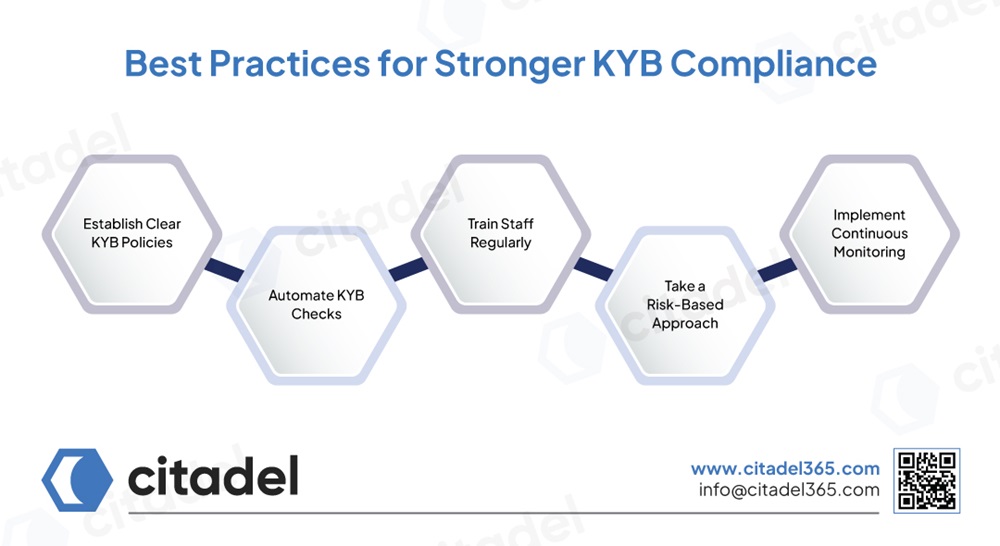
1. Establish Clear KYB Policies
A defined and structured KYB workflow must be maintained by regulated entities that outline mandatory documents, verification steps, escalation triggers, and risk-based review cycles. The policies must be updated regularly and should reflect all the latest regulatory changes and changing corporate structures. When responsibility is spelt out plainly, teams act consistently; fewer things slip through the cracks.
2. Automate KYB Checks
Entities should pick automated KYB software linking directly to the registry records. These tools sketch out who really owns what across complex company chains instead of guessing and checking names against global watchlists, including PEPs, without needing someone to press buttons every time. Automation not only eliminates manual dependency but also improves accuracy, efficiency, and ensures real-time updates during onboarding and monitoring.
3. Train Staff Regularly
4. Take a Risk-Based Approach
REs should adopt verification processes based on ownership complexity, sector risk, jurisdiction exposure, and transaction expectations. High-risk customers must undergo enhanced due diligence, including multi-layered ownership tracing and deeper screening. A risk-based model improves resource allocation and strengthens AML/CFT controls.
5. Implement Continuous Monitoring
Every time details change, companies need to renew their records, track ownership changes, and re-screen UBOs and authorised signatories after each update. Monitoring should also include alerts for regulatory changes, adverse media, or shifts in business activity. Ongoing oversight ensures compliance throughout the customer lifecycle, not only during onboarding.
Need help adopting these KYB best practices?
Citadel365 builds KYB frameworks tailored to your sector.
Mitigating KYB Gaps: How Citadel365 Becomes Your Compliance Wingman
| Your KYB Pain Points | Citadel365 Solutions | Your Benefits |
| “We cannot identify UBOs behind layered structures.” | Advanced UBO mapping & corporate tree analysis | Clear visibility of ownership & risk |
| “Our team is overwhelmed with manual verification.” | Automated KYB compliance software integrated with registries | Faster, accurate onboarding |
| “Foreign company verification is almost impossible.” | Cross-jurisdiction registry access & validation support | Seamless global KYB checks |
| “Our KYB policy is outdated and unclear.” | Regulator-aligned KYB & corporate due diligence policy drafting | Audit-ready and regulator-friendly |
| “We face inconsistent data and documentation gaps.” | Standardised templates & quality review | Clean, uniform, reliable KYB data |
| “We are not confident about ongoing monitoring.” | Continuous KYB updates, alerts & periodic review frameworks | Compliance without operational stress |
| “We struggle with staff capability.” | KYB-focused training programs | Confident, skilled compliance teams |
Let KYB Fortify Your AML/CFT Compliance Shield
Most firms do standard company checks, yet solid KYB means going further and conducting deep verification, UBO identification, risk-based assessments, and continuous monitoring. By applying a structured KYB framework aligned with legal obligations, businesses can prevent the onboarding of shell companies, reduce ML/TF exposure, and maintain a strong AML framework.
Build a KYB framework that never misses a hidden risk.
Strengthen your corporate onboarding with smarter, sharper KYB.

Arjun is the Co-founder and CEO of Citadel365, where he leads the company’s vision across technology, business, and regulations. He brings over a decade of experience in building and scaling technology ventures. Arjun holds a B.Tech. in Information Technology and a Master’s in Management, supported by his certification as a Financial Crime Specialist, an uncommon combination that allows him to balance innovation with regulatory requirements.
Having advised leading banks and financial institutions on digital solutions and compliance technology, Citadel365 continues to grow with an ambition.