
Ready to Defeat Your AML Compliance Obstacles?
Citadel Brings Revolution with Secure Solutions to AML Compliance Problems
Manual processing of investigations becomes operationally and compliantly challenging as alerts generated by the systems increase and compliance obligations continue to evolve over time. Organisations that depend on emails, spreadsheets, shared folders, and unintegrated or undedicated systems to manage cases are more susceptible to risk, decreased efficiency and quality of investigations, and regulatory non-compliance.
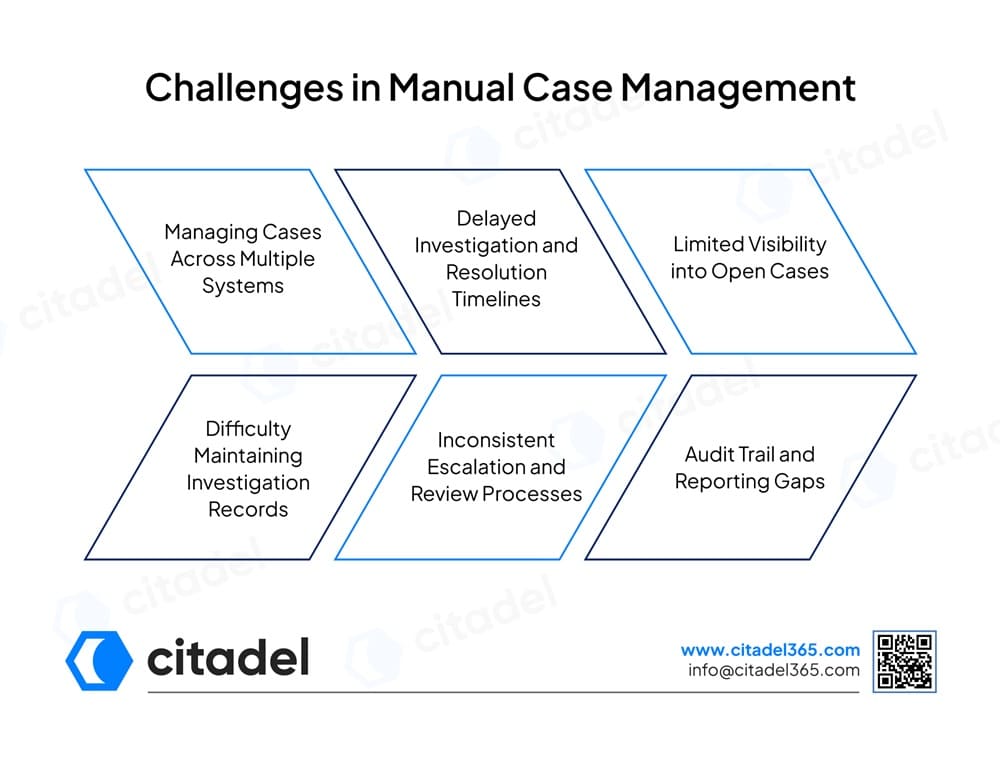
Manual case assignments, tracking and follow-up processes can significantly prolong the investigation timeline. As a result, compliance teams may struggle to prioritise cases efficiently, which can lead them to focus on less important cases and cause delays in reviewing high-risk alerts and suspicious activities.
Manual case allocation, dependency on emails for communications and a lack of an automated case prioritisation system can make tracking pending actions and meeting deadlines more difficult and time-consuming.
Extended investigation timelines can increase compliance risks to the business, negatively impact the organisation’s AML controls, and make it difficult to meet regulatory requirements of timely reviews and reporting.
Without a case management system, compliance teams often lack real-time insight into ongoing open cases. Manually collecting the information dispersed across various systems and systems makes tracking the workloads of investigators and case status more difficult. This can impede the ability to properly monitor case work due to a lack of real-time visibility into investigations. In addition, this can also lead to inefficient use of resources, overlooked or unattended cases, and challenges in monitoring team performance. If compliance managers have no clear visibility into investigations, it becomes difficult to perform their functions, which hinders effective compliance management and decision-making.
Compliance with AML regulations requires organisations to maintain records of their investigations that include decisions made along with their justifications, approvals, communications and the evidence collected. Records of investigations are difficult to maintain manually when they are stored across fragmented filing systems. This may result in:
The lack of proper records makes it difficult for regulators to recognise that investigations and reviews were conducted in compliance with regulatory requirements.
Without standardised procedures, different investigators may take different approaches when reviewing and escalating cases. This inconsistency results in the application of different levels of scrutiny, documentation quality, and decision-making across cases. Manual systems have no clear escalation criteria, inconsistent approval processes, delayed management reviews, and a lack of accountability for case ownership, which usually leads to variations in investigation outcomes. Inconsistency in the escalation and review process heightens compliance risks and undermines the effectiveness of the organisation’s AML measures.
Organisations are expected by regulators in the UAE to maintain detailed documents on how alerts were generated and how investigations were conducted. Such records should include details of each and every action taken, decisions made, approvals obtained, and timelines followed. Manual processes often fail to capture this information comprehensively and may result in missing records of escalation and review activities. This makes it difficult for organisations to prepare compliance reports and demonstrate regulatory compliance, which might lead to increased scrutiny during regulatory inspections.
AML Case Management Software provides organisations with an efficient, automated, integrated and monitored means of managing compliance investigations from initiation to resolution. Automating case workflows and consolidating case data within case management software gives the organisation increased visibility into cases and a greater ability to manage compliance risk and respond to case alerts more effectively and efficiently.
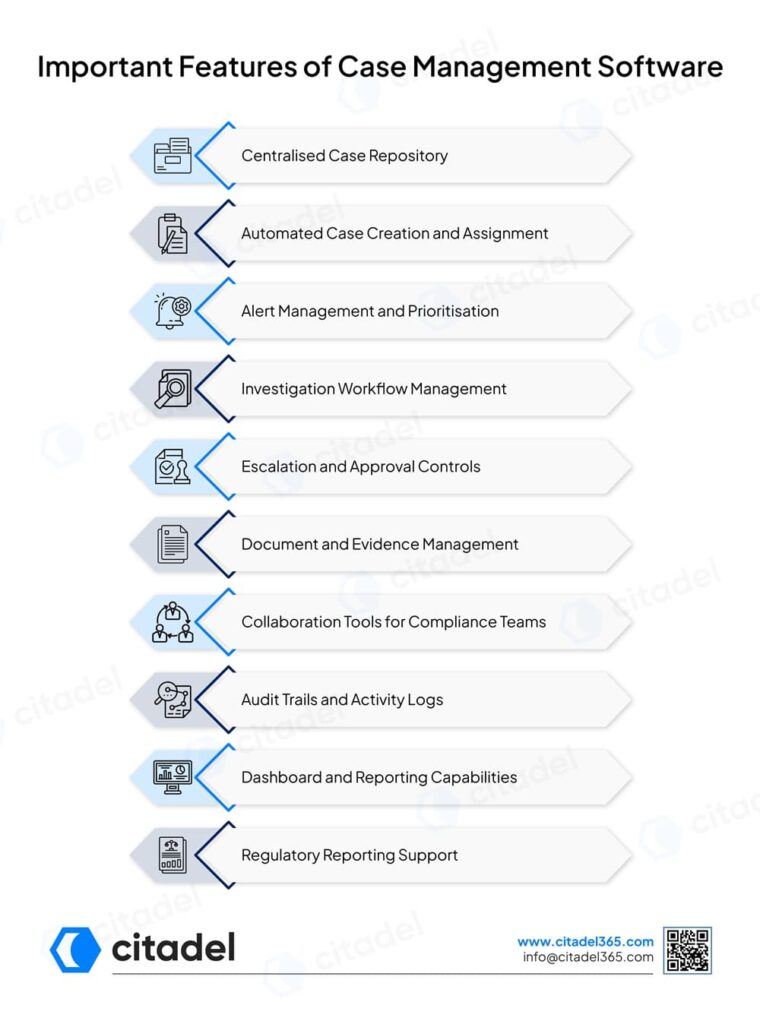
Some of the key features of case management software are:
Centralised Case Repository
A centralised case repository is one of the key features of AML case management software. A case data management system has the ability to consolidate and manage all data and information pertaining to a case in one unified place, such as the generated alerts, notes and conclusions of the investigation, customer information and/or documentation, communications and other related supporting case documents.
Case management software eliminates the need for relying on multiple sources like spreadsheets, emails and shared drives, as it allows compliance teams to pull all relevant information from one centralised location. It increases data availability, improves transparency and enables investigators to view case status and data in real-time as the investigation and compliance case progresses.
Automated Case Creation and Assignment
Alert Management and Prioritisation
Case management software allows organisations to manage alerts by consolidating and centralising alerts from multiple sources into a single platform. Additionally, the software ranks alerts according to their risk levels so that investigations are focused on high-risk cases first.
The case management software also helps teams to distinguish critical alerts from lower-risk events, thus improving resource allocation and ensuring faster response to the financial crime risk that requires the most urgency.
Investigation Workflow Management
Escalation and Approval Controls
Escalation and approval controls help ensure that high-risk cases receive an appropriate level of review.
The case management software also provides the automation of workflow management, which helps to route cases through predefined workflows based on the risk scores, results of investigation, or escalations.
Document and Evidence Management
Case management software allows the maintenance of documents and evidence securely and in an organised manner. With such a capability, organisations are able to store, categorise, organise, and access supporting evidence and related documents directly within a centralised case file. It ensures that all evidence is tightly linked to the relevant investigation and can be easily retrieved for internal audits, regulatory reviews, or future references.
Collaboration Tools for Compliance Teams
Case management software provides collaboration abilities that enable organisations to communicate, share updates, assign tasks, and exchange information within a unified platform. The combined expertise of various departments, including compliance, risk, legal, operations, business, etc., is required to handle challenges faced during AML investigations.
By centralising communication and reducing reliance on emails or separate messaging systems, the software integrates and simplifies communications across case management and enables a greater degree of collaboration among the teams, addressing the case, ensuring that the investigations progress efficiently and transparently.
Audit Trails and Activity Logs
Dashboard and Reporting Capabilities
The real-time dashboards and reporting tools embedded in the case management software allow simple monitoring of compliance operations and case management activities. These dashboards and reporting features can assist compliance managers by tracking the status of open cases, the workload of ongoing investigations, the time taken to resolve cases, and the overall performance of the compliance team.
Regulatory Reporting Support
AML case management software provides a structured framework for managing compliance investigations from the moment an alert is generated until the case is resolved and archived. It streamlines investigations by centralising the activities and automating the workflows. This allows organisations to review, document and address potential financial crime risks in a consistent and timely manner.
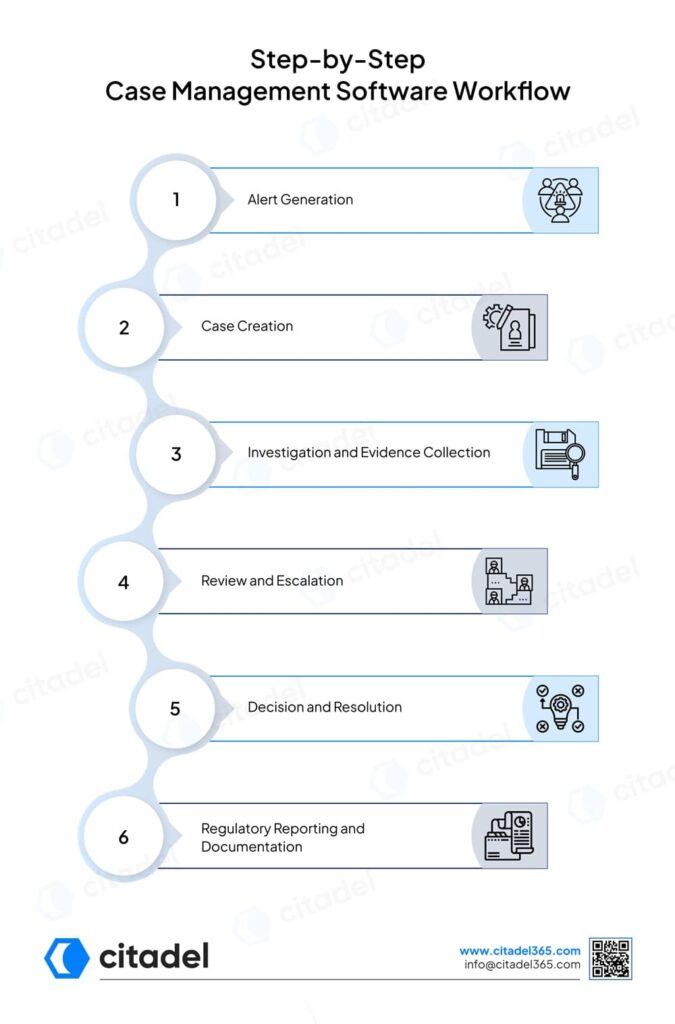
The steps involved in the case management are as follows:
1. Alert Generation
The process starts when one or more of the AML controls or monitoring systems in place generate an alert. Some of the monitoring systems that generate alerts include transaction monitoring systems, sanctions and PEP screening tools, adverse media coverage, CRA systems, KYC tools, due diligence systems, etc. These AML controls are meant to identify customer behaviours and transactions that may be suspicious and high-risk customers, along with any potential regulatory violations or non-compliance.
Some of the monitoring systems that generate alerts include transaction monitoring systems, sanctions and PEP screening tools, adverse media coverage, CRA systems, KYC tools, due diligence systems, etc.
The generated alert is then categorised as low, medium, or high risk based on the organisational risk framework relevant to the identified risks.
2. Case Creation
When the alert is generated and requires further review, the case management software automatically creates a case and begins the investigation.
At this point, the system will automatically create a unique case record. It also captures the details of the alert, evidence that supports the alert, the customer and associated transactions, and assigns a risk score and sends the case to the appropriate compliance team/officer.
The automated case creation is designed to increase the efficiency of an organisation in handling alerts with better consistency and uniformity in the process of investigation.
3. Investigation and Evidence Collection
Once a case is created and assigned, investigators review the alerts generated and gather additional information to determine if a transaction or activity is suspicious.
The software allows investigators to gather information from:
The investigators report their findings through the system itself with supporting evidence in case they find any suspicious activity, which helps in building a comprehensive investigation file. The case management software acts as a consolidated repository and ensures that all the relevant information of any particular case is maintained at one centralised location.
4. Review and Escalation
By routing cases automatically through predefined approval workflows, case management software escalates high-risk cases, alerts relevant supervisors, facilitates management reviews, thoroughly records reviews and recommendations, and helps with structured review.
This stage ensures that important cases get the right oversight and that decisions are aligned with the organisation’s policies and regulatory requirements.
5. Decision and Resolution
6. Regulatory Reporting and Documentation
When suspicious activities are found, organisations are required to submit reports to the appropriate regulatory authorities. Case management software helps by keeping thorough investigation records, accessing all supporting documents and seamlessly allowing the filing of required reports.
The software also helps with the required record retention by:
Proper reporting and record retention enable organisations to demonstrate compliance and provide proof of their AML investigation activities during regulatory reviews or audits.
As financial crimes become more complex and corresponding regulations become more stringent, compliance teams face more alerts, investigations, and reporting obligations.
Manual investigations are extremely inefficient, time-consuming, labour-intensive, and create a lot of inconsistencies. All this diminishes the ability to keep an organisation’s AML/CFT controls effective.
The AML Case Management Software provides organisations with the ability to streamline compliance processes by offering a centralised system to conduct investigations and by automating workflows, improving visibility, and providing better governance throughout the case lifecycle.
Some of the benefits of case management software that improve compliance operations are:
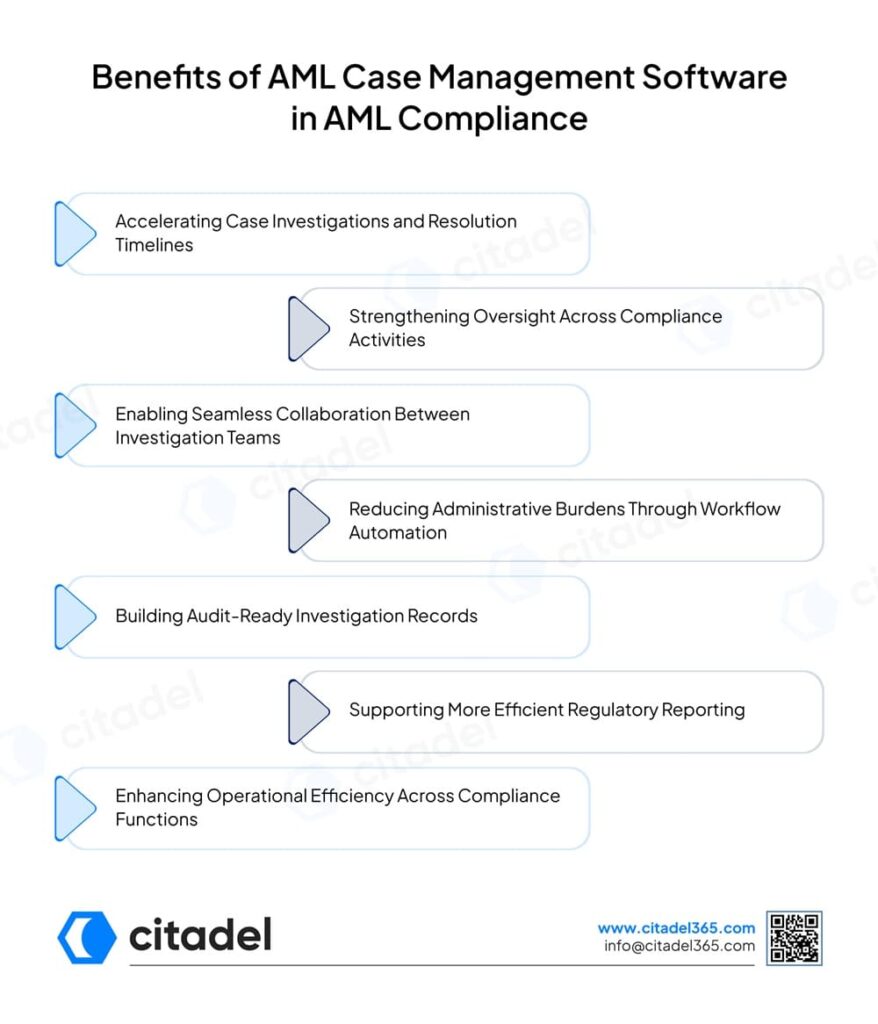
Accelerating Case Investigations and Resolution Timelines
One major benefit of AML Case Management Software is its ability to significantly shorten the time needed for case investigation and case resolution. By automatically creating cases and intelligently assigning them, and by centralising access to customer and transaction data, it eliminates most delays associated with manual investigations.
Investigators no longer spend time gathering information from multiple systems, nor do they have to manually determine the status of a case. Instead, all necessary information is readily available in one single system, allowing them to concentrate on assessing risks and resolving cases. Quicker investigations enable organisations to respond more effectively and promptly to potential financial crime threats while meeting regulatory requirements on time.
Strengthening Oversight Across Compliance Activities
Managing the effectiveness of the compliance process requires real-time oversight of investigations, open cases, and the performance of employees. In the absence of a centralised system, keeping track of compliance operations becomes nearly impossible.
The AML case management software can help compliance managers have better visibility into live investigations, case status, workload distribution, and escalations. This live visibility enables organisations to track teams and case progression, optimise resource allocation and ensure compliance obligations are always met.
Enabling Seamless Collaboration Between Investigation Teams
There are several parties involved in the investigation of an AML case, which typically includes compliance analysts, risk managers, legal representatives, operational personnel, and senior management.
The use of email, spreadsheets or stand-alone systems to communicate between these parties creates an inefficient and uncoordinated investigation process. Case management software replaces a collection of disparate tools with a single platform for collaboration, where different users can share updates, document findings, create and assign tasks and review case information.
This means that everybody is in the loop with information and the investigation is efficient, minimising the gaps and disconnects in communication between the parties involved.
Reducing Administrative Burdens Through Workflow Automation
A significant amount of compliance work consists of administrative tasks that take up valuable time and resources. Manual case assignments, status tracking, follow-up reminders and approval can detract from investigators’ time for more valuable compliance activities.
The AML Case Management Software assists organisations by automating the repetitive administrative functions through customisable workflows, automatic notifications, escalation triggers and task management features.
Building Audit-Ready Investigation Records
Keeping complete and accurate investigation records is essential for AML compliance. Regulators expect organisations to show how alerts are reviewed, what actions were taken, and the reasoning that was applied to the final decision.
AML Case Management Software automatically captures the details of every investigative step and includes supporting documents, review comments, approvals, and case outcomes throughout the investigation process. This creates a thorough and well-documented record for analyses and is available on demand for audits or regulatory reviews, helping organisations demonstrate compliance confidently.
Supporting More Efficient Regulatory Reporting
Regulatory reporting is a vital part of an organisation’s AML/CFT compliance requirements. Preparing reports manually can take a lot of time, especially when information is spread across different systems and records.
AML case management software in UAE centralises investigation data and supporting documents, making it easier to compile the information needed for suspicious activity reporting, management reports, and regulatory submissions. This provides a comprehensive and well-documented trail for analyses, available on demand for audits or regulatory reviews, helping organisations to demonstrate compliance with confidence.
Enhancing Operational Efficiency Across Compliance Functions
As organisations expand and compliance obligations become more complicated, compliance teams must handle more alerts and investigations without significantly increasing resources.
AML Case Management Software boosts operational efficiency by introducing standardisation of investigation processes, reducing duplication of effort, streamlining case handling, and promoting better resource allocation.
Improving Visibility, Accountability, and Decision-Making
AML Case Management Software provides advanced dashboards, analytics, and reporting capabilities to give management teams greater insight into compliance operations.
Organisations can measure key indicators, evaluate investigation performance, identify emerging trends, and assess operational risks through a single, unified platform. Meanwhile, clearly defined workflows, user responsibilities, approval processes, and audit trails enhance accountability within the compliance function.
The right Case Management Software can strengthen an organisation’s AML/CFT compliance framework. It can also assist in managing the efficiency of investigations, meeting the specific internal and regulatory needs of an organisation, and adapting to an evolving regulatory environment. When choosing a case management software, the following factors should be strongly considered.
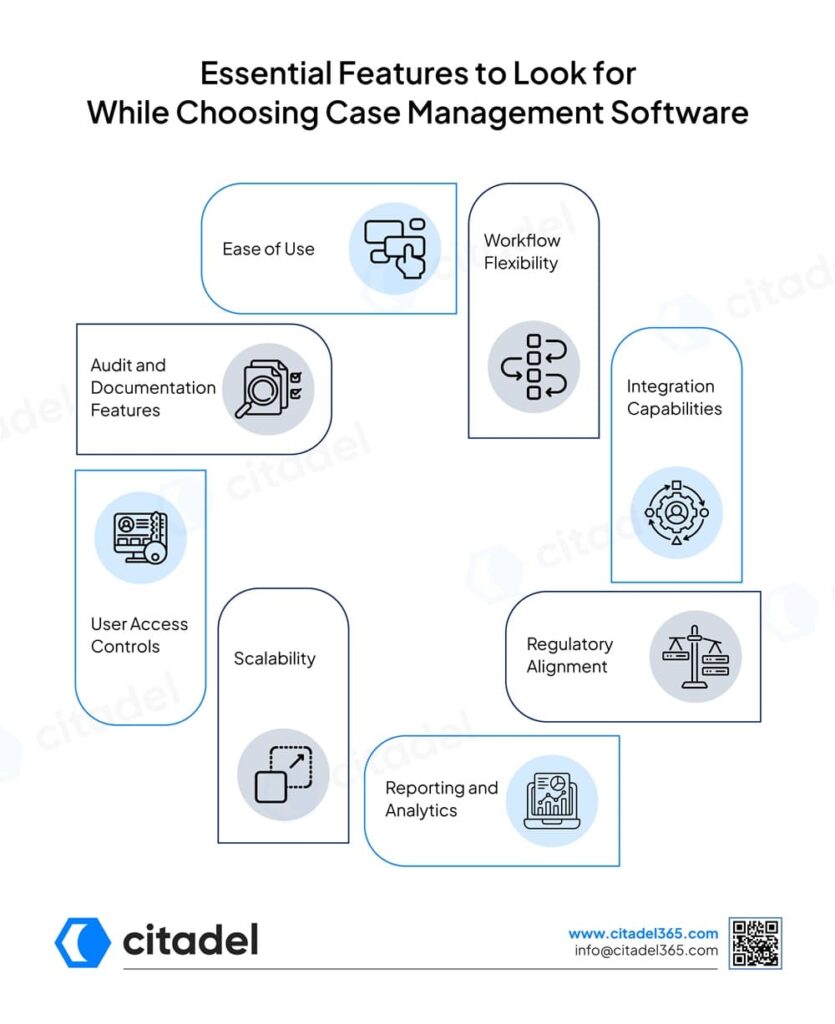
Workflow Flexibility
Every organisation has its own case management and review policies. The ability to create and change workflows according to an organisation’s policies and risk management practices is crucial for a case management solution. Customising approval processes, review stages, and case management lifecycles should be possible without making significant changes to the solution.
Integration Capabilities
To conduct effective and efficient AML investigations, case management solutions must connect with customer due diligence, transaction monitoring, and customer risk assessment and screening systems. Integration of these systems must provide a thorough understanding of compliance systems. When case management solutions integrate with compliance systems, they eliminate the need to capture and enter data multiple times, break down data silos, and greatly improve investigative efficiency.
Regulatory Alignment
Case management software must help UAE-based organisations adhere to AML/CFT legislation and improve compliance with industry-specific regulations. The chosen systems should facilitate investigations and aid in completing regulatory reports while offering ways to manage and retain case files.
Reporting and Analytics
Effective decision-making requires rapid and accurate access to compliance information. Comprehensive reporting and analytics features should be included in case management software so that organisations can track how effective investigations are, assess risk exposure, and measure compliance efficiency.
Scalability
As businesses grow, compliance workloads also increase due to higher customer volumes, more transactions, and an ever-evolving regulatory environment. The case management software should be capable of handling this increase in alert volumes and investigation demands without compromising on performance. A scalable solution allows organisations to maintain consistent investigation standards and operational effectiveness despite expanding compliance operations.
User Access Controls
AML investigations often involve sensitive customer information, risk assessments, and confidential compliance records. Strong data security and user access controls are needed to ensure that information is accessible only to authorised personnel. Role-based access management enables organisations to define permissions based on job responsibilities, restrict access to sensitive data, maintain segregation of duties, and strengthen overall data security and governance.
Audit and Documentation Features
Comprehensive recordkeeping is one of the fundamental requirements of AML compliance. Therefore, a powerful documentation tool must be implemented in the software solution to allow investigators to record findings, attach supporting evidence, track activities within an investigation process, and keep a thorough investigation history.
It will also be helpful if comprehensive audit trails can be provided as part of the tool’s functionality, which captures user actions, approvals, escalations, and case updates, helping organisations demonstrate transparency, accountability, and compliance during audits and regulatory examinations.
Ease of Use
All the advanced features in a software solution can become obsolete if the solution is difficult to use. A user-friendly interface reduces training requirements and is essential for encouraging adoption and improving productivity.
Investigators and compliance officers need to be able to navigate the system easily, find the necessary information quickly, and perform required tasks effortlessly. An intuitive and well-designed platform eliminates operational challenges, enhances user experience, and allows compliance teams to focus on investigations rather than on learning and managing complex technology.
AML case management software is a solution helping organisations to manage, investigate, document, and resolve suspicious activities, alerts and compliance cases in a single platform.
Case management software helps reduce investigation times by streamlining processes, automating workflows, and enabling faster case resolution.
Collaboration enables compliance teams to share information, assign tasks, track progress, and resolve cases more effectively while maintaining a complete audit record.
Yes, AML case management software can integrate with customer onboarding and screening systems to streamline the investigation process.
Yes, AML case management software helps DNFBPs in the UAE and supports their compliance obligations through improved record-keeping, investigations, and regulatory reporting.

Arjun is the Co-founder and CEO of Citadel, where he leads the company’s vision across technology, business, and regulations. He brings over a decade of experience in building and scaling technology ventures. Arjun holds a B.Tech. in Information Technology and a Master’s in Management, supported by his certification as a Financial Crime Specialist, an uncommon combination that allows him to balance innovation with regulatory requirements.
Having advised leading banks and financial institutions on digital solutions and compliance technology, Citadel continues to grow with an ambition.