
Ready to Defeat Your AML Compliance Obstacles?
Citadel Brings Revolution with Secure Solutions to AML Compliance Problems
A weak customer onboarding process can expose organisations to money laundering risks, regulatory penalties, and reputational damage.
Think of it like a security checkpoint at an airport: if checks are rushed or incomplete, the wrong people can slip through.
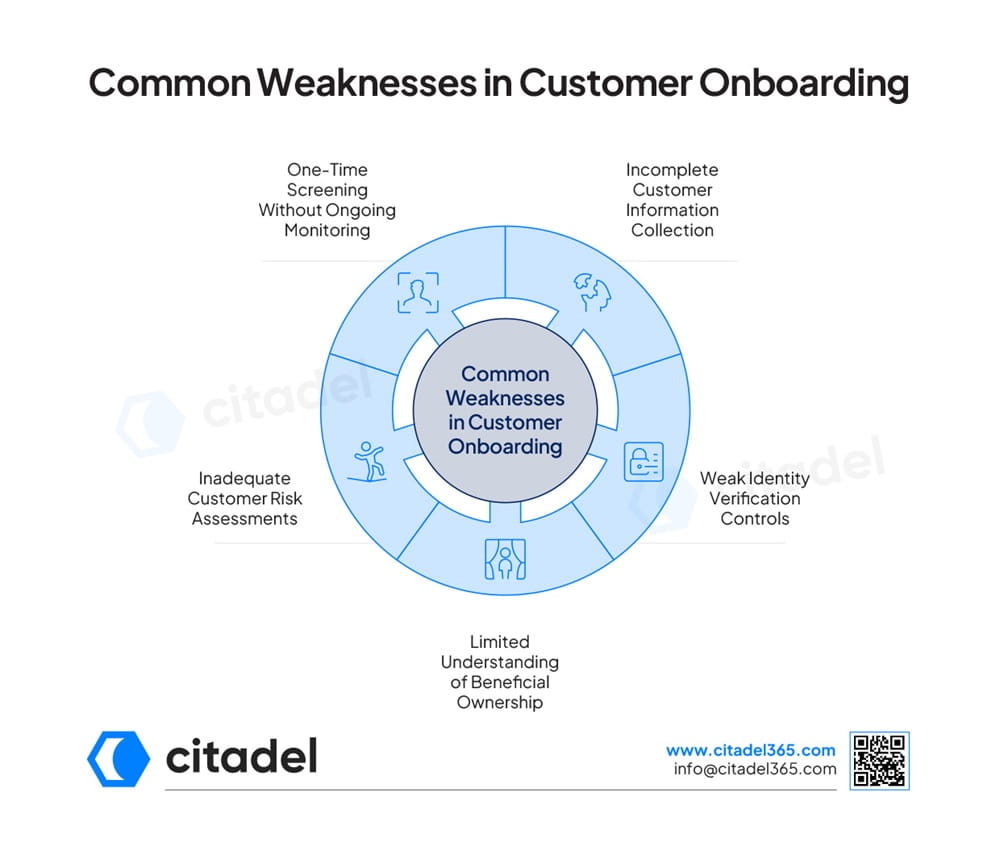
Several common gaps make the onboarding process vulnerable and reduce compliance effectiveness.
At the time of onboarding, when organisations fail to collect enough customer information, such as legal names, addresses, or source of funds, they may struggle to accurately identify customers and their business activities, creating compliance blind spots.
Verifying identity is a core part of customer onboarding, confirming that customers are who they claim to be. When these controls are weak, the result can be identity fraud, ML/TF risks, fines, and reputational damage.
Identifying the individuals who ultimately own or control an entity, a core part of Know Your Business (KYB) checks, is essential to enhancing transparency and reducing the risk of money laundering, sanctions evasion, or other financial crime.
Customer risk profiles are dynamic and can change over time; conducting screening only at the time of onboarding creates significant vulnerability. Organisations should conduct ongoing monitoring, ensuring they remain compliant with regulatory expectations.
Customer onboarding is the first line of defence against financial crime; weak and uneven controls let criminals slip through, hiding their identities, masking ownership, and exploiting the financial system.
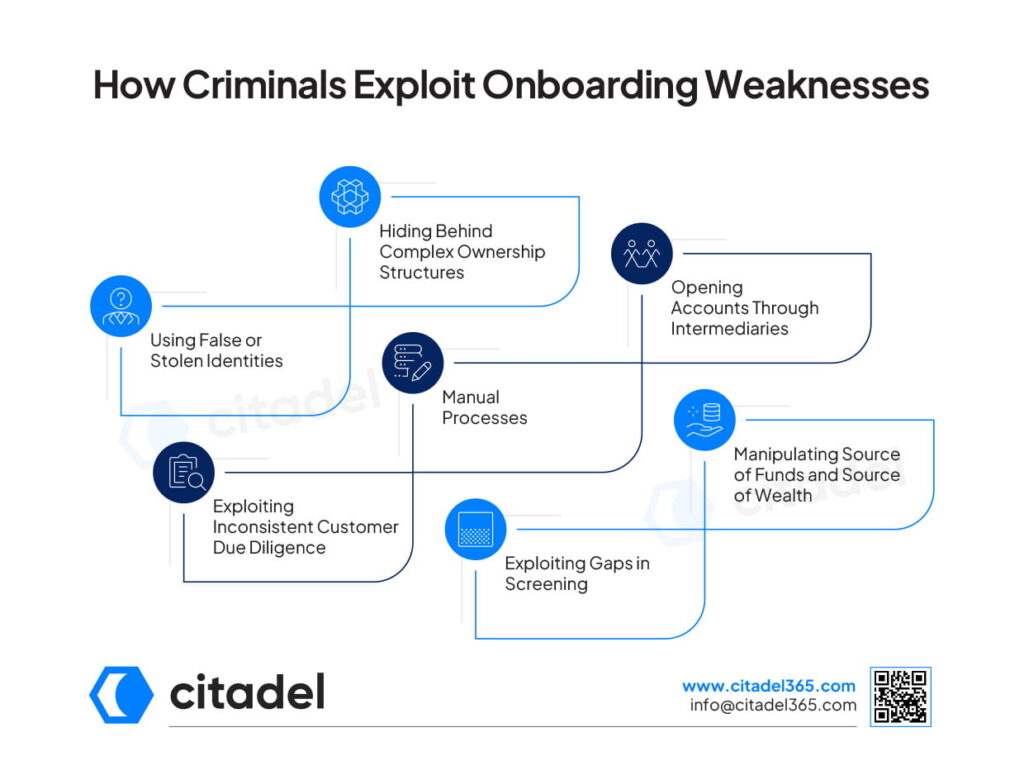
Using False or Stolen Identities
Criminals often use forged documents and stolen identities to bypass the verification controls, making it easier for them to enter the financial system.
Hiding Behind Complex Ownership Structures
Exploiting Inconsistent Customer Due Diligence
Manual Processes and Human Error
Manual processes can be vulnerable to oversight, human errors, and inconsistent decision-making, enabling criminals to exploit these weaknesses and circumvent compliance checks.
Opening Accounts Through Intermediaries and Third Parties
Third parties and intermediaries can be used to obscure the identity of the actual customer, making it difficult for organisations to identify the individuals ultimately controlling or benefiting from an account.
Exploiting Gaps in Sanctions and PEP Screening
Outdated and incomplete screening data allows sanctioned individuals or politically exposed persons (PEPs) to bypass the onboarding process and go undetected, increasing regulatory and reputational risks.
Manipulating Source of Funds and Source of Wealth Information
Common mistakes during the onboarding stage can lead to compliance gaps, increased ML/TF risks, and regulatory penalties. Some of the common mistakes include:
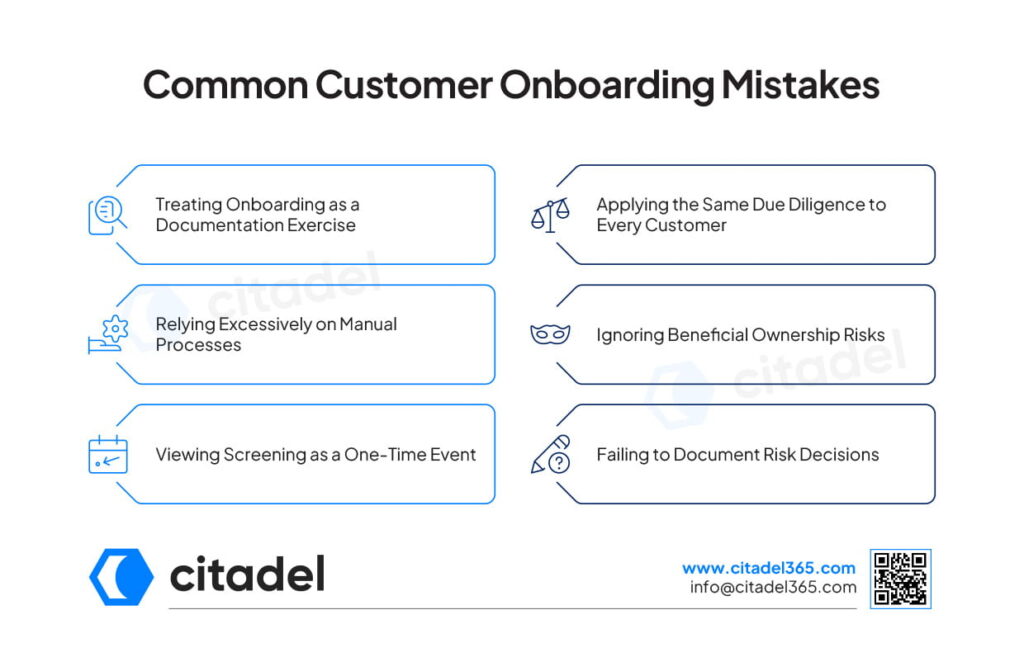
Treating Onboarding as a Documentation Exercise
Onboarding is not just about collecting documents; it is also about understanding the customer’s risk profile. Ignoring this can result in important red flags being overlooked.
Applying the Same Due Diligence to Every Customer
Applying the same due diligence for every customer may lead to insufficient scrutiny of high-risk customers and unnecessary effort for low-risk ones.
Relying Excessively on Manual Processes
Over-reliance on manual reviews increases the risk of human error, inconsistencies, and missed warning signs.
Ignoring Beneficial Ownership Risks
Viewing Screening as a One-Time Event
Failing to Document Risk Decisions
Criminals exploit customer onboarding processes to hide their identities, gain unauthorised access to financial systems, and conduct illicit activities.
Verifying beneficial owners is important to identify who ultimately owns or controls a business, often reducing the risk of hidden ownership and ML/TF risks.
Yes, weak onboarding can lead to sanctions breaches due to ineffective sanctions screening, allowing sanctioned individuals or entities to be onboarded.
Criminals often exploit poor CDD by providing false information, concealing beneficial ownership, or misrepresenting their activities to avoid detection.
Customer risk assessment helps organisations to identify high-risk customers and apply appropriate due diligence and monitoring measures.
Ongoing monitoring helps detect changes in customer risk profiles, identify suspicious activity, and surface emerging risks after onboarding.
Know Your Business (KYB) verifies a company’s legal existence, ownership, and control, while Know Your Customer (KYC) verifies an individual. KYB identifies ultimate beneficial owners and screens the business, its directors, and counterparties, which is essential when onboarding corporate customers.
Common money mule red flags include funds that leave an account almost immediately after they arrive, deposits from multiple unrelated sources, transactions that do not match the customer’s stated profile, and reluctance to explain the source of funds.
Screening is not a one-time event. Sanctions lists, PEP databases, and adverse media change constantly, so customers should be re-screened on an ongoing or periodic basis and whenever their information or risk profile changes. e-KYC and automated tools make continuous re-screening practical.

Arjun is the Co-founder and CEO of Citadel, where he leads the company’s vision across technology, business, and regulations. He brings over a decade of experience in building and scaling technology ventures. Arjun holds a B.Tech. in Information Technology and a Master’s in Management, supported by his certification as a Financial Crime Specialist, an uncommon combination that allows him to balance innovation with regulatory requirements.
Having advised leading banks and financial institutions on digital solutions and compliance technology, Citadel continues to grow with an ambition.