
Ready to Defeat Your AML Compliance Obstacles?
Citadel Brings Revolution with Secure Solutions to AML Compliance Problems
Name screening software for real estate brokers in the UAE is an automated tool that screens buyers, sellers, and beneficial owners against global sanctions watchlists, PEP databases, and adverse media sources. The software screens customers at onboarding and performs daily rescreening to update customer risk profiles and prevent financial crime.
Real estate brokers in Dubai need to verify the buyer and seller to ensure AML compliance, prevent fraud and avoid penalties. Name screening software in Dubai automates anti-money laundering (AML) checks by verifying buyer, seller and UBO to detect sanctions, PEP and adverse media matches. Further, the software provides documented, timestamped evidence to support regulatory inspections.
Real estate brokers and agents must screen buyers, sellers, beneficial owners and third-party funders against the sanctions, PEP, and adverse media lists to ensure compliance with the UAE AML laws.
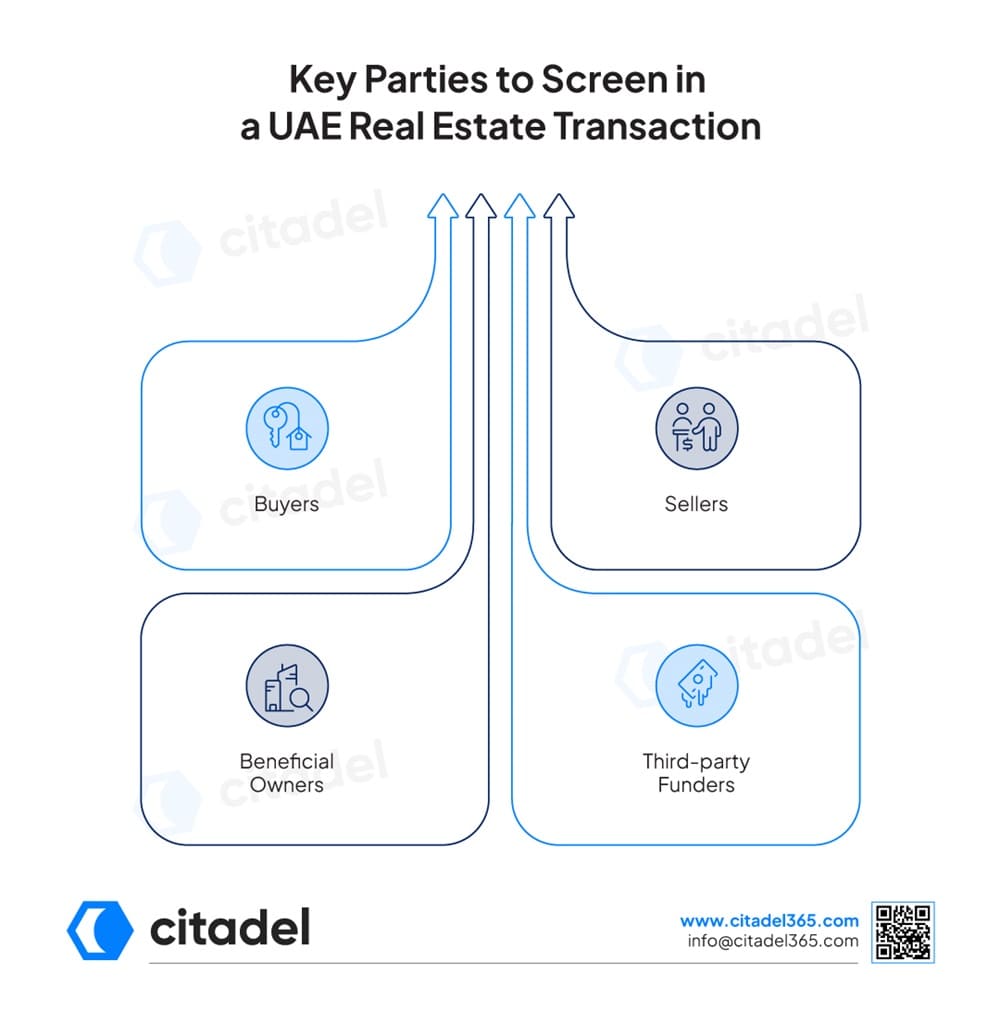
Buyers: These are individuals or corporate entities purchasing the property and must be screened before any transaction proceeds.
Sellers: These are individuals or corporate entities selling their property. Brokers must verify them against PEPs, sanctions and adverse media sources.
Beneficial Owners: When dealing with a corporate entity, trust or offshore company, brokers must identify the ultimate beneficial owners who own or control the entity.
Third-party Funders: In cases where a third party funds the purchase, the real estate brokers should screen the party for regulatory compliance.
Simplify AML Screening for Every Deal
Equip your team with Citadel365 that streamlines screening, reduces compliance risks, and supports regulatory requirements.
Name screening software helps real estate brokers comply with UAE AML laws by addressing sector-specific challenges and automating checks on buyers, sellers, UBOs, and third parties.
Screening Requirement | Sector Challenge | Name Screening Feature | Evidence Generated |
Buyer screening | Screening the named buyer at instruction | Automated buyer screening at matter intake | Buyer screening record, match results, timestamps |
Seller screening | Screening the seller on both sides of the deal | Automated seller screening | Seller screening record, match results, timestamps |
UBO screening behind purchasing entities | Screening through to natural persons behind corporate buyers | UBO screening linked to KYB capture | UBO screening records per tier, match results |
Third-party funder screening | Screening parties funding the purchase | Third-party funder screening with document link | Third-party screening record, alert notes |
PEP identification | Detecting politically exposed persons on either side | PEP database screening on buyer, seller, and all UBOs | PEP match results, EDD trigger, review history |
Daily rescreening | Monitoring all active deal parties for new listings | Automated daily rescreening across all parties in open deals | Rescreening logs, new hit alerts, timestamps |
Alert management | Reviewing and documenting screening hits | Alert workflow with reviewer notes, escalation, closure trail | Alert records, decision trail, MLRO escalation log |
The following are red flags that name screening software helps detect for the real estate sector:
The features of name screening software for real estate brokers include the following:
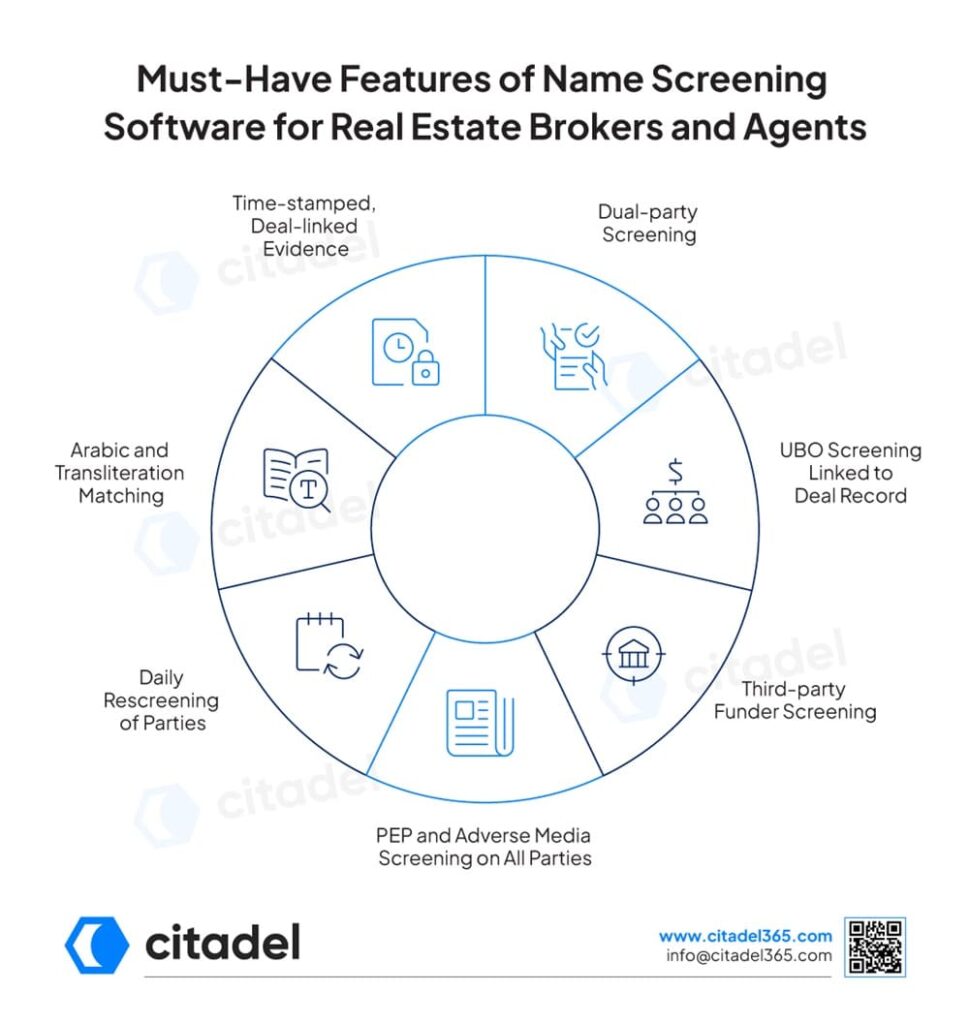
Name screening software should screen all the relevant parties involved in the real estate transaction, including buyers and sellers.
When a corporate entity is involved, the name screening software should support KYB entity screening and screen the ultimate beneficial owners linked to the transaction, capturing beneficial ownership for anti-money laundering compliance.
The name screening software must check the third-party funder against the watchlist, PEP lists and adverse media sources identified during the source of funds checks. This helps ensure that all parties connected to a real estate transaction are verified.
Name screening software should not only check against the sanctions lists but also perform PEP and adverse media checks for buyers, sellers, UBOs, and third-party funders. This helps real estate brokers to identify financial crime risks before a real estate transaction is completed.
Continuous screening is important. Name screening software should rescreen all parties on an ongoing basis and generate alerts if a match appears until the deal is active, to identify new sanctions, PEP or adverse media links. This automated watchlist screening gives brokers continuous watchlist monitoring against the latest AML watchlist for the full life of the deal.
As regulatory compliance name matching software, the name screening software should recognise the same name spelt in different languages, whether written in the Arabic or Latin alphabet. The software should help identify spelling variations of names that improve match accuracy and reduce risks of missed sanctions.
Name screening software should work as sanctions screening tools with audit trails, providing time-stamped records linked to the specific client and transaction with easy download options to meet MoET regulatory expectations.
Make Every Name Count
Citadel365, the right name screening solution, helps real estate brokers remain compliant throughout every transaction.
Manual screening, which involves checking buyers, sellers, and investors against watchlists, is time-consuming and prone to human errors, while name screening software automates checks against sanctions, PEP and adverse media sources to provide results in seconds. The following table lists why name screening software is better than manual screening:
Screening Area | Manual Process Risk | Name Screening Software Advantage |
Buyer screening | Manual check at instruction, often only buyer covered | Automated buyer and seller screening |
Seller screening | Frequently omitted or inconsistent | Systematic seller screening on every deal |
UBO screening | Missed for offshore and corporate buyers | UBO screening linked to KYB and deal record |
Third-party funders | Not systematically screened | Third-party funder screening workflow |
PEP screening | Manual database checks, missed on UBOs | PEP screening on all parties including UBOs |
Ongoing monitoring | No rescreening between instruction and completion | Daily rescreening |
Inspection evidence | No retrievable screening history per deal | Time-stamped, deal-linked results exportable per deal |
Citadel365 name screening software checks buyer, seller, UBOs and third-party funders against UNSC Consolidated List, UAE Local Terrorist List, PEP databases, and adverse media sources. Further, the name screening software performs daily rescreening and provides time-stamped results through immutable audit trails. The AML software links the screening records to a specific client or transaction and helps generate downloadable reports for MoET inspection.
Citadel365 helps independent property agents, conveyancing teams, brokerages, property developers, and real estate management companies in the UAE to ensure AML compliance.
Real estate brokers and agents must ensure that the name screening software meets the checklist below to fulfil AML compliance requirements:
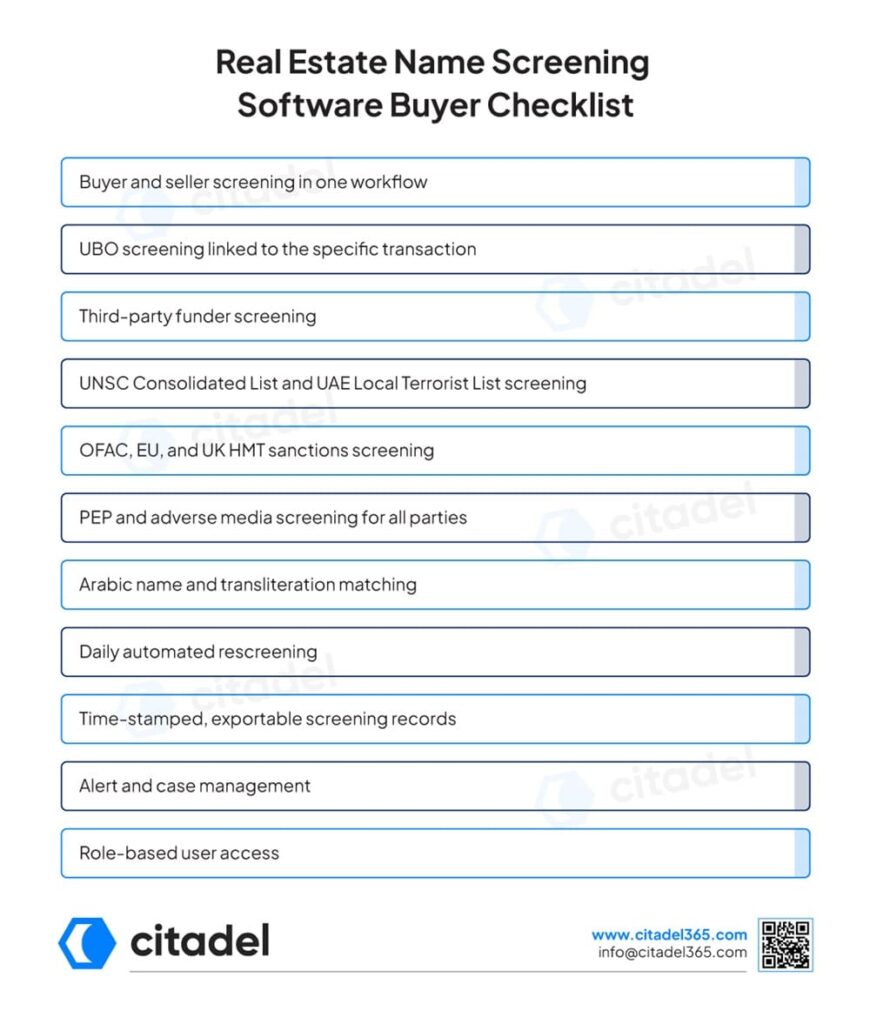
Further, name screening software should ask the following questions to the name screening vendor:
Name screening for UAE real estate brokers and agents covers the buyer, the seller, the beneficial owners, and the third-party funders. Choosing name screening software in Dubai that automates screening checks and performs daily rescreening helps remain compliant with AML/CFT obligations. Citadel365 helps UAE real estate brokers with an automated solution that checks transaction parties against sanctions, PEP and adverse media and provides time-stamped records to meet MoET regulatory requirements.
Frequently Asked Questions
Yes, real estate brokers and agents must screen all parties involved in a property transaction in the UAE, including the buyer and seller, to comply with AML/CFT obligations.
Real estate brokers and agents must screen against the UN Security Council Consolidated List and the UAE Local Terrorist List. Further, depending on the risk exposure, brokers should screen against the OFAC SDN List, the EU Consolidated Sanctions List, and the UK HM Treasury Sanctions List.
Daily rescreening automatically checks the transaction parties against sanctions, PEP, and adverse media sources to identify matches. It matters because a buyer, seller, or UBO may be added to sanctions, PEP or other watchlists after the initial checks, and daily rescreening helps identify these changes and allows brokers to take appropriate actions to remain compliant.
Yes, a broker must screen a third-party funder if the funder is involved in a property transaction as part of their due diligence process. It helps identify potential sanctions, PEPs, or relevant risks related to the transaction.
PEP screening helps identify whether the individuals linked to a property transaction are known PEPs or associated with a Politically Exposed Person (PEP) and to further apply enhanced due diligence (EDD) to remain compliant.

Vasantha holds a Master’s in Law specialising in Banking Laws and Anti-Money Laundering and is CAMS and CGSS certified. With over 35 years of experience, she has worked closely with regulators and international financial institutions, building financial crime risk frameworks, sanctions monitoring programmes, and compliance systems across multiple jurisdictions.