
Ready to Defeat Your AML Compliance Obstacles?
Citadel Brings Revolution with Secure Solutions to AML Compliance Problems
Name screening software for gaming operators in the UAE is an automated tool that checks players against sanctions lists, PEP databases and adverse media sources. Further, the software conducts daily rescreening of registered players and provides time-stamped, exportable results to ensure AML compliance.
Gaming operators are a new regulated sector in the UAE, supervised by the General Commercial Gaming Regulatory Authority (GCGRA). The authority monitors the compliance operations of gaming operators closely and penalises for non-compliance. As such, gaming operators should build an accurate screening program or use an effective name screening solution that automates checks and helps identify high-risk or sanctioned individuals.
UAE gaming operators must screen for the following groups:
Check Every Player Every Time
Automate player screening at onboarding and daily rescreening with Citadel365
Name screening software prevents gaming operators from onboarding sanctioned individuals, helps identify high-risk customers, and automates screening in real time.
Screening Requirement | Sector Challenge | Name Screening Feature | Evidence Generated |
Player screening | Screening all the players | Automated player screening | Player screening record, match results, timestamps |
High-roller PEP screening | Identifying PEPs on large-value player accounts | PEP database screening on high-roller and VIP players | PEP match results, EDD trigger, review history |
Corporate account UBO screening | Screening entities and UBOs behind corporate accounts | Entity and UBO screening linked to KYB capture | Entity and UBO screening records, match results |
Third-party funder screening | Screening parties funding a player’s buy-in | Third-party funder screening workflow at buy-in | Third-party screening record, alert notes |
Adverse media screening | Detecting negative news on high-value players | Adverse media integrated with sanctions and PEP run | Adverse media hits, alert notes, review history |
Daily rescreening | Monitoring registered players for new listings | Automated daily rescreening of all registered players | Rescreening logs, new hit alerts, timestamps |
Alert management | Reviewing and documenting screening hits per player | Alert workflow with reviewer notes and MLRO escalation | Alert records, decision trail, MLRO escalation log |
The common red flags that name screening software helps identify are as follows:
The following are essential features that name screening software should possess that help gaming operators in the UAE meet screening requirements:
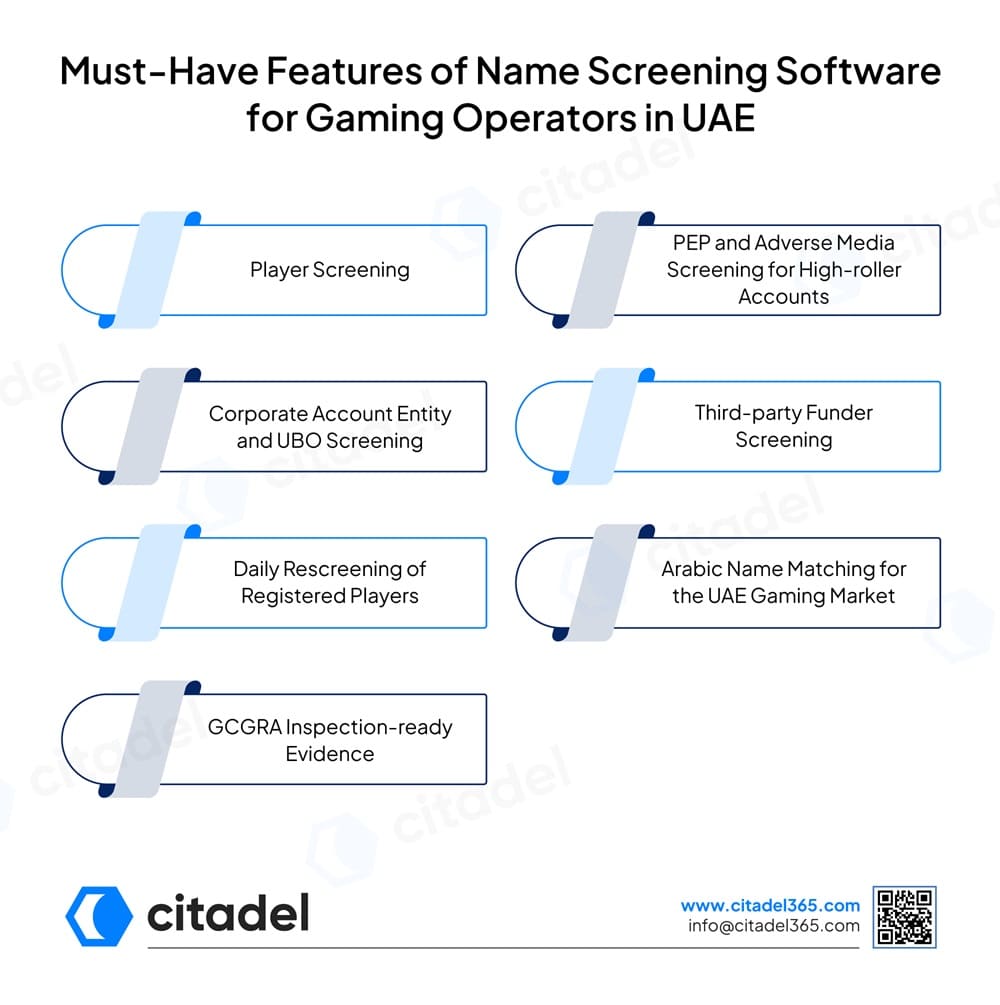
Name screening software should automate screening when a customer engages in a financial transaction. The software should screen the customer before the transaction is made or the customer continues the gaming activity.
Name screening software should screen customers against the PEP database and adverse media sources, in addition to sanctions screening. This helps to conduct enhanced due diligence for high-risk customers.
When dealing with a corporate account entity customer, name screening software should screen the entity and its UBO. It should identify the individuals who ultimately own and control the company, and verify them against sanctions, PEP, and adverse media databases.
In cases where the player or customer is funded by a third party to carry out buy-in or gaming activity, name screening software should screen that individual. Screening third parties helps reduce compliance risks and prevents illicit financial flows.
Screening should be an ongoing process. The name screening software should automate daily rescreening for all players to check them against updated sanctions lists, PEP databases and adverse media sources. For instance, when a player matches to sanctions, the software can automatically detect the match and generate an alert.
For fuzzy name matches, Arabic names, or spelling alterations, the name screening software should support transliterations. This helps minimise missed matches and enhances screening.
The name screening software should maintain a complete record of screening checks and retain it for at least five years, which is the minimum retention period Cabinet Resolution No. 134 of 2025, Article 25 sets for DNFBP records. The platform should document the screening results in a time-stamped format, including date, time, list of checks, and the outcome. Further, the software should allow exportable records for GCGRA inspections or internal audit.
Know Who’s Playing Before the Game Begins
Equip with Citadel365 that automates name screening against sanctions lists, PEP databases, and adverse media sources
Citadel365 name screening software automates checks that help gaming operators in the UAE meet their screening requirements.
The name screening software screens customers against the global watchlists, such as the UNSC Consolidated List and UAE Local Terrorist List, PEP databases, and adverse media sources. Further, Citadel365 conducts daily rescreening of existing customers to identify new sanctions or PEP matches.
Moreover, for a corporate gaming customer, Citadel365 screens both the entity and its UBOs as part of customer due diligence. The name screening software records every result in a time-stamped format, which can easily be exported for audit or inspections.
Citadel365 is specifically designed for lottery operators, commercial casinos, online gaming platforms, and compliance teams that require an efficient screening solution to meet GCGRA requirements.
Gaming operators may use the following checklist for choosing the right name screening solution for their business to ensure compliance:
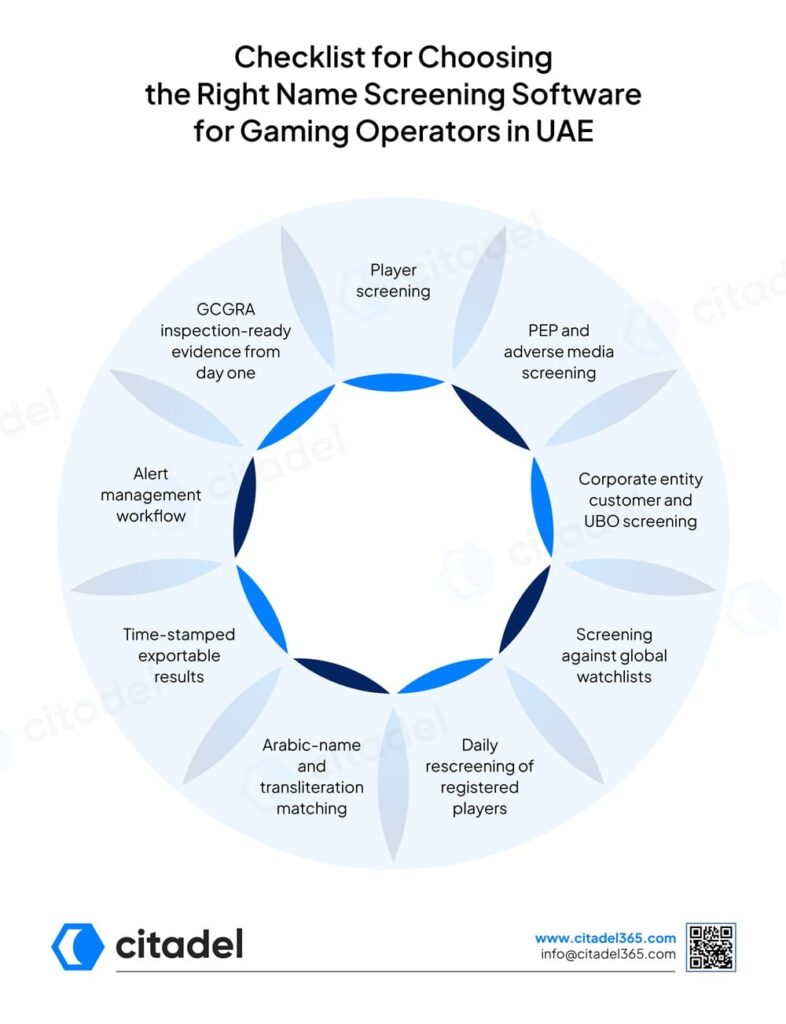
Further, the gaming operator may ask the following questions to the name screening vendor for choosing the optimal platform for ensuring compliance:
The Smarter Way to Screen Every Player
Citadel365 with automated screening, daily rescreening, and effective audit trails keeps you compliant-ready.
Name screening is an essential part of AML compliance for gaming operators in the UAE. Further, name screening should involve screening high-roller players, VIP players, corporate account holders, their UBOs, and third-party funders. Choosing a name screening software helps screen players at onboarding and conduct daily rescreening to identify new matches and avoid risks. Citadel365 helps gaming operators automate real-time name screening and maintain records for GCGRA inspections.
Frequently Asked Questions
Politically Exposed Person (PEP) screening is the process of checking whether a customer holds a prominent public position or is a close associate of a PEP. It helps gaming operators identify high-risk customers among high-roller gaming accounts and apply enhanced due diligence when required, meeting AML/CFT compliance obligations.
Yes, when a customer opens a gaming account, the gaming operator should screen both the corporate customer and its beneficial owners to understand who owns and controls the company and reduce financial crime.
Daily rescreening means checking existing customers every day against updated sanctions lists, PEP databases and adverse media. The legal standard in Cabinet Resolution No. 74 of 2020, Article 21(2) is continuous verification against the lists plus a fresh check whenever a list changes; running the check daily, and immediately on a list update, is how operators generally satisfy it. It catches players whose risk profile has changed, including anyone newly designated or newly reported as high risk, so the operator can freeze and report as required.
Gaming operators must keep screening records for at least five years and produce them to the authorities on request (Cabinet Resolution No. 134 of 2025, Article 25). Records should show the customer screened, the lists checked, the date and time of the check, any match or alert, who reviewed it, the decision reached, and any freeze or report that followed.

Sridhar is a Certified Anti-Money Laundering Investigator (CAMI) with over 30 years of experience in compliance, risk, and audit, including more than 20 years in AML and financial crime prevention. He has contributed to the development of UAE regulatory standards through the FERG sub-committee and has maintained active engagement with the Central Bank of the UAE on supervisory and compliance matters.