
Ready to Defeat Your AML Compliance Obstacles?
Citadel Brings Revolution with Secure Solutions to AML Compliance Problems
The General Commercial Gaming Regulatory Authority (GCGRA) is the supervisory authority for gaming operators in the UAE. Under Cabinet Resolution No. 134 of 2025, gaming operators, including commercial gaming conducted on board vessels or marine craft, are considered Designated Non-Financial Businesses and Professions (DNFBPs). The activity that triggers CDD involves a single or linked financial transaction with a value equal to or exceeding AED 11,000.
Further, gaming operators need to conduct ongoing monitoring, which includes reviewing their transaction activity to identify unusual patterns, reassessing risk and maintaining accurate customer information.
For high-risk players, gaming operators should conduct enhanced due diligence, including understanding their source of funds and obtaining supporting documents to facilitate GCGRA supervisory inspections.
Gaming operators are required to file a suspicious transaction report and a suspicious activity report when they identify suspicion, such as structuring patterns, third-party funding, or unusual win patterns. Operators must submit the STR/SAR through the UAE FIU’s goAML platform.
Simplify AML Compliance for Gaming Operators
Citadel365 helps manage player identity verification, screening, and risk assessment, ensuring compliance with UAE AML requirements.
AML software helps gaming operators meet UAE AML requirements, address sector-specific challenges and generate evidence to support GCGRA inspections.
UAE AML Requirement | Sector Challenge | AML Software Feature | Evidence Generated |
Player Due Diligence | Threshold-triggered KYC at AED 11,000 buy-in | Digital player onboarding workflow at the threshold trigger | Player profile, ID documents, approval logs |
Source of Funds | Establishing fund origin for high-value buy-ins | Source of funds capture with document upload and review | Source documents, fund trail evidence |
Beneficial Ownership | Corporate accounts and third-party funders | KYB for corporate account holders with UBO mapping | UBO records, ownership notes |
Sanctions Screening | Screening players, UBOs, and third-party funders | Sanctions, PEP, adverse media screening at threshold and ongoing | Match results, alert notes, review history |
Player Risk Assessment | Scoring high rollers, structuring patterns, third-party funding | Configurable player risk model with EDD triggers | Risk scores, rationale records |
Play and Payout Monitoring | Detecting structuring, unusual win patterns, and cash cycling | Rule-based play and payout monitoring | On the roadmap: alerts and investigation trail |
STR/SAR Support | Suspicious player activity reporting | Case management with goAML STR preparation | Investigation notes, escalation records |
Recordkeeping | GCGRA inspection readiness from day one | Centralised audit trail per player account | Timestamped activity logs, exportable profiles |
The following are features or essentials of an AML software for gaming operators in UAE:
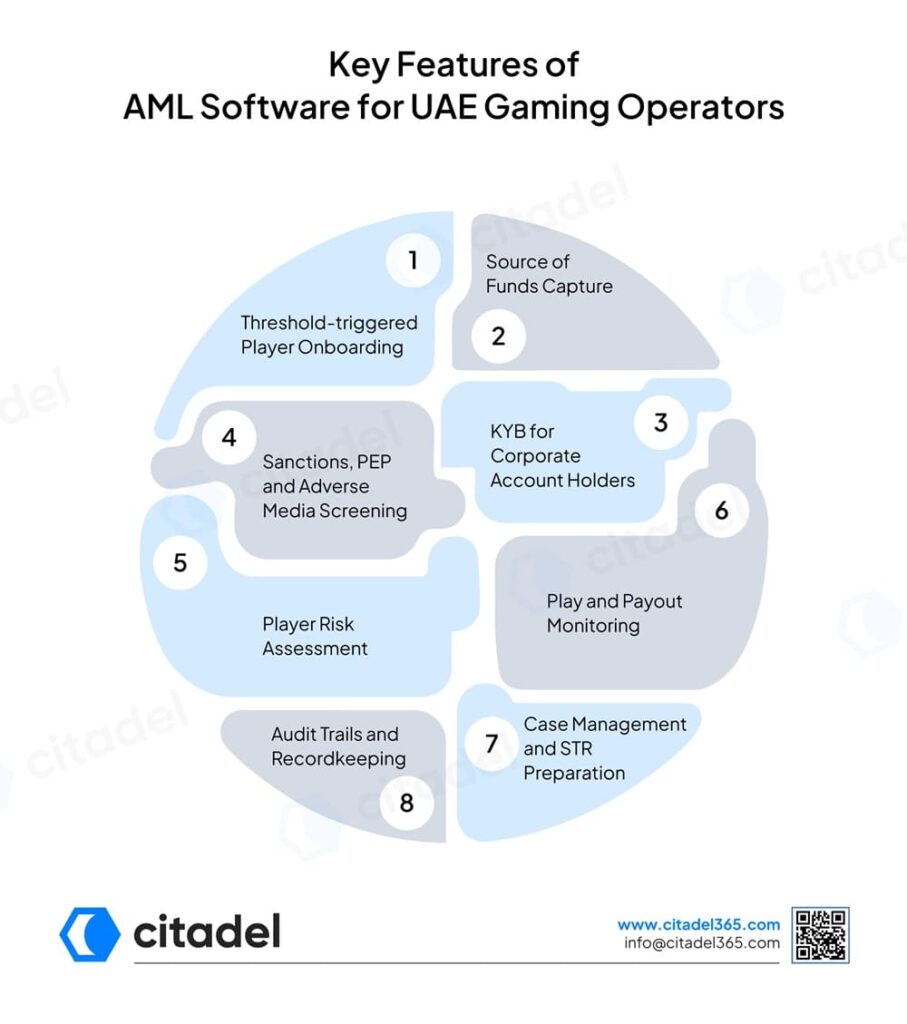
The AML software should automatically conduct customer due diligence for players making cash transactions of AED 11,000 or more in a single transaction or several linked transactions.
AML software for gaming operators should capture the source of funds information and allow the upload of supporting documents. The AML software should allow linking of this information to the specific player account, thereby creating a review workflow.
An AML software should feature case management that provides a workflow for compliance teams to investigate alerts. The platform should allow recording findings, uploading evidence, escalating cases, and preparing suspicious transaction reports (STRs) to submit through goAML.
The AML software that helps maintain records through effective audit trails is effective. AML software should keep records of player information, transaction history, screening results, and investigation records for at least 5 years to meet AML/CFT obligations.
Are you Ready for GCGRA Compliance Inspections?
Manage AML compliance, reduce manual work, and maintain inspection-ready records.
Tailored AML software for different gaming businesses helps adjust to their risk profiles, transaction volumes and meet regulatory obligations.
AML software for Commercial Casino Operators
Commercial casino operators require AML software that helps them verify retail players, track activities of high-roller accounts, monitor play and payout, and detect suspicious activity to prevent illicit financial activities.
AML software for Lottery Operators
For lottery operators, AML software is required to automatically verify the winner’s identity, facilitate EDD for high-value prize claims, monitor misuse of prize money, and help prepare STRs when required.
AML software for Online Gaming Platforms
Online gaming platforms need AML software to automate remote onboarding. The features include identity verification, liveness checks, account-based transaction monitoring and detection of suspicious payout requests or unusual player behaviour.
Citadel365 helps UAE gaming operators efficiently manage AML compliance. It automates customer due diligence for threshold-triggered players, including collecting source of funds information, conducting name screening, assessing player risks and detecting suspicious activity.
With effective audit trails, Citadel365 helps maintain records ready for regulatory inspections. The platform is designed for lottery operators, commercial casino operators, online gaming platforms and gaming compliance teams who need to streamline compliance and meet GCGRA obligations.
Citadel365 helps gaming operators implement AML controls with ease, and its case management enhances investigations by documenting evidence and escalating to the required personnel. The platform supports day-to-day compliance activities while helping gaming operators meet UAE regulatory requirements.
Gaming operators in the UAE must ask the following questions to AML software vendors before selecting an AML software:
Manage Your AML Compliance with Citadel365
We support KYC, screening, risk assessment, and case management on a single platform.
Gaming operators in the UAE require a risk-based system that helps them identify players at the threshold to perform their due diligence. The AML software should help capture the source of funds, screen against sanctions watchlists and PEP databases, and monitor play patterns. Further, gaming operators should choose AML software that eases alert investigations and helps maintain records. Citadel365 allows UAE gaming operators to build and manage their AML compliance programme and helps them meet AML regulatory requirements.
The General Commercial Gaming Regulatory Authority (GCGRA) supervises AML compliance for the gaming operators in the UAE. The authority assesses ML/TF risks, conducts AML/CFT supervision, issues guidance, and imposes administrative penalties on gaming operators.
GCGRA is the only AML/CFT supervisor for gaming operators in the UAE. It was established in September 2023 and is headquartered in Abu Dhabi.
Gaming operators must screen players, their beneficial owners, and other parties involved against the UAE sanctions lists. The operators should screen at the time of onboarding and conduct rescreening whenever there are changes or updates.
UAE gaming operators should carry out customer due diligence (CDD) for transaction values that exceed AED 11,000 when a player makes a single transaction or several connected transactions of this value.

Vasantha holds a Master’s in Law specialising in Banking Laws and Anti-Money Laundering and is CAMS and CGSS certified. With over 35 years of experience, she has worked closely with regulators and international financial institutions, building financial crime risk frameworks, sanctions monitoring programmes, and compliance systems across multiple jurisdictions.