AML Software for DPMS in UAE-Key Takeaways
- AML software helps DPMS businesses in the UAE, including jewellers, jewellery retailers, and bullion traders, manage KYC, screening, risk assessment, transaction monitoring, reporting, and recordkeeping.
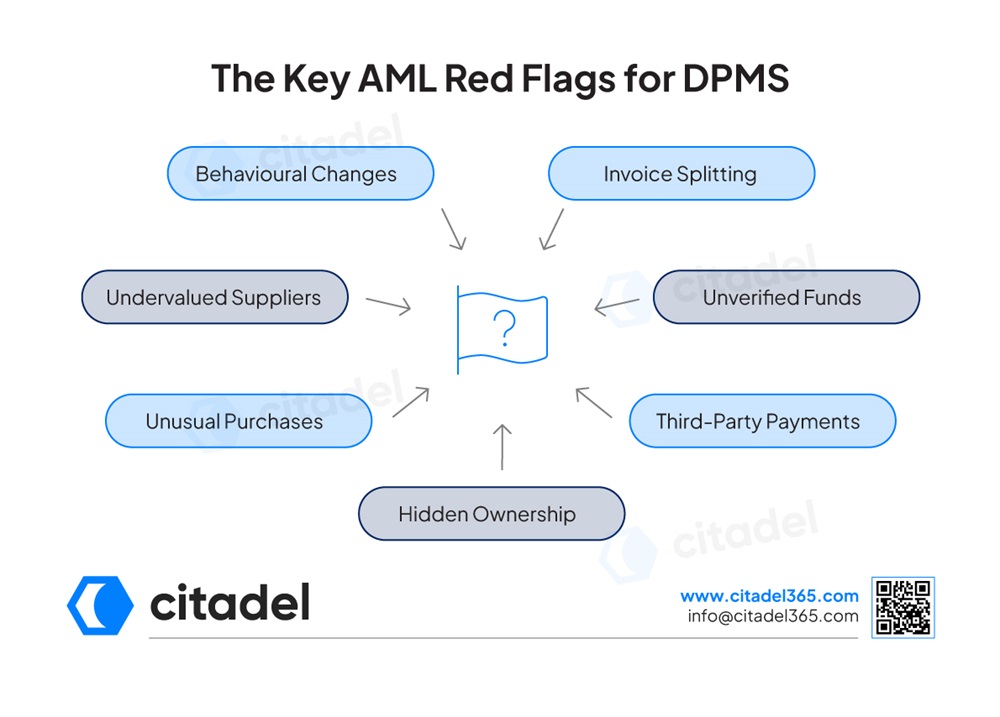
- The key AML red flags include invoice structuring, third-party payments, transactional anomalies, hidden ownership, or unusual behaviours.
- Citadel365 helps UAE DPMS businesses by reducing manual compliance work and maintaining audit-ready records, supporting regulatory investigations.
What Is AML Software for DPMS in the UAE?
AML software for Dealers in Precious Metals and Stones (DPMS) in the UAE is a compliance platform that helps businesses meet anti-money laundering (AML) and counter-terrorist financing (CFT) requirements.
AML software for DPMS in the UAE also helps manage customer due diligence, sanctions screening, risk assessment, transaction monitoring, case management, preparation of suspicious transaction reports, and ensures audit-ready recordkeeping.
Why this matters for UAE DPMS businesses
In the UAE, AML software is essential for DPMS businesses due to the stringent regulatory requirements. These businesses often deal with high-value, easily portable, and
cash-intensive goods, including gold, diamonds, jewellery, bullion, and precious stones.
The Ministry of Economy and Tourism (MoET) guidance for Designated Non-Financial Businesses and Professions (DNFBPs) identifies the DPMS sector as being exposed to money laundering risks, due to key factors including frequent cash use, portability and high value of precious metals and stones,
cross-border payments, use of intermediaries, and complex supply chains that can obscure the origin of assets.
How AML software supports compliance teams
AML software supports compliance teams by automating
customer onboarding, name screening against sanctions lists, monitoring of suspicious transactions, escalating cases, and maintaining detailed audit trails to support regulatory investigations.
Why DPMS Businesses in the UAE Need AML Software
DPMS businesses in the UAE need AML software to comply with AML/CFT requirements and protect themselves from operational risk and reputational damage.
DPMS sector often handles high-value, portable assets such as gold, diamonds, jewellery, bullion, and precious stones. These products are considered high-risk because they can be traded across borders and are often purchased with cash, making them more vulnerable to money laundering and terrorist financing risks while making their origin more difficult to verify.
Manual AML compliance processes, including spreadsheet-based monitoring, paper-based KYC files, single-time screening only at onboarding, missed threshold triggers, and inconsistent staff escalations, create potential compliance gaps.
AML software standardises key compliance activities across every customer and transaction, automating onboarding, screening, risk assessment, case management, reporting, and audit-ready record-keeping, helping DPMS businesses to apply consistent AML controls across all branches.
What Does DPMS Mean Under UAE AML Regulations?
DPMS stands for dealers in precious metals and stones and is classified as a
Designated Non-Financial Business or Profession (DNFBP) and is supervised by the Ministry of Economy and Tourism (MoET) under UAE AML regulations and is subject to specific AML/CFT requirements, including conducting
customer due diligence, transaction monitoring, screening, record-keeping, and suspicious transaction reporting.
The following businesses qualify as DPMS businesses:
- Jewellers and jewellery retailers
Businesses manufacturing or selling gold, silver, platinum, diamond, or gemstone jewellery are considered DPMS entities.
- Bullion traders and gold dealers
Businesses that trade bullion and gold products also fall under the DPMS category.
- Diamond and precious stone dealers
DPMS also include businesses dealing in diamonds, loose diamonds, gemstones, precious and semi-precious stones, and high-value stone trading.
- Jewellery wholesalers, importers, exporters, and refiners
Wholesalers, refiners, importers, and exporters also fall within DPMS businesses, and due to complex supply chains, they are more exposed to
trade-based money laundering (TBML) risks.
How AML Software Helps DPMS Businesses Comply with UAE AML Rules
AML software helps DPMS businesses comply with UAE AML rules by providing essential tools and a compliance framework.
UAE AML Requirement | Sector Challenge | AML Software Feature | Evidence Generated |
Customer Due Diligence | Walk-in and B2B customer verification | Digital KYC workflow | Customer profile, ID documents, approval logs |
Beneficial Ownership | Complex corporate buyers | UBO capture and verification workflow | UBO records and ownership notes |
Sanctions Screening | Screening customers, owners, suppliers, and transactions | Sanctions, PEP, and adverse media screening | Match results, alert notes, review history |
Enhanced Due Diligence | High-risk customers or unusual behaviour | EDD workflow | Source of funds, approvals, documents |
Transaction Monitoring | Split payments, linked transactions, high-value deals | Rule-based monitoring | Alerts and investigation trail |
DPMSR Support | DPMS reporting workflow | Report preparation workflow | Transaction evidence and case file |
SAR/STR Support | Suspicious behaviour review | Case management | Investigation notes and escalation records |
Recordkeeping | Inspection readiness | Centralised audit trail | Timestamped activity logs |
DPMS AML Red Flags AML Software Can Help Detect
- A customer breaking the jewellery purchases into multiple smaller invoices, which may indicate structuring to avoid reporting thresholds.
- A buyer paying in cash but unable to justify the source of funds, indicating obscuring the illicit funds.
- Third-party payments for the purchase of gold, diamonds, gemstones, or jewellery without a clear legitimate reason.
- Corporate clients with unclear or concealed beneficial ownership structures make it difficult to identify the true ownership and control of the business.
- Frequent purchases of bullion or loose stones that are inconsistent with the customer’s known business profile or expected activity.
- Supplier offering precious metals at significantly below-market value or without clear documentation.
- Sudden changes in a customer’s purchase value, product type, payment method, or transaction frequency that are different from their normal behaviour indicate a potential red flag.
Essential Features of AML Software for DPMS in UAE
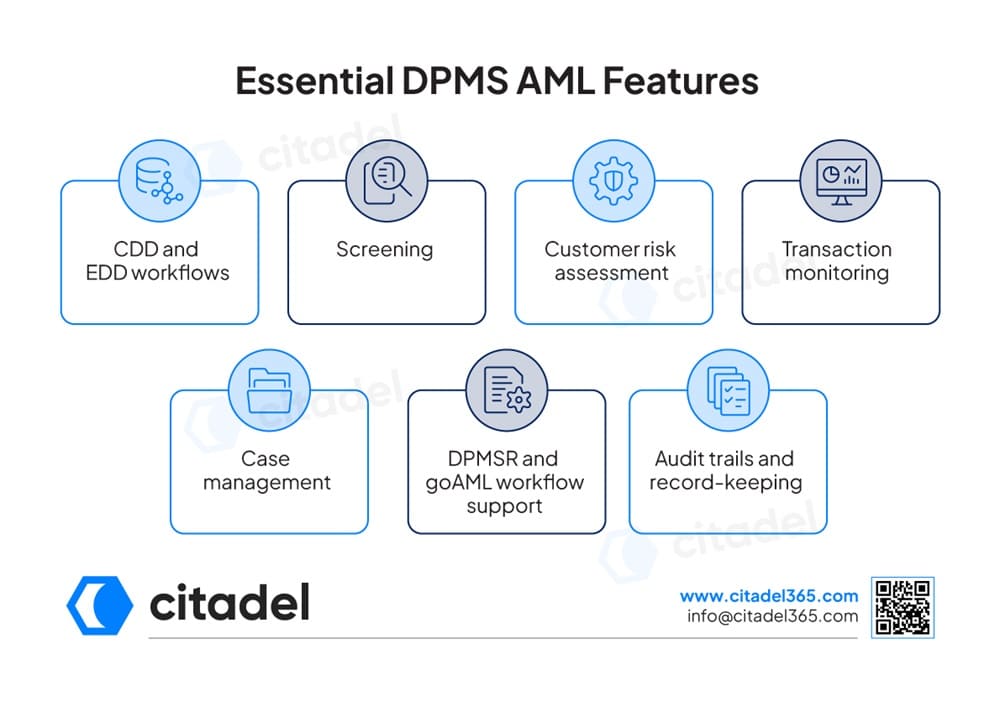
The key features of AML software for DPMS in the UAE include:
- Digital KYC and customer onboarding
These are essential features of AML software for DPMS in the UAE that ease onboarding, enable businesses to verify customer identities, and help in risk classification.
These features automate CDD and EDD workflows, including customer verification,
source-of-funds checks, source-of-wealth checks, senior management approvals, and periodic reviews.
AML software also helps screen counterparties against
sanctions, PEP, and adverse media lists at onboarding and continuously.
It also helps assess customer risk based on various factors, including customer type, country, product, payment method, ownership structure, and transaction patterns.
- Transaction monitoring for DPMS
AML software helps in monitoring qualifying AED 55,000 cash transactions, linked-transaction detection, split-invoice alerts, third-party payment alerts, high-risk product monitoring, and
supplier and cross-border transaction risk monitoring.
AML software features include an integrated case management module that covers investigation notes, escalations, approvals, evidence uploads, closure reasons, and reviewer accountability, all on a single platform.
- DPMSR and goAML workflow support
The Ministry of Economy and Tourism requires DPMS businesses to submit Dealer in Precious Metals and Stones Reports (DPMSRs) through goAML, where applicable. DPMSR reporting software supports structured data capture, report preparation, and goAML submission workflows.
- Audit trails and record-keeping
AML software should maintain audit trails, including timestamped decisions, user activity logs, supporting documents, and regulatory-ready records for at least 5 years after the business relationship ends.
Manual AML Compliance vs AML Software for DPMS
Manual compliance processes are often slow, inconsistent, and error-prone, making it difficult for DPMS businesses to keep pace with evolving regulatory requirements. AML software at the same time automates key compliance processes, improves accuracy, strengthens risk detection, and helps maintain a regulatory-ready
audit trail.
The table below showcases the key differences between manual AML compliance and AML software for DPMS:
Compliance Area | Manual Process Risk | AML Software Advantage |
KYC | Missing or incomplete customer files | Standardised digital onboarding |
Screening | One-time or inconsistent checks | Ongoing sanctions, PEP, and adverse media monitoring |
Risk Assessment | Subjective scoring | Configurable risk models |
Transaction Monitoring | Missed linked transactions | Automated alerts and rule-based detection |
Case Management | Scattered emails and notes | Centralised investigation workflow |
Reporting | Manual evidence preparation | Structured case and report support |
Audit Readiness | Hard-to-retrieve documents | Timestamped audit trail |
How to Choose the Right AML Solution for DPMS in the UAE
Choose the right DPMS compliance software that aligns with your business, compliance obligations, and future growth. The key factors include:
The software should support UAE DNFBP requirements, including CDD, EDD, screening, transaction monitoring, report preparation, and record-keeping.
The software should be able to monitor and detect AED 55,000 threshold breaches, linked transactions, split invoices, high-value goods, third-party payments, and supplier risks.
The software should also be easy to use for compliance officers, sales teams, branch teams, and management, and not only for technically trained staff.
The software should support scalability and help businesses ranging from single-store jewellers to multi-branch retailers, refiners, and bullion traders.
It should also provide role-based access, audit trails, user activity logs, and secure document management.
DPMS AML Software Buyer Checklist
Must-have checklist while evaluating AML software for your DPMS business:
- Digital KYC and customer onboarding simplify customer identification, verification, and profile creation.
- Automates customer due diligence and enhance due diligence workflows
- Screening of the customer against sanctions, PEP, and adverse media to identify high-risk individuals and entities.
- Continuously monitoring or periodically rescreening of customers to detect changes in risk profiles.
- Customer risk assessment based on customer, geographic, and transactional risk factors.
- Monitors transactions to detect unusual, high-value, or suspicious transactions.
- Identifies linked transactions that may be structured to avoid reporting thresholds.
- Simplifies the preparation and management of DPMS reports.
- Maintains a complete, timestamped record of all compliance actions and decisions.
- Restricts system access based on user roles and responsibilities.
Questions to ask an AML software vendor
- Can the software detect qualifying AED 55,000 threshold cash transactions?
- Does the software identify linked transactions and split invoices?
- Does it support UAE DPMS-specific AML workflows?
- Is the software able to screen customers, UBOs, suppliers, and transactions against sanctions, PEP, and adverse media lists?
- Does it maintain audit-ready records and complete activity logs?
- Can the software support both walk-in retail operations and B2B bullion trading?
- How does it minimise false positives while ensuring effective risk detection?
Citadel365 AML Software for DPMS in UAE
Citadel365 helps DPMS businesses in the UAE by automating customer onboarding, making it easier to collect, verify, and manage customer information.
It also enables
screening of counterparties against sanctions, PEPs, and adverse media lists to identify potential money-laundering and terrorist-financing risks.
Citadel365
customer risk assessments help assign risk scores based on customer profiles, geographic locations, and transactional activity.
Citadel365 also helps with
case management by organising compliance investigations, transaction monitoring to detect suspicious activity, activity logging by maintaining a complete audit trail, and audit-ready compliance workflows to support regulatory investigations.
Citadel365 helps jewellers, jewellery retailers, bullion traders, precious stone dealers, gold traders, diamond dealers, wholesalers, refiners, and DNFBPs in the UAE.
Citadel365 helps DPMS businesses by making AML compliance easy through workflow automation, reduced manual errors, centralised records, faster review, configurable risk controls, and inspection readiness.
Conclusion: Make DPMS AML Compliance Easier, Faster, and Audit-Ready
AML compliance for DPMS businesses in the UAE is more than just meeting thresholds. Jewellers, jewellery retailers, bullion traders, and precious stone dealers in the UAE require a risk-based approach to identify potentially risky customers, conduct screening, monitor transactions, and maintain audit trails to support MoET inspections.
FAQs - AML Software for DPMS in UAE