
Ready to Defeat Your AML Compliance Obstacles?
Citadel365 Brings Revolution with Secure Solutions to AML Compliance Problems
Sanctions Screening Software is an important part of AML measures. It helps Regulated Entities in Dubai, Abu Dhabi, Sharjah, and other cities in the UAE to comply with AML/CFT regulations, including Targeted Financial Sanctions (TFS) obligations. It enables organisations to automate checking of customer databases against various global and local sanctions lists like the UAE local terrorist list, the UN consolidated list, the European Union list, the UK HM Treasury list, and other global lists.
Sanctions Screening Software helps in the identification of designated terrorists, terrorist organisations, as well as entities having terrorist links. This safeguards the Regulated Entities from entering into prohibited transactions, detecting potential risks, and strengthening AML/CFT compliance.
The UAE has strengthened its AML/CFT laws to combat money laundering, terrorist financing, and other financial crimes. Sanctions screening software is an essential tool for Regulated Entities to protect themselves against financial crimes, helping them to identify sanctioned individuals, suspicious entities and high-risk counterparties. It prevents them from participating in illegal transactions or working with persons or institutions associated with financial crime, terrorism, or any other illegal activities.
The software reduces the financial, regulatory and reputational risks of exposure for regulated entities by enabling AML/CFT compliance and international standards. Sanctions are frequently updated, and as such, organisations must constantly monitor customers, vendors, and transactions to identify emerging risks. Sanctions screening tools enable real-time and continuous screening.
Here are some of the key features of a robust modern Sanctions Screening Software:
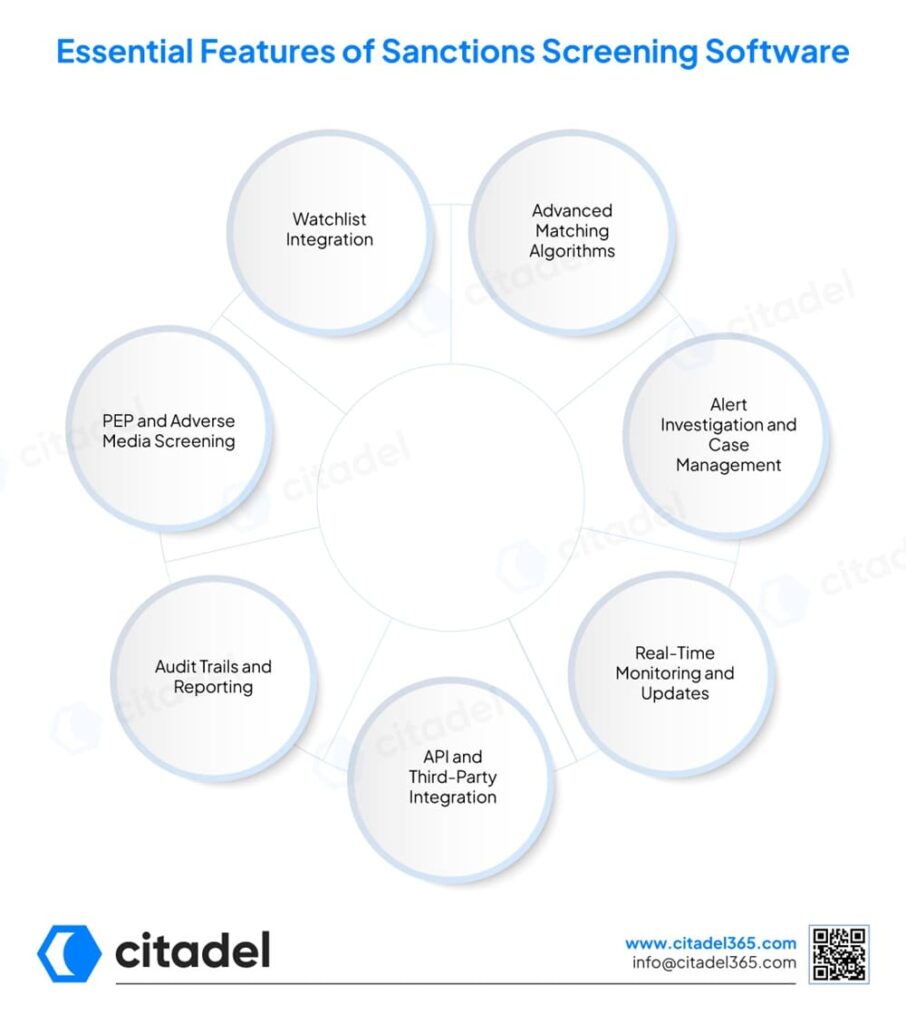
The software integrates multiple global and local sanctions lists, including UN, OFAC, EU, UK HMT, UAE local terrorist, and other regulatory watchlists, into its database and performs automated screening. This helps in the effective identification of sanctioned individuals and entities.
Sanction screening software uses advanced fuzzy matching algorithms to identify potential matches even when the data contains typos, phonetic variations, abbreviations, aliases, and transliteration differences. It can identify matches across different languages, like Arabic, and different naming formats. This reduces the risk of missing potential matches and ensures screening accuracy.
Sanction screening software generates automated alerts for potential matches and routes high-risk or flagged applications to the compliance teams to investigate further. It has an inbuilt workflow management system that enables compliance teams to escalate or close cases.
The system continuously screens customers, vendors, beneficial owners, and transactions against updated sanctions lists during the life of the customer. It automatically identifies and alerts on sanction updates and matches in real-time. The software also enables batch screening to periodically scan against updated watchlists.
The software uses APIs to seamlessly integrate onboarding systems, banking platforms, and transaction monitoring systems. This feature improves operational efficiency and supports data sharing across systems and teams.
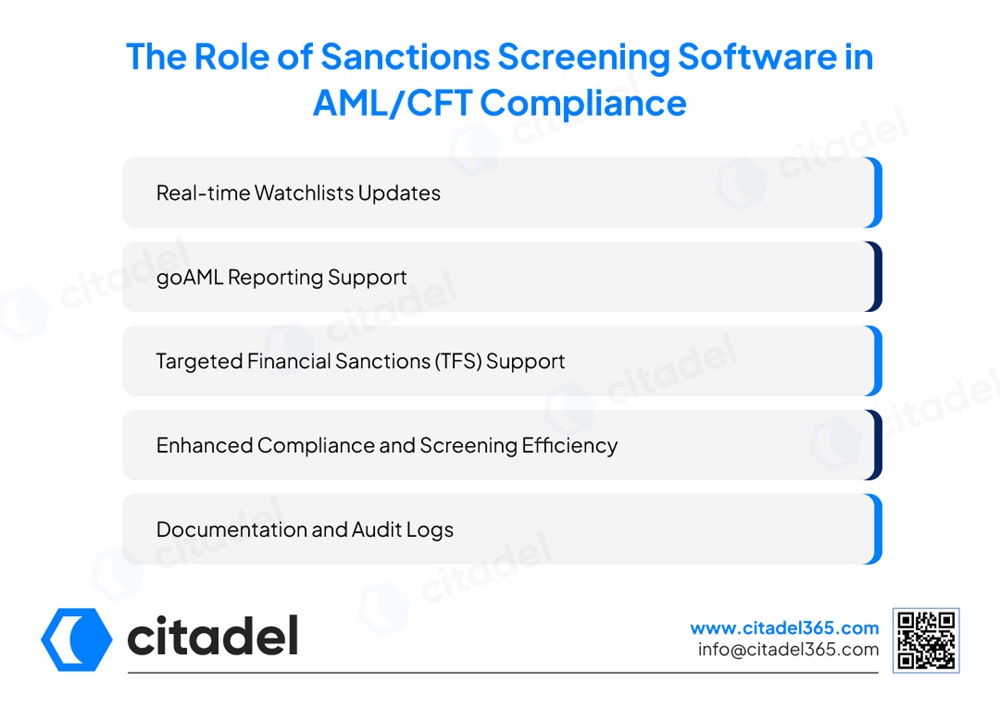
Real-time Watchlists Updates
The sanctions screening software automatically updates its sanctions lists, watchlists databases on a real-time basis by continuously monitoring global watchlists and local lists like the UAE Local Terrorist List, UN Consolidated List, OFAC lists, and EU sanctions lists without relying on manual updates. This helps organisations to stay aligned with UAE regulatory requirements and international sanctions obligations.
goAML Reporting Support
The sanction screening software helps compliance teams generate reports which help in filing Confirmed Name Match Reports (CNMR) and Partial Name Match Reports (PNMR). It helps organisations to maintain organised screening reports required to be submitted through the UAE goAML portal and other regulatory reporting systems.
Targeted Financial Sanctions (TFS) Support
Sanction screening software automatically screens to identify accounts, assets, or transactions linked to sanctioned parties. It implements the required freezing measures or restrictions as per the UAE Targeted Financial Sanctions (TFS) obligations.
Enhanced Compliance and Screening Efficiency
Documentation and Audit Logs
Sanction screening software maintains detailed audit trails of all screening activities, investigations, escalations, and compliance decisions. These records and audit trails help demonstrate compliance during regulatory inspections.
In the UAE, sanctions screening software is used across various regulated industries, such as:
Industry | Why do they use Sanctions Screening |
Banking and Financial Institutions | Financial institutions process huge amounts of financial data on a daily basis. Sanctions screening software is used to automatically identify sanctioned individuals, high-risk entities and suspicious transactions prior to payment processing or opening of an account. |
DNFBPs | Designated Non-Financial Businesses and Professions (DNFBPs) such as accounting firms, auditors, company formation agents, etc., are required to comply with TFS regulations and use sanctions screening software to comply with regulatory requirements and to identify high-risk customers. |
Insurance Companies | Sanctions screening software is used by insurance providers when onboarding policyholders, beneficiaries, and corporate clients, to prevent issuing policies or processing claims for high-risk sanctioned individuals or entities. |
Virtual Asset Service Providers (VASPs) | Cryptocurrency exchanges and other virtual asset service providers (VASPs) employ sanctions screening software to identify high-risk sanctioned individuals, wallet holders, investors, and transactions that could be involved in money laundering or other financial crimes. |
Real Estate Businesses | Real estate agents especially in the UAE very often deal with high value transactions which sometimes involves foreign investors as well. They use sanction screening software to detect buyers, sellers, tenants and beneficial owners who might be involved in money laundering, terrorist financing. |
Precious Metals and Jewellery Dealers | High-value cross-border transactions are very common for the gold, diamond, and jewellery businesses. Sanctions screening software is used to identify risky customers and meet AML/CFT regulations. |
Legal and Corporate Service Providers | Law firms and corporate service providers use sanctions screening software to screen clients, beneficial owners, and counterparties prior to providing company formation, advisory, or transaction-related services. |
Shipping and Logistics Companies | The UAE, as a global trade hub, is a strategic location for shipping and logistics companies that use sanctions screening software to validate vessels, cargo owners, suppliers, and trade counterparties to detect sanctioned entities and restricted trade activities. |
Corporate and Trading Businesses | Sanctions screening software is used by trading companies and multinational businesses to evaluate suppliers, distributors, customers, and international business partners prior to entering into commercial relationships or engaging in cross-border transactions. |
The UAE has strong AML/CFT regulations in place, but many regulated entities face practical challenges while conducting sanctions screening. Some of the common challenges are:
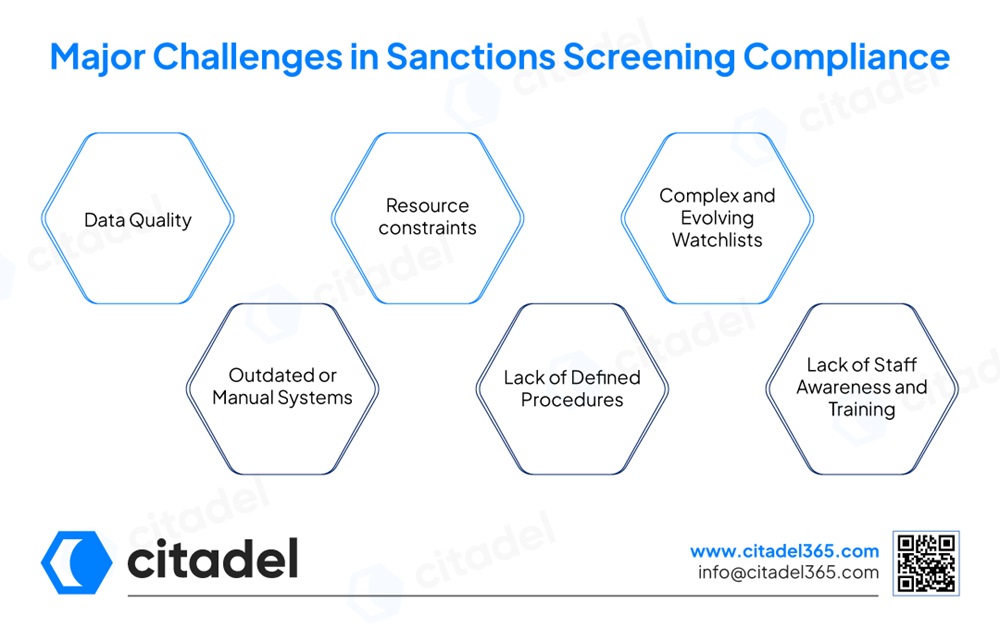
Data Quality
Incomplete, inaccurate, or inconsistent customer data affects the accuracy of sanctions screening. Misspelt names, missing identification information, and different data formats often increase false positives and miss genuine risk.
Complex and Evolving Watchlists
Both local and global sanctions lists are regularly updated. Organisations find it difficult to continuously monitor in real time and keep the screening databases up to date with the latest updates.
Resource constraints
Skilled compliance teams, appropriate internal controls and advanced screening technology are essential for an effective sanctions compliance framework. Many organisations struggle to manage growing compliance burdens due to limited resources.
Lack of Defined Procedures
Without clear escalation procedures and compliance workflows, organisations might not be able to conduct timely reviews, investigations, or report to authorities. This increases the risk of non-compliance with TFS and AML/CFT obligations.
Outdated or Manual Systems
Manual screening processes and legacy systems are slow, unscalable, and error-prone. It can lead to increased operational burden and delay the identification and investigation of potential sanctions matches. Ongoing monitoring can also become operationally challenging with manual systems.
Lack of Staff Awareness and Training
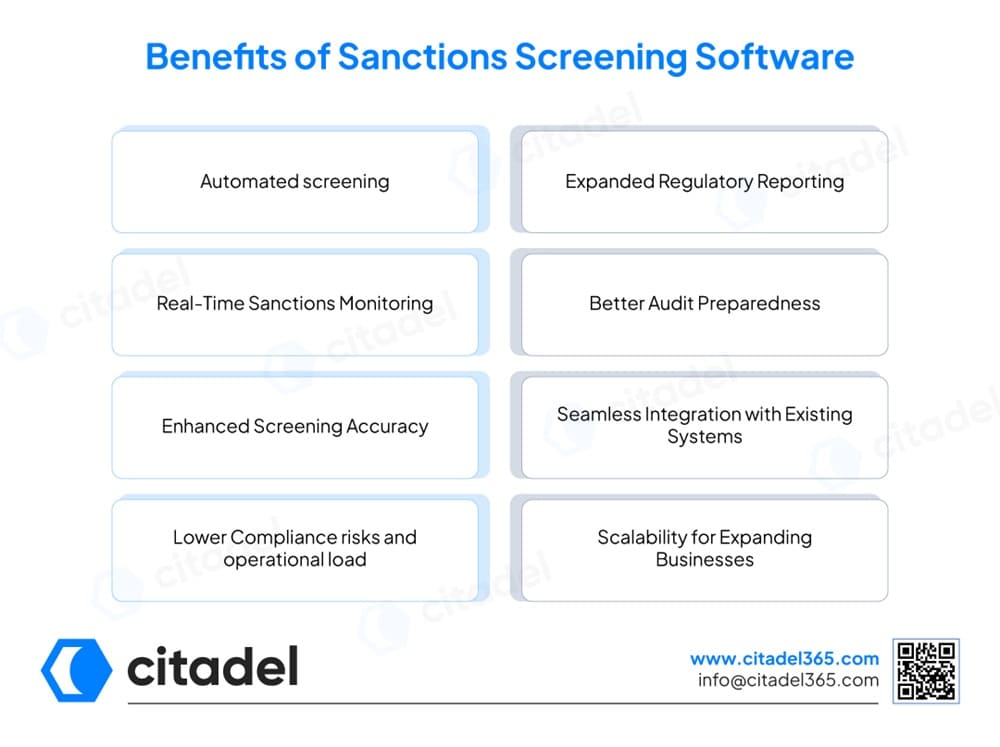
Automated screening
The software automates screening of customers, vendors, transactions and beneficial owners against local and global sanctions lists and watchlists, providing significant reductions in manual effort and speeding up compliance processes.
Real-Time Sanctions Monitoring
Sanctions screening software automatically updates sanctions databases in real time and monitors customer profiles continuously, allowing organisations to quickly identify newly sanctioned individuals or entities.
Enhanced Screening Accuracy
Lower Compliance risks and operational Burden
Sanctions screening software reduces exposure to financial crime risks, regulatory breaches and prohibited transactions by identifying sanctioned and high-risk parties through continuous and automated screening. Automation and streamlined workflows allow compliance teams to manage high screening volumes more efficiently.
Expanded Regulatory Reporting
The sanction screening software enables the generation of compliance reports such as Confirmed Name Match Reports (CNMR) and Partial Name Match Reports (PNMR), helping organisations meet the UAE’s TFS and other reporting obligations more effectively. It also supports the timely implementation of freezing measures as part of regulatory requirements.
Better Audit Preparedness
The system maintains detailed audit logs, screening records, investigation details, decision-making process, and regulatory reporting supporting inspections and internal audits. It helps in demonstrating compliance during regulatory reviews and audits.
Seamless Integration with Existing Systems
Modern sanctions screening software can be seamlessly integrated into the existing onboarding systems, transaction monitoring systems, CRM tools and internal compliance systems. This helps organisations centralise compliance operations more efficiently.
Scalability for Expanding Businesses
The sanction screening software helps organisations to manage growing compliance requirements as they expand across regions, customer bases and transaction volumes without significantly increasing the manual workload.
There’s more to choosing the right sanctions screening software than just checking names against watchlists. The software should enable accurate screening, ongoing monitoring, regulatory reporting, and scalable compliance operations for DNFBPs, VASPs, financial institutions, and other Regulated Entities in the UAE.
Here are some important things organisations should think through before selecting a sanctions screening solution:
Factor | Why is it important |
AML/CFT Regulatory Compliance | The sanction screening software must support UAE AML/CFT requirements, Targeted Financial Sanctions (TFS) and international sanctions compliance obligations. It should also support ongoing screening and real-time list updates as required by UAE regulations. |
Ease of Use and Operational Efficiency | Compliance teams should be able to use the system easily without excessive manual effort. User-friendly dashboards, automated workflows, and intuitive reporting features can improve productivity, reduce operational burden, and enhance compliance management. |
Integrated Sanctions and Watchlists | Organisations should ensure that the software screens against all the major global and local sanctions lists, including UN lists, OFAC lists, EU sanctions lists, UK HMT lists, UAE Local Terrorist Lists, PEP databases and adverse media sources. This increases accuracy and reduces exposure to financial risks. |
Exact Match and Fuzzy Matching Configuration | A good sanctions screening solution should support configurable fuzzy matching and exact match settings. This helps to identify true matches while reducing unnecessary false positives and increasing screening accuracy. |
Arabic and Multilingual Name Matching | Names in the UAE may be spelt and transliterated differently. The sanction screening software should provide Arabic name screening and multilingual matching capabilities to improve detection accuracy. |
Ongoing Monitoring Capabilities | Screening shouldn’t just be for onboarding. The software should allow for continuous monitoring and automated re-screening when the list of sanctions or customer risk profiles is updated. |
Batch Screening Functionality | Organisations handling large customer or vendor databases should select software that can automate batch screening to speed up and improve the efficiency and accuracy of periodic screening. |
Scalability and Performance | As the business grows, the sanction screening software should be able to scale to accommodate larger volumes of customers, transactions, and screening requirements without affecting speed or operational efficiency. |
Alert Generation and Case Management | The sanction screening software should help compliance teams manage alerts, investigations, escalations and approvals in an efficient manner with the use of centralised workflows and case management tools. |
goAML Reporting Compatibility | Organisations should consider software that can generate reports such as STRs, PNMRs, and CNMRs in formats compatible with the UAE FIU’s goAML reporting requirements. |
Integration with Existing Systems | The software should integrate seamlessly with onboarding systems, transaction monitoring systems, CRM platforms, and internal compliance systems to improve operational efficiencies and data flow. |
Audit Trails and Record Keeping | A reliable sanctions screening software must maintain detailed audit logs, investigation records, screening history, decision-making process and compliance documentation to support audits and regulatory inspections. |
| Basis | Sanctions Screening Software | AML Software |
| Primary Purpose | Screening of customers, entities, beneficial owners and transactions against sanctions lists, watchlists, to identify sanctioned or restricted parties. | Oversees all AML/CFT compliance activities, including customer due diligence, EDD, transaction monitoring, customer risk assessment, alert generation, investigations and regulatory reporting. |
| Focus Area | Helps ensure compliance with sanctions and TFS obligations and prevents organisations from dealing with sanctioned individuals, entities or prohibited counterparties. | Detects suspicious behaviour, unusual transaction patterns, money laundering, terrorist financing risks and other financial crime activities. |
| Monitoring and Alerts | Provides alerts for sanctions matches, watchlist hits and high-risk counterparties through ongoing customer monitoring | Generates alerts for suspicious transactions, unusual customer behaviour, high-risk activities, and AML-related risks through ongoing transaction and customer monitoring |
| Reporting and Compliance Support | Supports sanctions related reporting, including Confirmed Name Match Reports (CNMR), Partial Name Match Reports (PNMR), and other sanctions compliance | Supports Suspicious Transaction Reports (STRs), AML investigations, regulatory reporting, customer due diligence documentation, and broader AML/CFT compliance obligations |
| Use in Compliance Operations | Used primarily during onboarding, vendor screening, transaction screening and ongoing sanctions monitoring to identify sanctioned parties. | Used throughout the entire AML compliance lifecycle, from onboarding to customer risk assessment, transaction monitoring, investigations, enhanced due diligence, and ongoing AML compliance management. |
| Relationship Between Both | Often acts as a standalone compliance solution or as a component of a wider AML system. | AML software may include sanctions screening as one of its integrated compliance modules. |
Just as strong compliance frameworks build resilient institutions, effective sanctions screening software strengthens AML/CFT operations for Regulated Entities operating within the fast-evolving regulatory environment of the UAE. In a landscape where financial transparency, regulatory accountability and risk management are key, sanctions screening solutions need to go beyond simple list matching and facilitate intelligent, accurate and ongoing compliance operations.
Citadel365 helps organisations streamline sanctions compliance with automated screening, continuous monitoring and risk-based compliance workflows to help with meeting UAE AML/CFT obligations. The platform allows businesses to screen customers, beneficial owners, vendors and transactions against global sanctions lists, UAE local terrorist lists, PEP databases and adverse media sources in real-time.
Citadel365 is designed for modern compliance operations and offers advanced fuzzy matching and Arabic transliteration capabilities for the identification of potential matches across different spellings, aliases, and multilingual naming structures. This enables Regulated Entities to reduce false positives while increasing screening accuracy and operational efficiency.
It provides continuous sanctions monitoring, automated alerts, case management workflows and detailed audit trails, all in line with what the UAE regulators expect for compliance. It also helps organisations maintain regulatory records and generate reports such as Confirmed Name Match Reports and Partial Name Match Reports (PNMR), helping compliance teams meet sanctions obligations with increased speed, clarity and confidence.
Citadel365’s single platform centralises screening, monitoring, investigations and reporting processes, helping organisations to improve internal controls, increase visibility across compliance operations and manage the growing sanctions compliance burden efficiently.
UAE-based banks, financial institutions, exchange houses, insurance companies, DNFBPs, real estate companies, FinTech firms, Virtual Asset Service Providers (VASPs), corporate service providers and other Regulated Entities use sanctions screening software. It helps the organisations to meet AML/CFT and Targeted Financial Sanctions (TFS) requirements.
Sanctions screening involves screening customer data against global and local sanctions lists like the UAE local terrorist list, the United Nations (UN) consolidated list, OFAC sanctions lists, the European Union (EU) sanctions list, and the UK HMT list.
Fuzzy matching is a screening technique that helps find potential matches even when names are misspelt, transliterated differently, abbreviated, or entered in different formats. This enhances screening accuracy and mitigates the risk of missing real sanctions matches.
Yes, many advanced sanctions screening solutions include Arabic name-matching and transliteration features. This means organisations in the UAE can match up different Arabic and English spellings of names.
Ongoing or continuous sanctions screening is the process of continuous monitoring of customers, vendors, beneficial owners and transactions against updated sanctions lists and watchlists throughout the business relationship, not just at onboarding.
Sanctions screening software helps organisations to comply with AML/CFT regulations by identifying sanctioned individuals, entities and high-risk counterparties, automating screening and monitoring activities, reducing compliance risks, maintaining audit trails and supporting regulatory reporting obligations.
Sanction screening software is primarily used to screen customers and transactions against sanctions lists and watchlists to identify sanctioned or high-risk parties. AML software, however, supports a wider range of AML/CFT compliance activities, including transaction monitoring, customer risk assessment, suspicious activity detection, investigations, and regulatory reporting.
A false positive in sanctions screening is when the software incorrectly identifies a customer or transaction as a potential sanctions match due to similar names, incomplete data, spelling variations, or transliteration variations, even though there is no actual risk.
Organisations can reduce false positives in sanctions screening by using advanced screening solutions such as Citadel365 that support intelligent fuzzy matching, Arabic and multilingual name matching, configurable screening thresholds, and better data standardisation.

Arjun is the Co-founder and CEO of Citadel365, where he leads the company’s vision across technology, business, and regulations. He brings over a decade of experience in building and scaling technology ventures. Arjun holds a B.Tech. in Information Technology and a Master’s in Management, supported by his certification as a Financial Crime Specialist, an uncommon combination that allows him to balance innovation with regulatory requirements.
Having advised leading banks and financial institutions on digital solutions and compliance technology, Citadel365 continues to grow with an ambition.