
Ready to Defeat Your AML Compliance Obstacles?
Citadel Brings Revolution with Secure Solutions to AML Compliance Problems
Summary
AML software is the technology designed to help organisations stay compliant with anti-money laundering laws and regulations. These software solutions automate and assist in processes like
and many more complex functions.
A modern AML software typically combines multiple compliance functions into a single system to cater to all the compliance needs of an organisation.
In today’s time, it is essential for Regulated entities to have an AML software in UAE that is capable of identifying unusual patterns, supporting regulatory reporting obligations, and has risk analytics and configurable monitoring capabilities. Such dynamic and efficient AML software can help achieve operational efficiency along with robust compliance with regulatory requirements.
See What AML Compliance Costs Before You Commit
Four credit-based plans cover KYC onboarding, sanctions and PEP screening, risk scoring and case management, with no per-seat costs.
The UAE is an important global financial hub and aims to strengthen its AML/CFT frameworks to build trust, meet international compliance standards and combat financial crimes. Manual and outdated processes are just no longer enough to meet these goals as they can expose REs to AML/CFT risks, compliance gaps, and enforcement actions. Regulatory authorities expect businesses to implement effective risk-based compliance controls that are capable of processing complex transactions, meeting compliance requirements, and timely reporting.
UAE is also tightening its controls over Designated Non-Financial Businesses and Professions (DNFBPs) that include high-risk sectors like Real estate firms, precious metals and stones dealers, corporate service providers, accounting and auditing firms, along with virtual assets like crypto. Regulating these sectors requires implementing a structured AML compliance framework to identify, manage and mitigate risks effectively.
AML Software works by collecting and analysing large volumes of customer data using APIs, automatically screening them against global watchlists, and continuously monitoring customers and transactions against several risk factors. The system assigns risk scores based on factors like jurisdiction, customer type, unusual behaviour, ownership structures, and screening results. Alerts are generated for suspicious activities, and the compliance teams review and investigate further to confirm. AML software also maintains audit logs and properly documents alerts, compliance reports and supports both internal and regulatory governance.
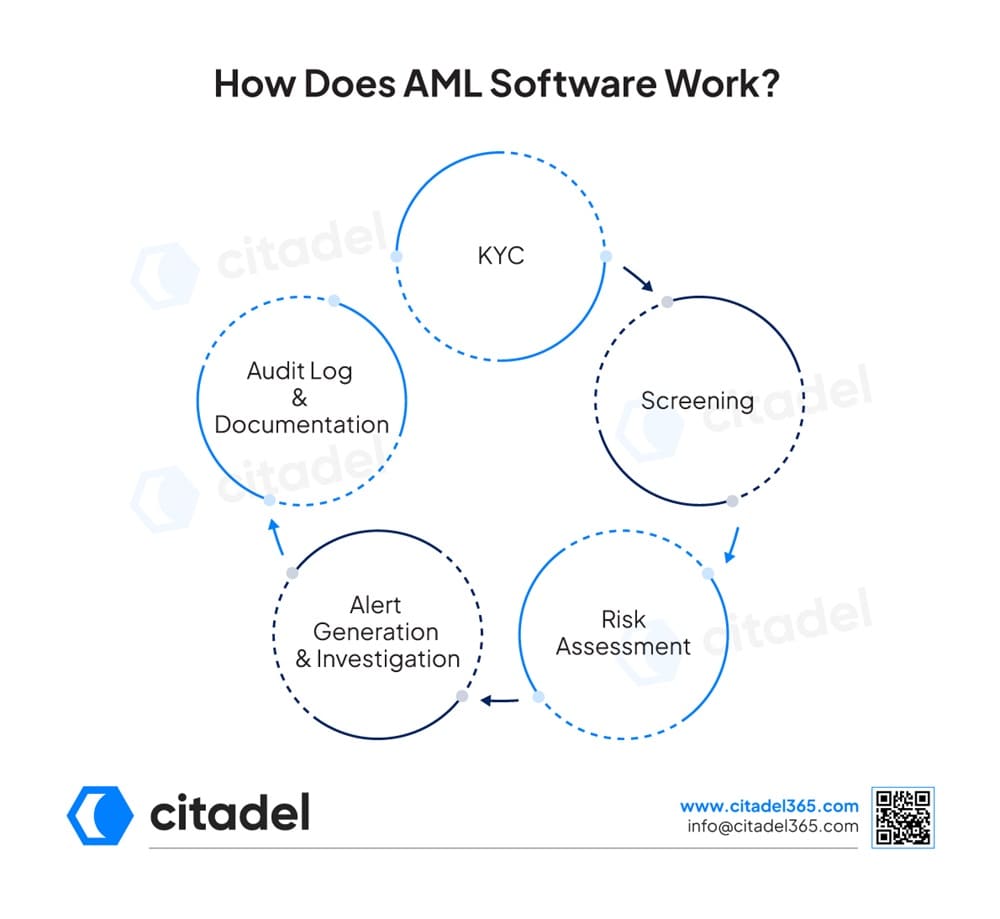
The AML Software collects customer information, transaction data, identification records, and business details from internal systems, APIs, and external sources.
Customer names and entities are then automatically screened against sanctions lists, PEP databases, and adverse media sources using advanced matching algorithms.
After screening, the anti-money laundering software assigns risk scores to customers based on various factors like screening results, transaction behaviour, ownership structures, geography, etc.
Automatic alerts are generated for potential matches or suspicious activities, which help compliance teams review and investigate them further.
AML software maintains detailed audit logs, investigation & decision records, along with regulatory reports to support regulatory obligations and internal governance.
A robust AML Software in UAE supports a wide range of compliance functions like-
AML Software in UAE helps with customer onboarding and KYC by collecting and verifying customer data like government IDs, business details, transaction data and supporting documents. It also helps organisations conduct CDD and EDD processes to assess customer legitimacy and identify potential risks during onboarding.
Name screening software in the UAE screens customer data, including details of beneficial owners, vendors, and counterparties, against the local UAE terrorist list, global sanctions lists, Politically Exposed Persons (PEP) databases, and global watchlists to identify prohibited entities and high-risk individuals.
AML software constantly monitors international and local negative news and adverse media sources to identify links between customers and fraud or criminal activities that could lead to potential reputational risk.
Transactions and activities are continuously monitored to identify any suspicious patterns, unusual behaviour, or potentially high-risk transactions. Upon detection, alerts are automatically generated and are further reviewed and investigated by compliance teams.
Customer profiles, risk scores, updates to sanction/PEP lists, etc., are constantly monitored by the AML software in UAE to ensure compliance in an ever-evolving regulatory environment. This also helps in identifying risks throughout the customer relationship lifecycle.
Citadel365’s customer risk assessment software conducts Customer Risk Assessment by assigning risk scores to customers based on factors such as geography, business activity, transaction behaviour, ownership structures, and screening results.
Citadel365’s case management software helps compliance teams assign responsibilities, investigate alerts, escalate alerts and maintain proper documentation through a centralised and comprehensive workflow system.
AML software maintains detailed logs for all the compliance activities conducted, including escalation and the decision-making process. It also generates compliance reports that are usually required for internal governance and regulatory inspections.
AML Software also securely maintains customer records, due diligence documents, investigation files, compliance reports, etc., along with supporting evidence to demonstrate compliance and support record keeping obligations.
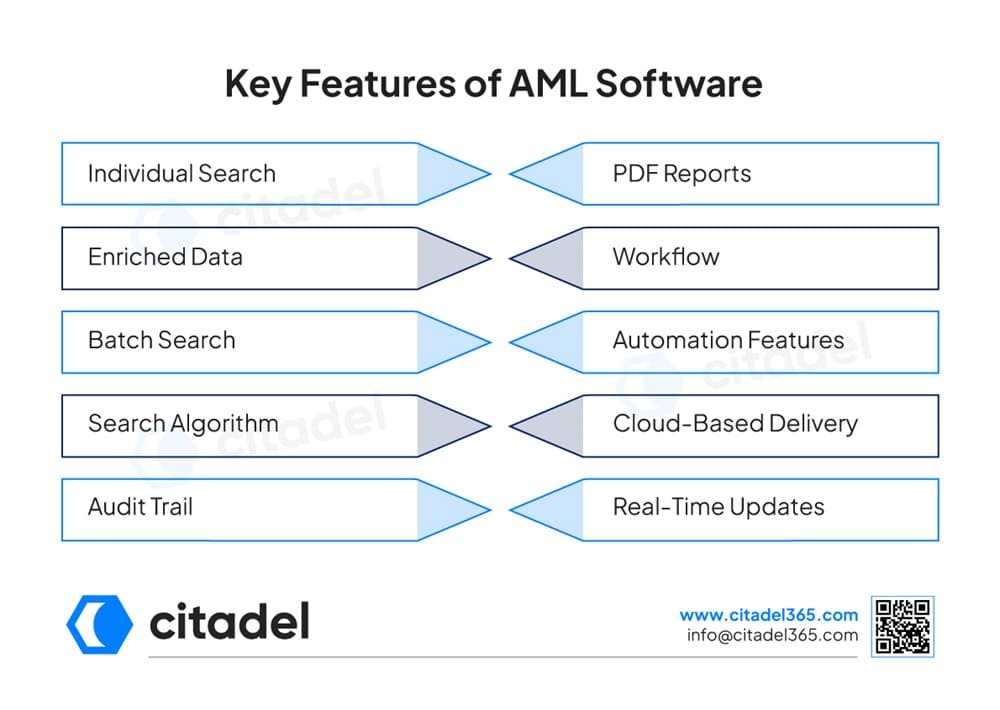
Individual Search
This feature enables compliance teams to screen a single person or entity against global sanctions, PEP, watchlists, and adverse media databases in real time.
Enriched Data
Enriched data, such as complex ownership structures, related parties, source of funds, etc., is collected by AML software, which helps in making more informed decisions by providing additional intelligence and deeper insights for more accurate risk assessment.
Batch Search
Batch search allows screening of large volumes of customer data simultaneously, which is very useful for conducting ongoing monitoring, periodic re-screening, screening of legacy data and large-scale review.
Search Algorithm
Advanced and sophisticated search algorithms of an AML software improve accuracy and reduce false positives by identifying name and data variations, including spelling differences, aliases, transliteration changes, abbreviations, etc.
Audit Trail
This functionality keeps a record for every action performed within the system, like user activity, screening history, alert logs and handling, decisions made, reports generated, etc. This helps organisations demonstrate accountability, regulatory compliance, and internal governance.
PDF Reports
AML software allows automated PDF reporting capabilities, which help teams to generate various documents like screening reports, due diligence records, evidence files, etc., and enable regulatory filings and record keeping.
Workflow
Workflow management features improve collaboration across teams and help them assign, track, review, and escalate cases efficiently while ensuring consistent review processes.
Automation Features
Automation eliminates repetitive tasks and reduces the need for manual compliance labour for tasks like risk profiling, alert generation, case routing, ongoing monitoring, etc.
Cloud-Based Delivery
Cloud-based infrastructure is much more secure than local servers or on-premises systems. This feature allows organisations to have remote accessibility, lower operational costs, real-time monitoring, centralised data management and automatic software updates.
Real-time Updates
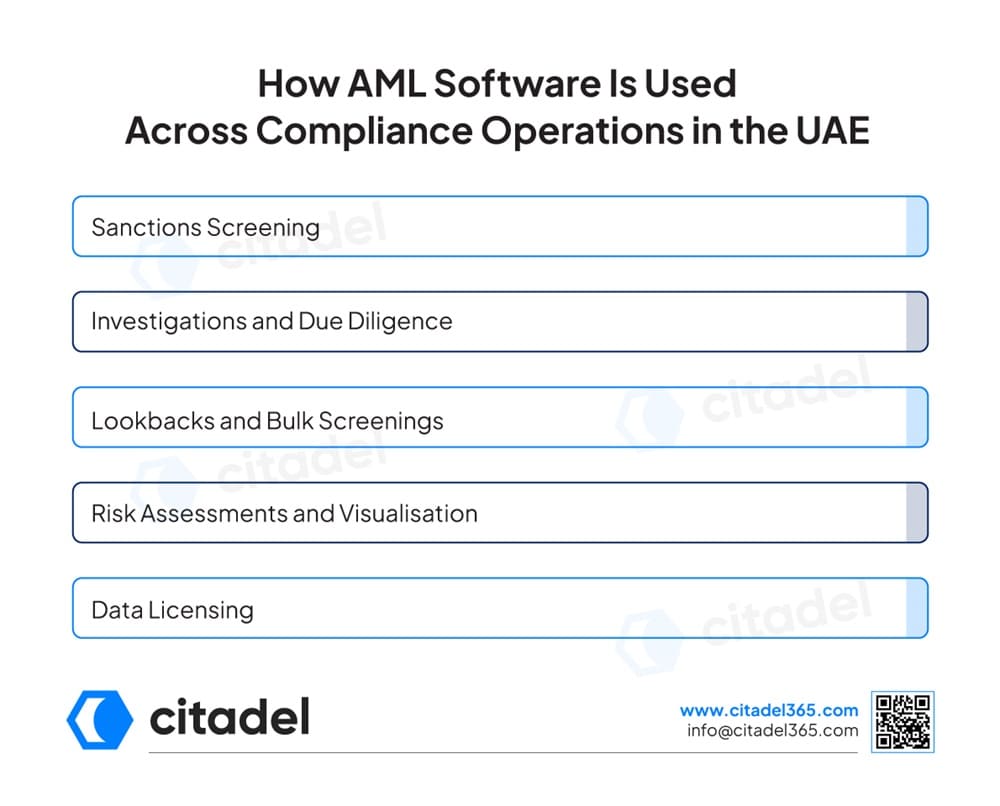
Sanctions Screening
Investigations and Due Diligence
AML software is used to conduct alert investigations that are generated upon identification of suspicious activities, high-risk customers, complex ownership structures, etc. AML software is used to automate and streamline CDD and EDD processes by collecting, analysing, and organising relevant customer and risk data efficiently.
Lookbacks and Bulk Screenings
UAE businesses often conduct periodic reviews to ensure ongoing compliance with AML obligations. AML software enables quick and consistent bulk screening. It is also used to perform historical reviews or large-scale remediation exercises.
Risk Assessments and Visualisation
AML software in Dubai helps businesses to implement a risk-based compliance approach by providing risk assessment tools, dashboards, and visualisation capabilities. It is used to conduct relationship mapping and link analysis, which helps in identifying hidden connections between individuals, companies, transactions, and jurisdictions.
Data Licensing
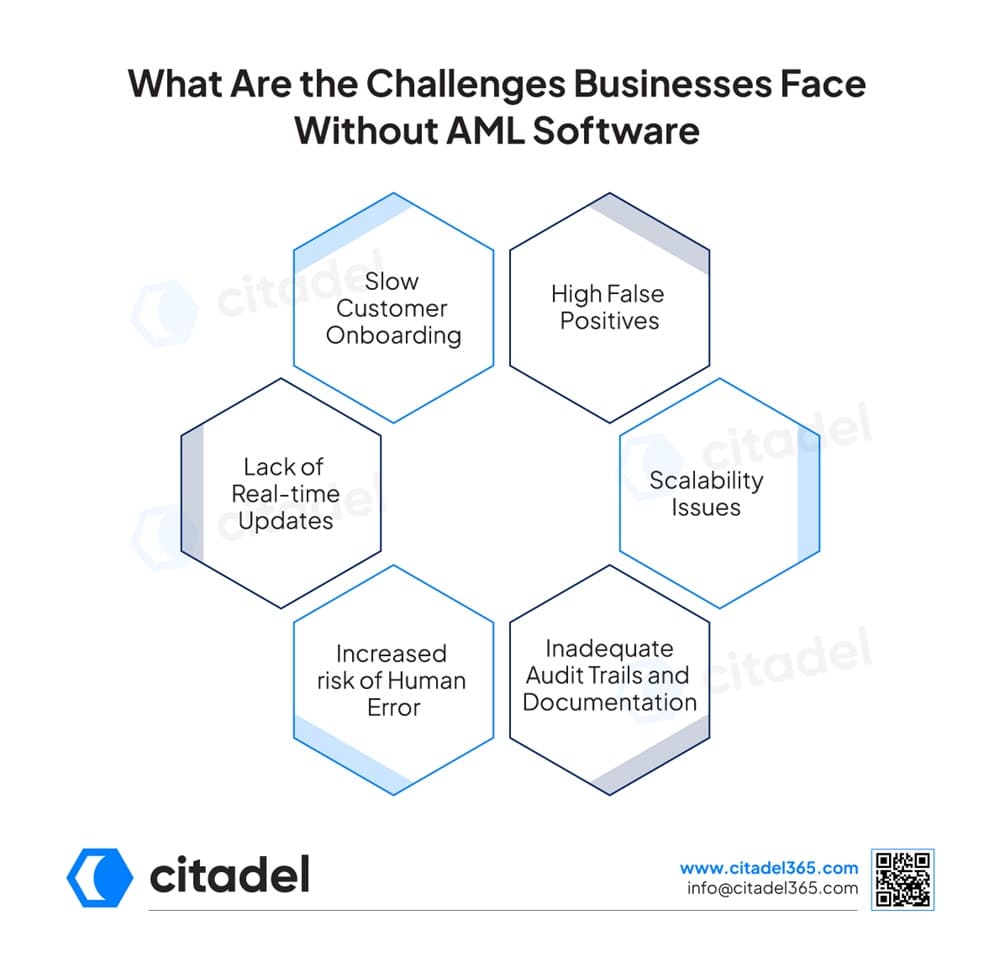
Businesses that rely on manual AML processes often face operational inefficiencies, compliance risks, and difficulty meeting evolving UAE regulatory requirements. Some of the challenges include:
AML software helps automate the compliance processes, detect risks, perform ongoing monitoring, and meet regulatory compliance efficiently.
AML software is required by regulated entities like banks, financial institutions, DNFBPs, fintechs, and virtual asset service providers to have a robust AML/CFT framework.
Yes, AML software reduces false positives by using advanced technology like modern search algorithms, fuzzy matching, and AI-driven screening to increase accuracy and reduce false positives.
AML software in UAE maintains detailed audit trails, investigation records, user activity logs, and compliance reports that help demonstrate regulatory compliance during audits and inspections.
AML software in UAE continuously monitors the customer profile, activities, transactions, along with updates to sanctions lists, PEP databases, and adverse media sources on a real-time basis to detect suspicious activities and newly sanctioned entities.
Yes, AML software automates workflows such as screening, risk scoring, alert generation, case routing, reporting, and ongoing monitoring.

Arjun is the Co-founder and CEO of Citadel, where he leads the company’s vision across technology, business, and regulations. He brings over a decade of experience in building and scaling technology ventures. Arjun holds a B.Tech. in Information Technology and a Master’s in Management, supported by his certification as a Financial Crime Specialist, an uncommon combination that allows him to balance innovation with regulatory requirements.
Having advised leading banks and financial institutions on digital solutions and compliance technology, Citadel continues to grow with an ambition.