
Ready to Defeat Your AML Compliance Obstacles?
Citadel Brings Revolution with Secure Solutions to AML Compliance Problems
Name screening software for Dealers in precious metals and stones (DPMS) is an anti-money laundering (AML) and counter-terrorist financing (CFT) compliance solution that helps in screening customers, beneficial owners, suppliers, and transaction counterparties against sanctions, politically exposed persons (PEPs), and adverse media lists. It performs screening during onboarding and daily thereafter, generating time-stamped records for the Ministry of Economy and Tourism (MoET) inspections.
DPMS businesses often deal with individuals, companies, and suppliers that may be exposed to sanctions or associated with politically exposed persons (PEPs). Missing even a single sanctions match can lead to violations of UAE Targeted Financial Sanctions (TFS) requirements, which include immediate asset-freezing obligations and regulatory penalties.
Mandatory screening for DPMS
DPMS firms, as designated non-financial businesses and professions (DNFBPs) supervised by the MoET, are required to screen customers and counterparties against the UNSC Consolidated List and the UAE Local Terrorist List. Further, depending on the jurisdictions an entity serves, it may be required to screen customers against the OFAC, HMT, EU, or global sanctions lists. A confirmed sanctions match triggers Targeted Financial Sanctions (TFS) obligations and requires immediate asset freezing and reporting to the UAE Financial Intelligence Unit (FIU).
PEP screening obligation
DPMS must also screen customers, beneficial owners, and key individuals behind corporate clients against the PEP list and apply enhanced due diligence where required.
Adverse media screening
The DPMS businesses are required to screen against adverse media lists, which help identify links to financial crime, corruption, or sanctions exposure. While it is not a standalone legal obligation, it is an important component of a risk-based customer due diligence (CDD) framework.
Ongoing rescreening obligation
Screening is not a one-time process; it must continue after onboarding. DPMS firms are expected to rescreen their customers on an ongoing basis, including rescreening of the active customer base for effective compliance.
Supplier and counterparty screening
The screening must also extend to suppliers and counterparties and not just retail customers for DPMS firms, engaged in B2B trading, including bullion traders, refiners and wholesalers. A sanctioned supplier poses the same compliance risk as a sanctioned customer, regardless of transaction value, and must be identified before any business relationship is established.
Name screening software plays a crucial role in supporting DPMS compliance by helping businesses to identify and manage risks associated with sanctions, PEPs, and adverse media.
The table below outlines how name screening software helps DPMS firms to comply with screening obligations in the UAE:
Screening Requirement | Sector Challenge | Name Screening Feature | Evidence Generated |
UNSC Consolidated List | Checking every customer and supplier against the UN list | Automated UNSC screening at onboarding and ongoing rescreening | Match results, alert notes, reviewer decisions, and time-stamped |
UAE Local Terrorist List | Screening against the UAE-specific TFS list | UAE Local Terrorist List is integrated into the screening engine | Match results, alert notes, time-stamped evidence |
PEP Screening | Identifying politically exposed persons behind transactions | PEP database screening on individuals and beneficial owners | PEP match results, EDD trigger, review history |
Adverse Media | Detecting negative news on customers and suppliers | Adverse media screening integrated with sanctions and PEP run | Adverse media hits, alert notes, reviewer decisions |
Supplier Screening | Screening upstream B2B counterparties and suppliers | Entity screening on suppliers, counterparties, and intermediaries | Supplier screening records, alert notes, review history |
Ongoing Rescreening | Monitoring the existing customer base for new listings | Automated rescreening across all active customers and suppliers | Rescreening logs, new hit alerts, timestamped results |
Alert Review | Investigating and closing or escalating screening hits | Alert workflow with reviewer notes, escalation, and closure records | Alert records, decision trail, MLRO escalation log |
Name screening software helps DPMS businesses identify potential ML/TF risks that manual checks might miss. The common red flags that software helps in detecting include:
Identify AML Risks Before They Become Compliance Issues
Citadel365 helps with automated screening against sanctions, PEP, and adverse media lists to detect risks early and simplify DPMS compliance.
The key features that DPMS businesses should look for when selecting name screening software to support UAE AML/CFT compliance include:
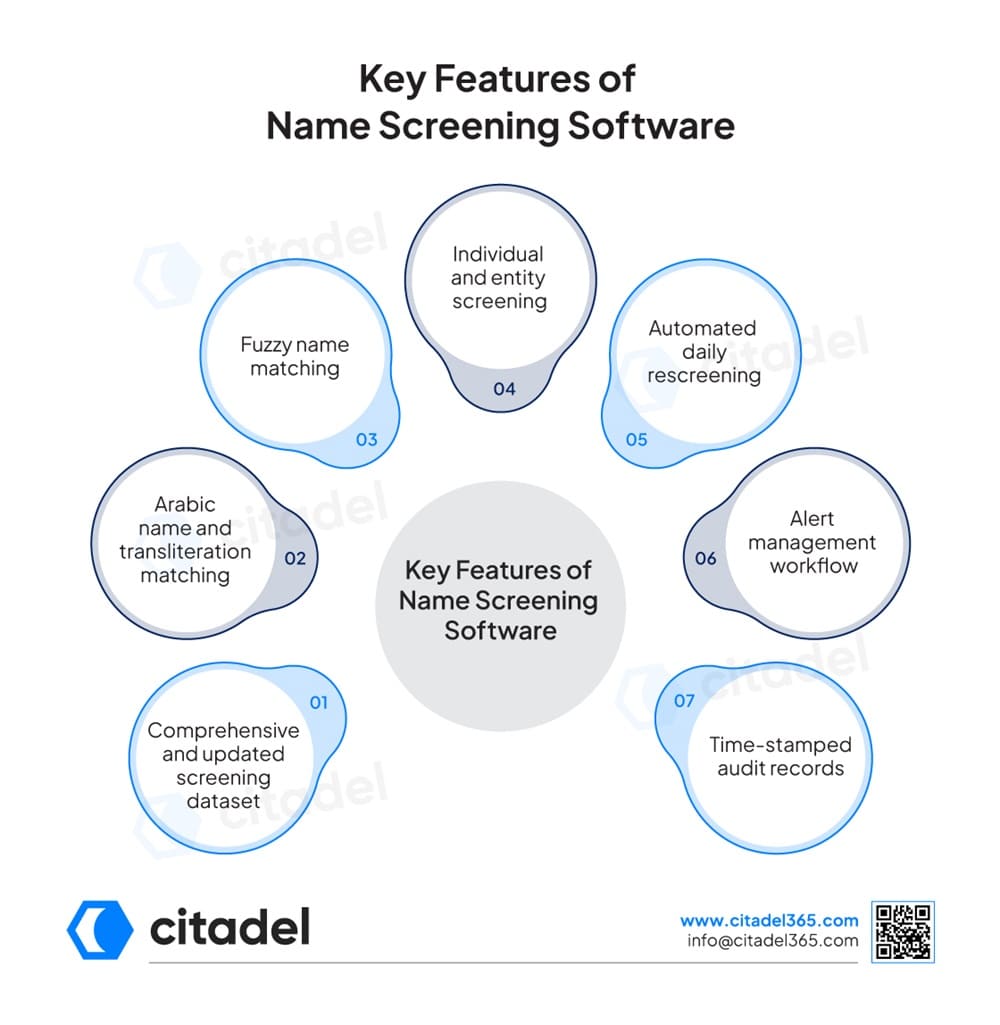
Comprehensive and updated screening dataset
The software should be able to screen against the UNSC Consolidated List, the UAE Local Terrorist List, the OFAC SDN List, the EU consolidated list, the UK HMT sanctions list, and major PEP databases with automatic daily updates.
Arabic name and transliteration matching
The AML software should be able to accurately match Arabic names and common transliteration variations, as DPMS customers in the UAE frequently have names that can be transliterated in multiple ways, reducing the risk of missed sanctions or PEP matches.
Fuzzy name matching
The AML solution should detect spelling variations, aliases, and transliterations using configurable fuzzy-matching thresholds that balance detection accuracy and false positives.
Individual and entity screening
DPMS firms should be able to screen both individual and legal entities, including corporate customers, beneficial owners, suppliers, and counterparties, using registered names, trading names, and known aliases.
Automated daily rescreening
The software should also provide automated watchlist screening, automatically rescreening customers, suppliers, and counterparties whenever watchlists are updated.
Alert management workflow
Time-stamped audit records
Every screening activity should generate time-stamped, exportable records, including screening results, alert history, reviewer decisions, and audit logs that can be presented during regulatory inspections.
Name screening for jewellers in UAE
Software for jewellers in the UAE focuses on high-volume retail customer screening, Arabic name and transliteration matching and rapid alert reviews that minimise delays at the point of sale.
Name screening for jewellery retailers
Support consistent screening across multiple branches, enable frontline staff to escalate potential matches, and help maintain centralised alert management and branch-level audit logs.
Name screening for bullion traders
Prioritise B2B counterparty and supplier screening, entity-level screening for corporate customers, beneficial owner screening, and automated daily rescreening of trading relationships.
Name screening for diamond and precious stone dealers
Focus on screening cross-border customers, suppliers, and intermediaries while identifying sanctions and jurisdictional risks associated with high-risk countries.
Name screening for refiners and import/export businesses
Support end-to-end supply chain screening, including suppliers, shipping agents, freight forwarders, financial intermediaries, and other transaction counterparties involved in the settlement.
The table below highlights the key differences between manual screening and name screening software for DPMS businesses in the UAE:
Screening Area | Manual Process Risk | Name Screening Software Advantage |
Sanctions screening | Manual checks on customers, suppliers, and third parties | Automated screening at every onboarding event and rescreening |
PEP identification | Missed PEPs on beneficial owners and corporate principals | PEP database screening on all individuals, including UBOs |
Supplier screening | No systematic supplier or counterparty screening | Dedicated supplier and counterparty screening workflow |
Name matching | Exact name only, misses transliteration variants | Fuzzy matching with Arabic-script support and alias detection |
Ongoing monitoring | No rescreening after onboarding | Ongoing automated rescreening with new hit alerts |
Alert handling | Unstructured, undocumented decisions | Structured alert workflow with reviewer notes and audit trails |
Inspection evidence | No retrievable screening history | Time-stamped, exportable results per customer and per date |
While choosing name screening software, DPMS businesses should ensure the solution includes the following capabilities to support effective UAE AML/CFT compliance.
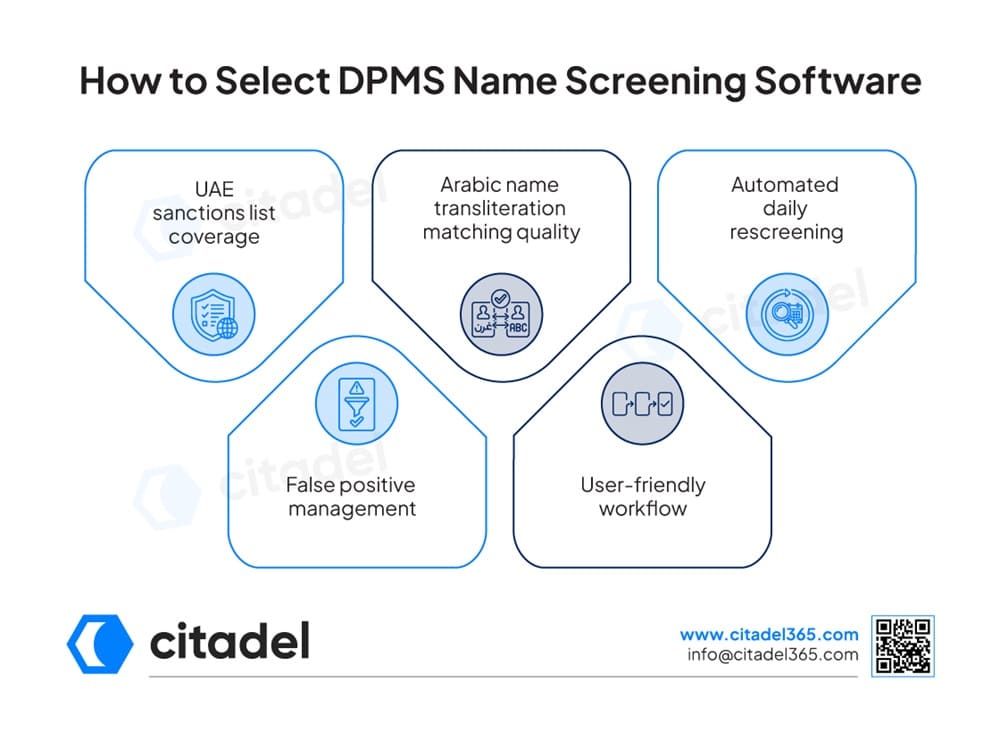
UAE sanctions list coverage
The software should, at a minimum, screen against the UNSC Consolidated List and the UAE Local Terrorist List, as these are the sanctions lists that trigger Targeted Financial Sanctions (TFS) obligations in the UAE.
Arabic name transliteration matching quality
Choose software that accurately matches Arabic names and common transliteration variations to minimise the risk of missed sanctions or PEP matches.
Automated daily rescreening
The platform should automatically rescreen customers, suppliers, and counterparties, maintain detailed rescreening logs, and generate alerts promptly when new matches are identified.
False positive management
The software should have configurable fuzzy-matching thresholds, match scoring, and a structured alert review workflow that helps compliance teams investigate and resolve potential matches efficiently.
User-friendly workflow
The software should be easy to use for both compliance teams managing investigations and frontline staff performing customer screening, enabling fast and consistent compliance across the business.
Must-have checklist to evaluate whether a name screening solution meets the AML/CFT compliance requirements for DPMS businesses in the UAE.
The following questions DPMS businesses should ask vendors before selecting a name screening solution:
Effective name screening of DPMS businesses goes beyond one-time customer checks. It covers screening customers, beneficial owners, suppliers, and counterparties, with continuous daily rescreening to identify new sanctions risks after onboarding. It also ensures audit-ready records for MoET inspections.
Citadel365 helps DPMS businesses in the UAE by automating screening, reducing manual effort, and supporting inspection-ready evidence, making AML/CFT compliance more efficient and reliable.
Confident Compliance Starts Here
We help you confidently manage screening obligations with a solution built for UAE DPMS businesses.
Name screening software in the UAE for DPMS businesses is a solution that helps in screening customers, beneficial owners, and suppliers against sanctions, PEP, and adverse media lists.
DPMS businesses should screen against the UNSC Consolidated List, UAE Local Terrorist List, OFAC SDN, HMT, and other applicable sanctions and watchlists.
Daily rescreening refers to the continuous process of screening customers, beneficial owners, and related parties against updated sanctions and watchlists to identify potential ML/TF risks, helping DPMS businesses detect new risks after onboarding.
A Politically Exposed Person (PEP) is an individual who holds or has held a prominent public role and presents higher ML/TF risks.
Citadel365 helps DPMS businesses in the UAE by automating screening against sanctions, PEP, and adverse media lists, reducing false positives, and ensuring regulatory-ready reports to support MoET compliance.

Vasantha holds a Master’s in Law specialising in Banking Laws and Anti-Money Laundering and is CAMS and CGSS certified. With over 35 years of experience, she has worked closely with regulators and international financial institutions, building financial crime risk frameworks, sanctions monitoring programmes, and compliance systems across multiple jurisdictions.