
Ready to Defeat Your AML Compliance Obstacles?
Citadel Brings Revolution with Secure Solutions to AML Compliance Problems
AML training in the UAE is mandatory for Financial Institutions (FIs), Designated Non-Financial Businesses and Professions (DNFBPs) and Virtual Asset Service Providers (VASPs). The FIs include banks, exchange houses, and insurance companies, while DNFBPs include real estate brokers & agents, lawyers and legal professionals, auditors and accountants, TCSPs, and DPMS. Within these regulated entities, AML/CFT training is required to implement customer onboarding, name screening, ongoing monitoring, and other compliance functions.
AML training should cover the following concepts to combat financial crime and ensure compliance with regulatory requirements:
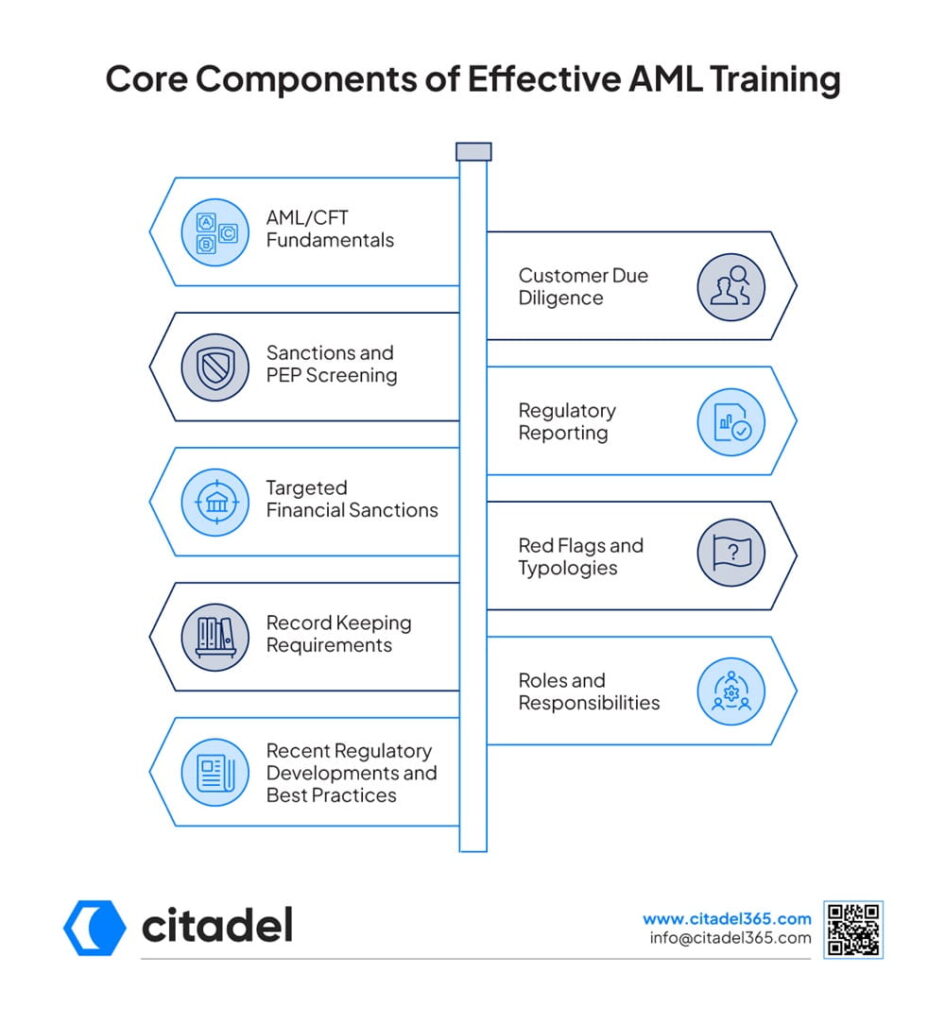
Equip employees about the basics and stages of money laundering & terrorist financing, the impact of financial crime on the business, and the regulatory requirements related to AML/CFT compliance.
Employees should learn to comply with TFS obligations regarding asset freezing and restricting business relationships with sanctioned individuals and entities.
AML training should educate compliance teams about emerging typologies, common money laundering techniques, and indicators or red flags that help detect suspicious ML/TF activities.
Train employees to understand their roles in the compliance team and individual duties to comply with AML/CFT obligations.
Update employees regarding recent regulatory developments, enforcement actions, and measures to strengthen the compliance framework.
AML training services should not be generic or one-size-fits-all; they should be broadly defined based on entities’ needs and fit to meet regulatory requirements. AML training services include:
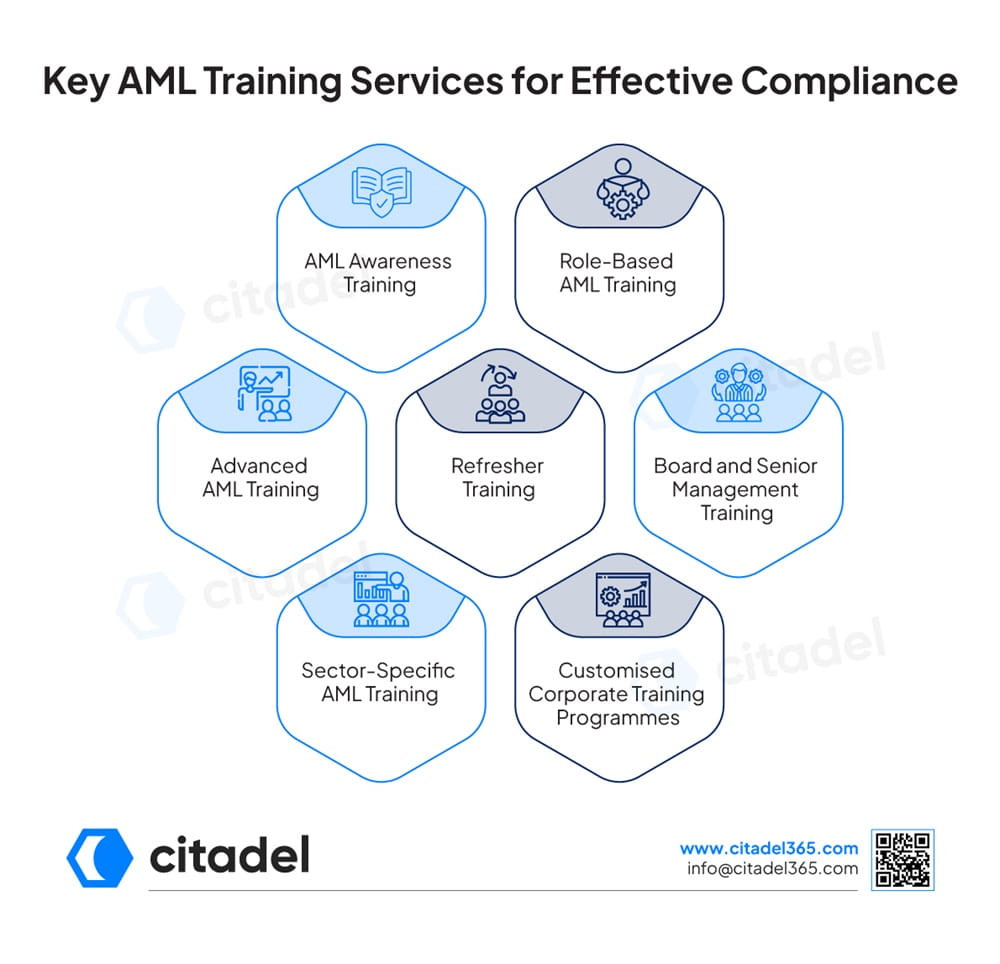
AML Awareness Training
It includes providing general training to employees to help them understand regulatory expectations, ML/TF red flags, and compliance measures to detect and prevent financial crime.
Role-Based AML Training
Advanced AML Training
Refresher Training
Periodic, ongoing training to employees to strengthen their knowledge about financial crime risks, internal procedures and regulatory expectations. Training staff regarding the newly updated law to detect and report suspicious activity.
Board and Senior Management Training
It focuses on training the senior staff regarding personal liability, duties, regulatory compliance, and building a strong compliance culture.
Sector-Specific AML Training
Educating about AML programs based on sector-specific requirements and risk factors. For instance, teaching the real estate sector to detect suspicious cash purchases and filing REAR reports.
Customised Corporate Training Programmes
Generic AML training fails because it lacks real-world, practical sector-specific scenarios and examples. As different sectors face different risks, AML training should define specific red flags the sector faces and the measures the business should take.
Further, not one size fits all, as every regulated entity differs in terms of daily operations. AML training programs must be role-specific and risk-based, tailored to the regulated entity’s exposure to ML/TF risks.
Moreover, AML training that fails to train employees regarding their specific product, customer base and geographic risks may fail to identify the exact red flags, leading to compliance deficiencies.
In addition, providing AML training on regulations with no real-world examples, scenario-based case studies, and role-based guidance results in compliance gaps. Compliance teams may fail to implement rules for daily transactions, resulting in fatigue and compliance shortfalls.
Citadel365’s AML training programmes are designed specifically for employees’ roles and responsibilities. The tailored AML training programmes focus on AML responsibilities that frontline employees, compliance officers and senior management must fulfil to comply with AML regulations.
Further, Citadel365 ensures the training programmes address industry- specific ML/TF risks, helping UAE-regulated entities comply with sector-specific guidelines and rules. With comprehensive real-world examples, case studies, and risk scenarios, Citadel365 helps employees understand and detect ML/TF risks and typologies sooner.
Moreover, Citadel365 develops customised training for all levels of the organisation on AML obligations and regulatory requirements for frontline staff, senior management, and compliance teams.
In addition, Citadel365 helps employee identify red flags, follow internal policies and procedures, and make accurate compliance decisions by strengthening their day-to-day compliance awareness. Citadel365 helps regulated entities in the UAE develop a compliance culture by training staff about shared responsibility, personal liability and risk management to ensure AML/CFT compliance.
Yes, AML training is mandatory in the UAE for financial institutions, DNFBPs and VASPS. Regulated entities should provide ongoing training to their employees regarding emerging ML/TF typologies, red flags, and AML obligations to prevent financial crime.
Regulated entities should provide ongoing AML training to their employees to ensure employees remain informed and updated with evolving regulations, emerging risks and internal policy updates.
Yes, AML training can be customised to align with a regulated entity’s risk, regulatory obligations, and internal policies. Further, customised AML training specific to the sector and roles helps meet AML/CFT compliance requirements.
Businesses can measure the effectiveness of AML training through assessments, employee performance, reporting quality and audit outcomes.
AML training is significant because it helps identify, prevent and report ML/TF activities. It further ensures staff understand AML obligations, apply AML controls, detect suspicious behaviour and help reduce financial crime.

Arjun is the Co-founder and CEO of Citadel, where he leads the company’s vision across technology, business, and regulations. He brings over a decade of experience in building and scaling technology ventures. Arjun holds a B.Tech. in Information Technology and a Master’s in Management, supported by his certification as a Financial Crime Specialist, an uncommon combination that allows him to balance innovation with regulatory requirements.
Having advised leading banks and financial institutions on digital solutions and compliance technology, Citadel continues to grow with an ambition.