
Name Screening Software in Singapore
Ready to Defeat Your AML Compliance Obstacles?
Citadel Brings Revolution with Secure Solutions to AML Compliance Problems
Name Screening Software in Singapore- Brief Overview
- Name screening software in Singapore is a compliance technology that automatically checks individuals and business names against global and local watchlists to prevent ML/TF and other financial crime risks.
- Key features of name screening software include real-time MAS TFS list coverage, batch screening, Advanced name matching and multilingual screening, PF risks screening, and adverse media screening.
- Citadel365 name screening software supports Singapore compliance through risk-based screening, automated rescreening, advanced name matching, alert management, and STR support.
What Is Name Screening Software?
Name screening software in Singapore is a compliance solution that helps regulated entities identify and verify individuals, organisations, or counterparties that may pose anti-money laundering (AML) or counter-terrorism financing (CFT) and other financial crime risks.
The screening software helps in screening against sanctions lists, politically exposed persons (PEPs) databases, adverse media sources, global watchlists, and internal risk databases, ensuring regulatory compliance with Targeted Financial Sanctions.
The name screening software supports screening against:
- Singapore Domestic Designations by Ministry of Home Affairs (MHA)
- Monetary Authority of Singapore (MAS) AML/CFT Notices and Lists
- UNSC Consolidated List
- Global Sanctions and Watchlists
A key Singapore-specific requirement is to monitor applicable targeted financial sanctions (TFS) lists and respond promptly to new designations. Where a confirmed match is identified, applicable asset-freezing and reporting obligations may arise.
How Name Screening Software Supports AML/CFT Compliance in Singapore
In Singapore, name screening sits at the cornerstone of customer due diligence and targeted financial sanctions compliance. Depending on the entity and its regulatory obligations, screening may cover customers, beneficial owners, counterparties and other relevant parties against applicable lists, including:
- The MAS TFS lists, MHA list, which are Singapore’s primary TFS obligations
- International sanctions lists, including OFAC SDN, the EU Consolidated List, and the UK HMT list, where relevant for cross-border activities.
- PEP databases, which are used to identify politically exposed persons and apply enhanced due diligence where required.
- Adverse media sources used as part of a risk-based customer due diligence process.
Screening also covers proliferation financing risk; entities are expected to identify counterparties associated with the proliferation of weapons of mass destruction (WMD) and related networks as part of the broader AML/CFT/CPF framework.
How Does Name Screening Software Work in Singapore?
Name screening software in Singapore automates the process of identifying customer names against global watchlists, sanctions, and regulatory databases to prevent ML/TF and other financial crime risks.
Data collection and name matching
Screening software collects customer information such as names, aliases, nationality, date of birth, and identification details, and screens it against relevant watchlists and databases, including the MAS TFS list for Singapore entities.
Fuzzy matching algorithms
Modern screening software uses fuzzy matching to identify names that are similar but not identical; this helps detect spelling errors, variations, aliases, and partial matches that may be missed by exact-name search tools.
Transliteration and multilingual screening
Singapore’s customer base spans various names, each with multiple romanisation variants, name screening software supports different scripts and Singapore-specific common name-variation patterns to reduce the risk of missed matches.
Risk scoring and alert generation
Potential matches are assigned risk scores based on predefined criteria. Possible matches then generate alerts for the compliance team to review.
Analyst review and escalation
Compliance analysts often review flagged alerts to determine if they are genuine matches. Confirmed matches require immediate action, including applicable asset-freezing measures.
Audit logging and documentation
The software keeps accurate records of screening activities, alert reviews, decisions made, and cases escalated, often supporting internal governance, audit requirements, and regulatory inspections.
Key Features of Name Screening Software for Singapore
A name screening software in Singapore should align with AML laws and standards to detect risk effectively, the key features of screening software include:
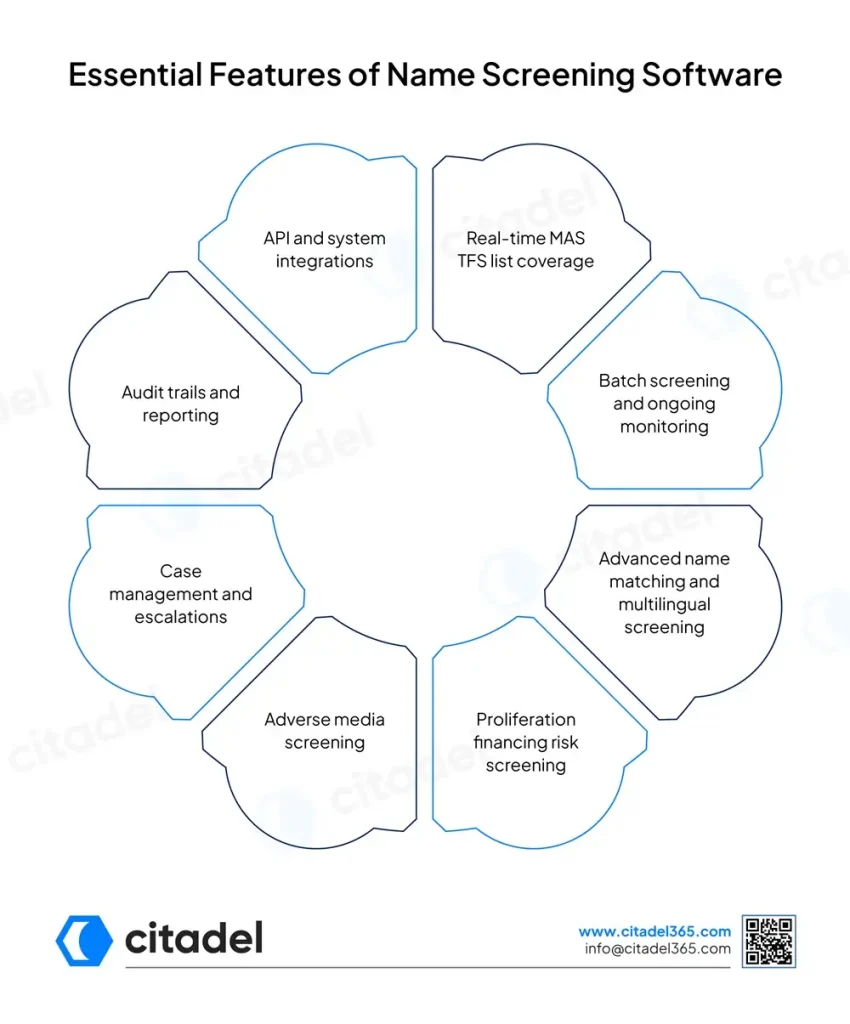
Real-time MAS TFS list coverage
Screening software should support timely updates. For regulated entities subject to Singapore’s sanctions requirements, the system should be able to identify new designations quickly and trigger alerts for appropriate review and action. Entities are required to freeze and report immediately when a confirmed match is identified, within the applicable legal timeframe.
Batch screening and ongoing monitoring
The software should have capabilities to support screening of large volumes of customer data periodically and daily rescreening of the customer base, helping entities conduct ongoing monitoring and identify new sanctions or risk information that may affect an existing relationship.
Advanced name matching and multilingual screening
The software should have advanced name matching capabilities to identify potential matches across different name orders, spelling variations, aliases, transliteration and multiple romanisation systems, helping reduce the risk of missed alerts.
Proliferation financing risk screening
Screening solutions should also support the identification of risks associated with proliferation financing, including parties related to the proliferation of weapons of mass destruction and related sanction measures.
Adverse media screening
It should also support adverse media screening that can help identify information relating to financial crime, fraud, corruption, and other risk indicators.
Case management and escalations
The software should provide structured workflows for reviewing potential sanctions matches, documenting decisions, and escalating them for further review. It should also support the preparation and submission of STRs to the STRO via SONAR filing format, where required.
Audit trails and reporting
A complete audit trail should record screening activities, alerts, decisions made, escalations and actions taken, helping to demonstrate that the screening and related compliance processes are being properly managed and also support regulatory examinations.
API and system integrations
Integration with onboarding platforms, customer relationship management systems and other internal systems can automate screening and reduce manual work.
Manual Screening Challenges
Operating without name screening software in Singapore exposes organisations to severe operational and regulatory risks; some of the key challenges are:
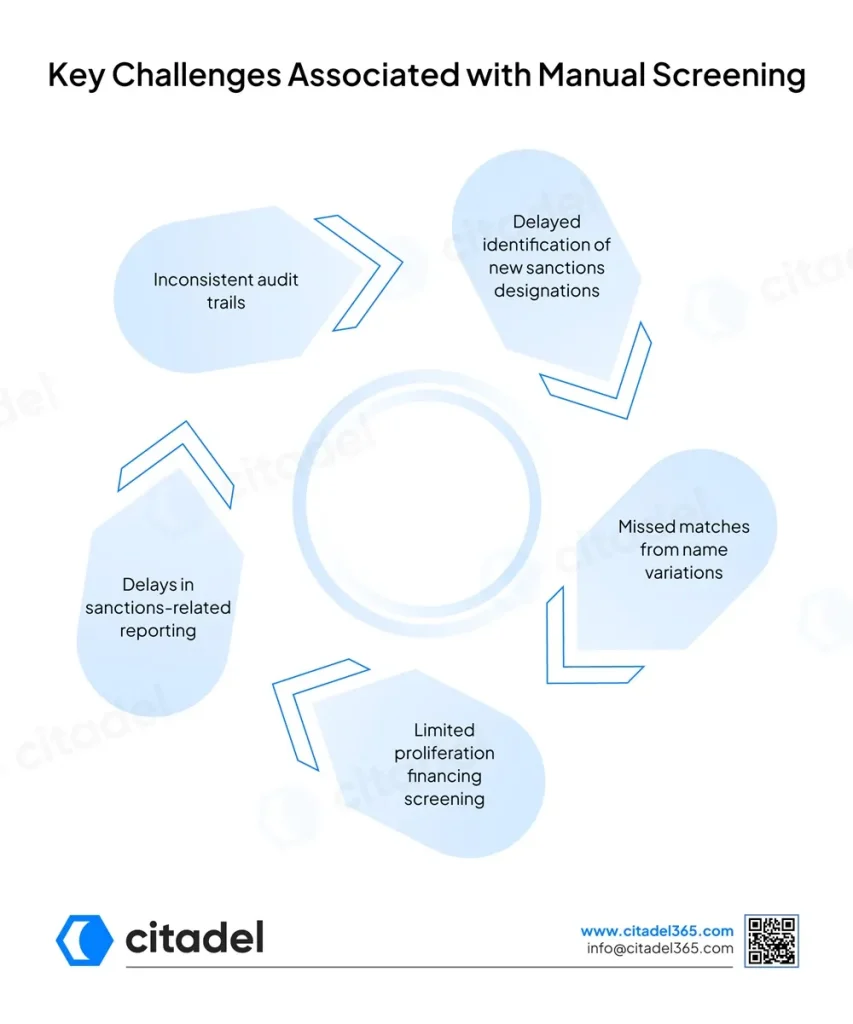
Delayed identification of new sanctions designations
Without timely sanctions list updates, new designations may not be identified promptly, this can often increase the risk of delays in taking required action, including freezing assets and making necessary reports.
Missed matches from name variations
Manual or exact-name screening may not effectively identify potential matches involving spelling variations, aliases, transliterations, different name orders, or different romanisation systems; this can increase the risk of missed alerts.
Limited proliferation financing screening
Without appropriate screening tools and processes, organisations may find it more difficult to incorporate proliferation financing risks into their broader AML/CFT framework and identify relevant customers or counterparties.
Delays in sanctions-related reporting
Manual reviews of alerts and reporting processes can make it difficult to investigate potential sanctions matches and complete required reporting within the applicable timeframe.
Inconsistent audit trails
Manual screening makes it difficult to maintain complete and consistent records of screening activities, alert decisions, escalations, and actions taken. This can make it more difficult to demonstrate effective compliance during internal reviews or regulatory inspections.
How to Select the Right Name Screening Software in Singapore
Regulated Entity | Key Screening Challenge | What the Software Should Offer |
Banks | Calibrated screening across large customer books, correspondent bank coverage | Tunable thresholds, documented rationale, daily rescreening logs, correspondent entity screening |
Payment service providers | Real-time transaction party screening, high volume | Transaction-level screening, real-time MAS TFS, SONAR-ready STR workflow |
Digital payment token (DPT) service providers | Pseudonymous customers, travel rule counterparty screening | Liveness-linked screening, PF coverage, travel rule counterparty screening |
Capital markets intermediaries | Securities transaction counterparty screening, investor PEP screening | Entity-level counterparty screening, PEP EDD trigger |
Corporate service providers | Multi-tier UBO screening, nominee arrangements | Entity and individual screening at every tier, ACRA integration |
Precious metals and stones dealers | Cash transactions, multilingual customers, supplier screening | Fuzzy matching, multilingual support, supplier and counterparty screening |
How Citadel365 Name Screening Software Supports Singapore Compliance
Citadel365 name screening software supports Singapore compliance with its risk-based screening that takes into account MAS AML/CFT requirements and Singapore’s regulatory environment.
Citadel365 enables screening of customers, beneficial owners, vendors, and counterparties against relevant sanctions and risk databases, including the MAS targeted financial sanctions (TFS) lists, MHA designations, UN Consolidated List, OFAC SDN, EU and UK sanctions lists, PEP databases, and adverse media sources. It also supports screening for proliferation financing risks as part of a broader AML/CFT/PF framework.
Citadel365’s key capabilities include fuzzy matching with multilingual screening across name variations, automated rescreening, alert and case management, and time-stamped audit trails.
Strengthen Your Singapore Name Screening Framework
Citadel365 screens against sanctions, PEPs, adverse media and other financial crime risks with intelligent, risk-based screening.
FAQs About Name Screening Software in Singapore
Name screening software in Singapore is a compliance solution that helps regulated entities screen customers, beneficial owners, and counterparties against relevant sanctions risk databases.
Real-time MAS TFS screening is required in Singapore to ensure financial institutions immediately detect, block, and freeze funds of designated persons and entities without delay, and fulfil applicable reporting obligations.
Proliferation financing screening is the process of checking customers, transactions, and entities against international sanctions and watchlists to prevent the funding of weapons of mass destruction (WMD) and their delivery systems.
Singapore’s AML/CFT framework has strengthened requirements relating to proliferation financing, and regulated entities should incorporate relevant PF risks into their risk assessment, controls and screening processes.
Name screening software helps identify and investigate potential hits and submit STR on a timely basis with the STRO.

Arjun is the Co-founder and CEO of Citadel, where he leads the company’s vision across technology, business, and regulations. He brings over a decade of experience in building and scaling technology ventures. Arjun holds a B.Tech. in Information Technology and a Master’s in Management, supported by his certification as a Financial Crime Specialist, an uncommon combination that allows him to balance innovation with regulatory requirements.
Having advised leading banks and financial institutions on digital solutions and compliance technology, Citadel continues to grow with an ambition.