Key Highlights: AML Software for Law Firms in UAE
- AML software for UAE law firms helps detect and prevent money laundering (ML), terrorist financing (TF), and other financial crimes.
- UAE law firms come under Designated Non-Financial Businesses and Professions (DNFBPs) and must meet obligations stated under Federal Decree Law No. 10 of 2025 and Cabinet Resolution 134 of 2025.
- Citadel365 helps legal professionals in the UAE automate compliance procedures, including KYC, screening, risk assessment, and monitoring, and provides centralised case management.
What is AML Software for Law Firms in UAE?
AML software for law firms in UAE is a compliance tool that helps legal professionals verify identities, assess their risk, and maintain records. It helps UAE law firms automate compliance procedures, such as Know Your Customer (KYC), sanctions and PEP screening, risk scoring, and managing cases.
Legal professionals in the UAE are subject to Anti-Money Laundering obligations as they are often involved in company formation, managing client funds and real estate transactions. Criminals misuse these services to move illicit funds or hide illegal money, requiring proper checks.
AML software helps UAE law firms
identify high-risk customers and transactions and report suspicious activity and transactions to the relevant authorities.
Why Law Firms in the UAE Need AML Software
UAE lawyers, notaries, and legal professionals are required to comply with AML obligations. Manual procedures often are time-consuming and prone to errors, whereas AML software fastens onboarding and minimises the regulatory risks. The following points make it clearer:
- Every client differs in risk level and requires a risk-based CDD. AML software automates risk profiling, source-of-funds checks, and ongoing monitoring to ensure controls are tailored based on customer risk level.
- Verifying the source of funds manually is a challenge for law firms in circumstances such as when money is deposited into a client account, invested in a company or used to purchase property. AML software helps trace the source of funds to understand the legitimacy behind transactions.
- Law firms need quick customer onboarding, which often puts pressure on their compliance teams. Also, using shortcuts for CDD may lead to missed sanctions, PEP screening failures or inadequate customer verification.
- AML software enables compliance, ensuring business operations run smoothly. It helps streamline the compliance workflows with self-KYC options, automating sanctions and PEP screening and centralising records, reducing compliance burdens on fee earners.
Which Activities Trigger AML Obligations for UAE Lawyers?
Under Federal Decree Law No. 10 of 2025 and Cabinet Resolution No. 134 of 2025, the following activities trigger AML obligations for UAE lawyers:
- Managing a customer’s money or other financial assets on their behalf.
- Helping customers buy or sell property or real estate.
- Managing bank, investment, or savings accounts for a customer.
- Setting up, buying, selling, or managing companies, trusts, or other legal entities for clients.
- Organising contributions to establish, operate, or manage companies.
How AML Software Helps Law Firms Comply
AML software helps law firms comply with UAE AML requirements by streamlining compliance workflows, automating CDD, and helping avoid penalties.
UAE AML Requirement | Sector Challenge | AML Software Feature | Evidence Generated |
Know Your Customer | Fast-moving client intake on specified activities | KYC self-service with document capture at intake | Client profile, ID documents, approval logs |
Source of Funds | Establishing fund origin for client account and conveyancing | Source of funds capture with document upload | Source documents, fund trail evidence |
Beneficial Ownership | UBO verification for corporate clients on company formation mandates | KYB and UBO mapping for corporate clients | UBO records, ownership structure notes |
Sanctions Screening | Screening clients at intake and on ongoing basis | Sanctions, PEP, adverse media screening | Match results, alert notes, review history |
Risk Assessment | Matter-level risk scoring without pre-empting privilege | Configurable risk scoring by activity type and client profile | Risk scores and rationale per client |
Privilege-aware Reporting | Surfacing risk without auto-reporting | Case management flags risk and records the firm’s decision | Investigation notes, decision records |
Recordkeeping | MoJ inspection readiness per matter | Audit trail linked to matter record | Timestamped activity logs, exportable profiles |
Legal Sector AML Red Flags AML Software Can Help Detect
AML software helps legal professionals detect the following red flags to prevent financial crime and report suspicious activity and transactions:
- Unexplained or unverifiable source of funds by the client.
- Involvement of a third party who funds a conveyancing transaction with no clear business relation with the buyer.
- Unclear or unverifiable beneficial ownership for a corporate client during company formation.
- Client identified as a PEP or appears in negative news.
- Unusual payment routing or funds passing through the client account with no clear business rationale.
- Client withdraws the transaction or cancels services when asked to explain the source of funds.
- Engagement with an offshore entity with no apparent business rationale.
Essential Features of AML Software for Law Firms in UAE
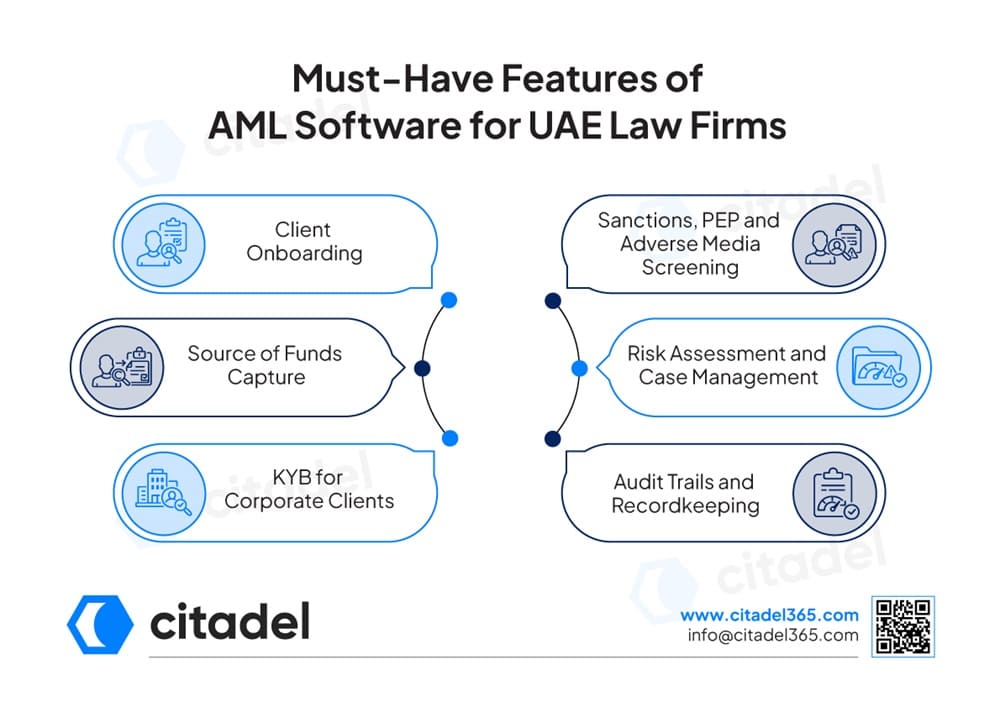
The must-have features of an AML software for law firms in UAE include the following:
Client Onboarding
Law firms are required to conduct risk-based CDD for services, such as real estate transactions, company formation, or management of client money. AML software should help law firms apply onboarding checks when required, involving the automation of KYC and
risk assessment.
Source of Funds Capture
AML software should provide a field for the
source of funds, where law firms can upload supporting documents and review them through a structured workflow. The platform should allow evidence to be linked to the relevant matter to facilitate investigation.
KYB for Corporate Clients
AML software should help law firms map the
ultimate beneficial owners through the complex, layered structures. With this, the platform must support verifying the UBOs and record the information for corporate clients.
Sanctions, PEP and Adverse Media Screening
Risk Assessment and Case Management
The AML software should help
assess customer risk, identify suspicious transactions, record compliance decisions and retain a complete case history. The platform should allow law firms to make the final judgement without auto-generating suspicious transaction reports.
Audit Trails and Recordkeeping
AML software should maintain timestamped records, including activity logs, supporting documents, and compliance decisions. The platform should retain these records for at least five years in order to support regulatory reviews.
AML Software for Different Legal Business Types
Every law firm differs in operations and hence requires tailored AML software for its different legal business types.
Commercial law firms require AML software that automates CDD to ensure compliance with global regulations. It includes real-time name screening, UBO verification and managing goAML reporting.
Real estate law firms and conveyancers require AML software for dual-party verification, source-of-funds capture, UBO mapping, and detection of suspicious activity in high transaction volumes. AML software that automates these activities through a centralised dashboard to escalate, investigate, and document helps real estate law firms and conveyancers.
Independent lawyers and notaries, classified as
DNFBPs, require simple AML software that helps them comply with AML obligations and provides convenience to sole practitioners. It includes KYC/KYB, name screening, customer risk assessment, ongoing monitoring, and case management.
Large multi-practice law firms offer a wide range of services across multiple jurisdictions and therefore require AML software that can handle complex client networks and large transaction volumes and help comply with MoJ expectations. It involves a centralised platform that supports risk-based CDD,
MLRO oversight, and timestamped activity logs.
Citadel365 AML Software for Law Firms in UAE
Citadel365 is an AML software that helps law firms meet UAE AML obligations through its single integrated platform. The platform automates
customer onboarding, screening, risk scoring, and transaction monitoring, which protects law firms from severe regulatory penalties.
The software facilitates self-KYC, which allows law firms’ clients to upload their documents themselves, enabling faster customer onboarding and convenient compliance. Citadel365
name screening software helps identify sanctions, PEP, and adverse media matches during onboarding and throughout the business relationship.
Further, the platform helps commercial law firms, real estate law firms, conveyancers, multi-practice firms, and independent lawyers & notaries in UAE to assess and manage risks by facilitating customised scores, ratings, and weightages.
Moreover, Citadel365 performs ongoing transaction monitoring, and its
case management provides a centralised space for creating and managing cases. The platform ensures timestamped records with
effective audit trails and downloadable reports to ease regulatory reporting and inspections.
Law Firm AML Software Buyer Checklist
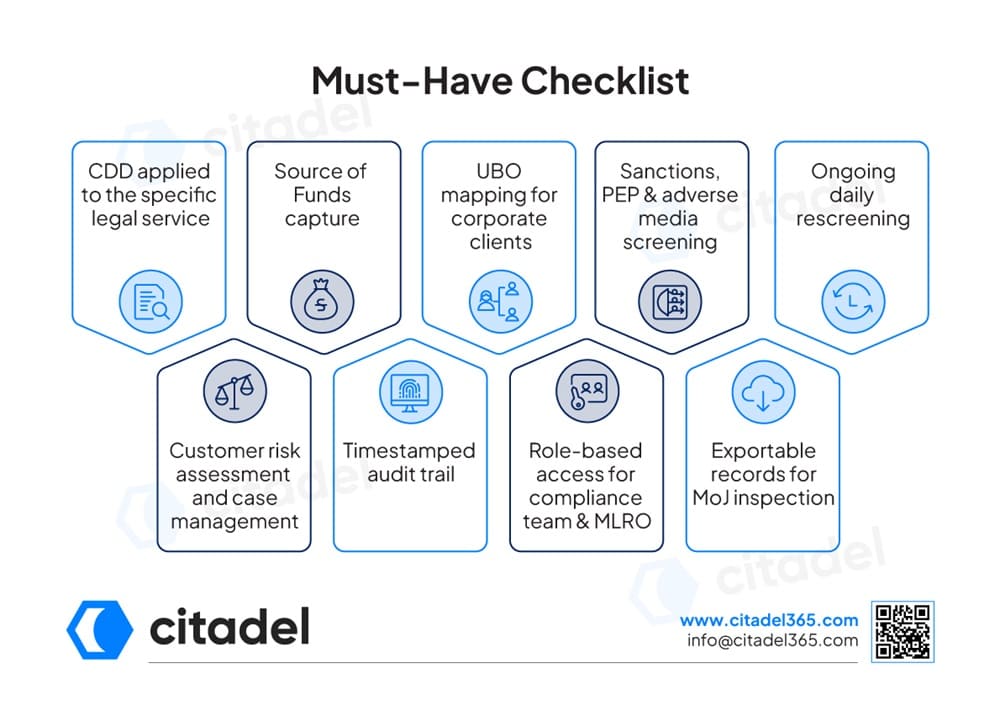
Law firms must check whether the chosen AML software helps them meet the following requirements or perform the listed compliance functions:
Legal professionals in UAE should ask the following questions to AML software vendors before selecting an AML software:
- Does the AML software trigger CDD for the AML-obliged legal service?
- How does the AML software capture the source of funds and link supporting documents to the relevant matter?
- How does case management help in securing investigation decisions without auto-generating an STR?
- Does the AML software provide downloadable records in a format suitable for MoJ inspection?
- How does the platform support ongoing screening for long-running client relationships?
- Does the AML software support both individual and corporate client onboarding on specified matters?
Conclusion: Make Law Firm AML Compliance Rigorous at Intake, Without Slowing the Firm Down
AML compliance for legal professionals calls for a
risk-based approach. For covered activities, law firms are required to conduct
customer due diligence and maintain effective records, and for other activities, they need to take a risk-based call and apply proportionate control measures. AML software helps law firms in verifying UBO, capturing the source of funds, assessing risk, monitoring transactions and logging every activity and decision for regulatory reporting and MoJ inspection, ensuring AML/CFT compliance.
Frequently Asked Questions (FAQs)