
Ready to Defeat Your AML Compliance Obstacles?
Citadel Brings Revolution with Secure Solutions to AML Compliance Problems
Name screening is not a set-and-forget control; risks emerge overnight, often in dim light, before the compliance team becomes aware of them.
As a compliance beacon, name screening enables organisations to detect sanctions, PEPs, and adverse media risks before they escalate.
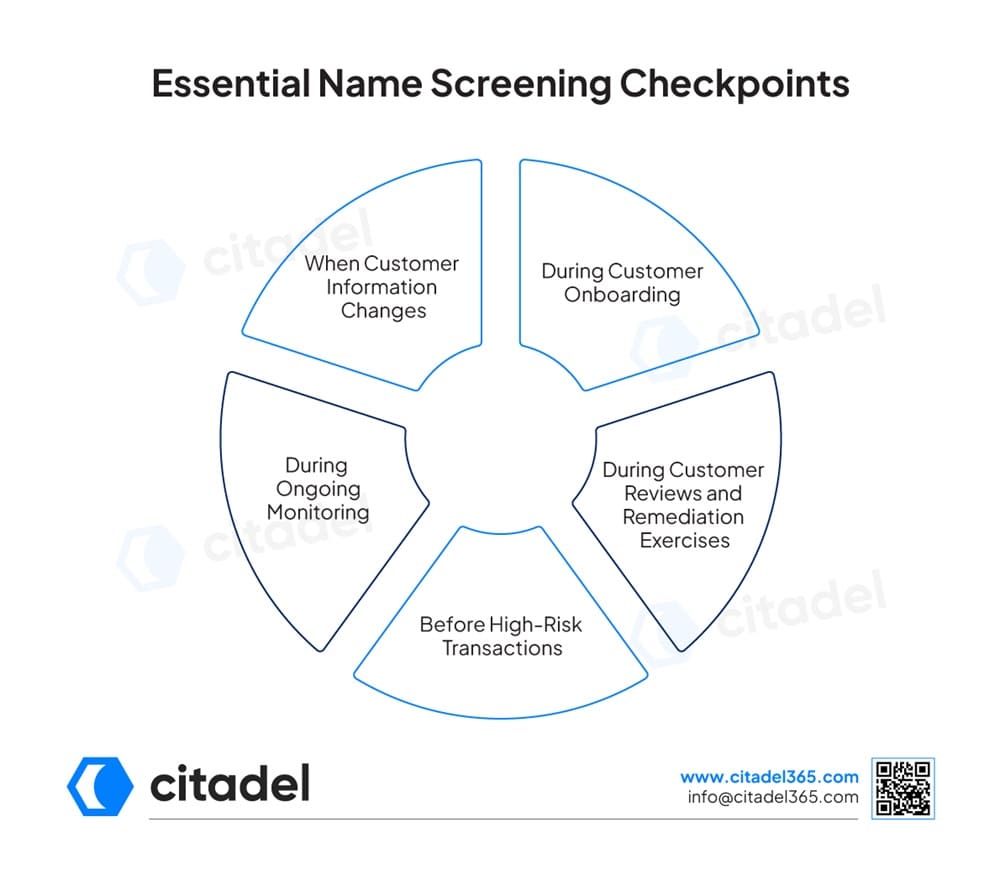
Key area where the name screening check should be conducted:
Name screening must also be conducted before processing any high-risk transactions to identify potential sanctions-related risks.
During the name screening check, the following information is used to identify potential risks, including:
The name screening process involves several key steps to ensure compliance with AML regulations and mitigate ML/TF and other financial crime risks. The step-by-step process includes:
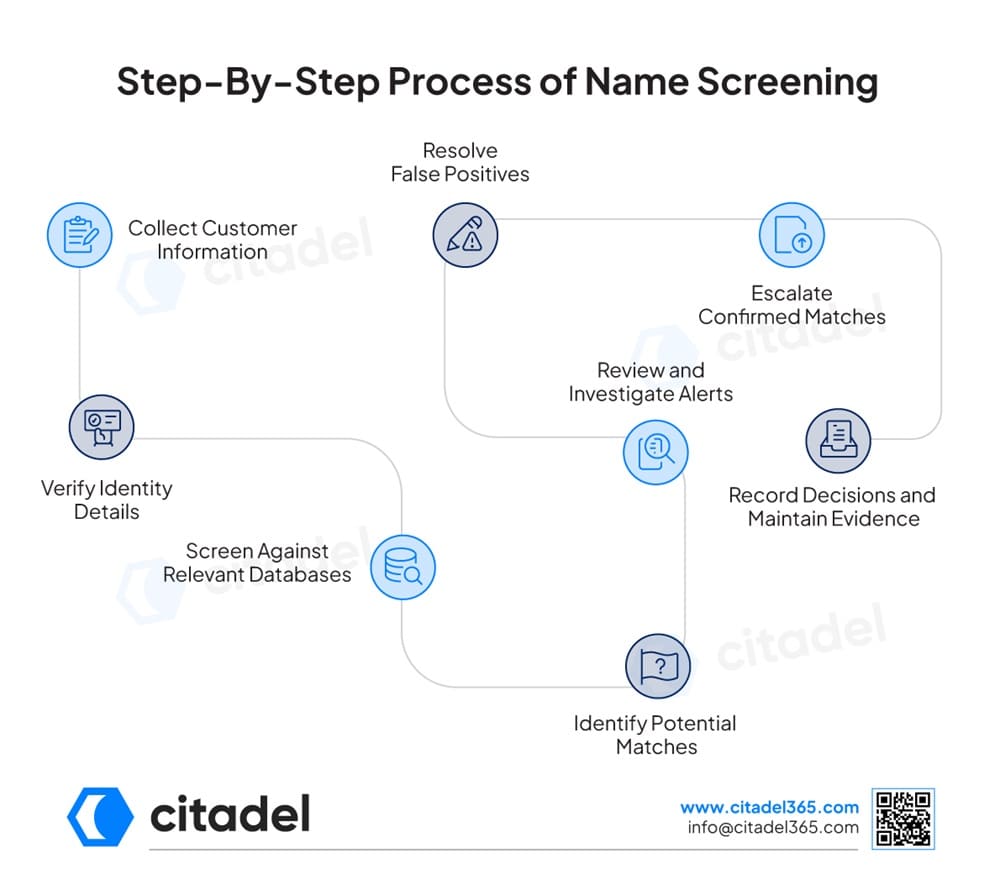
Collect Customer Information
Gather key customer information, including full customer name, date of birth, nationality, and beneficial ownership information.
Verify Identity Details
Screen Against Relevant Databases
Screen the customers against relevant databases, including sanctions lists, PEPs, adverse media, and other watchlists.
Identify Potential Matches
The system then flags records that closely match the customer’s details based on predefined information and matching criteria.
Review and Investigate Alerts
After identifying the potential matches, compliance teams then assess flagged matches and conduct further investigations as required.
Resolve False Positives
Potential matches that are determined as false positives and not related to the customer are cleared and well-documented, reducing the unwanted operational details.
Escalate Confirmed Matches
Record Decisions and Maintain Evidence
All the screening results, investigations, and decisions made are properly documented to support regulatory investigations and maintain compliance.
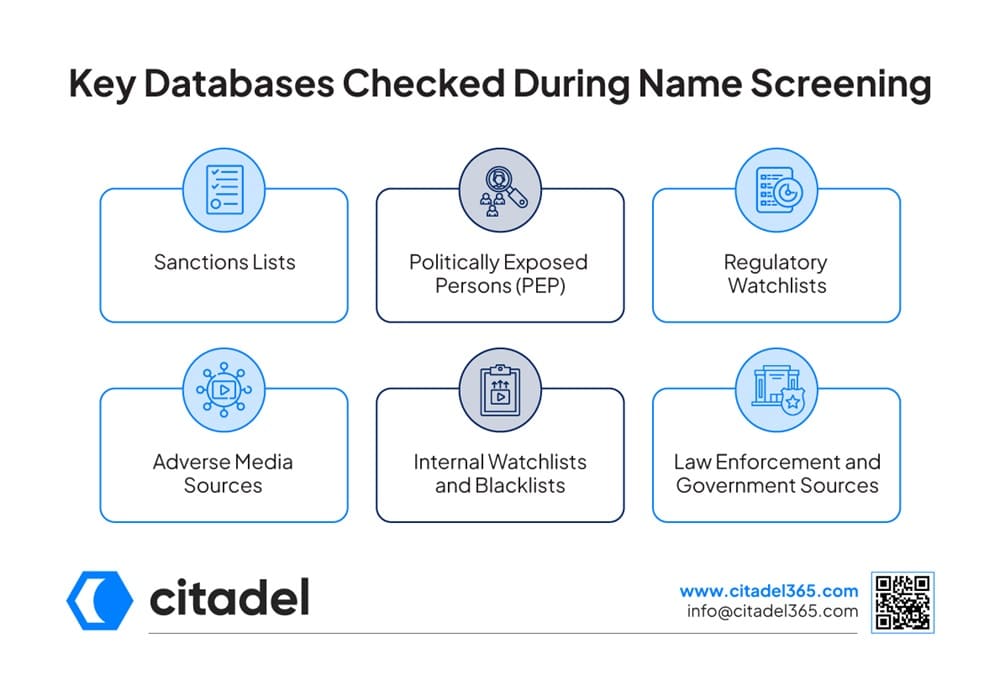
Effective name screening relies on confirming the customer information against various databases, helping organisations identify individuals and entities that may pose sanctions, regulatory, and reputational risks. The key databases include:
Common Names
Customers with similar names are most likely to match individuals listed in sanctions, PEPs, or other watchlists, increasing the chances of false positives.
Name Variations and Transliterations
Variations and transliterations between languages or spellings can cause screening systems to flag potential matches that require additional review.
Aliases and Nicknames
Individuals may have nicknames, aliases, or alternative identities, making it difficult to differentiate between genuine matches and unrelated records.
Data Quality Issues
Missing, incomplete, and outdated customer information results in unnecessary alerts and reduces operational efficiency.
A name screening check does not always result in a sanctions match. Some of the common key outcomes of a name screening check are as follows:
Besides being essential for AML compliance, name screening also presents operational compliance challenges, including:
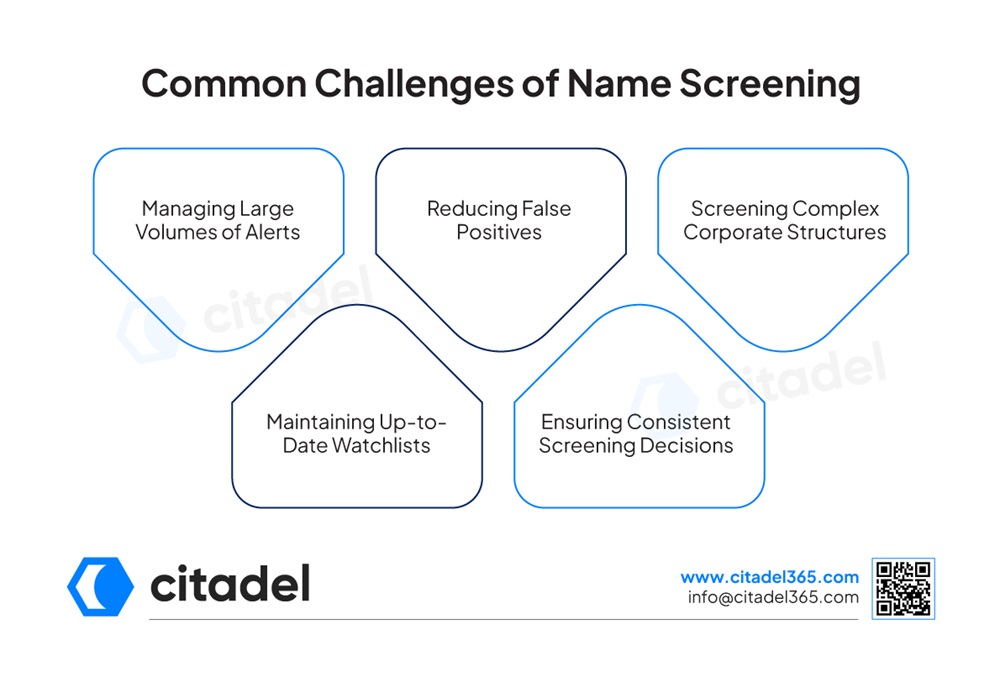
Managing Large Volumes of Alerts
A large number of screening volumes can generate many alerts, making the review process time-consuming and resource-intensive if done manually.
Reducing False Positives
Name similarities often trigger unnecessary alerts, increasing the operational burden and causing onboarding delays.
Screening Complex Corporate Structures
Identifying risks where the ownership structure is unclear or complex can be challenging.
Maintaining Up-to-Date Watchlists
Sanctions lists, PEPs, and other watchlists change frequently, which requires organisations to continuously update their screening data to maintain regulatory compliance.
Ensuring Consistent Screening Decisions
Different reviewers in the team may assess alerts differently, making the process challenging to maintain consistent decisions across teams.
Citadel365 helps in simplifying the name screening process through automated checks against sanctions, PEPs, and adverse media lists, helping organisations to identify potential matches effectively.
Citadel365 enables real-time sanctions and PEPs checks to detect potential high-risk customers before onboarding or any transaction processing.
Its intelligent match review workflows enhance the accuracy and efficiency of identifying potential matches, reduce manual efforts, and accelerate the review of screening alerts.
Citadel365 supports continuous monitoring and re-screening when the watchlists are updated, ensuring no risks go unnoticed.
Citadel365 helps maintain a complete audit trail of screening results, investigations workflows, and decisions made to support regulatory examinations and audits.
A name screening check refers to the process of checking a customer against sanctions, PEP, watchlists, and adverse media databases to identify potential ML/TF risks.
The lists that are checked during name screening include sanctions, PEP, adverse media, and other watchlists.
Name screening systems generate false positives due to the following reasons, including common names, spelling variations, incomplete customer information, and data quality issues.
Customers should be screened during onboarding and continuously monitored to ensure compliance with regulatory requirements.
Fuzzy matching in name screening is used to identify close or partial matches between names, including names with spelling variations, aliases, and transliterations.
Name screening identifies individuals and entities against databases, while identity verification confirms that a person is who they claim to be.

Arjun is the Co-founder and CEO of Citadel, where he leads the company’s vision across technology, business, and regulations. He brings over a decade of experience in building and scaling technology ventures. Arjun holds a B.Tech. in Information Technology and a Master’s in Management, supported by his certification as a Financial Crime Specialist, an uncommon combination that allows him to balance innovation with regulatory requirements.
Having advised leading banks and financial institutions on digital solutions and compliance technology, Citadel continues to grow with an ambition.