
Name Screening Software in KSA
Ready to Defeat Your AML Compliance Obstacles?
Citadel365 Brings Revolution with Secure Solutions to AML Compliance Problems
Name Screening Software in KSA: At a Glance
- Name screening software in KSA is a compliance tool that helps regulated entities screen individuals, entities and counterparties against sanctions, PEPs, and other watchlists.
- The key features of name screening software include Arabic-script matching and transliteration, sanctions list coverage, PEP and adverse media screening, batch screening, and real-time alerts.
- Citadel365 name screening software helps automate sanctions, PEP, and adverse media screening with ongoing rescreening and audit-ready case management.
What Is Name Screening Software?
Name screening software, also called AML screening software, is a compliance solution that enables regulated entities in Saudi Arabia to identify individuals, organisations, or counterparties that may pose AML/CFT risks. It screens customer data against sanctions lists, PEP databases, global watchlists, adverse media sources, and internal risk databases, supporting AML/CFT and targeted financial sanctions (TFS) compliance for both terrorism and proliferation financing.
In Saudi Arabia, applicable regulated entities are required to conduct appropriate screening as part of their AML/CFT and sanctions compliance obligations under the Anti-Money Laundering Law (Royal Decree No. M/20 of 1439H), the Law of Combating Crimes of Terrorism and Its Financing (Royal Decree No. M/21 of 1439H), and their Implementing Regulations.
The key challenge in the Saudi market is Arabic name handling, as the same individual or entity can appear in multiple transliteration variants across different documents, registrations, and sanctions list entries. Effective screening controls should account for relevant name variations and matching risks.
How Name Screening Software Supports AML/CFT Compliance in KSA
AML name screening in Saudi Arabia should cover sanctions, PEP, and adverse media screening against:
- Saudi national sanctions lists, which sit at the core of TFS compliance for regulated entities in KSA.
- The UN Security Council sanctions lists: financial institutions must screen relevant customers, beneficial owners, directors, authorised signatories, transactions, and other relevant parties against applicable UN and national sanctions lists.
- International sanctions lists, such as OFAC, EU, and UK lists, where relevant based on the institution’s international exposure.
- PEP databases: entities must take reasonable measures to identify whether customers or beneficial owners are politically exposed persons, with particular relevance in Saudi Arabia where government-connected individuals and family business structures are common.
- Adverse media and open-source information that helps identify negative news or other information that may indicate AML/CFT risks.
Key Features of Name Screening Software for KSA
Not every screening tool handles Saudi customer data well. These are the features to look for:
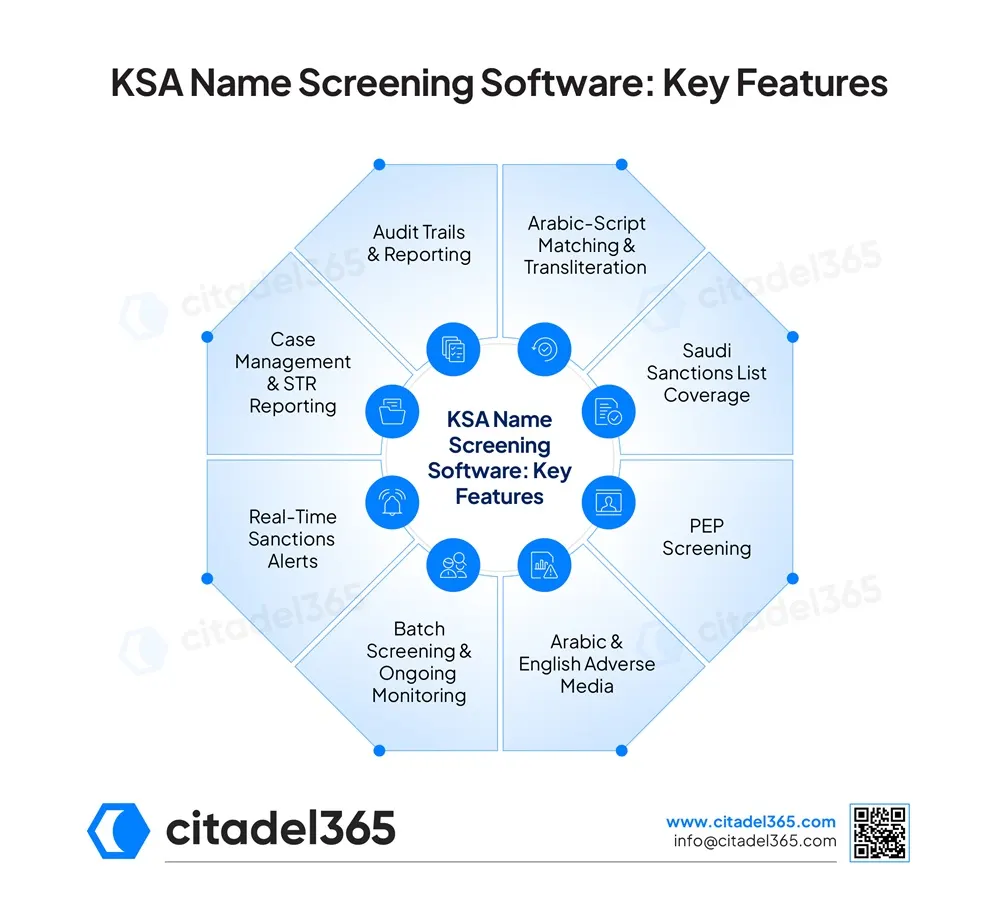
Arabic-script matching and transliteration
The screening software should have advanced cross-lingual matching algorithms that accurately handle Arabic name variations, spelling differences, and Arabic-to-English transliterations.
Saudi sanctions list coverage
The software should have real-time access to Saudi national sanctions lists, alongside the UN Security Council Consolidated List and, where relevant, OFAC, EU, and UK sanctions lists.
PEP screening with Saudi market depth
The software should provide comprehensive PEP data relevant to Saudi customers and counterparties, including senior public officials and their relevant family members and close associates, where applicable.
Adverse media in Arabic and English
The software should support Arabic and English adverse-media screening to help identify publicly available information that may indicate ML/TF and other financial crime risks.
Batch screening and ongoing monitoring
Batch screening lets organisations screen large customer bases efficiently and repeat screening when required by their risk-based monitoring framework.
Real-time alerts on new sanctions designations
The software should support timely alerts when sanctions lists are updated, allowing compliance teams to identify potential matches quickly. A confirmed match against a designated person requires funds and other assets to be frozen without delay and reported to the relevant authorities.
Case management and STR reporting
The software should support alert investigations, review, escalation, case documentation and audit-ready records. Where there are reasonable grounds to suspect money laundering or terrorist financing, reporting entities must promptly and directly report the suspicious transactions to the Saudi Arabia Financial Intelligence Unit (SAFIU) using the applicable reporting mechanism.
Audit trails and reporting
Detailed audit trails should record screening activities, alerts, investigations, outcomes, decisions, and escalations, helping organisations demonstrate how screening alerts were reviewed and handled to support regulatory examinations.
Types of Name Screening in KSA
The four core types of name screening used in KSA are:
Screening Type | What It Covers | KSA-Specific Note |
Sanctions screening | Saudi national sanctions lists, UN Consolidated List, OFAC SDN, EU, UK Sanctions List | Saudi national and UN sanctions lists form the core TFS screening requirements for financial institutions, with other international sanctions lists applied based on the institution’s risk and international exposure. |
PEP screening | Global and Saudi-specific PEP databases, relatives and close associates | Saudi and foreign PEPs should be identified using appropriate tools and information sources, with enhanced due diligence applied where required based on the applicable risk and regulatory requirements. |
Adverse media | Arabic and English language news, financial crime reporting, regulatory actions | Arabic-language Saudi and Gulf regional news sources should be covered alongside English-language international sources. |
Vendor and counterparty screening | Suppliers, business partners, intermediaries, correspondent banks | Saudi B2B relationships frequently involve family-owned and government-connected entities requiring entity-level screening. |
Challenges Without Name Screening Software in KSA
The key challenges without name screening software in KSA include:
Missed hits from Arabic transliteration gaps
Arabic names can often appear in different transliterations, spellings, and phonetic forms across documents and sanctions lists. Basic or exact-name screening may miss potential matches, making Arabic name and transliteration support important for effective screening.
Inadequate Saudi list coverage
A screening solution that does not properly cover Saudi national sanctions lists and UN Security Council sanctions lists can create gaps in sanctions screening.
PEP blind spots in the Saudi context
Limited or outdated PEP data can make it harder to identify Saudi PEPs and foreign PEPs, as well as relevant family members or close associates.
No Arabic adverse media coverage
Relying mainly on English-language sources may miss relevant negative news that was only published in Arabic.
Alert backlogs and false positives
Poorly configured name matching can result in a large number of false positive alerts, increasing the compliance team’s burden and making it harder to detect genuine matches. Using secondary identifiers such as date of birth, nationality, and ID number to discount namesakes is usually the fastest way to cut false positives without missing real hits.
How to Select the Right Name Screening Software in KSA
To select the right name screening software in KSA, businesses should prioritise local regulatory alignment, accurate Arabic name matching, and integration capabilities. Before buying, test each tool on a sample of your own customer names, including known Arabic spelling variants, and compare how many true matches and false positives each one returns.
Regulated Entity | Key Screening Challenge | What the Software Should Offer |
Banks | Large customer bases, high transaction volumes, correspondent relationships | Calibrated Arabic matching, Saudi list coverage, ongoing rescreening, correspondent entity screening |
Money changers and exchange houses | High transaction frequency, cash, cross-border remittances | Real-time transaction screening, Saudi national and UN sanctions list coverage, Arabic name matching |
Insurance companies | Complex beneficial ownership structures, broker networks | Entity screening, UBO screening, PEP identification, batch rescreening |
Fintech and payment providers | High-volume digital onboarding, real-time transactions | Real-time screening at application, transaction party screening, configurable thresholds |
Capital markets firms | Investor PEP screening, institutional counterparty screening | PEP database depth, entity-level counterparty screening |
DNFBPs: accountants, lawyers, real estate agents, dealers in precious metals and stones | Specified activity triggers, varied customer profiles | Service-triggered screening, Arabic matching, and STR support |
How Citadel365 Name Screening Software Supports KSA Compliance
Citadel365 supports AML compliance for KSA through its name screening software to identify sanctions, PEP, and other financial crime risks.
Its name screening software supports KSA businesses with Arabic-script matching and transliteration handling, screening against relevant Saudi and UN sanctions lists, PEP screening, Arabic and English adverse media monitoring, and timely alerts when the relevant sanctions lists are updated.
Citadel365 screens customers, beneficial owners, vendors, and counterparties through batch and real-time screening workflows. It also supports alert management, case documentation, and audit trails to help compliance teams review and document potential matches.
Citadel365 helps reduce false positives through Arabic-aware fuzzy matching, maintain ongoing rescreening across the full customer base, and produce a structured audit trail to support regulatory examinations.
Smarter Screening Starts Here
Citadel365 screens customers, UBOs, and counterparties with Arabic-aware matching, sanctions and PEP screening, adverse media monitoring, and ongoing rescreening.
Sources
- Anti-Money Laundering Law, Royal Decree No. M/20 (1439H), and its Implementing Regulations
- Law of Combating Crimes of Terrorism and Its Financing, Royal Decree No. M/21 (1439H), and its Implementing Regulations
- SAMA Rules on Combating Money Laundering and Terrorist Financing
- FATF Recommendations 6, 7, and 12 (targeted financial sanctions and politically exposed persons)
- FATF Mutual Evaluation Report of the Kingdom of Saudi Arabia (2018)
- UN Security Council Consolidated List
FAQs About Name Screening Software in KSA
Name screening software in KSA is a compliance tool that automates screening of individuals and entities against sanctions, PEP and other watchlists to support AML/CFT compliance.
Name screening software accounts for variations in Arabic names, including differences in transliteration, spelling and name structure. It can identify potential matches across spelling variations and use additional identifiers, such as date of birth and nationality, to help distinguish genuine matches from individuals with similar names.
PEP screening matters in Saudi Arabia because government-linked individuals and family-owned business groups are common among customers and counterparties. Identifying a PEP, or a PEP’s family member or close associate, triggers enhanced due diligence, including establishing source of wealth and source of funds and obtaining senior management approval.
Yes. Name screening software can search Arabic and English news and open sources, which matters in Saudi Arabia because some negative coverage of local individuals and businesses only appears in Arabic.
Citadel365 enables Arabic name matching, screening against sanctions, PEP, and adverse media, ongoing rescreening, and case management workflows.
Sanctions screening checks whether a person or entity is designated on a sanctions list, and a confirmed match triggers freezing and reporting. PEP screening identifies people who hold prominent public functions, and a match triggers enhanced due diligence rather than a ban on the relationship.
Yes. Financial institutions and DNFBPs in Saudi Arabia must apply targeted financial sanctions without delay and identify PEPs as part of customer due diligence, which in practice requires screening customers, beneficial owners, and relevant parties against sanctions lists and PEP data.
There is no single fixed interval. Customers should be rescreened when sanctions lists are updated, when their information changes, and at intervals set by their risk rating.
It captures the customer’s name in Arabic and Latin script with identifiers such as date of birth and nationality, compares them against sanctions, PEP, and adverse media data using fuzzy matching, and raises an alert for any likely match. An analyst then confirms or discounts each alert, and every decision is logged for audit.

Vasantha holds a Master’s in Law specialising in Banking Laws and Anti-Money Laundering and is CAMS and CGSS certified. With over 35 years of experience, she has worked closely with regulators and international financial institutions, building financial crime risk frameworks, sanctions monitoring programmes, and compliance systems across multiple jurisdictions.