
Name Screening Software for Company Service Providers (CSPs) in KSA
Ready to Defeat Your AML Compliance Obstacles?
Citadel365 Brings Revolution with Secure Solutions to AML Compliance Problems
Name Screening Software for Company Service Providers (CSPs) in KSA – Brief Overview
- Name screening software for Saudi corporate service providers is a digital compliance tool that screens clients, beneficial owners and related parties against sanctions, PEP and adverse media lists.
- Businesses should screen clients before engagement, re-screen when sanctions lists or ownership change, assess new parties during transactions and review higher-risk clients periodically.
- Citadel365 offers sanctions, PEP and adverse media screening, configurable fuzzy matching, maker-checker reviews, audit-ready reporting and integration with customer onboarding, risk assessment and case management.
What Is Name Screening Software for Saudi Corporate Service Providers?
Name screening software helps Saudi corporate service providers check clients, company owners and related parties against sanctions lists, politically exposed persons (PEPs) and adverse media lists. It flags potential matches for further review before the firm provides its services.
Saudi Arabia’s AML Implementing Regulation covers specified company and legal-arrangement services carried out by lawyers and other legal or accounting service providers. These include forming, operating or managing legal persons or arrangements and buying or selling commercial companies. Covered firms must identify beneficial owners, take reasonable measures to verify their identities, and understand the client’s ownership and control structure. They must also apply the sanctions-screening requirements relevant to their profession, including checks on clients and beneficial owners against applicable UN and Saudi sanctions lists.
The supervisor depends on who provides the service. The Ministry of Justice supervises lawyers and notary officers, while the Ministry of Commerce supervises chartered accountants who provide these services. Both must apply the Anti-Money Laundering Law and implement targeted financial sanctions under the Law of Combating Crimes of Terrorism and its Financing (Royal Decree No. M/21 dated 12/02/1439H), following their supervisor’s guidance.
Saudi Sanctions Screening Rules for Corporate Service Providers
Ministry of Justice Circular No. 476226920 dated 20/5/1447H sets out targeted financial sanctions requirements for lawyers and notary officers:
- Screen clients: check clients and beneficiaries against updated UN and Saudi sanctions lists before engagement or transactions.
- Monitor updates: track list changes and implement sanctions without delay, within the applicable 24-hour deadline.
- Check ownership: identify and screen relevant beneficial owners, directors and legal representatives using a risk-based approach.
- Use screening tools: automated or semi-automated tools are advised where possible; manual screening is accepted where it is effective and documented.
- Enable alerts: register with an automated alerts system for UN and national sanctions list updates.
- Record-keeping: retain targeted financial sanctions compliance records for at least ten years or longer where required.
Which Lists Must Saudi Corporate Service Providers Screen?
Screening list | Source | Status |
UN Security Council lists 1267/1989/2253 (ISIL and Al-Qaida) and 1988 (Taliban) | UN Sanctions Committees | Mandatory |
Unified National List (UNSCR 1373) | Permanent Committee for Combating Terrorism and its Financing, Presidency of State Security | Mandatory |
Proliferation financing lists (UNSCR 1718, 1737 and 2231) | UN Security Council under Chapter VII | Mandatory |
PEPs, family members to the second degree and close associates | Official records and reliable PEP databases | Required to identify; EDD for foreign PEPs and higher-risk domestic PEPs |
Adverse media and other countries’ lists | Reliable commercial and open public sources | Supporting checks |
Who Must Be Screened in a Saudi Client Structure?
Saudi corporate service providers should screen relevant individuals and entities connected to a client, including those who own, control or act on its behalf.
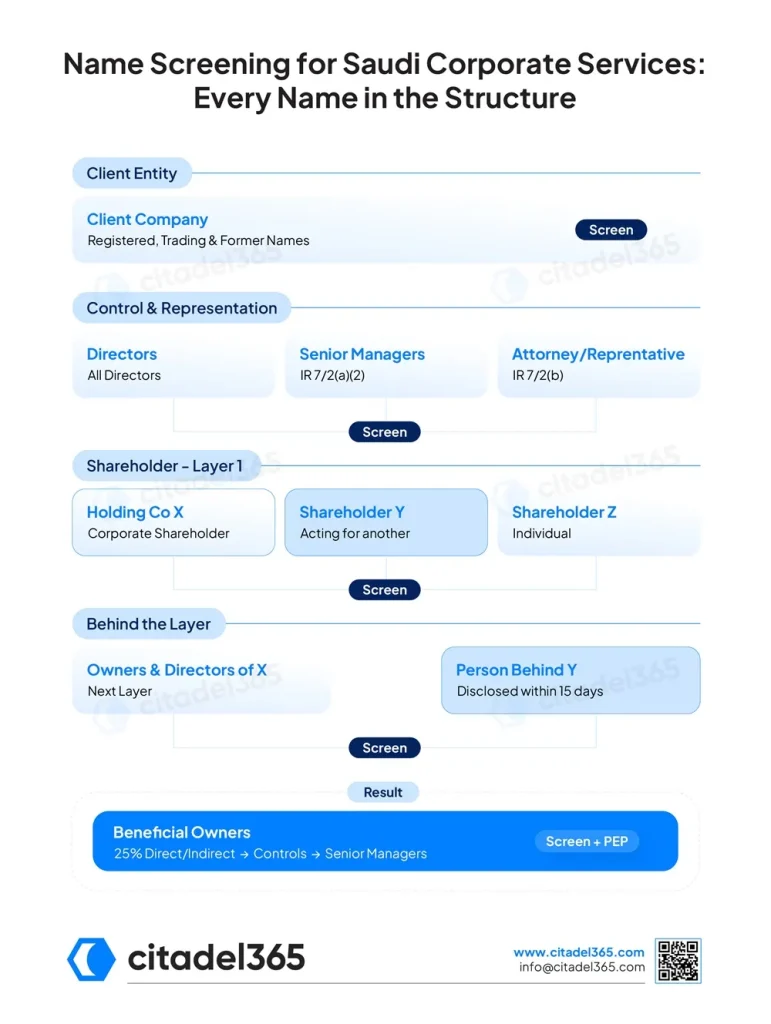
The client entity
Screen the company using its registered name, trading names and known former names; use name variations to help identify potential sanctions matches.
Directors and senior managers
Identify and screen directors and senior managers in accordance with applicable AML requirements.
Shareholders at every level
Screen corporate shareholders as entities and examine their ownership structures to identify relevant individuals and potential sanctions links.
Beneficial owners
Identify and screen beneficial owners who directly or indirectly own 25 per cent or more, as well as individuals exercising control through other means. Where no such persons can be identified, identify and screen the natural person who holds the senior management position.
Nominees and persons behind them
Where a shareholder acts on another person’s instructions, identify both the relevant parties and screen them accordingly. Under the Ministry of Commerce Beneficial Owner Rules issued on 05/06/1447H, companies must disclose their beneficial owners at incorporation, report changes within 15 days and confirm the data annually. Check the client’s disclosed beneficial ownership data, for example through the Wathq service, and report any discrepancies to the supervisory authority where required.
Representatives and counterparties
Screen authorised representatives acting under a power of attorney for company sales or acquisitions; also screen the counterparty and target company where relevant.
Screening Over the Life of a Client Structure
A client’s risk can change over time; Citadel365 supports screening at five key stages:
- Before engagement: screen relevant parties before providing services or conducting transactions.
- When sanctions lists change: re-screen existing clients and beneficial owners against the updated lists and apply targeted financial sanctions without delay, within 24 hours of listing.
- When ownership changes: screen new shareholders and beneficial owners, and confirm that the client has reported the change to the Ministry of Commerce within 15 days, as the Beneficial Owner Rules require.
- When new instructions arise: screen relevant parties involved in restructurings, capital increases and company sales.
- During periodic reviews: review higher-risk clients more frequently, based on their risk profiles and applicable requirements.
Handling a Sanctions Match on a Client Structure
Under the Ministry of Justice circular, lawyers and notary officers must take the following actions when a sanctions match is confirmed or reasonably suspected; accountants supervised by the Ministry of Commerce should apply equivalent freezing and reporting measures under the counter-terrorism law and Ministry of Commerce guidance:
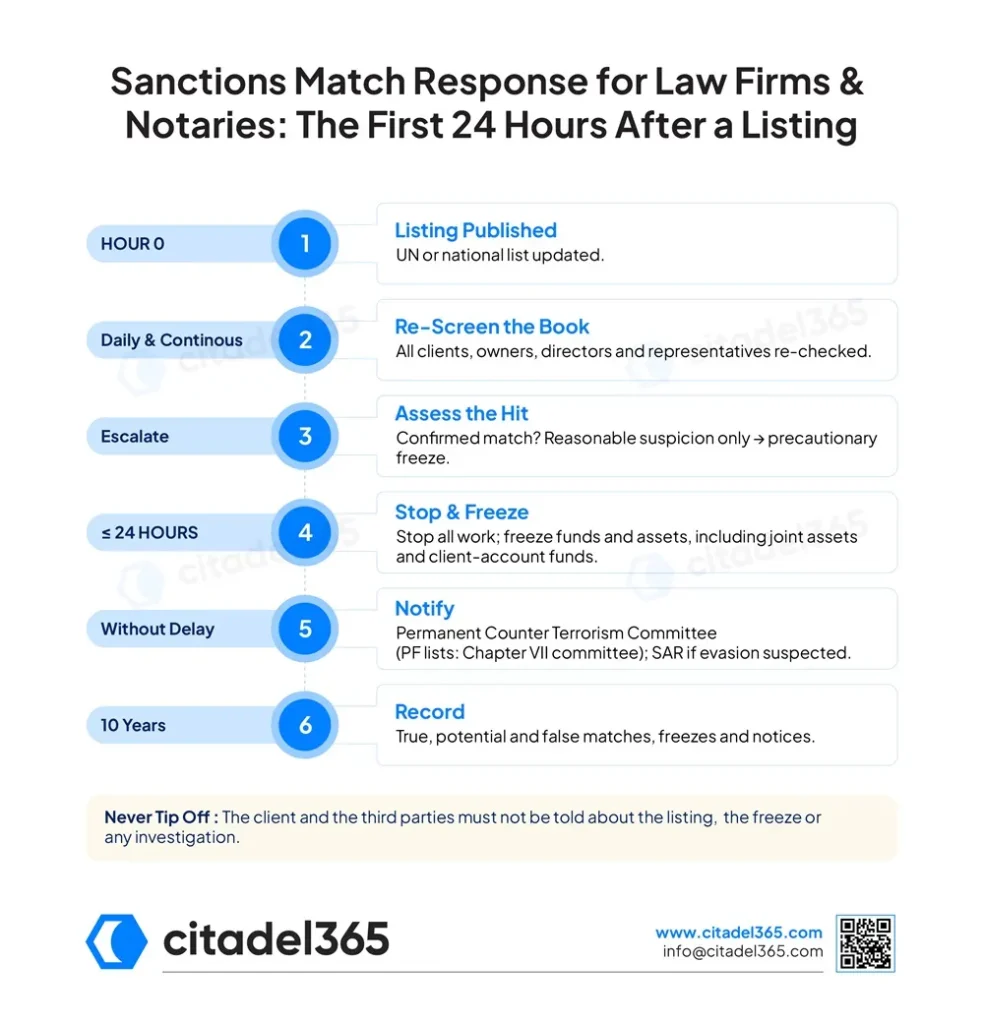
- Stop services: cease any transaction or ongoing or planned work related to the listed party.
- Freeze assets: freeze funds, financial assets and economic resources owned or controlled, directly or indirectly, by the listed party without delay and within 24 hours of listing, including jointly owned assets.
- Report promptly: notify the Permanent Committee for Combating Terrorism and its Financing or the standing committee for Chapter VII resolutions, as applicable, without delay through the designated channels.
- Address potential matches: assess potential matches promptly; where a match cannot be confirmed immediately but there are reasonable grounds for suspicion, apply a precautionary freeze and seek guidance from the supervisory or competent authority.
- Report suspected evasion: submit a suspicious transaction report whenever sanctions evasion, indirect provision of funds or other suspicious activity is suspected.
- Maintain confidentiality: do not inform the listed person or any third party of a freeze before it is executed, or that a suspicious transaction report has been filed.
Arabic Names and Entity Screening in Saudi Arabia
Arabic names can have various Latin-script spellings, while company names may vary due to translations, abbreviations and legal suffixes. Citadel365 uses configurable fuzzy matching to flag potential matches for individuals and entities. Reviewers can then use details such as date of birth, nationality, ID numbers and commercial registration numbers to verify or rule out matches.
Saudi Screening Requirements Mapped to Software Features
Requirement | Reference | Citadel365 capability |
Screen before engagement | Ministry of Justice Circular No. 476226920 dated 20/5/1447H, Section 1.1 | Screening during client onboarding |
Apply sanctions within 24 hours of listing | Ministry of Justice Circular No. 476226920 dated 20/5/1447H, Section 1.2 | Automated list refresh and re-screening |
Screen beneficial owners, directors and representatives | Ministry of Justice Circular No. 476226920 dated 20/5/1447H, Section 1.3 | Screening of linked parties |
Confirm beneficial ownership changes are reported within 15 days | Ministry of Commerce Beneficial Owner Rules issued on 05/06/1447H, Article 5 | Re-screening triggered by ownership changes |
Automated or semi-automated tools | Ministry of Justice Circular No. 476226920 dated 20/5/1447H, Section 1.4 | Real-time, batch and periodic screening |
Keep evidence of true, potential and false matches | Ministry of Justice Circular No. 476226920 dated 20/5/1447H, Section 1.4 | Full alert history with closure reasons |
Register for sanctions list update alerts | Ministry of Justice Circular No. 476226920 dated 20/5/1447H, Section 1.5 | Automated list update notifications and re-screening |
Identify PEPs with appropriate systems | Anti-Money Laundering Law (Royal Decree No. M/20 dated 05/02/1439H), Article 8 | PEP screening and risk-based enhanced due diligence |
Ten-year records | Ministry of Justice Circular No. 476226920 dated 20/5/1447H, Section 5.5; Anti-Money Laundering Law (Royal Decree No. M/20 dated 05/02/1439H), Article 12 | Exportable audit trail of screening records and decisions |
Manual Screening vs Name Screening Software for Corporate Services
Area | Manual screening | Name screening software |
Entity | Name checked manually, variations may be missed | Screens entity names and known name variations |
Ownership layers | Complex ownership structures are hard to trace | Supports screening across linked ownership layers |
Acting shareholders | Principal not checked | Principal linked and screened |
List updates | Checked at formation only | Re-screened on every update |
Evidence | Relies on manually maintained notes and files | Maintains searchable screening records and audit trails |
How Citadel365 Supports Name Screening for Corporate Service Providers in KSA
Citadel365 supports AML compliance for CSPs in KSA through its name screening software, which helps screen customers, beneficial owners and counterparties against sanctions, PEP and adverse media databases.
Citadel365 provides capabilities such as real-time, batch and periodic screening, including re-screening after list updates.
It identifies potential matches for individuals and entities using configurable matching thresholds.
Citadel365 supports maker-checker workflows, role-based access and documented match-closure reasons. It also generates audit-ready reports of screening activity, matches and review decisions.
Citadel365 name screening integrates with customer onboarding, customer risk assessment and case management to support connected compliance workflows.
Look Beyond Names, Uncover Hidden Risks.
Citadel365 helps screen clients, beneficial owners and complex ownership structures with smarter sanctions, PEP and adverse media screening.
Frequently Asked Questions
The client company, directors, senior managers, shareholders, beneficial owners and relevant parties should be screened, applying a risk-based approach. The persons behind acting shareholders and parties involved in company sales should also be screened where applicable.
Entity-level screening checks the company itself against sanctions lists using its registered name and known name variations; this helps identify potential sanctions exposure that screening individuals alone may miss.
Saudi firms should keep screening results, match assessments, decisions made and records of required sanctions actions. Article 12 of the Anti-Money Laundering Law requires records to be kept for at least ten years, and the Ministry of Justice circular applies the same period to targeted financial sanctions records.
Citadel365 screening software supports sanctions, PEP and adverse media screening, fuzzy matching, review workflows and screening reports. It also supports re-screening after list updates, maker-checker review and record-keeping.

Vasantha holds a Master’s in Law specialising in Banking Laws and Anti-Money Laundering and is CAMS and CGSS certified. With over 35 years of experience, she has worked closely with regulators and international financial institutions, building financial crime risk frameworks, sanctions monitoring programmes, and compliance systems across multiple jurisdictions.