
Name Screening Software for Accountants in Singapore
Ready to Defeat Your AML Compliance Obstacles?
Citadel365 Brings Revolution with Secure Solutions to AML Compliance Problems
Name Screening Software for Accountants in Singapore: Key Takeaways
- Name screening software for accountants in Singapore is a compliance platform that enables screening of clients, beneficial owners, and other relevant parties against sanctions, PEP and adverse media sources to manage ML/TF/PF risks under ACRA’s AML/CFT rules.
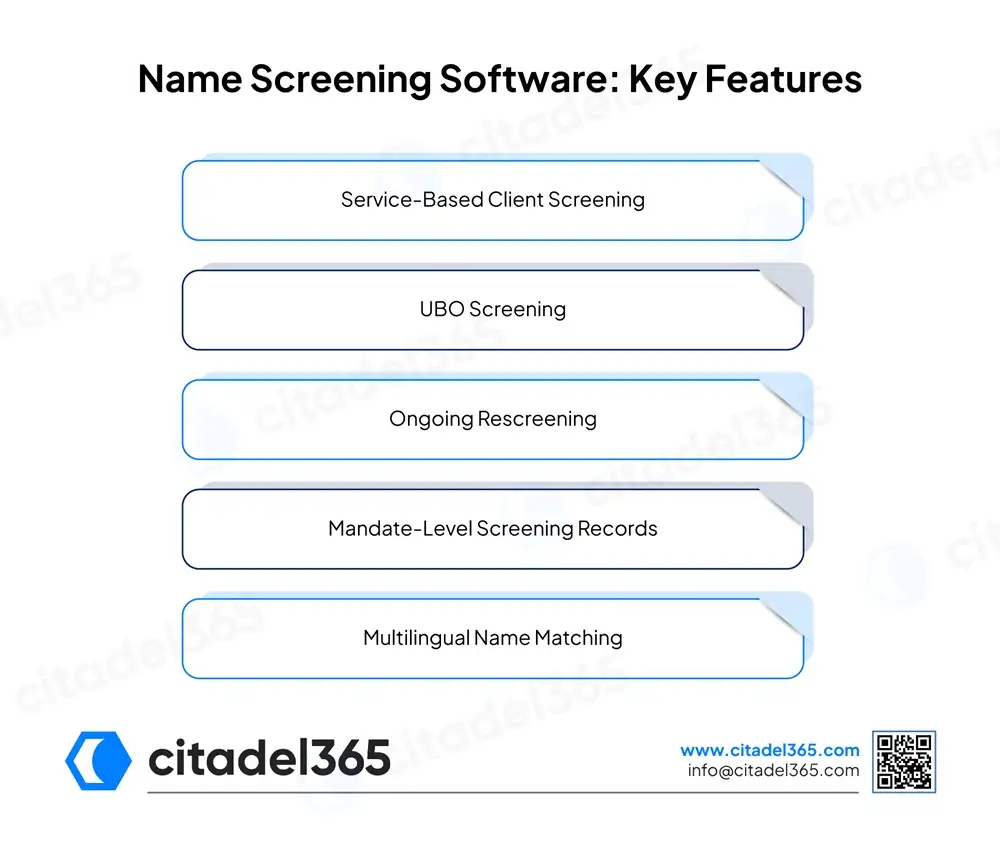
- Key features of name screening software include service-based client screening, UBO screening, ongoing rescreening, mandate-level screening records, and multilingual name matching capabilities.
- Citadel365 name screening software screens clients and their UBOs with ongoing rescreening and exportable records for ACRA inspection.
What Is Name Screening Software for Accountants in Singapore?
Name screening software for accountants in Singapore is AML compliance software that screens clients, their beneficial owners and other relevant parties against sanctions, PEP, and other financial crime risk databases as part of KYC screening and customer due diligence (CDD).
Why service-scoped screening matters for Singapore accounting firms
Service-scoped screening matters because Singapore’s AML/CFT obligations for accountants attach to the services a firm provides, not to the firm as a whole. Applying a blanket screening approach to every client, regardless of the service provided, may result in unnecessary screening for lower-risk activities while overlooking the need for enhanced due diligence in high-risk areas.
Under the Accountants (Prevention of Money Laundering and Financing of Terrorism) Rules 2023, which ACRA administers and ISCA has adopted in EP 200, customer due diligence applies when an accounting entity prepares for or carries out transactions for a client in specified activities. These activities include buying and selling real estate, organising contributions for companies, managing client money or assets, managing bank or securities accounts, creating or managing legal persons or arrangements, or buying and selling business entities. Work outside these activities may not trigger the same requirements, but the firm’s own risk assessment still applies.
How name screening software supports accounting compliance teams
Name screening software supports accounting compliance teams by automating client acceptance screening, beneficial owner screening, ongoing rescreening, alert management and audit trails.
Automated screening lets accounting firms keep consistent, timestamped records that support ACRA inspections.
Who Must Be Screened at a Singapore Accounting Firm?
Screening should cover clients, beneficial owners, persons acting on the client’s behalf and relevant trust parties, depending on the services provided and the nature of the engagement.
Clients on specified activities
Clients instructing the firm on specified activities covered by the applicable AML/CFT/PF requirements should be screened as part of the firm’s customer due diligence process.
Beneficial owners behind corporate clients
Where the client is a corporate entity, identify and screen the beneficial owners behind the entity, rather than only the named client contact.
Persons acting on behalf of the client
Directors, authorised signatories and anyone else who instructs the firm on the client’s behalf should be identified and screened, because sanctions and PEP risk can sit with the person giving instructions as well as with the owner.
Relevant trust parties where applicable
Where the engagement involves trust administration or another legal arrangement, relevant trust parties should be included in the screening population, where applicable. This may include settlors, trustees, protectors, beneficiaries or a class of beneficiaries.
How Name Screening Software Helps Singapore Accountants
Name screening software helps Singapore accountants meet AML/CFT requirements by automating checks against sanctions lists, PEP databases and adverse media. The table below maps each screening requirement to the sector challenge, the software feature and the evidence it produces.
Screening Requirement | Sector Challenge | Name Screening Feature | Evidence Generated |
Client screening at acceptance | Screening at service level for specified mandates | Service-triggered client screening at acceptance | Client screening record, match results, mandate reference |
UBO screening for corporate clients | Screening beneficial owners on company formation and trust mandates | UBO screening linked to KYB at acceptance | UBO screening records, match results, mandate reference |
PEP screening | Detecting PEP clients on corporate and trust mandates | PEP database screening on clients and UBOs | PEP match results, EDD trigger, review history |
Adverse media | Detecting financial crime reporting on clients | Adverse media integrated with sanctions and PEP run | Adverse media hits, alert notes, review trail |
Ongoing rescreening | Monitoring active specified activity clients for new listings | Ongoing rescreening while the specified activity engagement is open | Rescreening logs, new hit alerts, timestamps |
Compliance records for each client and service mandate | ACRA inspection evidence per service mandate | Records structured per client and per service mandate | Timestamped mandate records, exportable per service |
ACRA integration | Accurate entity data for Singapore-incorporated clients | ACRA business profile pulls for corporate client KYB | ACRA-sourced entity data, officer records, shareholder details |
Screening Red Flags for Singapore Accounting Firms
The key red flags that name screening software helps detect include:
- A client on a corporate service mandate is a close match to a sanctioned entity.
- A beneficial owner of a corporate client is identified as a PEP during screening.
- A client passes screening at onboarding but appears on a sanctions database mid-engagement.
- A director or other relevant individual connected to a corporate client is added to the UN Consolidated List during an ongoing engagement.
- A client has adverse media linking them to potential financial crime.
- A corporate client’s UBO is connected to a high-risk jurisdiction that was not identified at client acceptance.
What Happens After a Screening Match?
A screening match is an alert, not a conclusion. What the firm does next depends on whether the alert is a false positive, a PEP match, an adverse media hit or a confirmed sanctions match.
- False positives: the reviewer compares date of birth, nationality and identification details, records why the alert was discounted and closes it with a timestamp.
- PEP matches: the firm applies enhanced due diligence, including senior management approval and establishing the source of wealth and source of funds, before accepting or continuing the engagement.
- Adverse media hits: the reviewer assesses whether the reporting is credible and relevant, then updates the client’s risk rating and records the decision.
- Confirmed sanctions matches: the firm should not proceed, must avoid tipping off the client, and should file a suspicious transaction report with the Suspicious Transaction Reporting Office (STRO) and meet any reporting duties under Singapore’s targeted financial sanctions laws.
Essential Features of Name Screening Software for Singapore Accountants
The most useful name screening software for Singapore accountants screens by service, links UBOs to client records, rescreens automatically, organises records by mandate and handles multilingual names.
Service-based client screening
The software should be able to screen clients based on the type of service or engagement, rather than applying a blanket requirement to every client.
UBO screening for corporate clients
The software should screen the beneficial owners of corporate clients and connect the results to the relevant client record.
Ongoing rescreening
The software should automatically rescreen active clients to identify new sanctions, PEP, or other risk alerts during an engagement.
Mandate-level screening records
The software should organise screening results and alerts by client and service engagement, and keep them for at least five years, so reviewers and ACRA inspectors can follow the audit trail.
Multilingual name matching
The software should be able to recognise different name formats and variations across multiple languages.
Accountant Name Screening Software Buyer Checklist
When comparing AML compliance software or KYC software for an accounting practice, test these points in a demo rather than relying on the feature list.
- Ask the vendor to show how screening is triggered for a specified activity, such as a company formation mandate, and how scope updates when a client adds a new service.
- Check that UBO results link back to the corporate client record, so one review shows the entity and every owner screened.
- Confirm the ACRA data pull returns officers and shareholders, not just the entity name and UEN.
- Confirm adverse media screening runs in the same check as sanctions and PEP screening, not as a separate manual search.
- Ask for a demonstration of the alert an existing client generates when newly listed mid-engagement, and who receives it.
- Run sample names with spelling, word-order and script variations, such as Chinese, Malay and Tamil names, and compare match quality and false positive rates.
Questions to Ask a Screening Vendor
- Which sanctions, PEP and adverse media sources are covered, and how quickly are new UN and Singapore designations loaded?
- Where is client data hosted, and how does the platform support PDPA obligations?
- Can the audit trail show who reviewed each alert, the decision taken and the reason?
- Can screening records be exported per client and per engagement for ACRA inspections?
- How is pricing structured: per screening, per client or per user?
Citadel365 Name Screening Software for Accountants in Singapore
Citadel365 supports AML compliance for accountants in Singapore through its name screening software, helping accounting firms to screen clients and beneficial owners as part of their customer due diligence process.
Citadel365 supports screening against relevant sanctions lists, PEP databases and adverse media, with capabilities for ongoing rescreening, multilingual name matching and organised screening records to support regulatory inspections.
Citadel365 helps accounting firms, audit practices, public accountants, and tax advisers in Singapore strengthen how they screen clients and beneficial owners.
Conclusion
Name screening for accountants in Singapore is not a one-time check at the start of the client relationship. Under the Accountants (Prevention of Money Laundering and Financing of Terrorism) Rules 2023, screening covers clients, beneficial owners and persons acting for them on specified activities, with ongoing screening helping firms identify new sanctions, PEP or other risk alerts during an active client relationship.
Citadel365 helps accounting firms in Singapore to shift from manual and inconsistent screening to a more structured workflow with ongoing rescreening, multilingual name matching, and organised screening records.
Name Screening for Smarter Compliance
Citadel365 helps screen clients and beneficial owners with ongoing rescreening and organised compliance records.
Frequently Asked Questions
In Singapore, an accountant must screen a client before establishing a business relationship or undertaking an occasional transaction where the engagement involves a specified activity under the Accountants (Prevention of Money Laundering and Financing of Terrorism) Rules 2023. Client screening and ongoing monitoring must be conducted in accordance with the applicable requirements and on a risk-sensitive basis.
Yes. Where the Rules apply, a Singapore accounting firm must identify the ultimate beneficial owners (UBOs) of its corporate clients, take reasonable measures to verify them, and screen them as part of customer due diligence.
ACRA integration pulls a corporate client’s registered entity details, officers and shareholders from ACRA records, so the firm can verify the entity and identify who to screen without re-keying data.
No specific software is mandated. The Rules require accounting entities carrying out specified activities to perform customer due diligence, including screening, and to keep records. Software is the practical way to screen consistently, rescreen ongoing clients and produce inspection evidence.
Rescreening should continue for the life of the engagement and run whenever sanctions or PEP lists change, with closer review for higher-risk clients. Automated daily rescreening is a common way to meet this.
Singapore accountants should screen against the UN Security Council Consolidated List, persons and entities designated under Singapore’s Terrorism (Suppression of Financing) Act, PEP databases and adverse media. Firms with cross-border clients often add other major sanctions lists, such as OFAC, EU and UK lists.
Citadel365 helps accounting firms in Singapore by screening clients and beneficial owners, enabling ongoing rescreening, and maintaining records to support ACRA inspections.

Vasantha holds a Master’s in Law specialising in Banking Laws and Anti-Money Laundering and is CAMS and CGSS certified. With over 35 years of experience, she has worked closely with regulators and international financial institutions, building financial crime risk frameworks, sanctions monitoring programmes, and compliance systems across multiple jurisdictions.