
Proliferation and Proliferation Financing
Ready to Defeat Your AML Compliance Obstacles?
Citadel365 Brings Revolution with Secure Solutions to AML Compliance Problems
Define Proliferation and Proliferation Financing- Brief Overview
- Proliferation refers to the spread, development, acquisition, or transfer of weapons of mass destruction and related materials.
- Proliferation financing refers to the provision of funds, financial services, or assets that support WMD proliferation activities.
- Citadel365 helps businesses in the UAE to stay compliant through its ML/TF/PF risk assessments, sanctions screening, AML training, and support in meeting regulatory requirements.
What Is Proliferation?
Proliferation refers to the development, acquisition, manufacture, possession, transport, transfer, or use of weapons of mass destruction (WMDs).
Proliferation from an international security perspective is a global concern because it increases the risk of devastating weapons falling into the hands of rogue states, terrorist organisations, or sanctioned entities.
Preventing proliferation is essential for maintaining international peace and financial integrity, it can lead to an increase in global security threats, enable the development of harmful weapons, and lead to regulatory penalties and reputational damage.
The core types of proliferation include :
- Nuclear: the spread of atomic weapons, nuclear materials, or technologies that can be used to develop nuclear weapons.
- Chemical: the development or transfer of chemical weapons, toxic agents, precursors, or equipment used to manufacture them.
- Biological weapons: the distribution of biological weapons, pathogens, toxins, or related technologies that can contribute to the development of biological weapons.
- Missile technology: the transfer or development of missile systems that could support the delivery of weapons of mass destruction.
What Is Proliferation Financing?
Proliferation financing refers to providing or making funds, financial services, assets, or other economic resources available that are used to support the proliferation of weapons of mass destruction (WMDs), including the development, production, acquisition, possession, or transportation of WMDs, their means of delivery, and related materials.
FATF defines proliferation financing as providing funds or financial services for the manufacture, acquisition, development, export, transport or transfer of nuclear, chemical, or biological weapons and their delivery systems.
Difference Between Proliferation and Proliferation Financing
Aspect | Proliferation | Proliferation Financing (PF) |
Meaning | The physical creation, spread, transport, or use of nuclear, chemical or biological weapons and missiles. | The provision of funds, assets, or financial services to support the proliferation. |
Activities | May include procurement of materials, technology or equipment, development and production of WMDs, transportation, transfer, or acquisitions. | May include raising, moving, transferring, disguising, or providing funds and assets to support proliferation-related activities. |
Participants | May involve state actors, organisations, intermediaries, or individuals involved in WMD development. | May involve front companies, shell corporations corrupt intermediaries, or other facilitators providing financial support. |
From Compliance Gaps to Compliance Confidence
We help businesses build a stronger, more resilient AML/CFT/CPF framework.
Why Is Proliferation Financing a Serious Global Risk?
Proliferation financing is a serious global risk because it directly provides the financial and economic support which is needed to develop, acquire, manufacture, transport, or facilitate weapons of mass destruction (WMDs).
The risks of proliferation financing include:
- WMD development: provides funds to develop, buy, or test nuclear, chemical, and biological weapons and their delivery systems.
- Sanctions evasion: proliferation networks may use intermediaries, front companies, complex transactions, or third-country jurisdictions to circumvent targeted financial sanctions to conceal the true beneficial owner.
- International trade abuse: mixes illegal shipments with normal legitimate cargo by misusing dual-use goods that may ultimately be used to support WMD programmes.
- Shell companies: hide the true owners of funds and trades behind shell entities, or move illicit funds through multiple jurisdictions.
- Export controls: proliferators may attempt to bypass export controls through various techniques such as misrepresentation of goods, use of intermediaries, forged documentation or routing shipments through jurisdictions with weaker controls.
How Proliferation Financing Works
Proliferation financing can generally be understood through three stages, which include:
- Raise Funds: funds are generally raised through legitimate or illicit sources to support proliferation-related activities.
- Obscure Movement: funds are then transferred through complex transactions, intermediaries, shell companies, or multiple jurisdictions to conceal the origin of the funds.
- Procure and Ship: the funds are used to purchase, procure, and transport WMD-related materials, technology, equipment, or dual-use goods.
Proliferation Financing Typologies
Proliferation financing may use legitimate-looking business and financial activities to conceal the movement of funds and goods. The common examples are as follows:
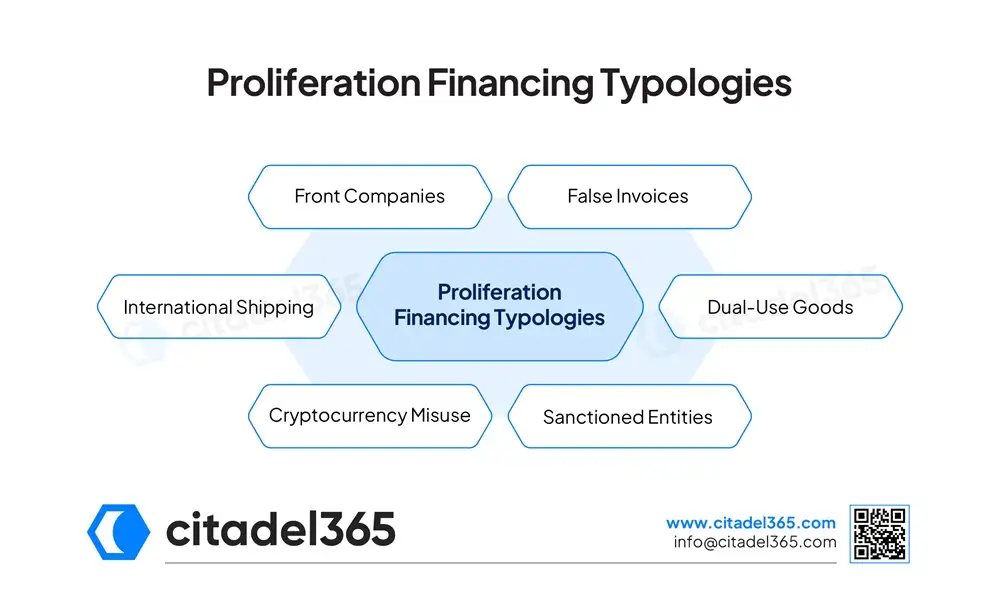
Front companies
Fake or shell businesses hide the true owners, acting as buyers or sellers for illegal shipments.
False invoices
Traders often list inaccurate descriptions, values, or quantities on invoices used to conceal the origin and nature of goods and payments.
Dual-use goods
Legitimate commercial products or technologies that can also be used in WMD-related activities.
Sanctioned entities
Attempts to conduct transactions with or on behalf of sanctioned individuals or entities, through intermediaries.
Cryptocurrency misuse
Digital assets or related services may be misused to move or obscure funds and make transactions harder to trace.
International shipping
Shippers use complex routes, intermediaries, or misleading documentation that may be used to conceal the source of funds and goods
Common Red Flags of Proliferation Financing
The common red flags of proliferation financing include:
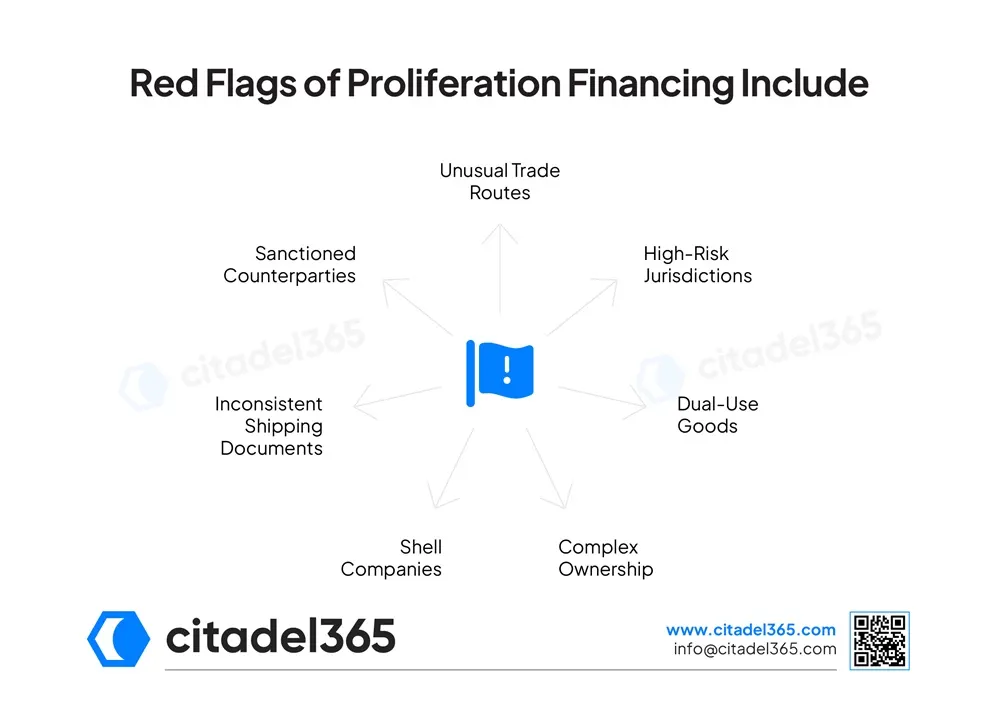
- Unusual trade routes: Goods or funds routed through countries that have no clear commercial connection to the transaction.
- High-risk jurisdictions: Involvement of high-risk jurisdictions that are often associated with high PF, sanctions, or illicit funds risks.
- Dual-use goods: Transactions involving goods, technology, or equipment that could have both legitimate and WMD-related applications.
- Complex ownership: Complex ownership structures that make the ultimate beneficial owners difficult to identify.
- Shell companies: Companies with little or no genuine business activity used to conceal the parties, purpose, and flow of funds.
- Inconsistent shipping documents: Inconsistent shipping documents that do not match the actual trade occurrence indicate a red flag.
- Sanctioned counterparties: Direct or indirect involvement of sanctioned individuals, entities, vessels, or other restricted parties.
Proliferation Financing vs Money Laundering vs Terrorist Financing
Aspect | Proliferation financing | Money laundering | Terrorist financing |
Purpose | To finance the development, acquisition, or transport of weapons of mass destruction. | To hide the illegal source of criminal money and make it look legitimate. | To finance for terrorist acts, training, and group operations. |
Source of funds | Often appears like normal, legal trade transactions | Primarily proceeds of crime or other illicit activities, | May come from legitimate or illicit sources. |
Examples | Using front companies to buy restricted dual-use chemicals or nuclear triggers. | Using shell companies or complex transactions to disguise proceeds from fraud, corruption, or trafficking. | Collecting donations or transferring funds to support terrorist operations or organisations. |
FATF Recommendations on Proliferation Financing
The FATF Recommendation 7 sets out specific requirements, especially on targeted financial sanctions, to counter proliferation financing.
Countries, financial institutions, DNFBPs and VASPs must identify, assess, and mitigate PF risks, including risks of sanctions breaches or evasion.
The FATF uses Immediate Outcome 11 to assess how effectively persons and entities involved in the proliferation of weapons of mass destruction are prevented from raising, moving and using funds, consistent with the relevant United Nations Security Council Resolutions
Industries Most Exposed to Proliferation Financing Risk
Proliferation financing risk may be higher in sectors involving cross-border payments, high-value trade, and asset concealment.
Some of the key industries exposed to proliferation financing risk are as follows:
- Banks: These sectors often process large volumes of international wire transfers and pose proliferation financing risks from hidden beneficial owners and complex corporate layers.
- Money service businesses: may face risks due to frequent cross-border cash transfers, which lead to low oversight in some regions.
- Freight forwarders: arrange cargo space and logistics, often lacking deep visibility into the original nature of shipped dual-use goods.
- Shipping: moves cargo through complex routes and intermediaries, which may lead to concealment of end-users and destinations.
- Insurance: covers maritime cargo insurance that may be linked with high-risk trade transactions.
- Precious metals: high-value, easily transferable assets can be easily misused to move or store illicit funds.
- Real estate: complex ownership structures can be used to conceal beneficial ownership.
- Corporate service providers: create trusts and shell companies, hiding who truly owns or controls high-risk business entities.
- Trade finance: relies on shipping and trade documents, which can be exploited to facilitate proliferation-related trade.
See the Risk Before It Becomes a Threat
Citadel365 identify PF vulnerabilities and strengthens your business against emerging financial crime risks.
How Businesses Can Reduce Proliferation Financing Risk
Businesses in the UAE can reduce proliferation financing risk by implementing a risk-based compliance framework:
- Customer Due Diligence: Businesses should conduct CDD to identify and verify customer identity and their business activities.
- Enhanced Due Diligence: Apply deeper scrutiny for high-risk customers, transactions, or jurisdictions.
- Sanctions Screening: Screen customers, counterparties, and transactions against relevant sanctions lists.
- Transaction Monitoring: Identify unusual transactions and potential PF-related activity.
- Trade Finance Controls: Verify trade documents, goods, and counterparties to detect potential risks involving dual-use goods.
- UBO Verification: Identify and verify the ultimate beneficial owner behind complex, multi-layered shell companies to uncover the hidden controllers.
- Employee Training: Train employees regularly, helping them to early recognise red flags specific to proliferation networks, such as mismatched shipping geographies or evasion of trade descriptions.
- Independent Audits: Perform regular, independent internal testing of compliance controls to locate vulnerabilities and ensure operational readiness.
Why Proliferation Financing Compliance Matters in the UAE
Effective proliferation financing compliance helps UAE businesses to manage regulatory risk, protect their reputation, and maintain access to the international financial system.
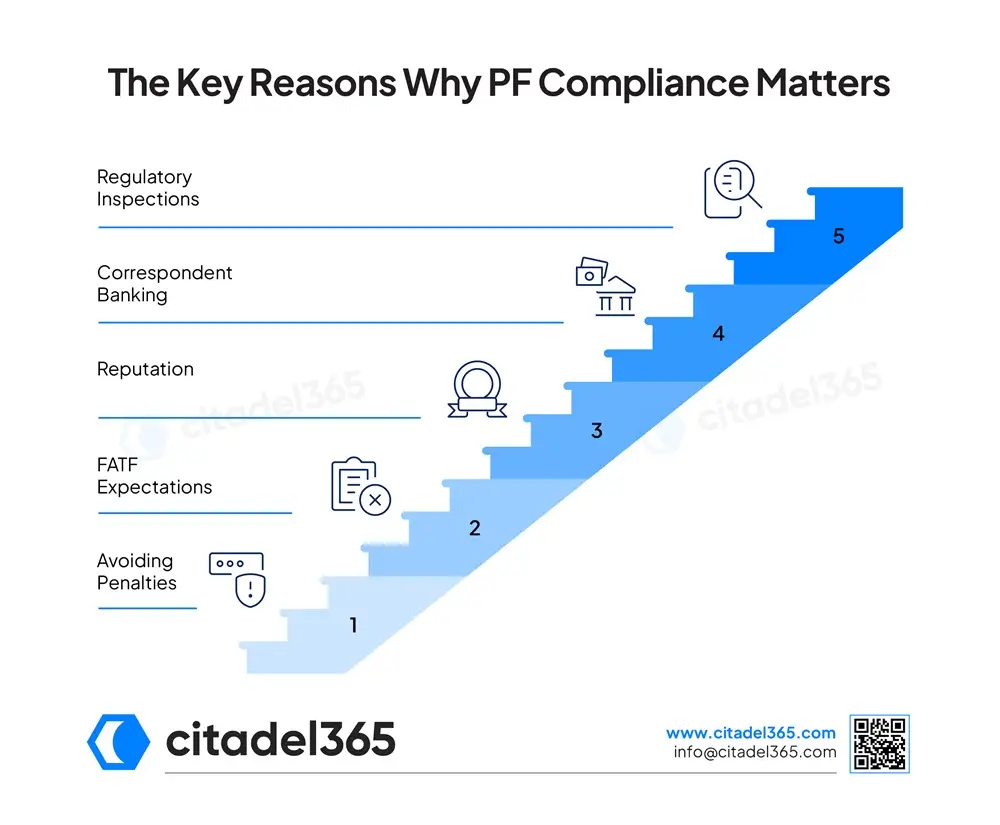
- Avoiding penalties: effective compliance controls help businesses to avoid breaching targeted financial sanctions or proliferation financing rules, reducing the risk of regulatory penalties.
- FATF expectations: robust PF controls support the UAE’s alignment with FATF standards and international best practices.
- Reputation: proactive compliance prevents links to proliferation networks, helping businesses protect against reputational damage and boost stakeholders’ confidence.
- Correspondent banking: effective AML/CFT/CPF compliance can help maintain relationships with international correspondent banks and financial institutions.
- Regulatory inspections: a risk-based PF framework with proper documentation helps businesses demonstrate compliance during regulatory inspections and supervisory reviews.
How Citadel Helps Businesses Stay Compliant
Citadel365 helps businesses stay compliant through its AML consulting service to strengthen overall AML/CFT/CPF controls.
It enables risk assessment to identify and assess the risk associated with proliferation financing to prevent businesses from ML/TF/PF risk.
Citadel365 screening software helps screen counterparties and organisations against sanctions, PEP, and adverse media lists to identify potential risk.
Citadel365 provides robust AML training to employees, enabling them to detect potential red flags early, preventing the organisation from financial crime risk.
Citadel365 also helps businesses meet UAE regulatory requirements and enables identifying control gaps and improving overall compliance effectiveness.
Protect Your Business, Strengthen Your Compliance
Citadel365 helps in identifying ML/TF/PF risks before they become regulatory risks.
Frequently Asked Questions
Proliferation financing refers to providing funds, financial services, or assets to support the development, acquisition, or proliferation of weapons of mass destruction.
The three stages of PF are raising funds, obscuring the movement of funds, and procuring and shipping WMD-related or dual-use goods.
Key proliferation financing red flags include unusual trade routes, high-risk jurisdictions, complex ownership structures, shell companies, dual-use goods, and inconsistencies in shipping documents.
Industries that are exposed to PF risks include banks, money services businesses, freight forwarders, shipping, insurance, precious metals, real estate, corporate service providers, and trade finance.

Vasantha holds a Master’s in Law specialising in Banking Laws and Anti-Money Laundering and is CAMS and CGSS certified. With over 35 years of experience, she has worked closely with regulators and international financial institutions, building financial crime risk frameworks, sanctions monitoring programmes, and compliance systems across multiple jurisdictions.