
Customer Risk Assessment Software in KSA
Ready to Defeat Your AML Compliance Obstacles?
Citadel365 Brings Revolution with Secure Solutions to AML Compliance Problems
Customer Risk Assessment Software in KSA: Brief Overview
- Customer risk assessment software is a compliance tool that helps regulated entities in KSA assess, score, document, and monitor customers’ ML/TF risk.
- The key features of customer risk assessment software include risk model configuration, documented rationale, PEP and screening integrations, source of wealth EDD workflow, automated periodic reviews, and a regulator-ready audit trail.
- Citadel365 provides configurable CRA workflows with documented rationale, EDD triggers, periodic review scheduling, and a full audit trail.
What Is Customer Risk Assessment Software?
Customer risk assessment (CRA) software is a compliance tool that scores each customer’s money laundering and terrorist financing (ML/TF) risk, assigns a documented customer risk rating, and keeps that rating current. It helps regulated entities in Saudi Arabia apply a risk-based approach to AML/CFT compliance.
In practice, it turns the entity’s customer risk assessment methodology into a repeatable workflow: it applies the same risk factors to every customer, triggers enhanced due diligence where required, and schedules periodic reviews so ratings stay current throughout the relationship.
Saudi Arabia’s Anti-Money Laundering Law (Royal Decree No. M/20 dated 05/02/1439H) and its Implementing Regulations require financial institutions and designated non-financial businesses and professions (DNFBPs) to identify, assess, document, and regularly update their ML/TF risks across customers, countries and geographic areas, products, services, transactions, and delivery channels. Under Article 7 of the Law, the scope of due diligence must reflect the risk the customer presents, and enhanced due diligence applies where the risk of money laundering is high.
An enterprise-wide risk assessment (EWRA) is the AML risk assessment for the business as a whole and sets the scoring methodology; the CRA is the customer risk assessment that applies that methodology to each customer relationship. Customer risk ratings should be based on relevant risk factors and supported by clear, documented rationale rather than relying solely on numerical scores.
Why Customer Risk Assessment Software Matters in KSA
Customer risk assessment software matters in KSA because every customer risk rating has to be explainable, documented, and kept up to date, and manual spreadsheets struggle to do that consistently as the customer base grows. Supervisory authorities such as the Saudi Central Bank (SAMA) and the Capital Market Authority (CMA) can request these risk assessments, so regulated entities should be able to demonstrate not only that customers have been assigned risk ratings, but also why those ratings were assigned, which factors influenced the assessment, and whether the ratings have been reviewed and updated when required.
Documented rationale helps demonstrate that the CRA process is consistent, risk-based, and properly supported.
Saudi Arabia’s customer risk environment can involve a range of factors that make configurable risk assessment important. This may include PEP status, beneficial ownership, source of wealth and source of funds, customer profile, products and services, transaction activity, and exposure to higher-risk jurisdictions.
For corporate customers, complex ownership structures may require closer assessment of UBOs and the jurisdictions involved. For high-net-worth customers, source of wealth and source of funds may also be relevant to overall customer risk assessment.
Ongoing review, often called ongoing due diligence, is also an important part of customer risk assessment. Higher-risk customers generally require more frequent reviews than lower-risk customers, with the frequency and scope determined by the customer’s risk profile and applicable requirements.
How Does Customer Risk Assessment Software Work?
The key processes of customer risk assessment software are as follows:
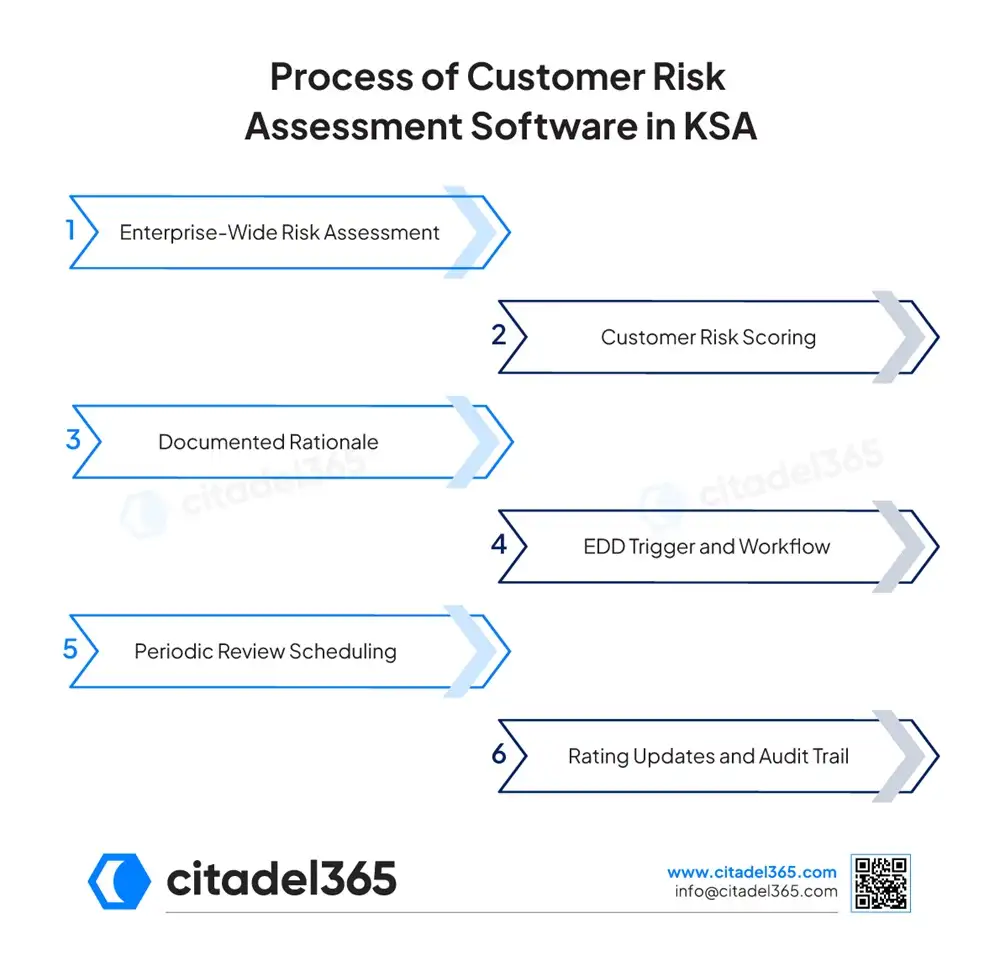
Step 1: Enterprise-wide risk assessment as the foundation
The EWRA documents the entity’s ML/TF risk profile across customer types, products, channels, and geographies; this provides the broader risk context for developing and configuring the customer risk assessment methodology.
Step 2: Customer risk scoring at onboarding
When a customer is onboarded, the software assesses their risk using factors such as nationality, residency, customer type, products, PEP status, screening results, business activity, transactions, and ownership. It weights these factors, often through an AML risk matrix or customer risk scoring model, into an AML risk score and a customer risk rating, typically low, medium, or high. That rating sets the level of due diligence: simplified due diligence, standard CDD, or enhanced due diligence.
Step 3: Documented rationale
The software records the factors behind each customer’s risk rating and why the rating was assigned, providing a clear record of the assessment.
Step 4: EDD trigger and workflow
If a customer is assessed as higher-risk, the software can trigger the appropriate enhanced due diligence process. This may include collecting source-of-funds and source-of-wealth information, conducting additional checks, and obtaining required senior management approval.
Step 5: Periodic review scheduling
The software schedules customer reviews based on their risk level. Higher-risk customers can be reviewed more frequently, while automated reminders and overdue alerts help keep reviews on track.
Step 6: Rating updates and audit trail
When the customer’s risk profile changes, such as a new PEP screening hit, a change in ownership structure, or a revised transaction pattern, the customer can be reassessed. This is often called dynamic risk assessment: the customer risk profile updates as new information arrives instead of waiting for the next scheduled review. The software records the updated risk assessment, rationale, review history, and other relevant actions in an audit trail, supporting regulatory examinations and AML/CFT compliance.
Key Features of Customer Risk Assessment Software for KSA
The following are key features of customer risk assessment software for KSA:
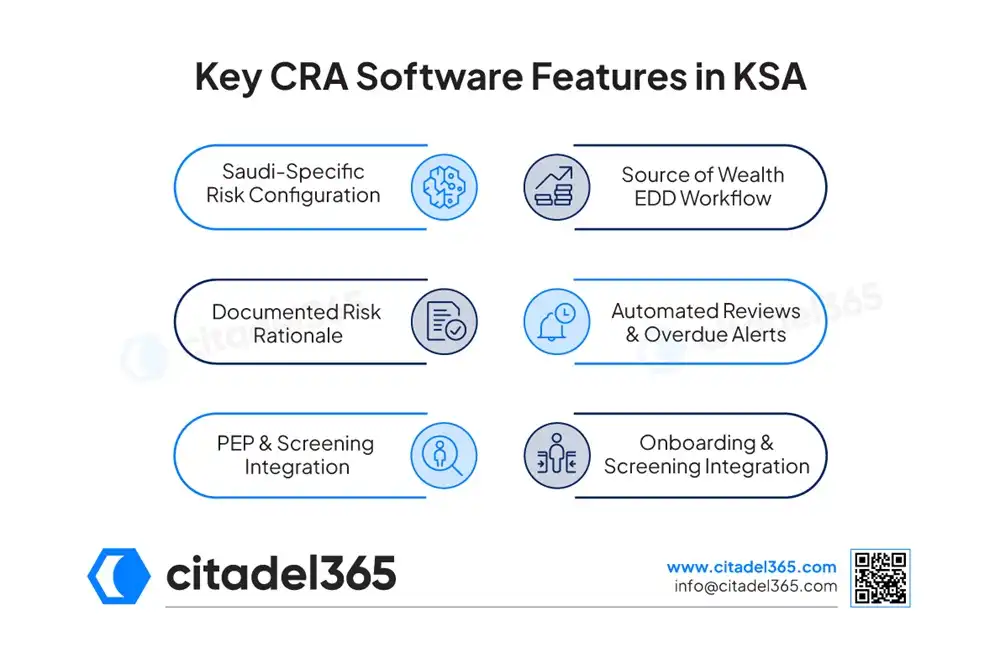
Saudi-specific risk model configuration
The customer risk assessment software should support customer risk profiling with configurable risk factors such as PEP status, beneficial ownership structure, customer type, source of wealth and funds, transaction activity, and jurisdictional exposure.
Documented rationale per customer rating
The software should enable capturing key factors behind each customer’s risk rating and maintain a clear record of the assessment, supporting consistent and transparent risk decisions.
PEP and screening integrations
It should connect screening results with customer risk assessments, allowing relevant screening outcomes to be considered in the customer’s overall risk profile and appropriate follow-up actions, such as triggering EDD where required, without manual re-keying of data.
Source of wealth EDD workflow
The software should support enhanced due diligence for high-risk customers with structured workflows for collecting source-of-wealth and source-of-funds information, additional checks, and required approvals.
Automated periodic reviews with overdue alerts
The customer risk assessment software should ensure every customer is reviewed on a schedule set by their risk level, with shorter cycles for high-risk customers, and generate escalations for missed reviews.
Audit trail and regulator-ready reporting
It should keep a complete history of each customer’s risk ratings, rationale, reviews, and approvals, and export it in a format that can be provided to SAMA, the CMA, or other supervisory authorities on request.
How Citadel365 Supports Customer Risk Assessment in KSA
Citadel365 supports AML compliance in KSA through its customer risk assessment software, which helps regulated entities assess and manage customer ML/TF risk through configurable risk factors, documented rationale, automated workflows, and periodic review scheduling.
Citadel365 enables enterprise-wide risk assessment that helps entities assess and document their overall ML/TF risk exposure as part of their broader AML/CFT risk management framework.
Citadel365 ensures that every risk rating, rationale record, review, and EDD trigger is well documented and maintained with an audit trail. Records are also retrievable and exportable to support regulatory examinations and overall AML/CFT compliance.
Simplify customer risk assessment in KSA
Citadel365 manages customer risk with configurable assessments, documented rationale, automated workflows, and periodic reviews.
FAQs About Customer Risk Assessment Software in KSA
Customer risk assessment software in KSA is a compliance tool that gives each customer a documented AML risk rating, usually low, medium, or high, based on configurable risk factors. That rating then sets the level of due diligence and the review schedule, in line with the risk-based approach under Saudi Arabia’s Anti-Money Laundering Law.
Review frequency should be based on the customer’s risk level. Saudi Arabia’s Anti-Money Laundering Law requires risk assessments to be documented and regularly updated, so higher-risk customers generally need more frequent reviews, and any customer should be reassessed when a relevant risk factor changes, such as a new PEP match or a change in beneficial ownership.
Good CRA software handles complex Saudi family business structures by mapping multi-layered ownership networks, identifying beneficial owners (UBOs), control structures, and relevant jurisdictions as part of the customer’s overall risk assessment.
Yes. Article 7 of Saudi Arabia’s Anti-Money Laundering Law requires financial institutions and DNFBPs to set the scope of due diligence based on the risk each customer presents, so every customer needs a risk assessment. The law does not require specific software, but entities must document their risk assessments, keep them updated, and provide them to supervisory authorities on request.
An enterprise-wide risk assessment (EWRA) measures the ML/TF risk of the business as a whole, across its customers, products, delivery channels, and geographies. A customer risk assessment applies that methodology to one customer at a time and produces an individual risk rating that drives CDD, EDD, and review frequency.
Citadel365 helps manage customer risk through configurable risk factors, documented rationale, automated reviews, workflows, and comprehensive audit trails.

Arjun is the Co-founder and CEO of Citadel365, where he leads the company’s vision across technology, business, and regulations. He brings over a decade of experience in building and scaling technology ventures. Arjun holds a B.Tech. in Information Technology and a Master’s in Management, supported by his certification as a Financial Crime Specialist, an uncommon combination that allows him to balance innovation with regulatory requirements.
Having advised leading banks and financial institutions on digital solutions and compliance technology, Citadel365 continues to grow with an ambition