
Customer Onboarding Software in KSA
Ready to Defeat Your AML Compliance Obstacles?
Citadel365 Brings Revolution with Secure Solutions to AML Compliance Problems
Key Takeaways: Customer Onboarding Software in KSA
- Customer onboarding software is a digital solution that helps KSA-regulated entities collect and verify customer information, reducing manual effort and human errors.
- Onboarding software helps banks, insurance companies, money changers, and DNFBPs to comply with CDD obligations and prevent fraud, money laundering and other financial crime risks.
- Citadel365 helps simplify customer onboarding, including document collection, verification, UBO mapping, screening, and record-keeping in a centralised system.
- In Saudi Arabia, onboarding software typically connects to Yakeen and Nafath for identity checks and scales due diligence from simplified to enhanced based on each customer’s risk.
What is Customer Onboarding Software?
Customer onboarding software is a compliance tool that helps regulated entities in Saudi Arabia identify and verify customers and collect their information to prevent money laundering, terrorist financing and other financial crime risks. Often called KYC software or an eKYC platform, it automates the customer due diligence (CDD) process so onboarding is faster, more consistent and less manual.
This tool is relevant for KSA banks, insurance companies, fintech firms, money changers, capital market institutions, and DNFBPs such as accountants, legal professionals, dealers in precious metals and stones (DPMS), and real estate brokers. These regulated entities must comply with customer due diligence obligations; customer onboarding software helps apply a risk-based approach proportionate to the customer’s risk profile.
Why Customer Onboarding Software Matters in KSA
Customer onboarding software helps KSA-regulated entities with KYC and KYB processes, making checks faster and more accurate than manual document collection. Rather than retyping data, entities can verify customer details against official government records through Elm’s Yakeen service. They can also authenticate citizens and residents (Iqama holders) through Nafath, the national single sign-on linked to Absher accounts.
For corporate entity customers, such as family groups, multi-tier holding structures and government-related entities, regulated entities are required to collect information on ultimate beneficial ownership (UBO). Onboarding software supports this KYB work by mapping ownership across each layer until it reaches the natural persons who ultimately own or control the entity.
Article 7 of the Anti-Money Laundering Law (Royal Decree No. M/20 of 1439H) requires financial institutions and DNFBPs to apply due diligence measures to their customers and to scale them to the risk involved, with enhanced measures where the risk is higher. The platform assesses customer risk, develops their risk profile, and applies simplified, standard or enhanced due diligence (EDD) as required.
Still Doing Customer Onboarding Manually?
Citadel365 conducts KYC, KYB, screening and risk assessment in one digital workflow.
How Does Customer Onboarding Software Work in KSA?
Customer onboarding software automates KYC, KYB, screening, risk assessment, and record-keeping in one structured process. The onboarding software workflow includes:
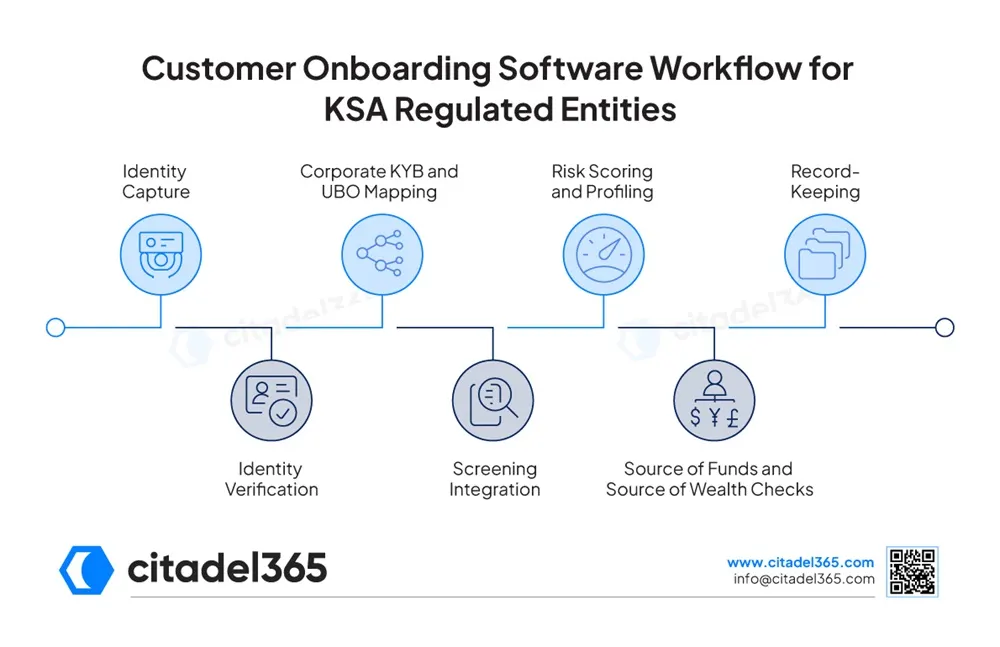
Identity Capture
Customer onboarding software first captures the customer’s basic identity information and required documents. It can integrate with Nafath for authentication and with Yakeen to retrieve and verify identity data, with the customer’s prior consent, as the SAMA Rulebook requires for banks using Yakeen.
Identity Verification
Customer onboarding software verifies the information against official sources such as Yakeen and the customer’s original documents. It uses OCR to extract document data, checks expiry dates and, for remote onboarding, runs a liveness check that matches the customer’s face to the ID photo.
Corporate KYB and UBO Mapping
The platform collects corporate entity customer information and ownership details. It maps the ownership across multiple levels to identify and verify the ultimate beneficial owner (UBO).
Example: a Riyadh trading company is 60% owned by a holding company, which is itself split between three siblings and a family trust. The software records each layer, links every shareholder to a verified Nafath or Iqama identity, and flags the trust for EDD because its beneficiaries are not visible on the Commercial Registration.
Screening Integration
Customer onboarding software integrates with a screening solution to check against relevant sanctions, PEP and adverse media sources. It helps identify potential matches among individual customers, corporate entity customers, and beneficial owners.
Risk Scoring and Profiling
The onboarding platform assesses customer risk based on customer type, geography, products or services, delivery channel, ownership structure and screening results, and assigns a risk level to build the customer’s risk profile.
Source of Funds and Source of Wealth Checks
As part of enhanced due diligence for high-risk customers, the onboarding platform collects the source of funds and source of wealth information and supporting documents to confirm that the customer’s funds and wealth come from legitimate sources.
Record-Keeping
Customer onboarding software routes the completed file for compliance approval, then stores customer details, verification results, screening records, supporting documents and the approval decision in one place. Article 12 of the AML Law requires due diligence records and copies of identification documents to be kept for at least ten years after the business relationship ends.
Key Features of Customer Onboarding Software for KSA
When comparing onboarding tools for the Saudi market, test these five capabilities first. Each supports a workflow step above, but the detail below shows what separates a KSA-ready tool from a generic one.
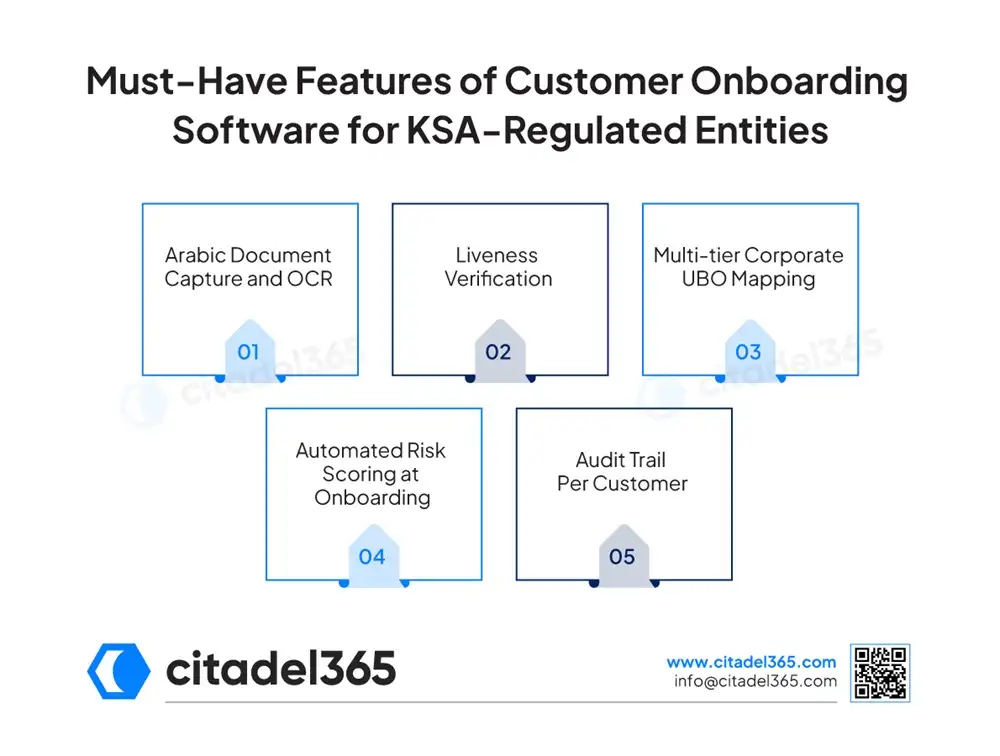
Arabic Document Capture and OCR
Customer onboarding software should not just capture identity documents; it should also extract information to facilitate verification. Many Saudi documents are issued wholly or partly in Arabic, so the software needs Arabic OCR to extract data from Saudi national IDs, Iqamas and Commercial Registrations without manual retyping.
Liveness Verification
For KSA businesses that operate digitally or onboard customers remotely, onboarding software should run a liveness check. It should ensure that the person is real and present during the verification process to avoid fraud, deepfakes and spoofing attacks.
Multi-tier Corporate UBO Mapping
An onboarding platform should map UBOs across complex ownership structures in Saudi family businesses and government-related entities. The platform should identify who actually owns and controls a business.
Automated Risk Scoring at Onboarding
Onboarding software should calculate customer risk automatically from customer information, screening results and other risk factors. It should also let compliance officers override a score and record the reason, so supervisors can see the human judgement behind each risk rating.
Audit Trail Per Customer
Customer onboarding software should keep customer documents, verification results, approvals, screening outcomes, and other onboarding actions in a time-stamped record that can be retrieved when required for supervisory inspections.
A Faster Way to Customer Onboarding
Citadel365 automates identity verification, UBO mapping, screening, risk assessment and record-keeping through a structured workflow.
How Citadel365 Supports Customer Onboarding in KSA
Citadel365 helps KSA-regulated entities with risk-based CDD workflows aligned to sector-specific supervisory obligations. The customer onboarding software accelerates customer data capture through a flexible multi-channel approach, including form-based entry, email-based KYC and Excel import.
The onboarding software integrates with a name screening solution to check customers against relevant sanctions, PEP and adverse media sources. It also supports mapping corporate entity structures to identify the ultimate beneficial owners.
Citadel365 supports risk classification and automates risk scoring and profiling. For KSA-regulated entities conducting remote onboarding, the software provides a structured workflow and ensures adequate verification before building a business relationship.
Citadel365 helps collect supporting documents for high-risk customers who require additional checks. The onboarding software also secures customer information and keeps documents, verification results, and decisions with a clear audit trail for regulatory reviews.
Primary Sources
- Anti-Money Laundering Law, Royal Decree No. M/20 dated 5/2/1439H (25 October 2017): Article 7 (due diligence) and Article 12 (record-keeping).
- Implementing Regulations of the Anti-Money Laundering Law.
- SAMA Rulebook, circular No. 371000018071 (23 November 2015): Yaqeen for ID Verification.
- Ministry of Commerce, Guidance Manual for Combating Money Laundering for DPMS.
FAQs About Customer Onboarding Software in KSA
Customer onboarding software in KSA is a digital tool that helps regulated entities simplify KYC/KYB processes, conduct screening checks, assess risk and maintain records. In Saudi Arabia it typically connects to Yakeen and Nafath for identity checks and keeps due diligence records for the ten years Article 12 of the AML Law requires.
For Saudi family business structures, onboarding platforms such as Citadel365 trace ownership through each layer of the corporate structure until they identify the ultimate beneficial owners behind each entity.
Customer onboarding software uses OCR technology to capture and extract information from Arabic documents such as Saudi national IDs, Iqamas, and Commercial Registrations. The extracted data is then checked against Yakeen records and expiry dates, which cuts manual data entry during onboarding.
Yes, where their supervisor permits it. SAMA allows banks to verify customer identity electronically through Yakeen with the customer’s prior consent. A remote onboarding process should combine Nafath authentication, a liveness check and document verification before the business relationship starts.
KYC verifies an individual customer’s identity. KYB verifies a business customer, including its Commercial Registration, directors and ultimate beneficial owners (UBOs). Customer onboarding software runs both in one onboarding process, so each corporate file links to verified individuals.
At least ten years. Article 12 of the Anti-Money Laundering Law requires financial institutions and DNFBPs to keep due diligence records, account files and copies of identification documents for at least ten years after the business relationship ends.
Citadel365 customer onboarding software helps KSA-regulated entities ensure faster onboarding, map UBOs across complex corporate structures, assess risk with configurable rules, and maintain records with effective audit trails.

Arjun is the Co-founder and CEO of Citadel365, where he leads the company’s vision across technology, business, and regulations. He brings over a decade of experience in building and scaling technology ventures. Arjun holds a B.Tech. in Information Technology and a Master’s in Management, supported by his certification as a Financial Crime Specialist, an uncommon combination that allows him to balance innovation with regulatory requirements.
Having advised leading banks and financial institutions on digital solutions and compliance technology, Citadel365 continues to grow with an ambition