
Case Management Software for Real Estate Agents and Developers in KSA
Ready to Defeat Your AML Compliance Obstacles?
Citadel365 Brings Revolution with Secure Solutions to AML Compliance Problems
Key Takeaways for Saudi Real Estate Businesses
- Real estate brokers’ staff must raise an internal report when they suspect, know or have reasonable grounds to suspect criminal conduct.
- The Compliance Officer reviews suspicious cases and decides whether to file an STR, even if no transaction has taken place.
- Brokers must keep a record of every investigation made, reasons for filing or not filing an STR, and all communications with SAFIU.
- Case management software helps open, organise, and manage cases in a centralised platform that records every activity and action taken to ensure compliance.
What Is Case Management Software for Saudi Real Estate Agents and Developers?
Case management software for Saudi real estate agents and developers enables structured, documented cases for every property transaction alert. Each case has an owner, evidence, a deadline and a recorded outcome. It helps track the entire process from investigation and escalation to the Compliance Officer, deciding whether to file an STR and maintaining an audit trail for REGA inspection.
For KSA real estate, the main challenge is the complexity of each deal. A single high-value property transaction may involve a company selling the property, multiple buyers, a lawyer and a funder, and payments spread over several months. A centralised platform simplifies investigation with a structured workflow and records every decision made. It also helps demonstrate compliance during inspections with clear audit trails.
REGA's Suspicious Transaction Reporting Rules for Real Estate Brokers
Saudi AML law and REGA guidance provide measures for brokers on handling suspicious transactions:
Report Promptly and Directly: When a broker suspects or has reasonable grounds to suspect that a client is trying to hide or move illegal money, they must report it to SAFIU with a detailed report, including transaction details.
Regardless of Amount: There is no specific limit or threshold for reporting suspicious transactions.
Internal Report First: Frontline employees with suspicion or knowledge may raise an internal report; then the Compliance Officer reviews it and decides whether to file an STR.
Record the Reasoning: Brokers must maintain records of all reasonable inquiries, rationale for filing or not filing, and every communication with SAFIU.
Use the Approved Format: REGA creates a standard, uniform reporting template for brokers to fill out. The report must also align with the format as required by SAFIU.
Respond to Follow-ups: Brokers must provide answers to every query or information asked by SAFIU, timely and completely.
Keep the Records: Brokers must also retain the customer information and CDD records for at least ten years after the relationship or transaction ends.
If a broker works alone, without any employee, they are treated as the Compliance Officer and must carry out these duties by themselves.
How a Real Estate AML Case Moves from Alert to Decision
Citadel365, through five stages, moves the case from opening to decision and record-keeping, leaving no room for suspicion.
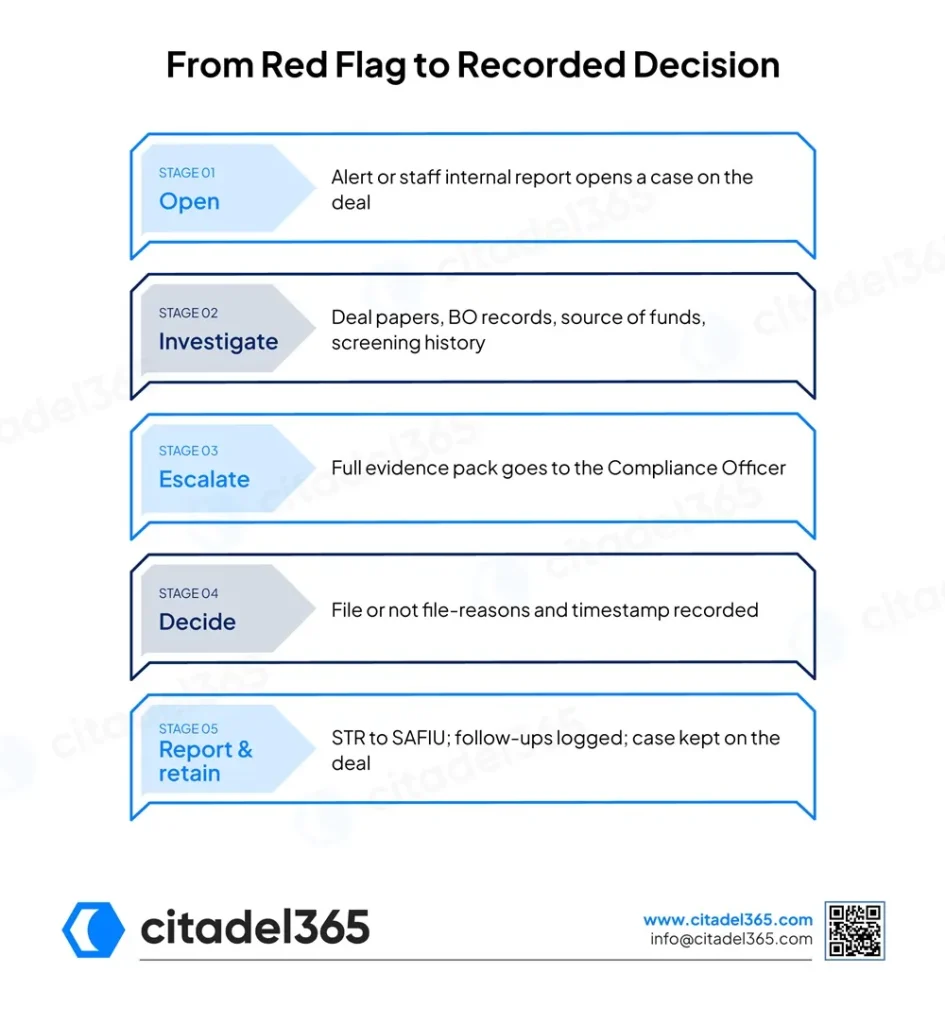
Open the Case:
Brokers may open a case for alerts from screening, risk assessment, suspicious transactions, or an internal report from staff.
Investigate:
The software allows analysts to review the property transaction documents, customer details, beneficial owner records, source of funds, screening results, and risk rating, and record each analysis.
Escalate:
The case moves to the Compliance Officer for further investigation, with all recorded case details.
Decide:
The Compliance Officer decides whether to file a report, with complete rationale and timestamped records. When it’s not possible to complete CDD, the transaction is stopped.
Report and Retain:
The software records all activities related to the case and actions taken, including filing an STR, submission reference, and any SAFIU follow-ups. It records every deal for ten years.
Simplify Real Estate AML Cases.
Citadel365 helps manage case reviews, evidence, escalations and reporting decisions in one workflow.
What Triggers a Case in a Saudi Property Deal?
When a suspicion is found, or a client requires deeper review, brokers must open a case. Suspicion is one or more warning indicators that customers cannot explain logically, triggering a case.
Trigger | Example from REGA’s guide | Where the alert comes from |
Screening match | Customer or beneficial owner on a sanctions list | Name Screening |
Third-party payer | An unrelated third party pays costs or the price, or appears late in the deal | Payment and onboarding checks |
Funds and value | Use of cash or foreign currency for payments with no source disclosed; property price far above or below market value | Risk scoring and deal review |
Ownership and identity | Proxy-company ownership; attorneys used to hide identity; sudden change in ownership | Onboarding and BO checks |
Failed due diligence | CDD cannot be completed | Onboarding |
Staff concern | An agent’s internal report | Manual case creation |
What a Saudi Real Estate STR Must Contain
Saudi law requires real estate brokers to provide adequate details while filing a suspicious transaction report. Citadel365 records every activity related to a customer in the case to help prepare the report with gathered evidence.
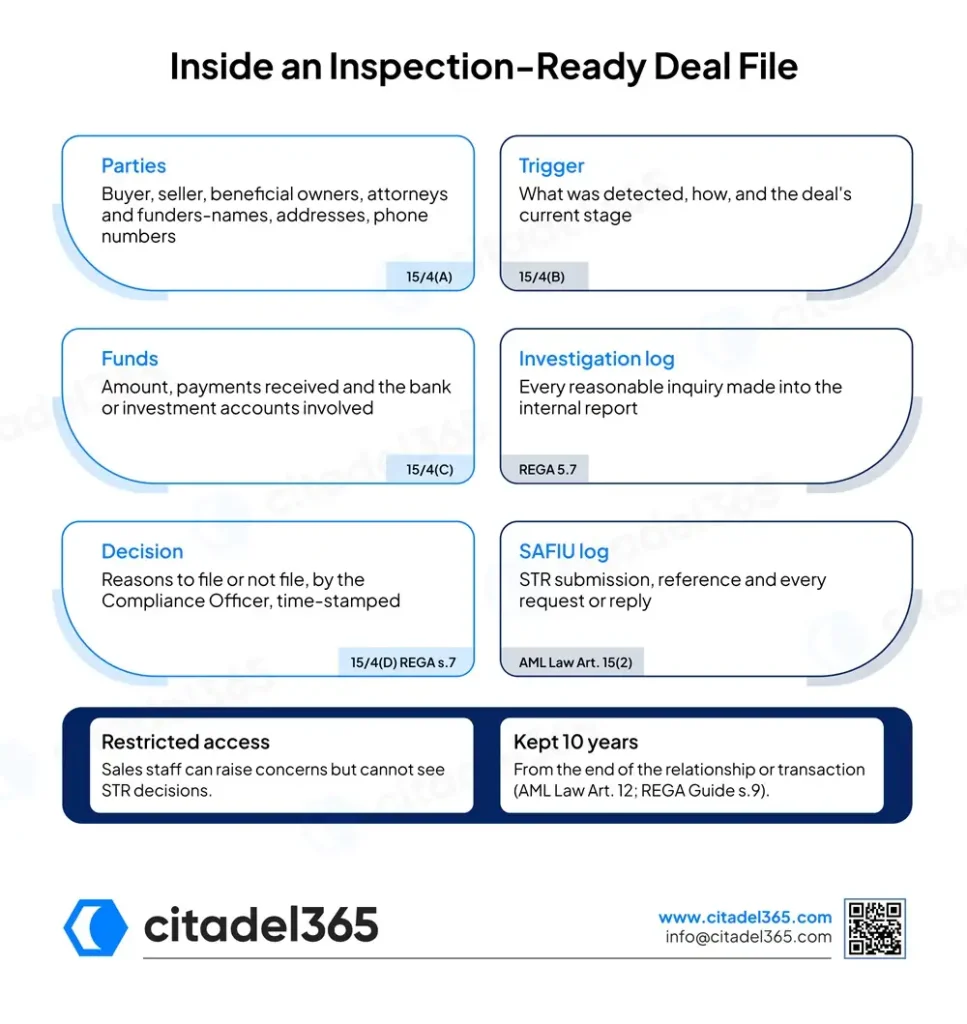
Required STR content | Captured in the case file as |
Names, addresses and phone numbers of those involved | Linked customer, beneficial owner and counterparty records |
The suspicious transaction, its parties, how it was detected and its current status | Deal summary, alert source and deal stage |
The amount and relevant bank or investment accounts | Payment records and source-of-funds evidence |
The reasons for suspicion | Investigation notes and the Compliance Officer’s rationale |
Tipping-Off and Confidentiality in Real Estate Cases
Brokers, their staff, or managers must maintain confidentiality when filing an STR. They must not tell a customer or anyone else that a report will be, is being or has been made, or that an investigation is being carried out. Brokers must not tell or give a hint about:
- The suspicion behind a delayed or postponed transaction.
- Customer details reported or will be reported.
- The investigation carried out by the relevant authorities for the customer.
Even a delay explained carelessly can result in tipping off. Citadel365 supports role-based access, so the system hides STR decisioning from the front-line team to avoid tipping off. Also, brokers won’t be punished or sued for reports made in good faith.
REGA Requirements Mapped to Case Management Features
Citadel365 helps real estate brokers meet each review and record-keeping requirement.
Broker requirement | Reference | How Citadel365 supports the workflow |
The Compliance Officer reviews internal suspicion reports. | REGA AML/CFT/CPF Guide §7 | Create a case manually for review and attach the internal report. |
Record reasonable inquiries and the reasons for filing or declining to file a suspicious transaction report (STR). | REGA Guide §7 | Add investigation notes and record the decision and rationale in the case history. |
Record all STR-related communications sent to or received from SAFIU. | REGA Guide §7 | Attach correspondence as supporting evidence and record follow-up in case notes. |
Include the prescribed information in the STR. | AML Law Art. 15(1) and AML Implementing Regulation §15/4 | Gather transaction details, investigation findings and supporting evidence for STR preparation. |
Maintain confidentiality and prevent tipping off. | AML Law Art. 16(1) and REGA Guide §7 | Role-based review permissions help limit access to sensitive case information on supported plans. |
If required customer due diligence (CDD) cannot be completed, do not establish the relationship or execute the transaction. End any existing relationship and consider an STR. REGA also directs brokers to stop the transaction and submit a suspicious activity report in this situation. | AML Implementing Regulation §7/8 and REGA Guide §5.3(a) | Document the CDD issue, the broker’s decision and any report filed. |
Keep records sufficient to reconstruct transactions and make them readily available to competent authorities on request. | AML Law Art. 12(4) | Maintain a chronological case history and download case reports for review alongside the underlying transaction records. |
Keep transaction records for at least ten years from completion. Keep CDD records, correspondence and analysis for at least ten years from the end of the relationship or, for an occasional customer, from the transaction date. Comply with any required extension. | AML Law Art. 12(1)–(3) and REGA Guide §9 | Download case reports for retention under the brokerage’s record-keeping policy. |
Keep Your AML Cases Connected.
Link customer alerts, evidence, investigation notes, and decisions in a single case record through Citadel365.
Manual Investigation vs Case Management Software
Manual handling of cases relies on email chains and shared folders, which make them hard to evidence during inspections. Case management software, by contrast, centralises and organises a case to streamline compliance workflows.
Area | Manual investigation | Case management software |
Record structure | Filed by client name | Linked to each deal and party |
Third-party payers | Spotted by chance | Case opened before funds are accepted |
Compliance Officer decision | Verbal or email | Mandatory rationale with timestamp |
STR preparation | Retyped from scattered notes | Built from fields already in the case |
Confidentiality | Files visible to all | Role-based access |
Inspection | Hours of searching | Per-deal export in minutes |
How Citadel365 Supports Case Management for Real Estate Agents and Developers in KSA
Citadel365 case management software is a centralised space to review cases, manage alerts and maintain track records for Saudi real estate businesses. The case management software features include:
Deal-Linked Cases: Link cases to sellers, buyers, attorneys, beneficial owners, and funders to maintain a complete record of each real estate transaction.
Alerts to Cases: Open cases from name screening, customer risk assessment and customer onboarding alerts for structured investigation.
Maker-Checker Review: Role-based access controls to keep investigation reviews separate from approval decisions, strengthening oversight and accountability.
Documented Compliance Decisions: Records the Compliance Officer’s rationale with timestamps and SAFIU correspondence to maintain a proper audit trail.
STR Content Fields: Record suspicious activity details, investigation findings and relevant evidence to support STR preparation aligned to applicable requirements.
REGA Inspection Reports: Easily generate reports of case histories, decisions and outcomes for REGA inspections.
Give Every Case a Clear History.
With Citadel365, maintain a chronological record of AML investigations for easier review.
Frequently Asked Questions
Case management software enables structured investigations for AML alerts related to screening hits or suspicious transactions. It is a centralised platform for Saudi real estate brokers that simplifies investigations, tracks compliance activities, and maintains a record of every compliance action and decision.
Under Article 15 of Saudi Arabia’s Anti-Money Laundering Law, real estate brokers must report suspicious transactions immediately and directly to the General Directorate of Financial Intelligence (SAFIU) once they suspect or have reasonable grounds to suspect money laundering. This duty also covers attempted transactions. REGA publishes a suspicious activity reporting template for brokers. Under section 15/4 of the AML Implementing Regulation, brokers must use the form approved by SAFIU and follow its prescribed submission method.
The real estate Compliance Officer must record all investigations, the reasons for filing or not filing an STR and every communication with SAFIU. They must keep the records for at least ten years after the business relationship or transaction ends.
Brokers should treat third-party payment as a red flag. For this, they must identify and screen the payer, record their relationship with the buyer, and verify the source of funds. When links or funds cannot be explained, the case must be escalated to the Compliance Officer for an STR decision.
For each change in an off-plan deal, open a case on the same deal record. Whether a new payer or beneficial owner is involved, a financing change occurs, or a sanctions update is made, the case management records the complete history of the case in one place for review.
Citadel365 case management software for KSA real estate brokers provides a centralised platform to open, manage and escalate cases related to screening and transaction alerts. It supports maker-checker review with role-based access to prevent tipping off. Further, it allows compliance officers to record decisions and facilitate one-click reports for REGA inspections.

Arjun is the Co-founder and CEO of Citadel365, where he leads the company’s vision across technology, business, and regulations. He brings over a decade of experience in building and scaling technology ventures. Arjun holds a B.Tech. in Information Technology and a Master’s in Management, supported by his certification as a Financial Crime Specialist, an uncommon combination that allows him to balance innovation with regulatory requirements.
Having advised leading banks and financial institutions on digital solutions and compliance technology, Citadel365 continues to grow with an ambition