
AML Software in KSA
Ready to Defeat Your AML Compliance Obstacles?
Citadel365 Brings Revolution with Secure Solutions to AML Compliance Problems
Key Takeaways: AML Software in KSA
- AML software supports KYC, screening, risk assessment, transaction monitoring and case management, helping entities meet the Saudi Anti-Money Laundering Law and the AML rules of SAMA, the IA and the CMA.
- It helps KSA-regulated entities simplify Arabic name matching, conduct real-time name screening for timely action, and ensure record-keeping for regulatory inspections.
- Citadel365 is a centralised compliance platform that helps teams manage risks, alerts and records of AML activities.
What is AML Software?
AML software, also called anti-money laundering software or an AML compliance solution, is compliance technology designed to help organisations comply with anti-money laundering and counter-financing of terrorism regulations. Modern AML software combines multiple compliance activities into a single platform. It includes:
- KYC and customer due diligence
- Sanctions, PEP and adverse media screening
- Customer risk assessment and classification
- Transaction monitoring
- Case management and suspicious transaction reporting
- Audit trail and documentation
Regulated entities in Saudi Arabia are better off using a unified platform that automates compliance functions through a risk-based approach, so compliance teams don’t work in isolation and can easily manage repetitive tasks.
Why AML Software is Important in KSA
Saudi Arabia holds a central position in the Gulf financial system. It is widely known for producing oil, being a growing fintech hub, and being a gateway for regional capital flows. These reasons also make strong AML controls important for KSA fintechs, banks, investment firms and other regulated entities to prevent money laundering and terrorism financing risks.
Supervisory entities such as the Saudi Central Bank (SAMA), which supervises banks, money changers and fintech firms, the Insurance Authority (IA) for insurance companies, and the Capital Market Authority (CMA) for securities and investment firms, inspect for compliance with AML regulations.
Under the Anti-Money Laundering Law, issued by Royal Decree No. M/20, regulated entities also need to file suspicious transaction reports (STRs) with the Saudi Arabia Financial Investigation Unit (SAFIU) under the Presidency of State Security. AML software helps these entities meet reporting timelines, maintain proper records and evidence, and apply a risk-based approach to meet regulatory expectations. FATF’s 2018 Mutual Evaluation of Saudi Arabia noted that while STR filings were trending upward, reporting levels were generally low, which keeps the quality and timeliness of STRs a supervisory focus.
Moreover, the regulatory requirements for targeted financial sanctions mandate screening against the UN Security Council consolidated list and the Saudi national terrorist list issued under the Law of Combating Terrorism Crimes and its Financing. AML software helps identify sanctions matches in real time so the entity can freeze funds without delay and meet its reporting obligations.
How Does AML Software Work?
AML software is a centralised platform that helps businesses manage their compliance processes. The steps below follow one corporate customer of a Saudi fintech through a typical AML workflow:
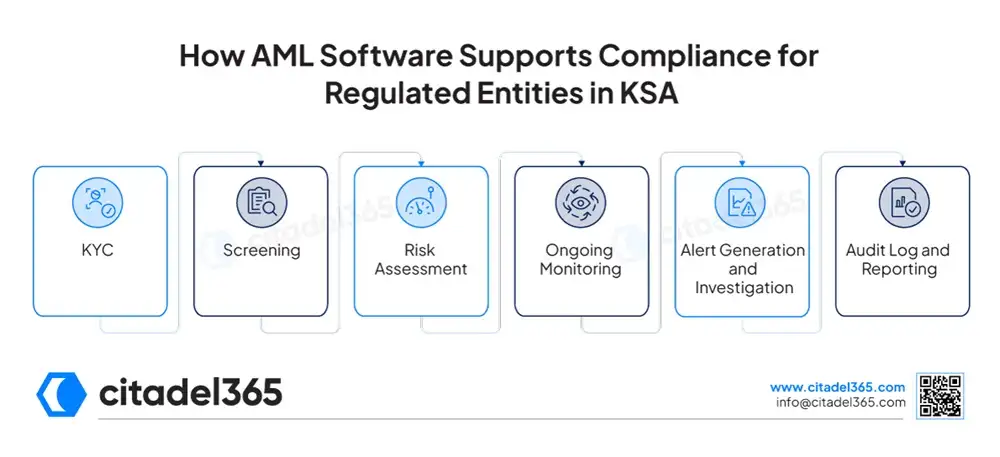
KYC
When the fintech onboards the customer, AML software collects its commercial registration, ownership details and the identity documents of directors and beneficial owners, then verifies them before the account goes live.
Screening
The customer, its directors and beneficial owners are screened against sanctions lists, PEP databases and adverse media sources. A possible match is held for analyst review instead of being cleared automatically.
Risk Assessment
Using customer type, ownership structure, location, expected activity and screening results, the software assigns a risk rating. If a beneficial owner is a foreign PEP, for example, the customer is rated high-risk and routed to enhanced due diligence.
Ongoing Monitoring
Once the account is active, the software monitors transactions against rules set for the customer’s risk level, such as a sudden spike in cross-border transfers, and re-screens the customer whenever watchlists change.
Alert Generation and Investigation
When activity breaks a rule, the platform generates an alert. An analyst reviews it, records notes and evidence, and either closes it with a documented reason or escalates it to the compliance officer for a possible STR to SAFIU.
Audit Log and Reporting
Every step, from onboarding checks to the final alert decision, is time-stamped and stored in one place, so the entity can show SAMA, the IA or the CMA what was checked, when and by whom.
Ready to Simplify Your AML Processes?
Manage screening, risk assessment, transaction monitoring, and case management in one system.
Essential Compliance Functions of AML Software in KSA
Key compliance functions that AML software helps simplify for KSA-regulated entities are as follows:
Customer Onboarding and KYC
AML software collects and verifies customer information, identity documents and other relevant details for both individual and corporate entity customers.
Sanctions, Name and PEP Screening
The software automatically checks customers and businesses against relevant sanctions watchlists, terrorist lists, and PEP databases to identify potential matches.
Adverse Media Screening
AML software also checks customer information against negative news sources to identify links to fraud, corruption, money laundering and other financial crime risks.
Customer Risk Assessment
The software helps classify customers based on their risk level as low-risk, medium-risk, and high-risk customers. It also helps apply the right level of due diligence, for instance, enhanced due diligence for high-risk customers.
Transaction Monitoring
AML software helps the compliance team detect potentially suspicious transactions or red flags that may require further investigation. It applies predefined rules, thresholds and risk indicators to identify anomalies during ongoing monitoring.
Case Management and STR Filing
AML software provides a centralised platform to review alerts, investigate cases, record decisions and maintain supporting documents. It helps compliance teams organise information, prioritise cases, and escalate them for reporting.
Key Features of AML Software for KSA Compliance
AML software should automate and simplify CDD, transaction monitoring, record-keeping, and case management to ensure KSA compliance.
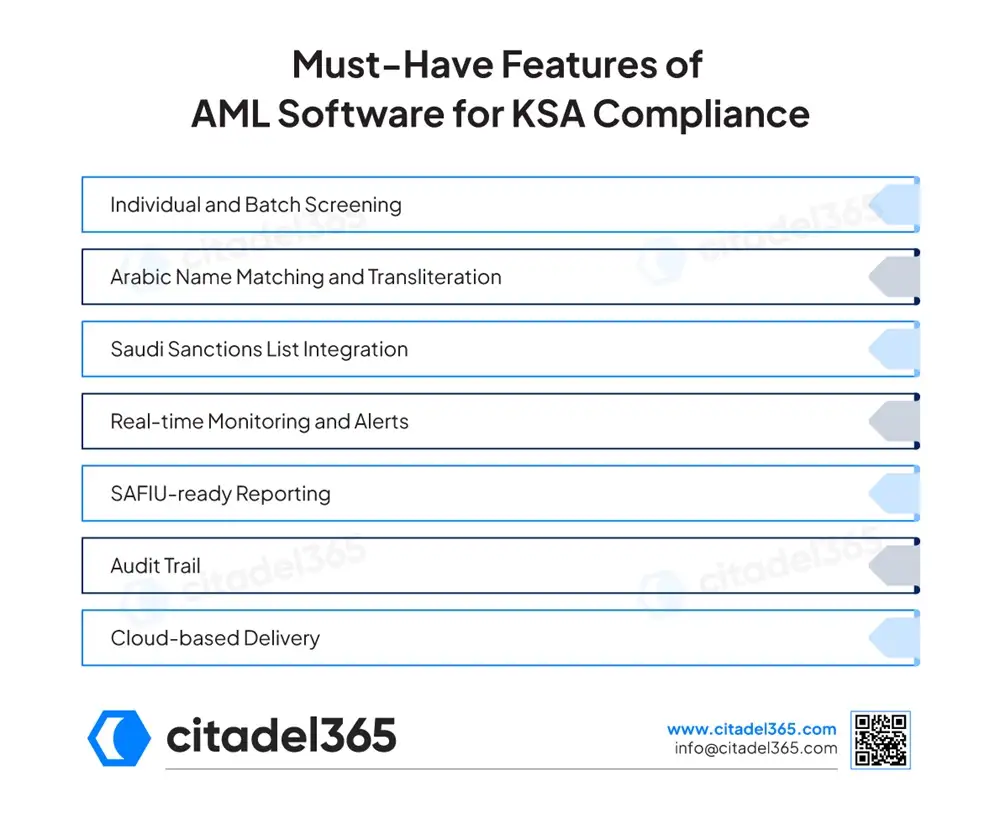
Individual and Batch Screening
AML software should allow compliance teams to screen an individual customer instantly or check thousands of records at once. The software should conduct periodic reviews and re-screening to identify potential sanctions matches.
Arabic Name Matching and Transliteration
The system should identify Arabic names and different English name spellings of the same name that appear in passport data, company registrations and sanctions list entries. It should help avoid missed matches when different names are used in customer data and sanctions lists.
Saudi Sanctions List Integration
AML software should cover local Saudi sanctions and terrorist lists, along with international lists such as the UN Consolidated List. It helps the compliance team comply with KSA sanctions obligations.
Automatic List Updates and Re-screening
Sanctions, PEP and other watchlists change over time. AML software should automatically update relevant lists to check customers in real time. It should help replace manual checks by automating re-screening.
SAFIU-ready Reporting
AML software should help detect suspicious transactions, generate alerts, and provide a workflow to process and record compliance investigations. This helps support preparation of STR-related information for submission.
Audit Trail
AML software should allow tracing of every important compliance action. It includes alerts, who reviewed them, what decision was made and when it was made. This helps Saudi-regulated entities comply with record-keeping requirements and demonstrate AML controls during regulatory reviews.
Cloud-based Delivery
A secure cloud-based AML platform gives compliance teams remote access to customer information, screening results and investigation records from one central location. For KSA businesses, the software should allow automatic updates to incorporate evolving regulatory changes, emerging financial crime patterns, and global sanctions lists without manual delays.
Struggling with False Positives?
Improve Arabic name matching and reduce unnecessary screening alerts.
Regulated Entities That Need AML Software in KSA
In KSA, regulated entities such as financial institutions and DNFBPs are required to comply with AML regulations. AML software helps them apply a risk-based approach, automate screening, UBO mapping, and ongoing monitoring, and ensure record-keeping.
Regulated Entity | Supervisor | Key AML Software Requirement |
Banks | SAMA | Full risk-based programme: CDD, UBO mapping, sanctions screening, transaction monitoring, STR filing |
Insurance companies and brokers | Insurance Authority (IA) | Customer onboarding, sanctions screening, ongoing monitoring, STR filing |
Money changers and exchange houses | SAMA | High-volume transaction screening, cash transaction monitoring, STR filing |
Fintech and payment service providers | SAMA | Digital KYC, real-time screening, transaction monitoring, STR filing |
Capital markets intermediaries | Capital Market Authority (CMA) | Investor due diligence, sanctions screening, ongoing monitoring, STR filing |
Real estate developers and agents | Ministry of Commerce (MoC) | CDD on high-value transactions, sanctions screening, beneficial ownership |
Accountants, gold and jewellery dealers | Ministry of Commerce (MoC) | CDD on specified activities, sanctions screening, STR filing to SAFIU |
Lawyers | Ministry of Justice (MoJ) | CDD on specified activities, sanctions screening, STR filing to SAFIU |
Challenges Businesses Face Without AML Software in KSA
Manual processes may result in the following challenges for KSA-regulated entities:
- Manually screening customers with different spellings of Arabic names may lead to false negatives.
- Sanctions lists can be updated at any time. Manual checks may miss new additions and cannot reliably detect and respond to new designations in real time.
- Processing high transaction volumes with cash and cross-border transfers requires speed and consistency, which becomes challenging with manual processes to detect suspicious activity.
- Scattered records across emails and spreadsheets can make regulatory inspections difficult.
- Manual case review and STR preparation can take longer, increase the risk of errors, or delay reporting timelines.
How to Choose AML Software in KSA
When comparing AML software for a Saudi-regulated business, check whether it:
- Covers the Saudi national terrorist list and the UN Security Council Consolidated List, with automatic updates
- Matches Arabic-script names against English transliterations and spelling variations
- Lets you configure risk models and monitoring rules for your sector and supervisor
- Produces a complete, exportable audit trail for SAMA, IA or CMA inspections
- Supports an STR preparation workflow for submission to SAFIU
- Hosts and processes customer data in line with the Personal Data Protection Law (PDPL)
How Citadel365 Supports AML Compliance in KSA
Citadel365 is an integrated platform that supports customer onboarding, name screening, risk assessment, transaction monitoring and case management. With effective customer onboarding and name screening software, it helps compliance teams collect and verify customer information and screen them against sanctions, PEP and adverse media sources.
Citadel365 customer risk assessment software assesses risk with configurable risk models and automates risk scoring and profiling. Its transaction monitoring software helps identify anomalies and unusual or suspicious patterns in customer transactions.
The case management software helps teams manage alerts and investigations. It maintains an audit trail, keeping compliance records timestamped, which can be downloaded to support regulatory reviews and AML requirements.
For KSA-regulated entities, it reduces manual work, structures AML workflows, reduces false positives, and produces evidence to meet regulatory obligations.
Keep Your AML Evidence Ready for Review.
Citadel365 maintains a clear record of compliance activity to support regulatory reviews.
FAQs About AML Software in KSA
AML software is a compliance tool that helps KSA-regulated entities manage customer onboarding, screening, risk assessment, transaction monitoring, and record-keeping in one place, aligning with AML/CFT regulations.
AML software matches Arabic-script names with different English transliterations and spelling variations to support Arabic name screening and identify potential matches.
Yes, AML software uses advanced logic, checks more than just the name, understands name variations, and filters out generic words to distinguish genuine matches from similar names that belong to different people or businesses.
Suspicious transaction reports are filed with the Saudi Arabia Financial Investigation Unit (SAFIU), which operates under the Presidency of State Security. AML software helps prepare the case details and evidence needed for each report.
Yes. The Personal Data Protection Law (PDPL), overseen by SDAIA, governs how customer personal data is processed and restricts transfers outside the Kingdom, so check where an AML provider hosts and processes your data.
AML software keeps customer records, alerts, investigations, and decisions in one place with clear audit trails, making it easier to demonstrate AML controls during SAMA examinations.

Arjun is the Co-founder and CEO of Citadel365, where he leads the company’s vision across technology, business, and regulations. He brings over a decade of experience in building and scaling technology ventures. Arjun holds a B.Tech. in Information Technology and a Master’s in Management, supported by his certification as a Financial Crime Specialist, an uncommon combination that allows him to balance innovation with regulatory requirements.
Having advised leading banks and financial institutions on digital solutions and compliance technology, Citadel365 continues to grow with an ambition