
AML Case Management Software in KSA
Ready to Defeat Your AML Compliance Obstacles?
Citadel365 Brings Revolution with Secure Solutions to AML Compliance Problems
Key Takeaways: Case Management Software in KSA
- AML case management software is a digital platform for creating, managing, and prioritising alerts in one place. It helps record investigations, decisions, and escalations through a structured workflow.
- KSA-regulated entities are required to file suspicious transaction reports (STRs) with the Saudi Arabia Financial Intelligence Unit (SAFIU). They must also keep records for at least ten years and produce them during supervisory inspections.
- Citadel365 case management software helps Saudi-regulated entities maintain evidence, investigation notes, approvals, escalations, and final decisions in a centralised system to support AML compliance.
What is AML Case Management Software?
AML case management software is a compliance tool that helps regulated entities in Saudi Arabia create, manage and organise cases in one place. Also called an AML case management system or AML investigation software, it provides a structured workflow to review alerts, investigate, escalate, and prepare reports for STR filing. The software keeps a clear record of actions taken, decisions and supporting documents.
In Saudi Arabia, regulated entities must file a suspicious transaction report (STR) with the Saudi Arabia Financial Intelligence Unit (SAFIU). Case management software helps these businesses organise investigations, document decisions, and maintain records for regulatory inspections.
Why AML Case Management Software Matters in Saudi Arabia
Case management software matters in KSA because supervisors expect regulated entities to show how they handled every alert. Supervisory authorities such as the Saudi Central Bank (SAMA), the Ministry of Justice (MoJ) and the Capital Market Authority (CMA) inspect whether the investigation process is timely, thorough and documented. A regulated entity that cannot demonstrate an effective audit trail from alert generation through investigation to the final filing decision fails to comply with regulatory obligations.
Case management software helps KSA-regulated entities manage alerts, prioritise high-risk cases, investigate and escalate cases, record MLRO decisions, support STR filing and keep an audit trail. The platform provides structure for the investigation workflow and retains records for at least ten years, as Article 12 of the Anti-Money Laundering Law (Royal Decree No. M/20 dated 05/02/1439H) requires, so they can be produced during supervisory inspections.
How Does Case Management Software Work?
Case management software follows a structured process to handle alerts, investigate cases and review decisions.
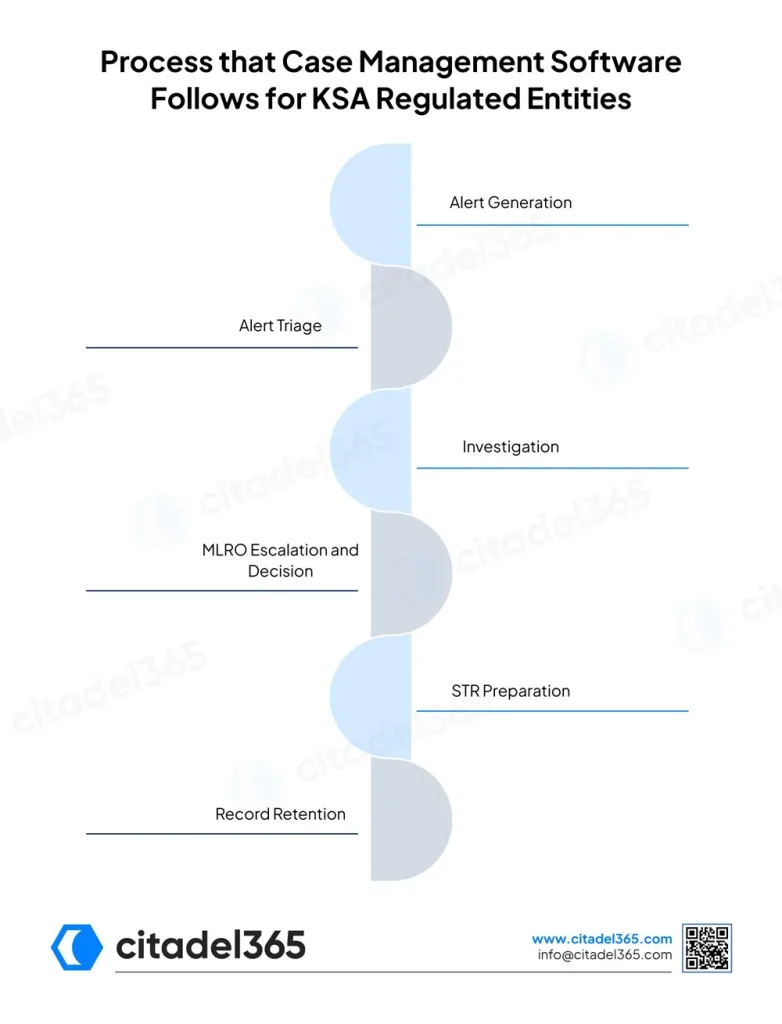
Alert Generation
Case management software lets analysts open a case when transaction monitoring or name screening software generates an alert, or when they identify suspicious activity themselves. Compliance teams may add essential customer details and define the reason for the review.
Alert Triage
Case management software lets the compliance team assign a risk level for each case based on predefined rules. The AML team can also prioritise high-risk cases and targeted financial sanctions (TFS) matches for immediate attention.
Investigation
In case management software, cases move through a defined workflow that records investigation notes, supporting documents, and actions taken. The platform records every action in timestamped, immutable logs.
MLRO Escalation and Decision
The compliance team can escalate cases internally and to the Money Laundering Reporting Officer (MLRO) for further review. Case management software records every decision, rationale and approval at each stage.
STR Preparation
For cases that require an STR, case management software holds the case information needed to prepare the report. The MLRO or compliance team can also document whether the case is resolved, an STR is filed, or the case is kept open. Article 15 of the Anti-Money Laundering Law requires reporting entities to report suspicion to SAFIU promptly and directly, and Article 16 prohibits telling the customer or anyone else that a report has been or will be filed. Case management software supports both duties by keeping STR work inside a restricted case file with controlled access.
Record Retention
Case management software retains the full case record, from the original alert to the final decision, for at least ten years, as required by Article 12 of the Anti-Money Laundering Law, in a clear audit trail for internal review and supervisory examinations.
Management Software for KSA-Regulated Entities
Citadel365 helps manage AML alerts through a structured workflow, keeping investigations, decisions and records connected.
Key Features of Case Management Software for KSA
Case management software should support alert prioritisation, case data for STR filing, MLRO decision recording, centralised alert management, and evidence upload.
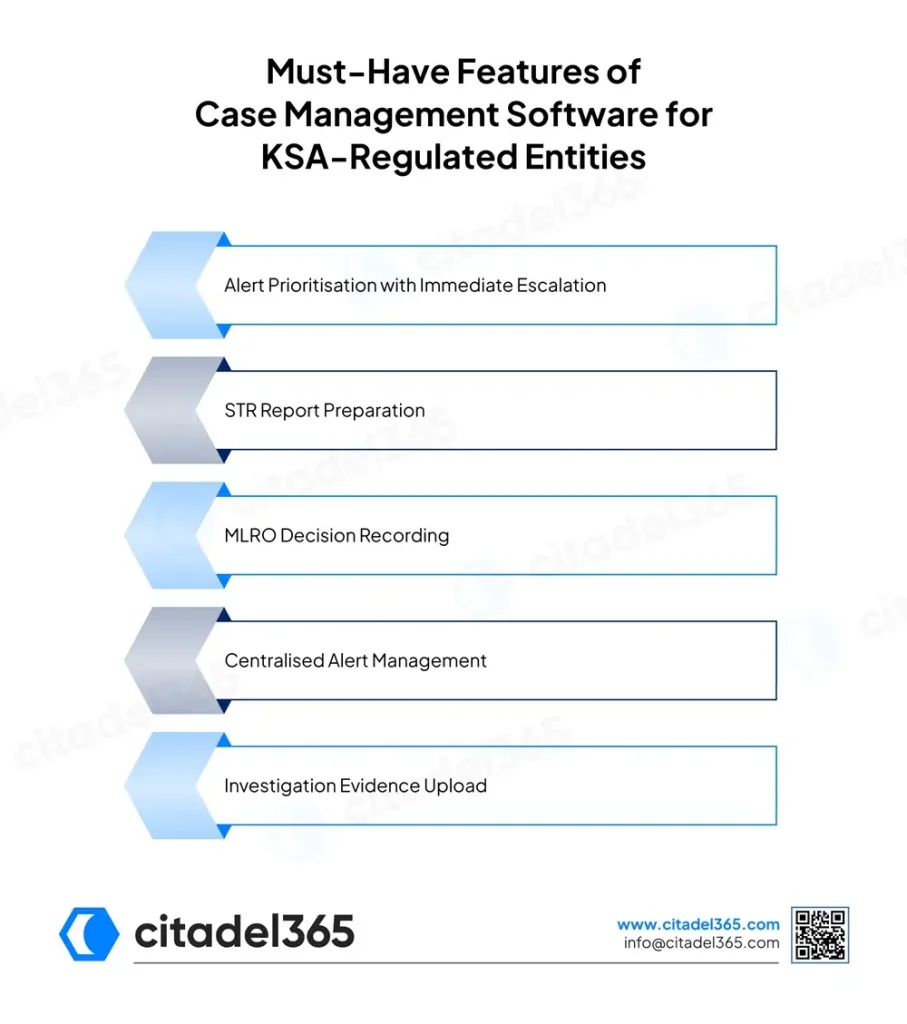
Alert Prioritisation with Immediate Escalation
Case management software should help organise alerts by risk level. It should help prioritise them for immediate review and escalation; for instance, potential sanctions matches should go to the top of the queue so freezing and reporting obligations can be met without delay.
Case Data for STR Filing
Case management software should support a proper case workflow and record customer details and decisions through an effective audit trail, so the information can be used to prepare STRs.
MLRO Decision Recording
Case management software should allow space for the MLRO to record decisions and rationale for reviewed cases. It should also help document the final decision depending on whether the case is resolved, reported or requires further action.
Centralised Alert Management
Case management software should manage all alerts from screening, transaction monitoring, and manual identification by compliance teams. It should provide a centralised place to consolidate alerts, investigation and escalation.
Investigation Evidence Upload
Case management software should support uploading documents such as bank statements, transaction records, entity documents and other evidence linked to the relevant case.
Who Needs Case Management Software in KSA
In KSA, banks, money changers, exchange houses, insurance companies, fintechs, payment service providers, capital market firms and DNFBPs, such as accountants, dealers in precious metals and stones (DPMS), real estate agents and legal professionals, need a structured, documented way to manage and investigate cases, which case management software provides.
Entity type | Key case management needs |
Banks | High-volume alert triage, TFS hit escalation, STR filing preparation, SAMA examination evidence |
Money changers and exchange houses | Cash transaction alert management, cross-border remittance alerts, STR filing preparation |
Insurance companies | Premium payment alerts, complex beneficial ownership investigations, STR filing preparation |
Fintech and payment providers | High-velocity transaction alerts, TFS hit escalation, STR filing preparation |
Capital market firms | Investor activity alerts, securities transaction investigations, STR filing preparation |
DNFBPs such as accountants, DPMS, real estate agents and legal professionals | Suspicious transaction identification, STR preparation |
Challenges Without Case Management Software in KSA
Compliance teams in KSA face the following challenges when handling alerts and cases manually through emails and spreadsheets:
No Structured Investigation Trail
Supervisory inspections require evidence of how alerts were handled and reviewed. Evidence scattered across emails and spreadsheets makes it hard to maintain a complete investigation history and demonstrate it to supervisors.
STR Filing Delays and Errors
Manual preparation of STR information can delay the process and may lead to errors. Late or incomplete STR filing may result in enforcement actions.
TFS Alerts Not Separated from Standard Alerts
High-risk alerts such as sanctions matches require immediate action. Managing them alongside standard alerts without prioritisation may create response-timing risk.
Undocumented MLRO Decisions
Recording MLRO decisions and actions manually or across different systems makes it difficult to maintain a complete decision history.
Record Retrieval Failures
Scattered data and information across emails, spreadsheets and folders make it hard to find older case files, evidence, investigation notes, and decisions.
How Citadel365 Case Management Software Supports KSA Compliance
Citadel365 helps Saudi-regulated businesses handle alerts through a structured workflow. The case management software helps create cases and organise and prioritise them by risk level. It keeps case details, investigation notes, supporting documents, and actions in one place.
Citadel365 also supports case escalation and helps the MLRO record decisions and the rationale behind them. It also captures case information that can be used to prepare STR data for filing. The case management software records case activities with timestamps and helps maintain a clear history through complete audit trails. It also makes records easier to retrieve when required for regulatory inspections.
Are Your AML Investigations Easy to Track?
Citadel365 centralises alerts, evidence, investigation records and final decisions for KSA-regulated entities.
FAQs About AML Case Management Software in KSA
AML case management software is a centralised digital platform that helps KSA-regulated entities, including financial institutions and DNFBPs, manage alerts, investigate cases, and maintain complete audit trails.
Case management software lets you flag high-risk alerts as priority so they stand out from routine transaction monitoring or screening alerts. This lets the team escalate potential TFS matches straight to the MLRO so freezing and reporting steps can be taken without delay, with every step time-stamped.
Yes, it should. Saudi-regulated entities often hold customer documents, case notes and correspondence in Arabic, so case management software should accept Arabic text and attachments and keep them searchable for inspections.
Look for six capabilities: risk-based alert prioritisation with a fast track for TFS matches, restricted case files that protect against tipping-off, case data ready for STR filing with SAFIU, fields for MLRO decisions and rationale, Arabic text support, and an audit trail that keeps records retrievable for at least ten years.
At least ten years. Article 12 of the Anti-Money Laundering Law requires records to be kept for at least ten years from the date of the transaction or the end of the business relationship, and the Public Prosecution can require a longer period for a criminal investigation.
Citadel365 case management software is a centralised platform for managing alerts, investigations, MLRO decisions, evidence and STR preparation. It helps KSA-regulated entities maintain complete case records, supporting compliance during regulatory reviews.

Sridhar is a Certified Anti-Money Laundering Investigator (CAMI) with over 30 years of experience in compliance, risk, and audit, including more than 20 years in AML and financial crime prevention. He has contributed to the development of UAE regulatory standards through the FERG sub-committee and has maintained active engagement with the Central Bank of the UAE on supervisory and compliance matters.