
Name Screening Software for Fintechs and Payment Service Providers in KSA
Ready to Defeat Your AML Compliance Obstacles?
Citadel365 Brings Revolution with Secure Solutions to AML Compliance Problems
Name Screening Software for Fintechs and Payment Service Providers in KSA: Brief Overview
- Name screening software is a compliance platform that helps fintechs and payment service providers (PSPs) in KSA screen customers and related parties against sanctions, PEP, and other risk lists to identify potential matches and support AML compliance.
- The key red flags that software helps detect include name variations, sanctioned payment beneficiaries, risk of hidden ownership, new sanctions listings, and repeated similar names.
- Citadel365 automated screening software offers real-time and batch screening, Arabic-aware name matching, configurable matching thresholds, ongoing re-screening, and structured alert management to support AML compliance for fintechs and PSPs in KSA.
What Is Name Screening Software for Saudi Fintechs and Payment Service Providers?
Name screening software for Saudi fintechs and PSPs is a digital compliance tool that identifies customer and related-party details against sanctions and politically exposed persons (PEP) lists and flags potential matches for further review, helping SAMA-licensed PSPs meet their targeted financial sanctions (TFS) obligations, which include freezing assets without delay, identifying links to listed persons and preventing funds from being made available to them.
High application volumes make name screening challenging in the Saudi payment market; names may also appear in Arabic or different Latin spellings, making accurate matching essential. Without effective screening systems, businesses may miss genuine matches or be flooded with false alerts.
Which Sanctions and PEP Lists Must Saudi Payment Service Providers Screen?
Saudi PSPs screen customers, beneficial owners, and payment messages against the following lists, with the status of each shown below:
Screening list | Source | Status for SAMA licensees |
UN Security Council sanctions lists (including ISIL/Al-Qaida and 1988 regimes) | UN Sanctions Committees | Mandatory |
National terrorism list (UNSCR 1373 mechanism) | Permanent Committee for Combating Terrorism and its Financing, Presidency of State Security | Mandatory |
Proliferation financing designations (Chapter VII resolutions) | Permanent Committee for the Implementation of Security Council Resolutions under Chapter VII, Ministry of Foreign Affairs | Mandatory |
Politically exposed persons, family members and close associates | Commercial PEP data and internal records | Mandatory to identify (AML Law Art. 8) |
OFAC, EU, UK and other countries’ lists | Relevant Foreign authorities | Not mandated by SAMA; risk-based (e.g. USD clearing, correspondent exposure) |
Adverse media | Reliable Open sources and media databases | Event-based screening trigger (TFS Rules 3.6(d)) |
Who Must Be Screened at a Saudi Fintech or Payment Service Provider?
Screening for Saudi PSPs goes beyond the account holders; a Saudi PSP should screen every party who could give a listed person access to funds.
Individual applicants and wallet holders
Screen individuals before onboarding and opening an account or e-wallet; existing customers must also be screened against applicable sanctions lists to identify newly designated individuals.
Merchants, beneficial owners, directors and signatories
When onboarding merchants, screen the business and relevant parties, including beneficial owners, directors and authorised signatories. PSPs must also consider whether an entity is directly or indirectly owned or controlled by a designated person, as a company may not be listed on a sanctions list under its own name.
Payment counterparties and intermediaries
Screen relevant parties involved in payments, which include originators, beneficiaries, correspondent banks and intermediaries, where applicable under SAMA’s requirements.
A payment may still involve a sanctions risk even if the sending customer has no sanctions match, so PSPs must identify and act on matches involving other parties to the transaction.
When Saudi Payment Service Providers Must Screen: SAMA's Screening Schedule
Below are the six screening triggers that PSPs should build into their systems:
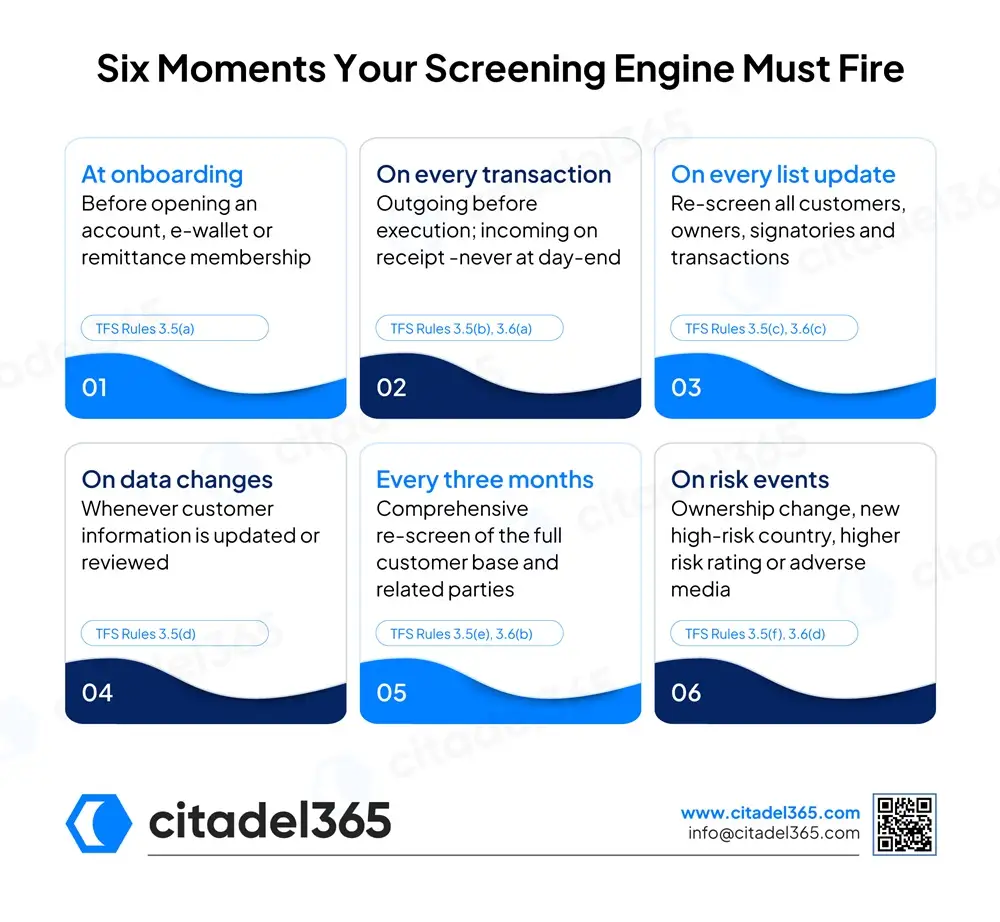
1. At onboarding
customers should be screened before opening an account, electronic wallet or remittance membership.
2. Before and upon transactions
screen outgoing transactions before execution and incoming transactions upon receipt, without waiting until the end of the day.
3. On every list update
immediately re-screen all customer and transaction data, beneficial owners, directors, authorised signatories and related parties against the updated lists, and record the action taken.
4. When customer data changes
re-screen whenever customer information is updated or reviewed.
5. At least every three months
conduct a comprehensive re-screening of customers, beneficial owners, directors, authorised signatories, and other relevant parties.
6. On risk events
re-screen when there are changes in ownership, exposure to a high-risk country, unusual transaction patterns, an increased risk rating, or relevant adverse media.
Name Screening Requirements Mapped to Software Features
The table below maps key SAMA TFS Rules requirements to Citadel365 name screening capabilities.
SAMA requirement | Reference | Citadel365 capability |
Real-time automated matching against sanctions lists | TFS Rules 3.8 | API and on-screen real-time screening |
Detect aliases, spelling variants, phonetic similarities and transliterations | 3.7 | Fuzzy, phonetic and transliteration-aware matching |
Document and periodically test the matching methodology | 3.11, 3.12 | Configurable thresholds with version history |
Two-specialist (maker-checker) alert review | 5.3 | Role-based maker-checker workflow |
Record minimum alert details (time, source, nature, reviewers, outcome) | 5.6 | Structured alert record and audit trail |
Governed internal whitelist for repeat false matches | 5.8 | Whitelist with periodic review, approval and re-screening |
Retain screening records for 10 years | 7.3 | Searchable, exportable screening history |
Arabic Name Matching and Transliteration in Sanctions Screening
Arabic name matching is the cornerstone of sanctions screening in Saudi Arabia, as the same Arabic name can be spelt in several ways in Latin script. SAMA’s TFS rules require screening systems to identify aliases, spelling variations, similar-sounding names and transliterations.
Why exact matching fails for Saudi names
The same person’s name may appear as “Mohammed”, “Muhammad” or “Mohamad” across various documents; names may also include prefixes such as “Al” or “El” and variations in family names or name order. Exact matching may fail to identify these differences.
How transliteration-aware matching works
The software compares different spellings and name variations, checks how names sound and identifies possible matches. Additional details, such as date of birth and nationality, can help reviewers differentiate a genuine match from someone with a similar name.
Tuning thresholds without missing true matches
Lower matching thresholds can identify more name variations, but they generate more false alerts, whereas higher thresholds reduce alerts but increase the risk of missing genuine matches.
Institutions are required to document their matching methods, test their effectiveness regularly, and review the cases where genuine matches were missed. Matching thresholds should be configured and tested based on the institution’s risk profile and screening records.
Handling Screening Alerts: Review, Freezing and Reporting
Saudi PSPs are required to review screening alerts promptly and maintain records of the decisions made. When a match is confirmed, they must freeze the relevant funds without delay.
Maker-checker review
Two specialists review alerts using customer due diligence (CDD) information and reliable public sources. If the alert is a false match, the decision must be promptly documented with the reasons for closure, and confirmed or uncertain matches must be escalated without delay to the senior officer responsible for TFS.
Freezing without delay
Where there are sufficient grounds for a direct or indirect link to a listed person, institutions must freeze the relevant funds without delay (within hours of the listing) and without prior notice. The freeze must not be delayed while waiting for committee decisions, legal reviews or management approval.
Notifying SAMA and the Notification System
After freezing funds, institutions must notify SAMA by email under paragraph 5.9 of the TFS Rules. The notice covers the customer and transaction, the freezing measures, the nature and value of the frozen funds, the listing details and any attempted transactions. SAMA also requires institutions to register on the Security Council Notification System and respond to each listing notification no later than 24 hours after receipt, including any freezing measures taken.
Confidentiality
Institutions must not disclose screening alerts or related details to customers or unauthorised third parties. Suspected sanctions evasion must be reported to the Saudi Financial Intelligence Unit (SAFIU) as a suspicious activity report.
Name Screening Red Flags in Saudi Payment Flows
Name screening software helps in identifying potential risks that may go unnoticed through a single name check. Some of the common red flags include:
- Name variations: an applicant’s name matches a sanctioned person but appears under different spellings or transliterations.
- Sanctioned payment beneficiary: a payment recipient appears on a sanctions list, even though the sender has no match.
- Risk of hidden ownership: a merchant’s beneficial owner is a PEP or listed person whose name variations were not detected during onboarding.
- New sanctions listings: an existing customer is added to a sanctions list and is identified during a subsequent list update and screening.
- Repeated similar names: multiple applications contain names similar to the same sanctions-list entry, potentially indicating attempts to evade screening.
Manual Screening vs Name Screening Software
The key difference between manual screening and name screening software:
Screening area | Manual process | Name screening software |
Timing | May involve delays between list updates, screening and payment processing | Real-time matching against sanctions lists, with screening before account opening and transaction execution |
Arabic names | Manual checks may struggle to identify different spellings and transliterations consistently | Can identify spelling variations, aliases, phonetic similarities and transliterations |
Counterparties | May focus on the account holder if the process is limited in scope | Supports screening of customers, beneficial owners, directors, authorised signatories and relevant payment parties |
List updates | May depend on staff downloading and updating lists manually | Supports automated list updates and time-stamped records, subject to system configuration |
Evidence | Records may be spread across spreadsheets and email | Can maintain structured alert records and an audit trail |
How Citadel365 Supports Name Screening for Fintechs and Payment Service Providers in KSA
Citadel365 helps fintechs and PSPs in Saudi Arabia support their AML compliance processes through its name screening software that screens customers, counterparties, entities, and beneficial owners against relevant sanctions, PEP lists and adverse media sources.
It also helps in identifying potential matches involving spelling variations, transliterations, and similar-sounding names, with configurable matching thresholds.
Citadel365 supports structured alert handling through maker-checker reviews, role-based access, and documented reasons for alert closing.
The software enables re-screening of relevant records after sanctions list updates and at scheduled intervals, while maintaining reports showing what was screened, when screening took place, which list version was used, and the results.
Citadel365 name screening integrates with customer onboarding, customer risk assessment, and case management workflows, helping compliance teams manage potential matches effectively and supporting overall regulatory compliance.
Stay Ahead of Sanctions Risks in KSA
Citadel365 helps fintechs and payment service providers meet their AML and TFS obligations with automated name screening, Arabic-aware matching, and continuous monitoring.
Frequently Asked Questions
Name screening software in Saudi Arabia helps in screening customers, beneficial owners, and other relevant parties against sanctions, PEP, and other risk lists to support ongoing AML compliance.
Yes, PSPs must screen customers and transactions, along with relevant parties such as beneficial owners, directors, authorised signatories, remittance beneficiaries, and intermediaries. Screening should therefore cover relevant parties on both sides of a payment, as applicable.
They should re-screen their customers immediately after every sanctions list update, whenever customer data changes, after every risk event, and through a comprehensive re-screening at least every three months.
Citadel365 helps fintechs and PSPs screen names, identify potential matches and manage alerts through structured workflows; its capabilities include real-time screening, Arabic name matching, risk assessment integration and audit trails, helping compliance teams simplify screening and record-keeping.

Sridhar is a Certified Anti-Money Laundering Investigator (CAMI) with over 30 years of experience in compliance, risk, and audit, including more than 20 years in AML and financial crime prevention. He has contributed to the development of UAE regulatory standards through the FERG sub-committee and has maintained active engagement with the Central Bank of the UAE on supervisory and compliance matters.