
AML Software for Fintechs and Payment Service Providers in KSA
Ready to Defeat Your AML Compliance Obstacles?
Citadel365 Brings Revolution with Secure Solutions to AML Compliance Problems
Key Takeaways: AML Software for Fintechs and Payment Service Providers in KSA
- Saudi fintechs, digital wallets, payment aggregators and SAMA-licensed payment service providers must comply with AML/CFT laws and adopt a risk-based approach for policies and controls.
- Effective compliance requires real-time screening, risk-based transaction monitoring, and documented reviews and decisions that can be retrieved for SAMA inspections.
- Citadel365 is AML software that automates and centralises KYC checks, sanctions and PEP screening, customer risk assessment, transaction monitoring, case management and record-keeping.
What is AML Software for Saudi Fintechs and Payment Service Providers?
AML software for Saudi fintechs and payment service providers is a digital compliance platform that helps verify customers, conduct screening, assign risk scores, monitor transactions and document each compliance decision.
Altogether, the AML software automates the anti-money laundering and counter-terrorist financing (AML/CFT) controls mandated for SAMA-licensed fintechs and payment service providers under Saudi law.
Under Article 36 of the Implementing Regulations of the Payments Law, licensed payment service providers must comply with AML/CFT laws, regulations and instructions. It also requires them to adopt a risk-based approach to their internal policies and procedures. This requires payment providers to not just understand the Anti-Money Laundering Law, its Implementing Regulation, the Law on Combating Terrorism Crime and its Financing and SAMA’s AML/CTF instructions, but also to embed them into daily operations.
Payment businesses can process thousands of transactions an hour, so spreadsheets are not adequate for compliance. Even SAMA’s AML/CFT guide notes that manual monitoring of transactions alone is not sufficient, making an automated solution essential.
AML Software and PSPs’ Regulatory Requirements
AML software helps conduct and trace the controls that fintechs and payment providers apply with respect to AML obligations. The table below states the regulatory requirement and software capabilities in fulfilling them:
Regulatory Requirement | Legal Source | Citadel365 Capability |
Identify, assess and document ML risk, including new products and technologies before launch | AML Law Art. 5; Implementing Reg. 5/1 to 5/6 | Configurable risk models and documented business risk inputs |
Complete CDD before opening an account or executing a one-off transaction | Implementing Reg. 7/1 | Customer Onboarding with mandatory checkpoints |
Identify beneficial owners holding 25% or more | Implementing Reg. 7/2(c) | Merchant KYB with UBO capture |
Use appropriate systems to detect PEPs | AML Law Art. 8 | PEP screening at onboarding and on review |
Screen before every account, wallet and transaction, plus quarterly full re-screening | SAMA TFS Rules 3.5 and 3.6 | Real-time and batch Name Screening |
Match aliases, spelling variants, phonetics and transliterations | SAMA TFS Rule 3.7 | Fuzzy and transliteration-aware matching |
Monitor transactions on an ongoing basis | AML Law Art. 13; SAMA Guide 7.5 | Transaction Monitoring with risk-linked rules |
Report suspicion promptly to SAFIU | AML Law Art. 15 | Case Management with STR preparation |
Keep records for at least 10 years | AML Law Art. 12; SAMA TFS Rules 7.3 | Immutable, time-stamped audit trail |
AML Software for Saudi Arabia’s Digital Payment Economy
Manage customer verification, screening, risk scoring, and monitoring in one centralised platform.
How AML Software Works for Saudi Payment Providers: From Onboarding to SAFIU Reporting
AML software for Saudi payment providers works in seven checkpoint steps, where each step shapes the next. The following points make it clearer:
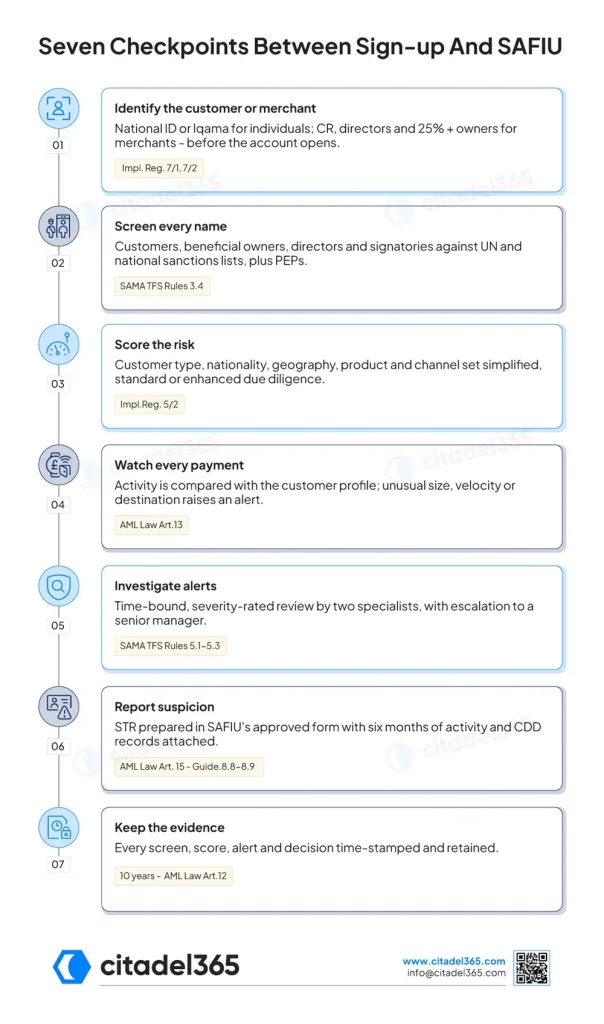
Step 1: Customer and Merchant Due Diligence
AML software captures customer information and verifies their identity documents before establishing the business relationship. For individuals, it records full legal name, date and place of birth, nationality, and national address, using the Saudi National ID or Iqama number. For merchants, the platform records Commercial Registration details, directors and beneficial owners who hold 25% or more.
Step 2: Sanctions and PEP Screening
The platform screens customers, directors, beneficial owners, and authorised signatories against UN Security Council lists, national lists issued through the Permanent Counter Terrorism Committee, other countries’ lists and PEP databases.
Step 3: Customer Risk Assessment
AML software then calculates the risk score based on factors such as customer type, geography, nationality, product, channel and screening results. The assigned scores help decide the level of due diligence, whether simplified, standard or enhanced.
Step 4: Transaction Monitoring
Further, the AML software compares the customers’ payments to their profile and expected activity. It flags suspicious activities such as unusual size, frequency, counterparties, or destinations.
Step 5: Alert Investigation
The software generates alerts for suspicious activities, requiring time-bound review. It helps create cases for alert review, assign them based on priority and allows escalation and maker-checker review.
Step 6: STR Preparation and SAFIU Reporting
AML software allows the compliance officer to record decisions on suspicious activity, prepare the STR for filing with SAFIU and keep a timestamped audit trail of each step.
Step 7: Audit Trail and Record Retention
The platform records customer information and every activity, including the screening checks, changes in customer risk profiles, alerts, and filing decisions, in a time-stamped format for a period of at least 10 years.
Core AML Software Features for Saudi Fintechs, Wallets and Payment Aggregators
Saudi payment service providers need technology that keeps pace with high transaction volumes and checks both individual and corporate customers. Citadel365 provides the following features:
Digital KYC and Merchant KYB
The platform offers self-KYC, which lets customers submit their own data and documents. The AML software records the verification checks, including the trusted and independent sources used. For merchant KYB, the software collects and verifies commercial registration, ownership structure, and control persons.
Real-time Sanctions Screening with Arabic Name Matching
The platform runs screening at the time of opening an account and before every outgoing payment. With configured matching rules, it enables checks for aliases, spelling variants, phonetic similarities, and Arabic-English transliteration. For instance, it can match name variants such as Mohammed, Muhammad and Mohamad to the same individual.
Customer Risk Scoring
The AML software allows configurable weightings and thresholds by customer type and their activities. For example, the system adjusts the scoring criteria for salaried Saudi wallet users, new micro-merchants, and high-volume expatriate remitters based on their risk levels.
Transaction Monitoring Tuned to Saudi Payment Typologies
The platform monitors transactions to detect unusual patterns linked to known ML/TF risks in Saudi Arabia. It identifies red flags such as transferring money quickly after deposits, collecting money from many people and transferring it abroad, or using someone else’s account. The platform also tracks wallet limits to generate alerts for suspicious accounts.
Case Management and STR Preparation
The AML software keeps all alerts, notes, supporting documents and decisions stored in one case file. It also facilitates access controls through role-based segregation and maker-checker controls, keeping the person who flags a suspicious transaction separate from the person who reviews and closes the case.
Audit-ready Records
The system produces reports for activities performed, such as what was screened, when, and against which list version and with what outcome. It helps maintain records which are required at SAMA inspections, ensuring compliance with AML/CFT laws.
One Place to Review AML Alerts
Let compliance teams record screening results, investigation notes and review decisions in a single platform.
Which Saudi Payment Businesses Need AML Software?
Every entity licensed under the Law of Payments and Payment Services, must apply AML controls proportionate to its business size and risk exposure. AML software helps these entities with real-time screening and monitoring, self-KYC, UBO mapping, and audit trails, reducing manual effort and human error.
Payment Business | Key AML Focus | Main Software Modules |
Payment institutions (accounts, transfers, card payments) | CDD, real-time screening, transaction monitoring | Onboarding, Screening, Monitoring |
E-wallet and e-money issuers | Wallet KYC, customer risk assessment and balance and transaction-limit monitoring | Onboarding, Risk Assessment, Monitoring |
Payment aggregators and acquirers | Merchant KYB, UBO checks, merchant risk assessment | Onboarding, Risk Assessment, Screening |
Payment initiation and account information services | Customer identification, screening and investigation of relevant alerts | Onboarding, Screening, Case Management |
Agents and e-money distributors | Agent risk assessment, compliance oversight and documentation of issues | Risk Assessment, Case Management |
Compliance Risks Saudi Payment Providers Face Without Automated AML Controls
Without automated AML controls, Saudi payment providers face the following compliance risks that may result in regulatory consequences:
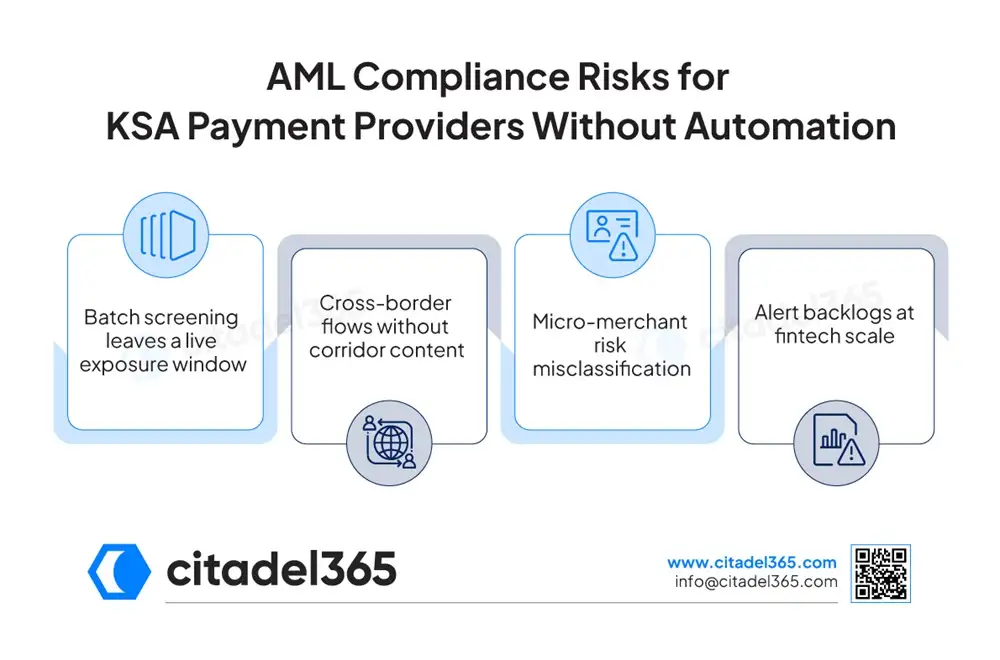
Batch Screening Leaves a Live Exposure Window
When screening runs in a batch overnight, it may allow a designated person to open a wallet and conduct transactions before the check completes. Relying on batch screening may fail to meet SAMA requirements for real-time sanctions screening.
Cross-border Flows Without Corridor Context
The legacy system may not be able to differentiate a normal family remittance from a high-risk international transfer. It may create too many false alerts or may miss genuine risks.
Micro-merchant Risk Misclassification
Small Saudi businesses often have limited financial records. Applying a generic risk model may classify them all as low-risk or high-risk.
Alert Backlogs at Fintech Scale
Systems with poorly configured screening settings may generate too many false alerts. Without accurate screening and case management tools, it becomes difficult to review and document the cases properly.
How to Choose AML Software in Saudi Arabia: A Buyer's Checklist
The right AML software for a Saudi fintech and payment provider helps meet SAMA’s compliance expectations. When choosing the right platform, they must check whether the platform can:
- Screen customers and related parties in real time before opening the account and before each outgoing payment.
- Document the matching rules and support regular effectiveness testing.
- Re-screen existing customers regularly against updated lists.
- Use customer risk scores to adjust transaction monitoring.
- Keep timestamped records of every compliance check and every alert decision.
- Keep records for at least 10 years and retrieve them when required.
- Help comply with Saudi data protection laws and SAMA’s IT governance requirements.
How Citadel365 Supports AML Compliance for Fintechs and Payment Providers in KSA
Citadel365 centralises onboarding, screening, risk assessment, transaction monitoring and case management in one platform for Saudi fintechs and payment service providers. It records customer information and decisions in a connected process.
Customer Onboarding Software: The platform supports self-KYC and merchant KYB with UBO mapping.
Name Screening Software: Screen against sanctions, PEPs and adverse media data. Conduct real-time screening, with batch and periodic screening facilities.
Customer Risk Assessment Software: Allows customisation of risk factors, weightings and thresholds, with risk calculated at onboarding and recalculated as the customer profile changes.
Transaction Monitoring Software: Flags transactions that are inconsistent with the customer’s profile.
Case Management Software: A centralised space for documenting and reviewing alerts, with maker-checker controls.
Spend Less Time on Repetitive AML Checks
Citadel365 automates screening and customer risk profiling while maintaining audit trail records.
Frequently Asked Questions
AML software for fintechs in KSA is a compliance platform that automates AML/CFT controls, including KYC, screening, risk scoring, transaction monitoring, and STR preparation. It helps comply with the KSA AML law, its Implementing Regulation and SAMA instructions and maintains records for 10 years to meet examiners’ expectations.
Yes, SAMA’s Rules for the Implementation of Targeted Financial Sanctions require entities to use automated systems that are capable of real-time matching.
Saudi payment providers must freeze funds without delay and must not wait for senior management approval once a match is confirmed. AML software helps detect sanctions matches in real time.
A Saudi payment service provider must verify the merchant’s name, proof of existence, legal form, directors and registered address, and identify the beneficial owners who own or control 25% or more. The payment platform identifies the person exercising control or the senior managing official if no one meets the threshold.
Article 12 of the AML Law requires financial institutions, including payment providers, to keep transaction records for at least 10 years from the transaction or account closure and to keep CDD records for ten years after the relationship ends. For an investigation, the Public Prosecution may extend this period.
Citadel365 is a centralised platform that automates onboarding, screening, risk scoring, transaction monitoring, and record-keeping. For Saudi fintechs, it maintains audit trails and provides one workspace for alerts, investigations and STR decisions.

Vasantha holds a Master’s in Law specialising in Banking Laws and Anti-Money Laundering and is CAMS and CGSS certified. With over 35 years of experience, she has worked closely with regulators and international financial institutions, building financial crime risk frameworks, sanctions monitoring programmes, and compliance systems across multiple jurisdictions.