
Customer Onboarding Software for DPT Service Providers (VASPs) in Singapore
Ready to Defeat Your AML Compliance Obstacles?
Citadel365 Brings Revolution with Secure Solutions to AML Compliance Problems
Key Takeaways: Customer Onboarding Software for DPT Service Providers (VASPs) in Singapore
• Digital Payment Token (DPT) service providers, supervised by the Monetary Authority of Singapore (MAS), are required to conduct CDD at onboarding and throughout the business relationship.
• CDD for DPT service providers involves KYC, screening, risk assessment, monitoring, and record-keeping as part of AML/CFT checks that MAS may review during inspections.
• Citadel365 automates and simplifies CDD checks and maintains secure records, reducing manual effort and supporting compliance.
What is Customer Onboarding Software for DPT Service Providers (VASPs) in Singapore?
Customer onboarding software for Digital Payment Token (DPT) service providers in Singapore automates customer due diligence (CDD), including Know Your Customer (KYC) checks for individuals and Know Your Business (KYB) checks for companies. It helps verify customers before activating their accounts or wallets.
DPT service providers, also known as Virtual Asset Service Providers (VASPs), are licensed under the Payment Services Act 2019 and must comply with MAS Notice PSN02. They are required to verify customer identity and related parties to meet their AML/CFT obligations.
How Does Customer Onboarding Software Work for DPT Service Providers?
Customer onboarding software works by moving each customer of a DPT service provider through five CDD stages: data capture and identity verification, business and UBO checks, customer screening, risk assessment, and ongoing monitoring with record-keeping.
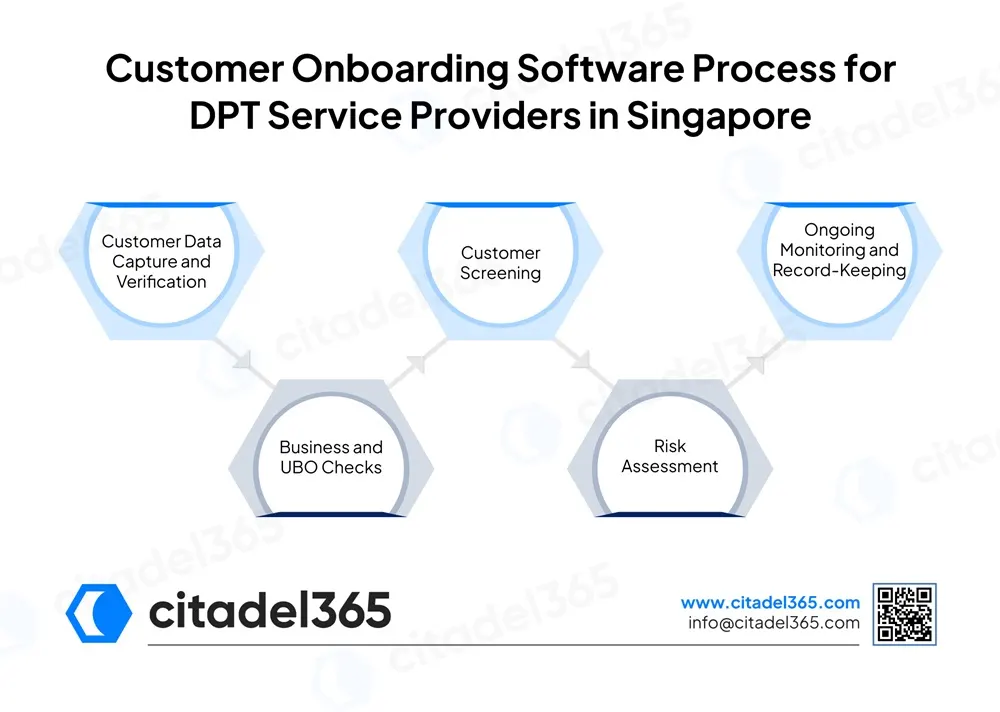
Customer Data Capture and Verification
Customer onboarding software helps DPT service providers in Singapore collect customers’ personal details and identity documents. With the customer’s consent, DPT service providers can use MyInfo to retrieve government-sourced personal data for identity verification.
Business and UBO Checks
Customer onboarding software helps DPT service providers collect information on corporate customers and their related parties, including directors, shareholders and ultimate beneficial owners (UBOs). DPT service providers can use Accounting and Corporate Regulatory Authority (ACRA) records as a reliable, independent source to verify the business and its ownership structure.
Customer Screening
Customer onboarding software, integrated with a screening solution, helps DPT service providers screen customers and relevant parties against applicable sanctions watchlists, politically exposed persons (PEPs) and adverse media data. MAS Notice PSN02 requires DPT service providers to screen customers, their beneficial owners and connected parties when establishing business relations and on an ongoing basis.
Risk Assessment
Customer onboarding software helps DPT service providers assess customer risk based on factors such as customer type, business activities, screening matches, and geographies. Under MAS Notice PSN02, DPT service providers must perform enhanced CDD for higher-risk customers, including foreign politically exposed persons (PEPs).
Ongoing Monitoring and Record-Keeping
Customer onboarding software helps DPT service providers monitor customer activities and transactions to identify changes and detect suspicious activities that may need to be reported to the Suspicious Transaction Reporting Office (STRO). Customer onboarding software also maintains required records of customer information and CDD checks, which DPT service providers must generally keep for at least five years.
Look Beyond the Company Name
Map corporate ownership structures and identify UBOs with Citadel365’s corporate structure mapping capabilities.
Which Compliance Functions Does Customer Onboarding Software Support for DPT Service Providers?
Customer onboarding software helps DPT service providers in Singapore carry out the following AML/CFT compliance functions under MAS Notice PSN02:
- Apply CDD checks based on a customer’s risk profile and circumstances.
- Identify potential sanctions and PEP matches before establishing the business relationship.
- Identify and verify the natural persons who ultimately own or control corporate customers.
- Capture supporting documents for additional checks for high-risk customers, where required.
- Detect unusual transaction patterns for further investigation.
- Facilitate the collection and transmission of originator and beneficiary information for DPT transfers in line with travel rule requirements under MAS Notice PSN02, including additional originator details for transfers above SGD 1,500.
- Maintain evidence of CDD checks, risk assessments and compliance decisions.
What Red Flags Can Customer Onboarding Software Detect for DPT Service Providers?
Customer onboarding software helps DPT service providers in Singapore detect the following onboarding red flags, which may indicate money laundering, terrorist financing or other financial crime:
- False or altered ID documents, or a customer who fails to match their ID during liveness checks.
- The UBO of a corporate customer cannot be identified beyond nominee shareholders or directors.
- A corporate entity’s registration is linked to a sanctioned or high-risk jurisdiction, such as one subject to a FATF call for action.
- The customer’s name appears in adverse media linked to financial crime.
- The customer’s stated profile does not match the documents provided.
- Transfers to or from self-hosted wallets where the customer cannot show ownership or control of the wallet.
Manual Onboarding vs Customer Onboarding Software for DPT Service Providers
Customer onboarding software reduces the delays and errors of manual onboarding for DPT service providers. It centralises data collection, automates verification, screening, UBO mapping, monitoring and record-keeping, simplifying compliance processes.
The table below compares manual onboarding with customer onboarding software across five onboarding areas.
Onboarding Area | Manual Process Risk | Software Advantage |
Individual identity | Manual collection and review of customer documents | Centralised KYC data and document collection |
Corporate customers | Inconsistent KYB checks and incomplete UBO identification | Full corporate KYB with UBO mapping |
Customer screening | Manual screening may be inconsistent | Integrated screening against sanctions, PEPs and adverse media data |
Ongoing monitoring | Missed or untracked periodic reviews, creating PSN02 ongoing monitoring gaps | Risk-based periodic review scheduling aligned with MAS Notice PSN02 |
Record-keeping | Customer records and decisions spread across files | Centralised document storage and timestamped audit trails |
How Citadel365 Supports DPT Service Provider (VASP) Onboarding in Singapore
Citadel365 helps DPT service providers in Singapore identify and verify customers through a structured workflow. The customer onboarding software supports data collection through Excel imports, forms, and email-based KYC, allowing compliance teams to collect information and documents efficiently.
Citadel365 also automates corporate structure mapping, helping DPT service providers identify shareholders, directors and ultimate beneficial owners (UBOs). Integrated with name screening software, it screens customers and beneficial owners against sanctions, PEP and adverse media data.
Citadel365’s customer risk assessment solution enables configurable parameters and automates risk scoring and profiling, supporting risk-based onboarding decisions. Citadel365 supports secure customer document storage, timestamped CDD check records, and role-based workflows for compliance teams and money laundering reporting officers (MLROs).
The customer onboarding software helps DPT service providers simplify customer due diligence processes, identify potential risks and maintain records to meet MAS requirements.
Keep Every Onboarding Check Documented
Citadel365 keeps customer documents and onboarding evidence organised with centralised storage and timestamped audit trails.
FAQs on Customer Onboarding Software for Singapore DPT Service Providers
Customer onboarding software is a digital tool for DPT service providers in Singapore that automates KYC/KYB checks to verify the customer before establishing a business relationship, helping prevent financial crime.
The travel rule is an AML/CFT standard under FATF Recommendation 16 that requires DPT service providers to obtain, hold and transmit required originator and beneficiary information during DPT transfers.
Paragraph 13 of MAS Notice PSN02 sets out requirements for in-scope DPT value transfers, irrespective of amount, subject to the notice’s definitions and exclusions. Before an in-scope transfer, the ordering institution must identify the originator and take reasonable measures to verify their identity, unless it has already done so as part of CDD under paragraph 6 of the notice.
For transfers exceeding SGD 1,500 or the equivalent in another currency or DPT, the ordering institution must identify and verify the originator and transmit the required information, including at least one prescribed additional originator detail: an address, a unique identification number, or the date and place of birth, incorporation or registration, as applicable. Customer onboarding software supports this by capturing originator and beneficiary details and verifying originator identity for relevant transfers.
Liveness verification helps Singapore DPT service providers confirm that a real, live person matches their ID document, reducing impersonation and identity fraud risks during remote onboarding. MAS Notice PSN02 requires policies and procedures to address the specific risks of non-face-to-face business relations, and liveness checks are one way to support this.
MAS Notice PSN02 sets the AML/CFT requirements for DPT service providers licensed under the Payment Services Act 2019. It covers customer due diligence, enhanced due diligence, ongoing monitoring, value transfers (the travel rule), record-keeping and suspicious transaction reporting.
Under MAS Notice PSN02, DPT service providers must perform CDD when they establish business relations, undertake a transaction for a customer without an account, or send or receive DPT value transfers for a customer. CDD is also required where there is a suspicion of money laundering or terrorism financing, or doubts about previously obtained CDD information.
Yes. MyInfo, accessed through Singpass, lets customers consent to share government-sourced personal data, such as name, NRIC or FIN, date of birth and address, with a DPT service provider. This supports identity verification and reduces manual document collection during remote onboarding.
No. MAS Notice PSN02 does not require any specific software. It requires DPT service providers to perform and document CDD, screening, ongoing monitoring and record-keeping, and onboarding software is one way to do this consistently and with an audit trail.
KYC (Know Your Customer) verifies the identity of individual customers. KYB (Know Your Business) verifies a corporate customer, its directors and shareholders, and the natural persons who ultimately own or control it. DPT service providers in Singapore need both, depending on whether the customer is an individual or an entity.
Citadel365 automates customer onboarding processes for DPT service providers in Singapore, including KYC checks, screening, risk assessment, and record-keeping through a structured workflow. It helps compliance teams organise customer information, identify ML/TF risks and maintain records, reducing manual effort and supporting AML/CFT compliance.

Sridhar is a Certified Anti-Money Laundering Investigator (CAMI) with over 30 years of experience in compliance, risk, and audit, including more than 20 years in AML and financial crime prevention. He has contributed to the development of UAE regulatory standards through the FERG sub-committee and has maintained active engagement with the Central Bank of the UAE on supervisory and compliance matters.