
Name Screening Software for Law Firms in Singapore
Ready to Defeat Your AML Compliance Obstacles?
Citadel365 Brings Revolution with Secure Solutions to AML Compliance Problems
Key Takeaways: Name Screening Software for Law Firms in Singapore
- Singapore law firms must screen clients when acting on a relevant matter under section 70A of the Legal Profession Act 1966, such as real estate transactions, managing client money, and forming or managing companies and trusts.
- Effective screening covers sanctions lists, politically exposed persons (PEPs) and adverse media in one run, so a PEP or negative-news hit can trigger enhanced due diligence (EDD) before the matter starts.
- Screening is not a one-time check: law firms need ongoing monitoring while the matter is open, and timestamped records they can produce during an AML inspection.
- A confirmed match needs a documented decision: EDD for a PEP or adverse media hit, no dealing with a designated person on a sanctions hit, and a suspicious transaction report (STR) to the Suspicious Transaction Reporting Office (STRO) where money laundering or terrorist financing is suspected.
What Is Name Screening Software for Law Firms in Singapore?
Name screening software for law firms in Singapore is an AML screening tool that checks clients, their agents and beneficial owners against sanctions watchlists, politically exposed person (PEP) databases and adverse media sources. It flags potential matches for review, rescreens existing clients when lists change, and keeps a timestamped record of each check to support the firm’s anti-money laundering and countering the financing of terrorism (AML/CFT) obligations.
Under Part 5A of the Legal Profession Act 1966 and the Legal Profession (Prevention of Money Laundering and Financing of Terrorism) Rules 2015, Singapore law practices acting on a relevant matter must carry out customer due diligence (CDD) before establishing a business relationship. Name screening is the step within CDD that checks whether a client, agent or beneficial owner is sanctioned, politically exposed or linked to financial crime. Because watchlists and client risk profiles change, firms also need ongoing monitoring for the life of the matter.
Name screening software automates these checks and the rescreening that follows, so the firm can show inspectors when each person was screened, what matched and how each alert was resolved.
Who Must Be Screened at a Singapore Law Firm?
A Singapore law firm acting on a relevant matter should screen four groups: the client, anyone acting on the client’s behalf, the client’s beneficial owners, and third parties funding the matter.
Clients and Their Agents on Relevant Matters
Singapore law firms must screen every client on a relevant matter, as defined in section 70A of the Legal Profession Act 1966. This broadly covers real estate transactions, managing client money and assets, creating or managing companies and trusts, and corporate or financial structuring. Rule 7 of the 2015 Rules extends due diligence to agents acting for the client, such as a director or attorney signing on its behalf, so screen them too.
Beneficial Owners Behind Corporate Clients
When the client is a company, trust or other legal arrangement, a Singapore law firm must identify and screen its ultimate beneficial owners (UBOs), the individuals who ultimately own or control the entity. Screening only the company name can miss a sanctioned or politically exposed individual behind it.
Third Parties Funding Client Account Matters
When a third party pays money into the client account, a Singapore law firm should screen that payer as part of its risk-based approach. This matters most in conveyancing, where purchase funds may come from someone other than the named buyer, such as a relative or an offshore company.
Know Who Sits Behind the Entity
Citadel365 maps and screens the UBOs behind corporate clients, so matches surface beyond the company name.
How Name Screening Software Helps Singapore Law Firms
Name screening software helps Singapore law firms run sanctions screening, PEP screening and adverse media screening on clients and UBOs. The table below maps each screening requirement to the matching software feature and the evidence it creates for an AML inspection.
Screening Requirement | What the Firm Must Do | Name Screening Feature | Evidence Generated |
Client screening at matter intake | Screen before work starts on a relevant matter | Matter-triggered client screening workflow | Client screening record, match results, matter reference |
UBO screening for corporate clients | Screening beneficial owners on company formation and conveyancing mandates | UBO screening linked to know-your-business (KYB) checks on the matter | UBO screening records, match results, matter reference |
PEP screening | Detecting PEP clients on high-value and sensitive matters | PEP database screening on clients and UBOs | PEP match results, EDD trigger, review history |
Adverse media | Find negative news linking clients to financial crime | Adverse media integrated with sanctions and PEP run | Adverse media hits, alert notes, review trail |
Ongoing rescreening | Monitoring active matter clients for new listings | Ongoing rescreening while the matter is open | Rescreening logs, new hit alerts, timestamps |
Matter-linked evidence | Inspection-ready records linked to the specific matter | All records linked to the matter reference | Timestamped records, exportable per matter |
Red Flags Name Screening Software Can Detect at Singapore Law Firms
Name screening software helps Singapore law firms spot these red flags at intake and during ongoing monitoring:
- A client’s name partially matches an individual on a sanctions list.
- The beneficial owner of a company the firm is incorporating for a client is a known PEP.
- An existing client is added to a sanctions list after onboarding, and the match surfaces during rescreening.
- A director or beneficial owner of a corporate client appears in adverse media linked to fraud, corruption or tax crime.
- A third party funding a conveyancing matter matches a sanctioned individual or entity.
What Should a Singapore Law Firm Do When Screening Finds a Match?
When name screening returns a potential match, a Singapore law firm should first confirm whether it is a true match, then act on the type of hit and record the decision either way.
- Review the alert: compare date of birth, nationality and identity numbers to rule out a false positive, and note the reason for clearing or confirming it.
- Confirmed PEP or adverse media hit: apply enhanced due diligence, typically senior management approval and checks on source of wealth and source of funds, before the matter proceeds.
- Confirmed sanctions match: do not act for, or deal with funds or assets of, the designated person, and make the reports required under Singapore’s targeted financial sanctions laws.
- Suspicion of money laundering or terrorist financing: file a suspicious transaction report (STR) with the Suspicious Transaction Reporting Office (STRO) and avoid tipping off the client. The Ministry of Law’s guidance on ongoing monitoring and STR filing timelines sets out the expected pace.
Essential Features of Name Screening Software for Singapore Law Firms
Name screening software for a Singapore law firm should include these five features:
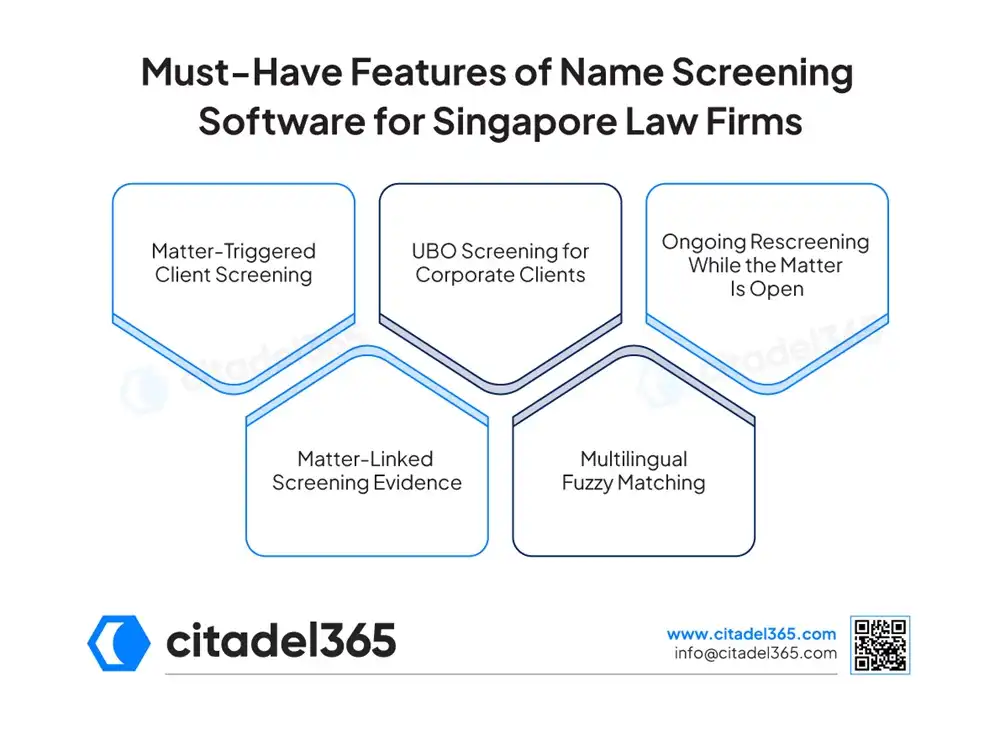
Matter-Triggered Client Screening
Name screening software should start a screening run automatically when a new matter is opened and flagged as a relevant matter, such as a conveyancing, company formation or trust mandate. This stops work from starting before the client, agents, and beneficial owners have been checked.
UBO Screening for Corporate Clients
For corporate and trust clients, name screening software should screen each UBO alongside the entity and link every UBO result to the client record, so a hit on an owner is visible on the matter.
Ongoing Rescreening While the Matter Is Open
Name screening software should rescreen every client on an open relevant matter whenever sanctions or PEP lists update, or at a frequency the firm sets by risk level. A new match should alert the compliance officer with the date and the list that triggered it.
Matter-Linked Screening Evidence
Name screening software should store every search, match decision and reviewer note against the matter reference, and export them as a timestamped report when the firm faces an AML inspection or audit.
Multilingual Fuzzy Matching
Name screening software should use fuzzy matching to catch spelling variants, transliterations and name-order differences common in Malay, Chinese, Tamil and English names. This reduces both missed matches and false positives for Singapore law firms.
Match Names Beyond Exact Spelling
Citadel365 uses fuzzy matching to help Singapore law firms detect spelling variants and similar names while reducing false alerts.
Citadel365 Name Screening Software for Law Firms in Singapore
Citadel365 name screening software checks clients, agents and UBOs on relevant matters in Singapore against sanctions watchlists, PEP databases and adverse media sources in a single run. It automates these checks, reducing manual effort and the risk of human error.
The name screening software also rescreens existing clients when sanctions, PEP or other lists change. Citadel365 allows law firms to configure rules and thresholds to improve detection accuracy and reduce false positives. Firms can also set how often periodic rescreening runs, so monitoring matches each client’s risk level.
Citadel365 helps law practices of every size in Singapore, from sole proprietorships to large firms with conveyancing and corporate teams, to meet their AML/CFT screening obligations with timestamped reports they can retrieve during regulatory inspections.
Name Screening Software Buyer Checklist for Singapore Law Firms
Before choosing name screening software, a Singapore law firm should confirm that it automates client, agent and UBO screening against sanctions watchlists, PEP databases and adverse media sources.
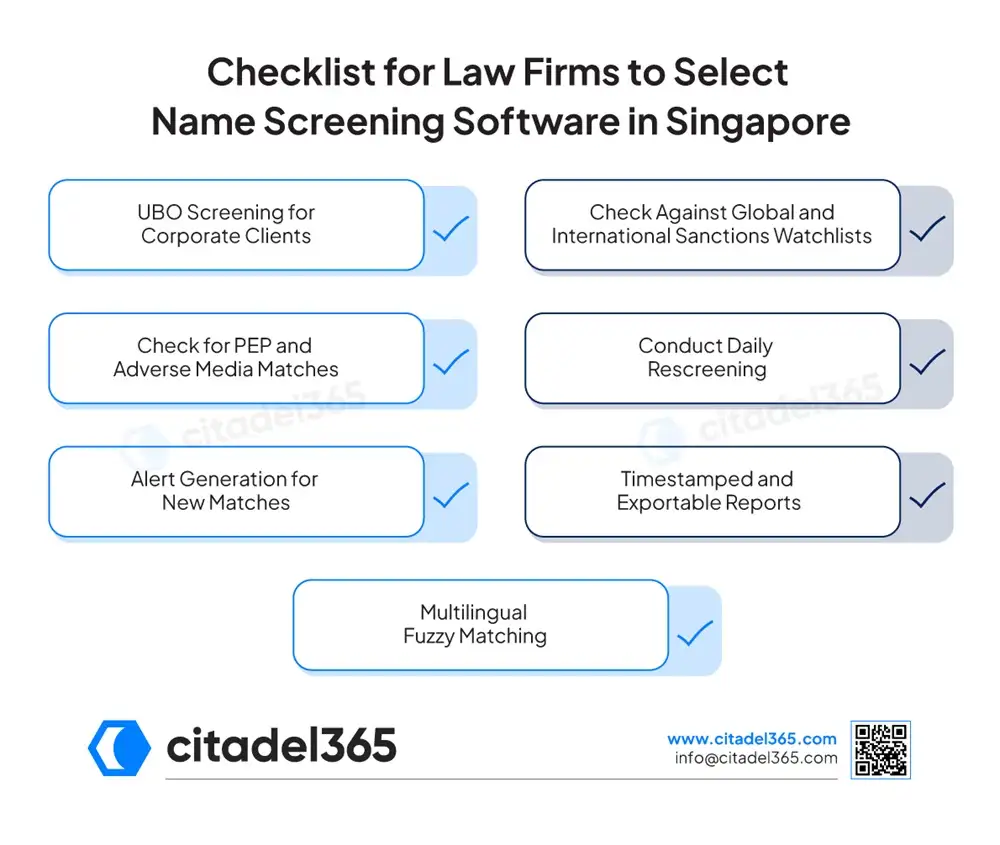
Ask the vendor these questions:
- Does the name screening software check clients on relevant matters such as company formation, conveyancing, trust work and client money management?
- Does it screen UBOs for corporate clients and link the results with the client details?
- Does the screening software check against sanctions, PEP and adverse media sources in one place?
- Does the name screening software rescreen clients automatically when global lists or client risk profiles change?
- Does it use fuzzy matching for Malay, Chinese, Tamil and English name variants, with configurable match thresholds?
- Can it export a timestamped audit trail for each matter during an AML inspection?
Still Using Multiple Platforms for Screening?
Identify sanctions, PEP and adverse media matches in one run with Citadel365.
Conclusion: Screen at Intake, Rescreen Through the Matter, Preserve the Firm’s Judgement
For Singapore law firms, name screening is not a one-time check. Screen clients, agents, beneficial owners and third-party funders before work starts on a relevant matter, then rescreen them until the matter closes. Software handles the volume and the record-keeping, but each match still needs a lawyer’s judgement on whether it is a true hit and what happens next. Citadel365 automates the screening and keeps the audit trail, so the firm’s compliance officer can focus on those decisions.
FAQs on Name Screening Software for Singapore Law Firms
Name screening software checks identity details only, such as names, dates of birth, nationalities and company registration data. It does not need the client’s instructions, the legal advice given or any other privileged communication. Keeping privileged material out of the screening platform, and limiting access to compliance staff, lets the firm meet its AML obligations without exposing privileged information.
Yes. When acting on a relevant matter for a company, trust or other legal arrangement, a Singapore law firm must identify the individuals who ultimately own or control it and screen them against sanctions, PEP and adverse media sources as part of CDD. Citadel365 helps law firms map and screen UBOs to uncover hidden risks and apply risk mitigation controls.
For relevant matters, yes. The Legal Profession (Prevention of Money Laundering and Financing of Terrorism) Rules 2015 require CDD on clients, their agents and beneficial owners, and Singapore’s targeted financial sanctions laws, including the Terrorism (Suppression of Financing) Act 2002 and regulations under the United Nations Act 2001, prohibit dealing with designated persons. Name screening is how a law firm checks both before it acts. Software is not mandatory, but manual checks are hard to evidence at scale.
Customer due diligence (CDD) is the full process of identifying and verifying a client, its agents and beneficial owners, and understanding the purpose of the matter and the source of funds. Name screening is one step within CDD: it checks those people against sanctions, PEP and adverse media sources. A clear screening result does not complete CDD on its own.
Citadel365 helps law firms in Singapore automate screening for clients, beneficial owners and related third parties against sanctions, PEP and adverse media data. It further lets law firms customise screening frequency, rules and thresholds to flag new matches as lists change and reduce false positives.

Vasantha holds a Master’s in Law specialising in Banking Laws and Anti-Money Laundering and is CAMS and CGSS certified. With over 35 years of experience, she has worked closely with regulators and international financial institutions, building financial crime risk frameworks, sanctions monitoring programmes, and compliance systems across multiple jurisdictions.