
AML Software in Singapore
Ready to Defeat Your AML Compliance Obstacles?
Citadel Brings Revolution with Secure Solutions to AML Compliance Problems
Key Takeaways: AML Software in Singapore
- AML software in Singapore helps automate compliance functions, including KYC, screening, risk assessment, ongoing monitoring, and record-keeping.
- In Singapore, AML software helps meet evolving AML/CFT regulations and detect ML/TF/PF risks to protect financial institutions and DNFBPs from regulatory penalties and improve operational efficiency.
- Citadel365, an AML software, helps regulated entities in Singapore automate CDD processes with a structured workflow, ensuring AML/CFT compliance.
What is AML Software?
AML software is a digital technology that helps organisations in Singapore efficiently manage their anti-money laundering (AML) obligations. Businesses in Singapore need to comply with the requirements of the Corruption, Drug Trafficking and Other Serious Crimes (Confiscation of Benefits) Act (CDSA), the MAS AML/CFT Notices, and sector-specific requirements enforced by regulators such as ACRA and the Ministry of Law.
Modern AML Software allows key compliance activities to function through one platform, helping organisations manage their customer information, perform screening, monitoring and record-keeping. AML software features include:
- Screening sanctions, politically exposed persons (PEPs) and adverse media to check individuals and businesses against global watchlists.
- KYC and customer due diligence (CDD) to collect and verify customer information.
- Customer risk assessment that classifies customers based on their risk factors.
- Transaction monitoring to detect unusual or suspicious activities.
- Case management and suspicious transaction reporting to investigate cases and manage reporting workflows.
- Audit trails and documentation to maintain records of compliance activities and decisions.
Why AML Software is Important in Singapore?
Singapore is a major global financial centre and, in recent years, has strengthened its AML/CFT controls significantly. The Monetary Authority of Singapore has revised its AML/CFT Notices effective from 1 July 2025, including the most significant update since 2024. The authority introduces proliferation financing as a mandatory standalone risk category, tightens suspicious transaction reporting timelines, and expands beneficial ownership requirements.
Entities must file suspicious transaction reports (STRs) in Singapore with the Suspicious Transaction Reporting Office (STRO) at the Commercial Affairs Department of the Singapore Police Force, using the SONAR platform. Entities must file STRs without any delay.
Meeting these requirements and timelines manually may delay the work. Further, MAS has increased enforcement activity on financial institutions in Singapore for AML/CFT failures. This includes imposing fines, licence revocations and prohibition orders for issues relating to transaction monitoring, risk assessments, and timely reporting.
AML/CFT obligations are also applied to DNFBPs supervised by their sector regulators. ACRA supervises corporate service providers and accountants, while the AML/CFT Division under the Ministry of Law supervises precious metals and stones dealers and the Gambling Regulatory Authority oversees casinos.
AML software helps these entities automate and structure workflows. It also helps meet AML requirements by simplifying screening, risk assessment, transaction monitoring, and record-keeping. The AML software ensures consistency and timeliness throughout for secure compliance.
How Does AML Software Work?
AML software helps identify and manage potential money laundering, terrorist financing and other financial crime risks through a structured process.
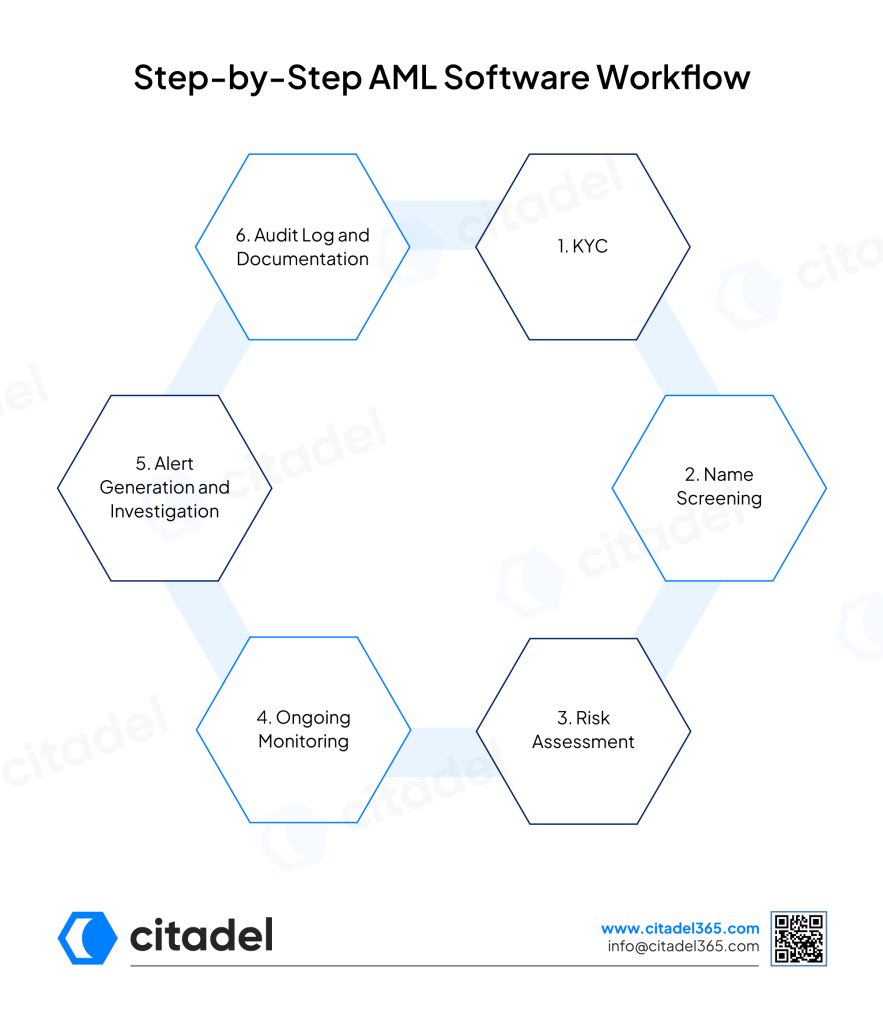
KYC (Know Your Customer)
The software collects and verifies customer information during onboarding. It connects with internal systems and external data sources through APIs to collect relevant customer information and keep the records updated.
Name Screening
AML software then screens customer information against sanctions watchlists, politically exposed persons (PEPs) databases, and adverse media sources. This helps identify potential matches and generates alerts for review.
Risk Assessment
AML software also helps assess customer risk using factors such as customer type, geography, products or services, and delivery channels. Customers may assign different risk levels based on these factors.
Ongoing Monitoring
The AML software analyses customer activity and transactions to identify unusual patterns and anomalies that may indicate money laundering and financial crime risks.
Alert Generation and Investigation
Further, the AML software generates alerts for suspicious activities and transactions. It also provides a centralised space for managing cases for investigation.
Audit Log and Documentation
AML software maintains audit trails that support record-keeping. The software records compliance activities and decisions that support reporting and other regulatory processes.
Essential Compliance Functions of AML Software in Singapore
AML software helps regulated entities in Singapore simplify compliance functions such as customer onboarding, screening, transaction monitoring, risk assessment, case management and recordkeeping.
Customer Onboarding and KYC
AML software helps collect and verify customer information, including business details, government IDs, and other supporting documents. The software supports onboarding both individual and corporate clients.
Sanctions, PEP and Adverse Media Screening
For regulated entities in Singapore, AML software helps screen customer data, including their beneficial owners and counterparties, against sanctions watchlists, PEP databases and negative news sources. The software conducts real-time screening and rescreening to identify matches when customer information or laws change.
Customer Risk Assessment
The compliance function also includes assessing customer risk based on factors such as customer type, geography, transaction, ownership structure, delivery channel, product and service. AML software helps assess customer risk by considering all relevant factors and automating risk scoring and profiling.
Ongoing Monitoring and Alert Generation
AML software continuously monitors customer activities, such as their profiles, risk scores, and transactions, to identify unusual patterns and behaviours and generate alerts. Monitoring also covers proliferation financing risks, as mandated by Singapore AML law from 1 July, 2025.
Case Management and STR Filing
AML software with effective case management helps compliance teams investigate alerts, escalate cases, and maintain records through a structured workflow. The software also supports STR preparation aligned to STRO’s SONAR platform for timely reporting.
Audit Logs and Inspection-Ready Reports
Record-keeping is a mandatory compliance obligation. AML software helps maintain detailed logs of all compliance activities, including escalation processes and decision-making. It also helps generate reports required for internal governance and supervisory inspection.
Key Features of AML Software for Singapore Compliance
AML software helps Singapore financial institutions and DNFBPs manage their compliance activities by providing a structured workflow. The key features should include:
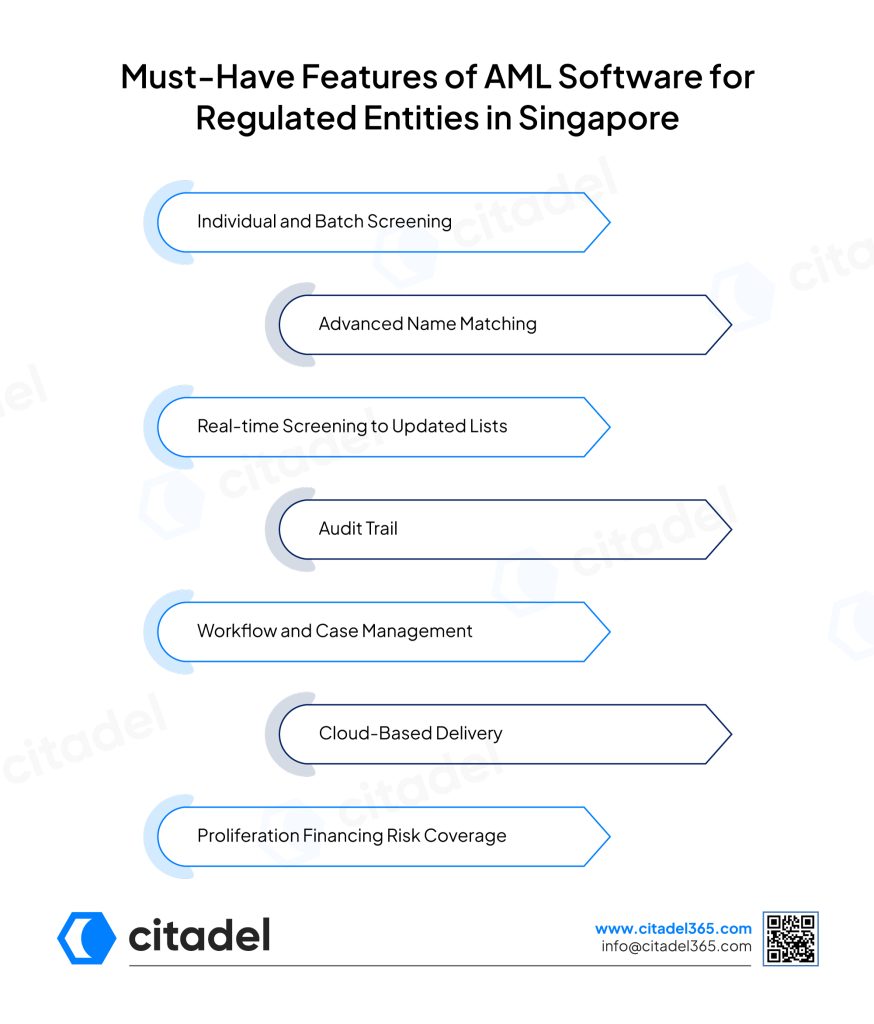
Individual and Batch Screening
Compliance teams should be able to screen an individual customer as well as a corporate entity customer. AML software should also enable screening of large groups of customers in bulk, which is useful for periodic re-screening, legacy data screening, and bulk monitoring reviews. The software should help compliance teams manage screening efficiently.
Advanced Name Matching
Regulated entities in Singapore may deal with customers whose names appear in different formats, languages or sequences. An effective AML software should be able to identify relevant name variations, aliases, transliteration differences and potential spelling differences. This helps identify potential matches in Chinese, Malay, English and Tamil names, without relying on exact-name searches.
Real-time Screening to Updated Lists
AML software should support screening customers against the relevant sanctions and PEP lists. The software should allow real-time screening of customers against updated watchlists so entities can take timely action when any customer is identified as sanctioned or a PEP. Additionally, the AML software should support alert generation and documentation of potential match reviews.
Audit Trail
A detailed audit trail helps demonstrate to regulators how alerts and potential matches were reviewed and what actions were taken. AML software should facilitate an audit trail that records screening results, alerts, actions, investigation notes, and other compliance activities.
Workflow and Case Management
AML software should facilitate compliance teams with a centralised space to assign alerts, record investigation findings, escalate cases, request additional information, and document final decisions. AML software with effective case management allows a structured workflow, ensures consistency, and keeps supporting documents together.
Cloud-Based Delivery
A cloud-based AML platform helps secure and centralise customer information, screening results, alerts and case records. The platform should also support remote accessibility, centralised data management, real-time monitoring, and automatic software updates.
Proliferation Financing Risk Coverage
The AML software should address proliferation financing risks, alongside money laundering and terrorist financing. The software should incorporate PF risk factors while assessing customer risk and PF typologies, and monitor transactions to detect risks associated with proliferation financing.
Challenges Businesses Face Without AML Software in Singapore
Regulated entities and their compliance teams may face the following challenges without AML software in Singapore:
Inability to Meet the One-business-day STR Timeline
For suspicious transactions that require reporting, compliance teams need to collect relevant information, investigate cases, and prepare an STR for submission through SONAR. Manual processes can be time-consuming and may make it difficult to meet the STR filing timeline.
Missing the Real-time Requirement
Regulated entities are required to keep customer information current and up-to-date. Updates to watchlists and changes in customer profiles require real-time screening. Entities with manual processes may miss sanctions requirements when watchlists update or customer details change.
No Proliferation Financing Dimension
Singapore AML law mandates covering proliferation financing risks, alongside money laundering and terrorist financing. Businesses need to include PF risks in their risk assessments and controls. Managing these considerations manually can become difficult.
Incomplete Audit Trails
Regulated entities are required to maintain complete records of customer checks, risk assessments, alerts, investigations, and final decisions. Without a centralised platform, the compliance team may struggle to retrieve and review information.
Scalability Issues
Without AML software, it becomes challenging to manage growing customer volumes, multi-entity screening, and complex corporate structures across different customers and entities.
One Platform for Every Critical AML Check.
From KYC and screening to transaction monitoring, manage AML workflow in one place.
How Citadel365 Supports AML Compliance in Singapore
Citadel365 helps regulated entities in Singapore manage their key AML/CFT compliance activities through an automation solution. The centralised platform brings together customer onboarding, name screening, risk assessment and case management.
Citadel365 customer onboarding software automates document collection and verification of customer information, reducing manual data entry. Its name screening software checks customers against sanctions watchlists, PEP databases and adverse media sources.
Further, customer risk assessment software evaluates risk through a risk-based approach and calculates risk at onboarding and for profile risk. Citadel365 case management software provides a centralised platform to manage cases and track activities. Moreover, the audit trails ensure every task is recorded in a systematic manner, meeting AML/CFT requirements and supporting compliance during inspections.
FAQs About AML Software in Singapore
AML software is a technology solution that helps financial institutions and designated non-financial businesses and professions (DNFBPs) in Singapore meet AML/CFT requirements by automating and streamlining processes. The software simplifies KYC, screening, transaction monitoring, reporting, and record-keeping through a structured workflow.
In Singapore, AML software can help financial institutions such as banks, capital market service providers, finance companies, and DNFBPs such as precious metals and stones dealers, accountants, and corporate service providers. AML software helps these entities manage large customer volumes, regular screening, ongoing monitoring, and record-keeping to meet AML/CFT compliance requirements.
Yes, AML software uses advanced name-matching algorithms, risk-based screening, and artificial intelligence instead of rigid thresholds and rules, which reduces false positives in Singapore screening.
AML software automates compliance obligations that financial institutions are required to meet for MAS supervisory inspections. The software enables real-time screening, meets strict reporting timelines, supports ongoing monitoring, and maintains audit-ready reports.

Arjun is the Co-founder and CEO of Citadel, where he leads the company’s vision across technology, business, and regulations. He brings over a decade of experience in building and scaling technology ventures. Arjun holds a B.Tech. in Information Technology and a Master’s in Management, supported by his certification as a Financial Crime Specialist, an uncommon combination that allows him to balance innovation with regulatory requirements.
Having advised leading banks and financial institutions on digital solutions and compliance technology, Citadel continues to grow with an ambition.