
Proliferation Financing Risk Assessment
See the Transaction. Understand the Trade Behind It.
Connecting the Dots. Challenging the Obvious
Money laundering hides the proceeds of crime. Terrorist financing supports acts of terror. Proliferation financing presents a different challenge altogether.
Many organisations operate across high-risk jurisdictions. Others facilitate international trade, complex ownership structures or cross-border financial flows. None of these activities is inherently problematic. Yet each can influence an organisation’s exposure to proliferation financing in ways that are not always immediately visible.
In the UAE, this is a legal obligation rather than a discretionary exercise. Article 19(1)(a) of Federal Decree-Law No. 10 of 2025 requires financial institutions, DNFBPs and virtual asset service providers to identify, assess, document and continuously update their proliferation financing risks, retain the assessment and produce it to their supervisory authority on request. Article 5 of Cabinet Resolution No. 134 of 2025 sets out the factors that the assessment must weigh.
Through our proliferation financing risk assessment service, Citadel365 brings those individual risk factors into focus through a risk-based approach that helps organisations understand their inherent exposure, evaluate the strength of their control environment and build a proportionate framework for mitigating proliferation financing risks.
Connect the Dots Before Others Connect the Case
Understanding how customers, transactions and jurisdictions interact provides a clearer picture of your true exposure.
How Our Proliferation Financing Risk Assessment Comes Together
Residual risk cannot be assessed in isolation. It only becomes meaningful once inherent exposure has been understood and the effectiveness of existing controls has been evaluated. Our assessment follows this sequence to ensure every finding has a clear foundation.
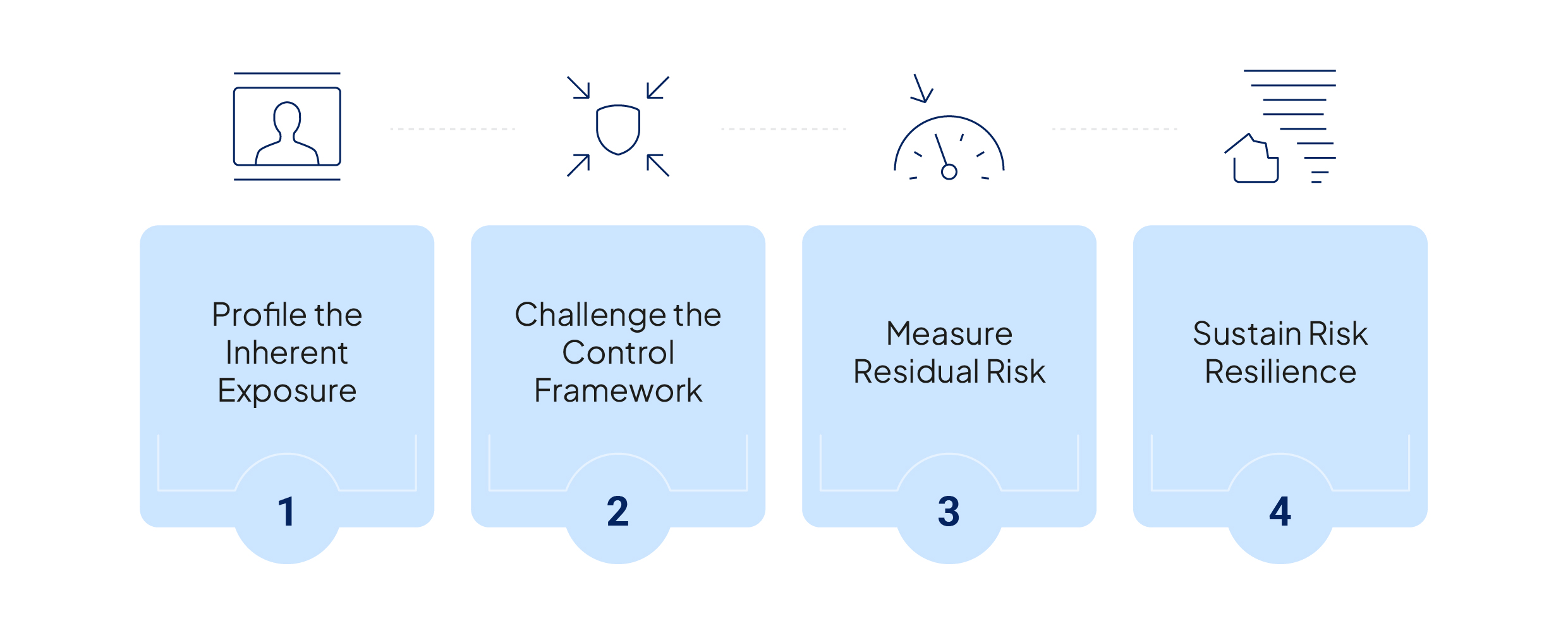
1. Profile the Inherent Exposure
Proliferation financing risk does not originate from a single source. It develops through the interaction of customers, products, delivery channels, jurisdictions, payment flows and, where relevant, trade activities. We assess these factors collectively to establish the organisation’s inherent exposure, identifying where sanctions evasion, trade-based proliferation financing or complex ownership structures could increase risk.
2. Challenge the Control Environment
A control framework is more than the sum of its parts. We determine how your governance, due diligence, screening and monitoring measures work together to manage proliferation financing risks, identifying where they reinforce one another and where gaps begin to emerge. By assessing the framework as a connected system rather than a series of individual controls, we establish whether it is proportionate to your organisation’s risk profile, responsive to evolving threats and capable of supporting risk-based decisions.
3. Measure Residual Risk
No framework eliminates risk entirely. It is more important to understand what survives after mitigation. By comparing inherent exposure with the effectiveness of existing controls, we determine the residual exposure that remains across the organisation. More importantly, we explain what those findings mean in practice, helping you distinguish between acceptable exposure, emerging vulnerabilities and areas requiring immediate action. FATF guidance treats residual risk as the exposure that remains once controls are applied. UAE law goes further: Article 5 of Cabinet Resolution No. 134 of 2025 requires proportionate measures where high proliferation financing risk remains, including enhanced internal controls, documented records available to the authorities and periodic review of those controls as the level of risk changes.
4. Sustain Risk Resilience
The assessment should support decisions beyond regulatory compliance. Our recommendations prioritise control enhancements based on risk, helping organisations strengthen governance, refine control design, and ensure the framework continues to respond to changes in business activities, emerging proliferation financing typologies and evolving sanctions obligations.
Beyond the Final Proliferation Financing Risk Assessment Report
The hallmark of a meaningful proliferation financing risk assessment is the clarity with which it distinguishes material exposure from ordinary business.
1. Risk Does Not Begin at the Border
Proliferation financing is often associated with sanctioned jurisdictions, yet geography alone does not map the whole story. Exposure is more often created by the interaction between customers, beneficial ownership, intermediaries, payment flows, trade activity, and the movement of controlled or dual-use goods. Assessments built around these connections distinguish genuine proliferation financing exposure from routine commercial activity, allowing resources to be directed towards risks that genuinely warrant attention.
2. Context Gives Risk Its Meaning
No customer, jurisdiction or transaction carries the same level of risk in every organisation. Their significance depends on the business model, customer base, products, delivery channels, and operating environment in which they exist. Assessments grounded in business context produce conclusions that are proportionate and reflective of actual exposure.
3. A Good Assessment Explains Itself
A risk rating should never feel arbitrary. The value of an assessment is not the score at the end. Every conclusion should be supported by a clear rationale, giving the management confidence in both the findings and the decisions that follow. This allows management to understand why conclusions have been reached, enables internal audit to challenge them where necessary and provides regulators with confidence that the conclusions reflect the organisation’s actual exposure rather than a generic template.
4. We Don’t Deliver Reports That Gather Dust
The completion of the report should not mark the end of its usefulness. An effective assessment becomes part of the organisation’s broader risk management framework, providing a benchmark against which future changes in business activities or regulatory expectations can be evaluated.
Choose Citadel365 and Leave Less to Chance
Build a proliferation financing risk assessment that supports confident decision-making.
Connecting the Dots of AML Compliance
Take the next step towards a stronger compliance framework. Explore our other service offerings.
Sanctions Compliance
Financial Crime Risk Assessment
Payment Risk Assessment
External Compliance Officer
ML/TF Risk Assessment Data Collection Process
AML Consulting Services
AML/CFT Gap Assessment
AML AUP
Typology Assessment
Rule Optimisation & Threshold Tuning
AML Periodic Inspection
Counterfeit Currency Detection Training
FAQs
A proliferation financing risk assessment identifies where your organisation may be exposed to proliferation financing risks and evaluates your controls. It gives you a clear view of your inherent risk, the effectiveness of your controls and the residual risk that remains. Proliferation financing itself is the provision, collection or making available of funds, directly or indirectly, knowing they will be used for weapons of mass destruction, their delivery means or related materials, including dual-use goods and technologies. It is a criminal offence under Article 3(3) of Federal Decree-Law No. 10 of 2025.
A Business-Wide Risk Assessment focuses on money laundering and terrorist financing risks. A proliferation financing risk assessment specifically evaluates the risk associated with proliferation financing and the effectiveness of the controls designed to mitigate it.
The assessment should be reviewed whenever there are significant changes to your business, products, customers, or operating jurisdictions. It should also be updated periodically to reflect your current risk profile.
Yes. Risk depends on how an organisation operates. Even businesses with a relatively low risk profile should understand where proliferation financing exposure could arise and whether the existing controls are appropriate.