Key Highlights: Customer Due Diligence for UAE Real Estate Agents and Brokers
- Customer Due Diligence (CDD) is a mandatory AML obligation in the UAE for real estate agents and brokers.
- Real estate agents and brokers need to identify and verify customers, assess risk and monitor customers & transactions, and apply enhanced due diligence for high-risk customers.
- Citadel365 supports real estate agents and brokers by automating CDD procedures and helping them meet compliance obligations.
Understanding Customer Due Diligence Under UAE AML Regulations
Customer Due Diligence (CDD) is a process that involves collecting customer information, verifying their identities, assessing their risk profiles, and monitoring them continuously to prevent
money laundering, terrorist financing and other financial crimes. In the UAE, it is mandatory for DNFBPs, including real estate agents and brokers, to implement CDD into their daily operations.
Real estate agents and brokers must apply CDD measures upon the commencement of a business relationship, when they suspect criminal activity, and when existing customer information is incomplete, inaccurate, or outdated, as stated in Federal Decree Law No. 10 of 2025.
The Ministry of Economy and Tourism (MoET) is the supervisory body for real estate agents and brokers in the UAE. Under
Cabinet Resolution 134 of 2025, real estate agents and brokers must conduct risk-based CDD, identify & verify the beneficial owner, apply enhanced due diligence and perform ongoing monitoring to combat ML/TF risks.
Who Must Be Subject to Customer Due Diligence?
Real estate agents and brokers must conduct customer due diligence on all parties who are involved in the property transaction. Regulated entities must identify and verify the following:
- Property Buyers and Sellers: Individuals, companies, trusts, or foundations buying or selling properties.
- Corporate Customers: Shell companies, complex legal entities, to identify and verify the ultimate beneficial ownership.
- Ultimate Beneficial Owners (UBOs): The individuals who ultimately own or control a corporate customer or property transaction.
- Representative Acting on Behalf of Customers: Any individual who is authorised to act on behalf of the buyers or sellers.
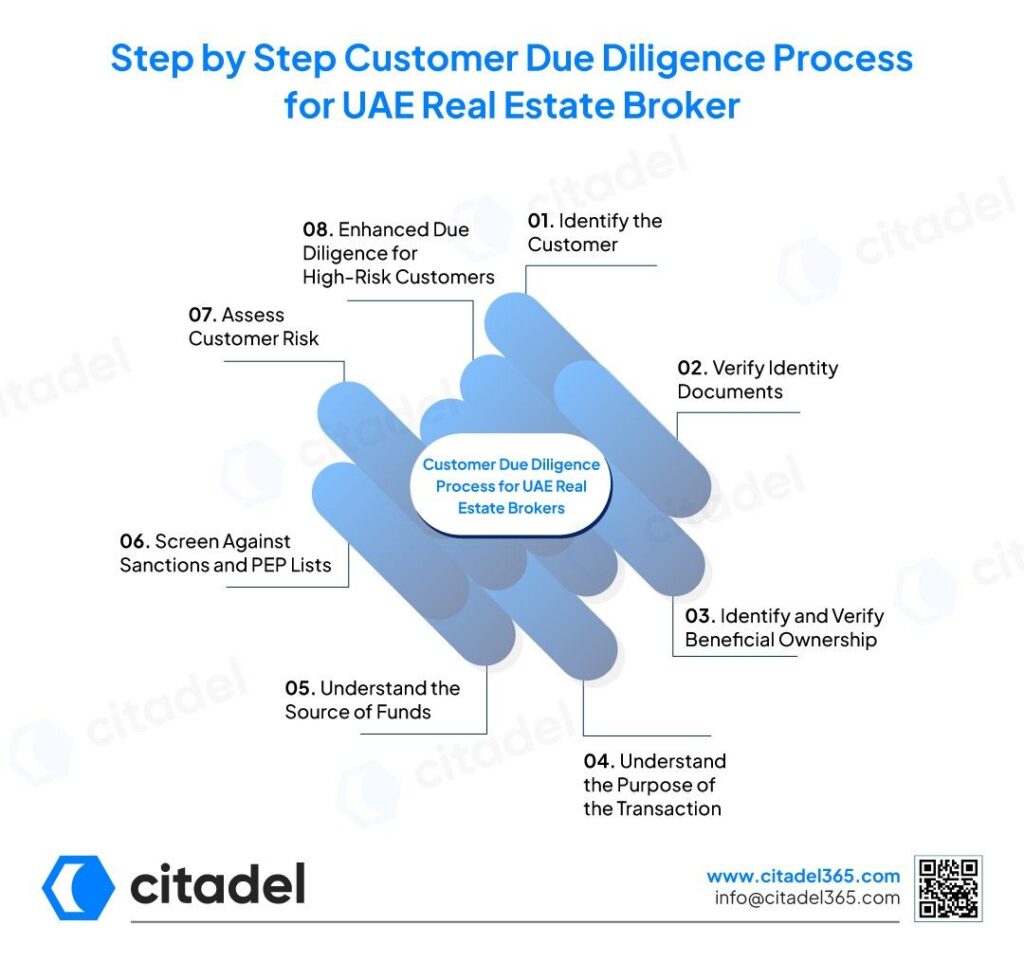
The Customer Due Diligence Process for UAE Real Estate Brokers
Real estate brokers and agents in the UAE must follow a comprehensive CDD process, which involves customer & UBO identification & verification,
risk assessment, screening, and enhanced due diligence. The following points make the CDD process clearer:
Identify the Customer
Collect basic customer information, including their name, address, contact details and legal status.
Verify Identity Documents
Verify customer identity using reliable documents such as a passport, Emirates ID, trade license, or any other valid government-issued identity document.
Identify and Verify Beneficial Ownership
Brokers must identify and verify
beneficial owners, or persons who ultimately own or control the corporate business (holding 25% or more shares/voting rights), when dealing with a legal-entity customer.
Understand the Purpose of the Transaction
Real estate agents and brokers must examine the customer’s purpose of buying, selling or investing in a property and whether it aligns with the customer’s stated profile.
Understand the Source of Funds
Real estate brokers and agents must evaluate the origin of money used in the property transaction and ensure the legitimacy of funds.
Screen Against Sanctions and PEP Lists
Screen customers, beneficial owners, or any parties involved in property transactions against the
sanctions lists and politically exposed person (PEP) databases to determine high-risk customers.
Assess Customer Risk
Brokers must assess customer risk based on factors such as customer type, transaction value, geographic exposure, etc.
Enhanced Due Diligence for High-Risk Customers
When a customer is identified as high-risk, such as PEP, or engages in complex transactions, real estate brokers and agents should conduct enhanced due diligence, including deeper background checks and increased ongoing monitoring.
What Information Do Real Estate Brokers Collect During CDD?
Real Estate Brokers must collect the relevant information to identify and verify customers during CDD and to comply with the AML/CFT regulations in the UAE. The basic information for CDD includes the following:
- Personal details, such as name, DOB, and nationality.
- Identification documents such as Emirates ID, passport, driving license and any other government-issued document bearing a photograph.
- Address proof documents such as utility bills, bank statements, municipal tax records, insurance policies, or rent agreements.
- Identification Documents such as trade license, certificate of incorporation, Memorandum of Association, and Articles of Association.
- Address Verification Documents include a utility bill, a bank statement, a rent agreement, and a municipal tax record.
- Other documents include the register of shareholders, directors, UBOs, audited financial statements, board resolution appointing the authorised signatory and identity documents and address proof for the authorised signatory and UBOs.
- Real estate brokers and agents must assess the source of funds (bank savings, sale of another property or inheritance), the purpose of the relationship and the intent of the property transactions.
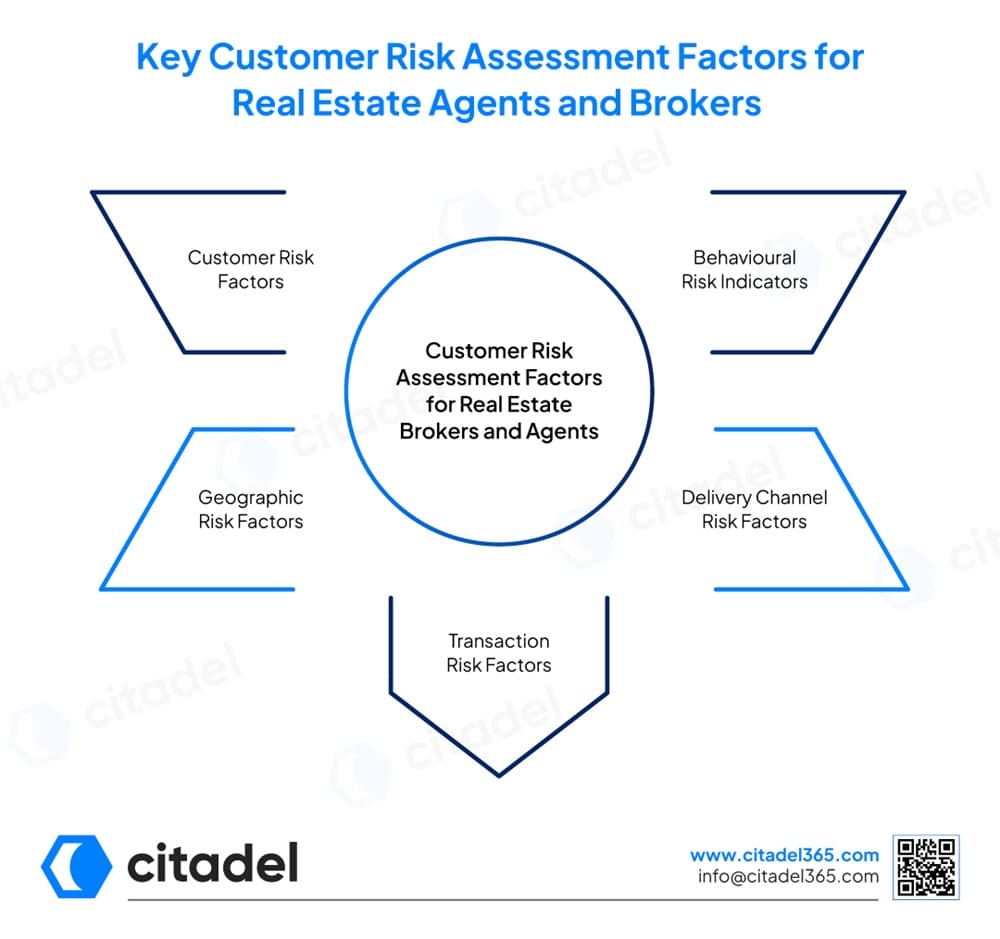
How Real Estate Brokers Assess Customer Risk
Real estate brokers and agents assess customer risk through evaluating the following factors:
Evaluate the customer’s background, business activity, occupation, ownership structure, and PEP status.
Identify nationality, country of residence, and business operations in/with high-risk jurisdictions.
Assess the nature of the transaction, mode of payment, transaction value, and whether they match the customer’s stated profile. Check frequent property transfers, high-value property purchase/sale, third-party payments, and the source of funds associated with a transaction.
Assess transactions involving intermediaries, agents, and non-face-to-face interactions.
Evaluate whether the customer’s behaviour poses a risk, such as unusual urgency, inconsistent documentation, or reluctance to provide information.
When Enhanced Due Diligence Becomes Necessary
While customer due diligence is a standard AML obligation during the onboarding process to identify & verify customers,
enhanced due diligence is necessary for high-risk customers. It involves a deeper investigation, requiring a source of wealth check and increased ongoing monitoring. Real estate agents and brokers must apply enhanced due diligence in the following cases:
- When dealing with politically exposed persons (PEPs), or their close associates and family members.
- Customers belong to or have connections to high-risk jurisdictions.
- Transactions involve companies with complex ownership structures, unclear UBOs, and multiple layers of ownership.
- Unusual payment arrangements, large transactions, or activities do not align with the customer’s known profile.
- Customers whose names appear in negative news or have adverse media exposure.
- Reluctance or unwillingness of customers to explain the source of funds used in a property transaction.
Common Red Flags Real Estate Brokers Should Watch For
Real estate brokers in the UAE must constantly watch for or identify the following red flags or warning signs to combat ML/TF risks:
- Customer delays or refuses to provide identification documents, maybe an attempt to hide the true identity.
- Provide no explanation for the use of third parties to make payments.
- Payments from different accounts, multiple payments, or complex payment arrangements.
- Inconsistency between transaction and customer profile, including income, occupation or business activity.
- Rapid buy and sale of properties within a short period may indicate suspicious activity.
- Large cash payments or the use of virtual assets to carry out property transactions.
- Use of complex ownership structures with no clear business purpose may be an attempt to hide the true owner.
Ongoing Due Diligence After Customer Onboarding
Customer Due Diligence is an ongoing process with ongoing due diligence as an essential component. Real estate agents and brokers are required to continuously monitor customers, transactions, and business relationships after customer onboarding. This involves:
- Monitoring changes in customer risk profile, including whether a customer turns out to be a PEP or develops connections with high-risk jurisdictions.
- Reviewing transaction activity to detect unusual patterns, behavioural changes, or transactions that are inconsistent with the customer’s stated profile.
- Updating changes in customer information, which includes customer records, beneficial ownership details, and replacing expired documents with clients’ new identification documents.
- Reassessing high-risk customers, for triggered events, update information and adjust their risk level, or perform enhanced checks.
Recordkeeping Requirements for Real Estate Brokers
Recordkeeping is an essential requirement under Cabinet Resolution No. 134 of 2025, requiring real estate brokers and agents to keep records for at least 5 years. Real estate brokers and agents are required to maintain records of customer identification documents, transaction data, beneficial ownership information, CDD processes, source of funds information, and suspicious activity reviews.
Recordkeeping is necessary for real estate agents and brokers to be made available when requested by regulatory authorities. This serves as evidence of compliance with AML/CFT obligations and supports brokers and agents from regulatory penalties and compliance risks.
Common CDD Challenges Faced by Real Estate Brokers
Real estate brokers and agents face the following challenges while conducting CDD:
- Identifying the ultimate beneficial owner (UBO) behind the complex corporate structures, which include shell companies, offshore entities, or trusts.
- Validating the source of funds for cross-border investments and international buyers with privacy laws, third-party payments, layered transactions, and complex structures.
- Managing high-risk customers, such as PEP who requires enhanced checks and ongoing monitoring.
- Maintaining complete documentation can be time-consuming, especially without automated solutions.
- Meeting regulatory requirements with constant updates in regulations, keeping in place AML controls with current obligations.
How Citadel365 Supports Customer Due Diligence in Real Estate
Citadel365 accelerates the customer due diligence process with multi-channel data capture that replaces slow and manual onboarding and streamlines customer information collection. Further, it automates customer risk assessment by helping calculate risks at onboarding and profile risk, providing a weighted risk score.
Its
name screening software screens customers against PEP databases and sanctions lists to identify high-risk customers and apply required procedures. Further,
Customer Onboarding Software provides ongoing monitoring functionality of the customer information and transactions.
Moreover, Citadel365’s
case management software ensures audit-ready customer records with immutable timestamped audit trails and a centralised platform for compliance operations. Therefore, it helps UAE real estate agents and brokers to meet regulatory requirements with ease, eliminating human errors, transaction delays, and manual paperwork.
Frequently Asked Questions About Customer Due Diligence for Real Estate Brokers