
Ready to Defeat Your AML Compliance Obstacles?
Citadel Brings Revolution with Secure Solutions to AML Compliance Problems
In the UAE, customer onboarding software has become an integral part of the AML/CFT framework due to strict regulations issued by regulatory authorities. These regulatory bodies expect businesses to have a robust system in place that is able to conduct customer due diligence, enhanced due diligence (wherever required), verification of customer IDs, screening customers against sanctions and PEP lists, assess customer risk, and continuously monitor customer data and transactions.
AML onboarding software in the UAE simplifies all these compliance obligations and governance measures by integrating them into a single automated system. It has features like real-time document validation, facial biometrics, and liveness checks to prevent identity fraud and spoofing. This reduces onboarding delays, enables faster KYC onboarding, lowers false positive rates, improves screening accuracy, increases operational efficiency, and prevents exposure to risks while supporting AML/CFT compliance processes. KYC onboarding software acts as a onboarding and compliance support solution.
Customer onboarding software supports AML and KYC Compliance by automating various manual processes like customer data collection, verification, screening, risk assessment, and ongoing monitoring. This helps businesses to make onboarding customers efficient and quick while also ensuring compliance with UAE regulatory requirements and reducing exposure to financial crime risks.
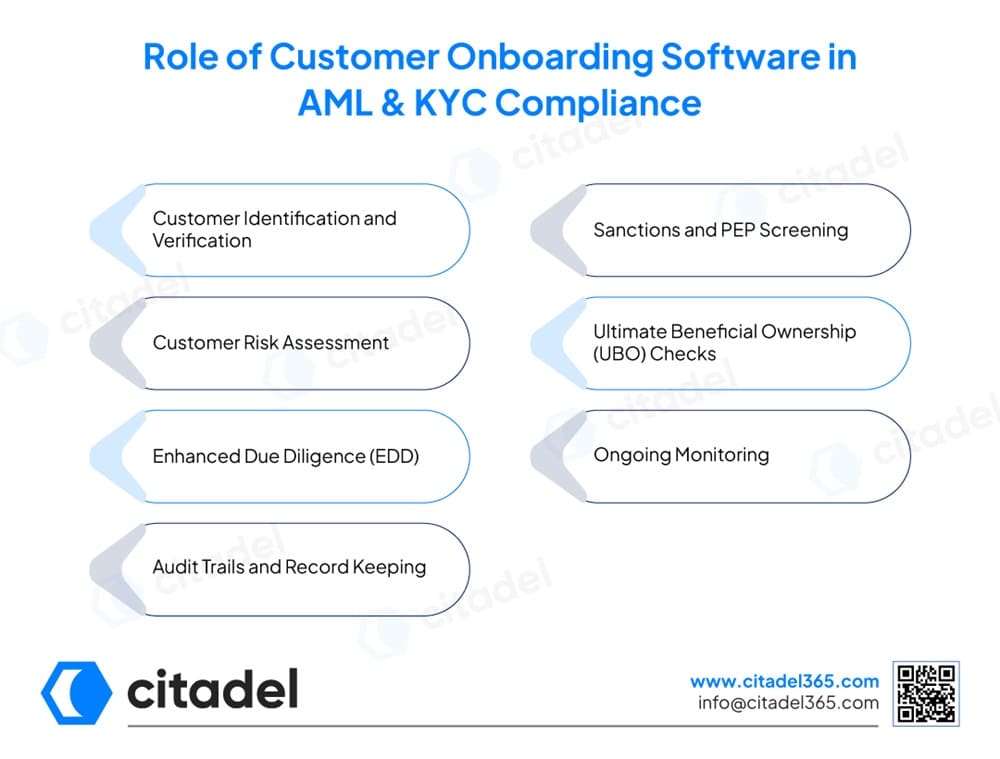
Customer Identification and Verification
The customer onboarding tool collects all the customer data and instantly verifies the identity and documents provided by the customer using advanced technologies such as eKYC, Optical Character Recognition (OCR), biometric authentication, liveness check, and database verification. This helps in quick, secure, and accurate customer identification with reduced manual work and reduced onboarding delays.
Sanctions and PEP Screening
Citadel365’s name screening software automatically screens individuals and entities against global sanctions lists, watchlists, PEP databases, adverse media sources and the UAE’s local terrorist list. This functionality helps in the identification of high-risk customers, sanctioned entities, or individuals with potential financial crime exposure before onboarding is completed.
Customer Risk Assessment
Ultimate Beneficial Ownership (UBO) Checks
Enhanced Due Diligence (EDD)
Customer onboarding software supports Enhanced Due Diligence (EDD) by ensuring the application of enhanced scrutiny wherever required and strengthening internal controls for high-risk customers. It facilitates additional document requests, verification of the source of wealth/funds, advanced background screening, and obtaining management approvals.
Ongoing Monitoring
The KYC onboarding software enables continuous monitoring of customer profiles throughout the customer lifecycle. It identifies emerging risks by monitoring and rescreening customers against changes in sanctions lists, adverse media and risk profiles.
Audit Trails and Record Keeping
Customer onboarding software maintains secure and immutable audit trails of all activities, documents, verifications, screening outcomes, and compliance decisions. This comprehensive system helps organisations demonstrate compliance during internal reviews or regulatory inspections and audits.
Here are some of the key features of a robust customer onboarding software:
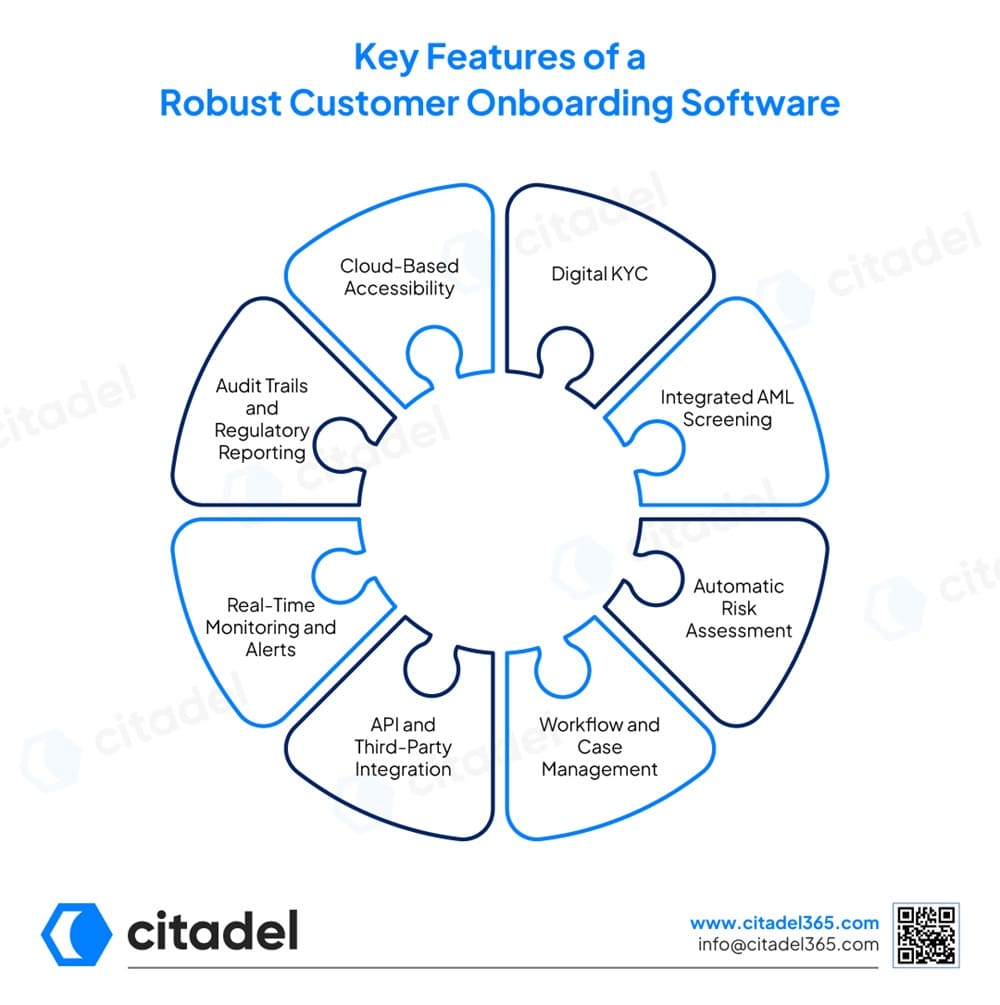
Digital KYC allows customers to start the onboarding process by submitting KYC documents and completing identity verification remotely, using various tools like AI-powered Optical Character Recognition (OCR) and liveness detection. This reduces paperwork, onboarding time, and enhances customer experience.
This feature allows automatic screening of customer data against sanctions lists, Politically Exposed Persons (PEP) databases, and adverse media sources. This allows identification of high-risk individuals at an early stage.
The customer onboarding software automatically assigns risk scores/levels, typically low, medium, or high, to the customer based on their transactional behaviour, profile data, geographical location, and screening results, etc. This risk-based approach helps in determining the level of due diligence and onboarding procedures required.
The customer onboarding software has inbuilt workflow management, which enables compliance teams to review, escalate, approve, or reject customer applications efficiently. It automatically routes high-risk or flagged applications to the compliance teams along with the necessary data for quick review.
The software uses APIs to seamlessly collect and integrate data from government databases, credit bureaus, and tax registries with existing systems. It also allows collaboration with CRM systems, banking platforms, etc., to improve operational efficiency and support data sharing across systems.
The system continuously scans customer profiles against updated sanctions lists, PEP databases, etc., throughout the customer lifecycle. It automatically identifies and generates alerts for suspicious activities, sanction matches, risk score changes, and compliance breaches.
The customer onboarding software in the UAE automatically records every step of the customer journey, including screening results, alert logs, decision-making processes, etc. It also generates compliance-ready reports for regulatory bodies and ensures compliance with regulatory documentation and reporting obligations effectively.
Cloud-based onboarding solutions provide centralised compliance management, secure remote access over the web, and on-demand access to onboarding tools, which enables seamless scaling as user volume grows. This feature also enables easier collaboration across teams and locations.
Customer onboarding is an essential AML/CFT measure. However, there are several operational and compliance-related challenges associated with it. Some of the challenges include:
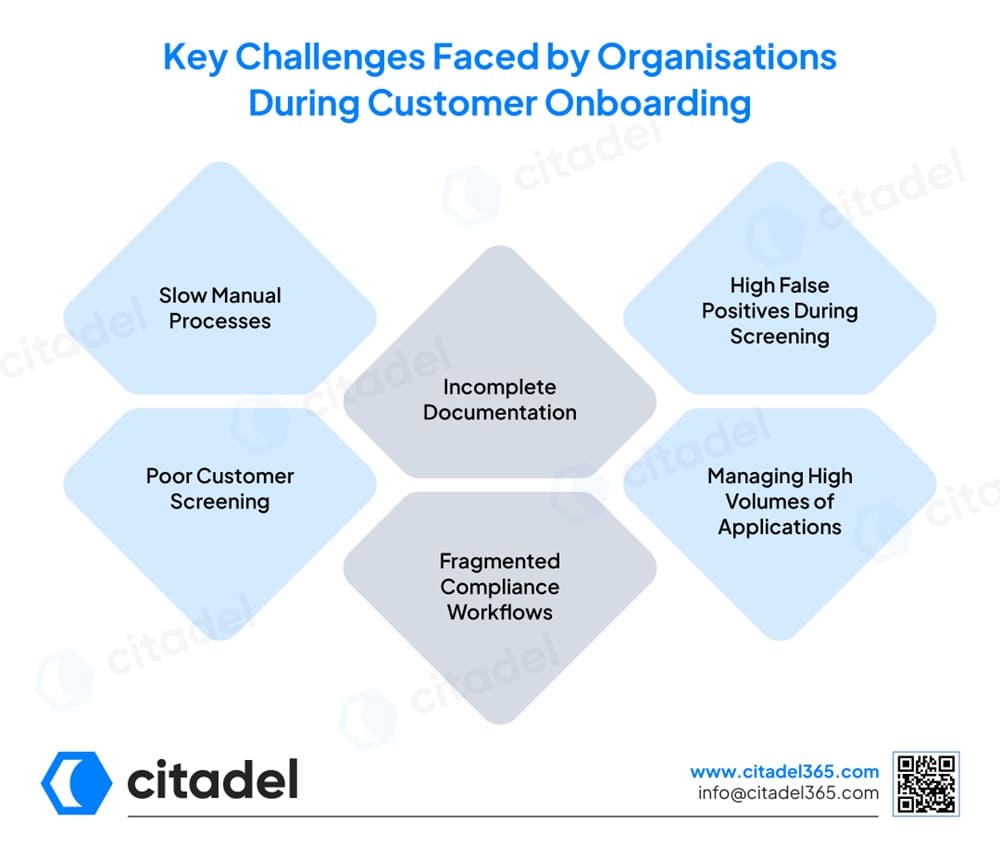
Slow Manual Processes
The traditional onboarding process often uses manual processes for data collection, verification, and compliance reviews. This slow and repetitive task consumes significant time and resources, increasing operational costs and delaying customer approvals and onboarding.
Incomplete Documentation
Sometimes customers provide outdated, incomplete or inconsistent data that can make verification difficult and slow down onboarding. It creates compliance gaps and follow-ups for document collection, increases delays, and provides a poor customer experience.
High False Positives During Screening
Poor Customer Screening
Weak or outdated screening processes may fail to identify sanctioned entities, Politically Exposed Persons (PEPs), adverse media risks, or other high-risk customers, exposing businesses to regulatory breaches and financial crime risks.
Fragmented Compliance Workflows
Many organisations use multiple disconnected systems for KYC, AML screening, document management, and approvals. Fragmented compliance workflows create inefficiencies, duplicate work, and increase the possibility of compliance gaps.
Managing High Volumes of Applications
Manual systems might fail to manage high volumes of applications, creating backlogs and increased turnaround time. Limited compliance resource availability can lead to delayed reviews and inconsistent verification processes.
Customer onboarding software in the UAE plays an important role in strengthening compliance controls and improving customer management processes. Some of the benefits of customer onboarding software include:
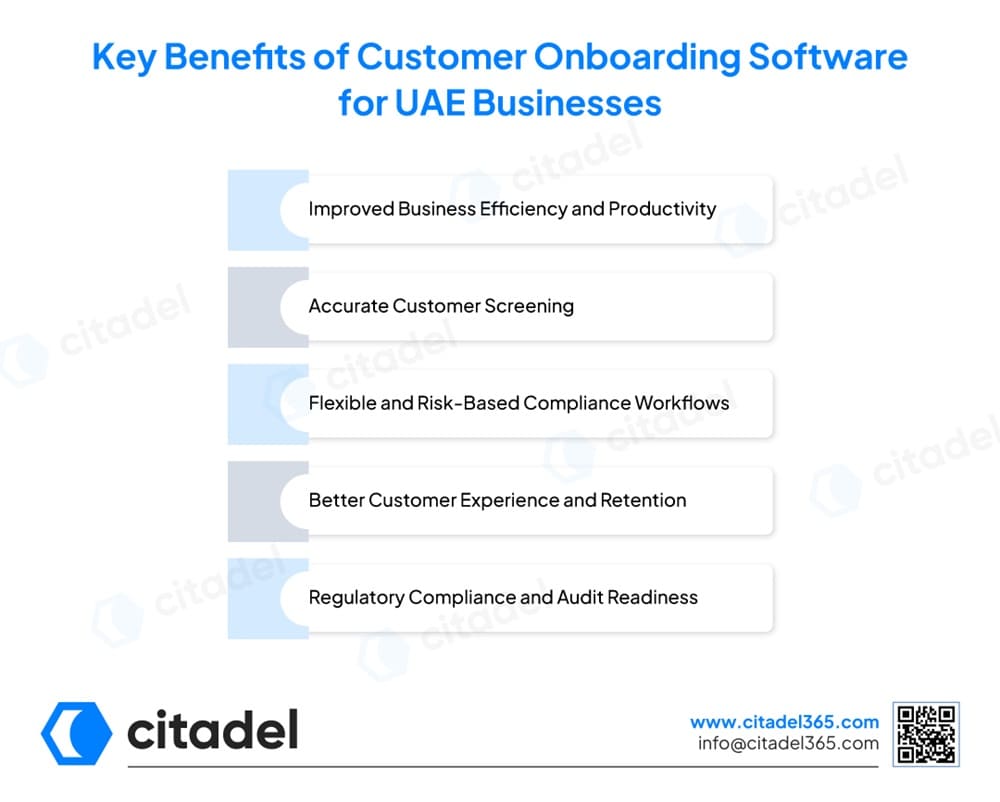
Improved Business Efficiency and Productivity
Customer onboarding software automates onboarding steps like customer verification, document collection, screening, and management approvals. This eliminates repetitive tasks, manual workload, and human errors, thus making the onboarding process quick and efficient while reducing administrative and compliance-related costs.
Accurate Customer Screening
AML onboarding software provides integrated AML screening tools that enable accurate screening of customers and identification of sanctioned individuals, high-risk entities, adverse media risks, and Politically Exposed Persons (PEPs) before establishing business relationships.
Flexible and Risk-Based Compliance Workflows
Customer Onboarding Software allows businesses to create risk-based, customised workflows based on customer risk profiles and scoring. This flexible risk-based approach helps businesses align their onboarding procedures with AML/CFT regulatory requirements.
Better Customer Experience and Retention
The first impression of a business is often shaped by a customer’s onboarding experience. Digital onboarding processes, which include multilingual support, real-time application tracking, and transparent document requirements, can create a smooth and user-friendly experience and help businesses build trust and long-term relationships.
Regulatory Compliance and Audit Readiness
Customer Onboarding Software helps businesses maintain a structured and auditable compliance process. Digital records are maintained for all activities and stored securely. This enables organisations to maintain proper audit trails and demonstrate compliance during inspections, and reduces the risk of regulatory penalties while strengthening their overall AML/CFT compliance framework.
Customer Onboarding Software helps Regulated Entities (REs) ease the process of onboarding by automating manual processes and ensuring compliance with AML/CFT requirements. It follows a systematic approach to perform compliance:
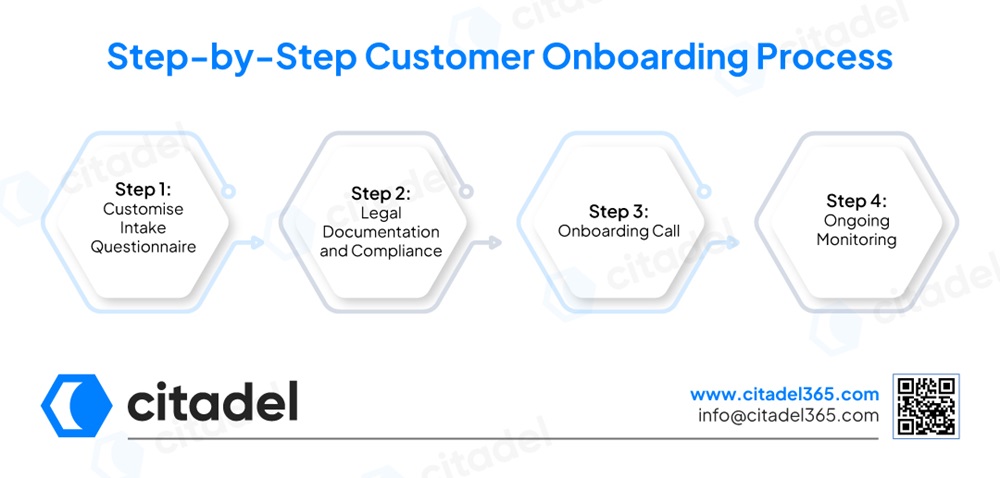
Step 1: Customise Intake Questionnaire
Step 2: Legal Documentation and Compliance
As a next step, the software conducts due diligence. It performs identity verification and screening of customer data against sanctions lists, PEP databases, adverse media sources and local watchlists. This helps organisations to identify potential financial crime risks and high-risk entities early while complying with the UAE’s AML/CFT requirements and international standards efficiently.
Step 3: Onboarding Call
Once verification, screening, and due diligence are complete, the customer onboarding software reviews customer profiles and conducts onboarding assessments.
If a customer is flagged as high-risk, the software at this stage initiates Enhanced Due Diligence (EDD) procedures and requests additional documentation or approvals.
The software ensures that customer risk is properly assessed before scheduling an onboarding call.
Step 4: Ongoing Monitoring
The customer onboarding process does not end at onboarding. The customer onboarding software conducts continuous monitoring of customer profiles and activities throughout the customer lifecycle. That includes watching out for sanctions updates, changes in customer profiles, unusual activity or transactions, adverse media developments, etc.
If any red flags are identified, the system generates alerts for compliance teams to investigate, create cases and take appropriate action.
Information and Documents Commonly Collected During Customer Onboarding:
Onboarding Area | Individual Customer Requirements | Corporate Customer Requirements |
Identity & Registration Details | Full Name, Date of Birth, Nationality | Registered Business Name, Corporate Registration Details |
Address Verification | Residential Address | Registered Business Address |
Professional / Business Profile | Occupation or Employment Details | Nature of Business Activities |
Ownership & Risk Information | Source of Funds Information | Ownership Structure, UBO Details |
Regulatory & License Information | Visa or Residency Status (if applicable) | Business / Trade License Status |
Contact Details | Phone Number, Email Address | Official Business Contact Information |
Primary KYC Documents | Passport, Emirates ID | Certificate of Incorporation, Business / Trade License |
Government Verification Documents | Driver’s License or Other Government-Issued ID | Memorandum & Articles of Association |
Address & Supporting Documents | Address Proof Documents | Shareholding Structure Documents |
Enhanced Due Diligence (EDD) Documents | Source of Funds, Source of Wealth, and Supporting Documents | UBO Declaration Documents, Board Resolutions / Authorisation Documents, Source of Funds and Source of Wealth |
Why is Customer Onboarding Software important? | How it helps |
Simplifies and Automates Onboarding | Automates the complete onboarding activities such as data collection, verification, and compliance checks, helping businesses save time, making the process faster, smoother, and more efficient for both businesses and customers. |
Supports AML/CFT/CPF Compliance | Establishes a structured onboarding process aligned with AML/CFT/CPF regulations, ensuring proper collection of customer information and compliance documentation. |
Improves Transparency During Onboarding | Clearly communicates what information and documents are required, helping customers understand the purpose of compliance checks and reducing confusion during onboarding. |
Strengthens Data Security and Privacy | Protects sensitive customer information through built-in security controls such as encryption, secure storage, and restricted access management. |
Enables Ongoing Monitoring and Compliance Checks | Supports continuous monitoring, periodic reviews, and ongoing compliance checks to help businesses identify evolving risks and maintain regulatory compliance. |
Enhances Customer Trust and Confidence | Creates a secure, professional, and well-structured onboarding experience that improves customer confidence and strengthens long-term business relationships. |
Provides Interactive and User-Friendly Experience | Includes dashboards, automated workflows, and guided onboarding journeys that make the process easier and more engaging for both customers and compliance teams. |
Delivers a More Professional Onboarding Journey | Helps businesses create a seamless and organised onboarding experience that improves operational efficiency while maintaining strong compliance standards. |
A customer onboarding system must do more than just collect customer data. It should ensure AML/CFT compliance, improve efficiency, and simplify the whole customer lifecycle. An ideal onboarding software is a combination of robust compliance measures and a better user experience.
Below are some of the most important features and functionalities organisations should look for in Customer Onboarding Software.
| Feature | Why it is essential for strengthening customer onboarding |
| Online KYC Document Upload | Allows customers to securely upload KYC documents, trade licenses, Emirates IDs, UBO declarations etc. Supports centralised and secure storage of compliance records, ensuring early compliance and building trust. |
| Self-Onboarding Process | Enables customers to complete onboarding at their own pace digitally through guided forms, reducing manual intervention, meeting compliance requirements, and improving onboarding speed and accuracy. |
| Real-Time Onboarding Tracking | Provides live visibility into onboarding status, pending approvals, missing documents, and compliance reviews, etc., which allows both customer and compliance teams to track progress. |
| Automated Compliance Tasks | Advanced AI and ML tools are used to automate repetitive activities such as sanctions screening, document reminders, verification checks, and follow-ups to improve consistency and reduce manual workload. |
| Customisable Risk Scoring | Automatically assigns customer risk ratings based on risk indicators like geography, business activity, transaction profile, and regulatory exposure to support risk-based due diligence. This allows prioritising tasks based on their risk level and early detection of red flags. |
| Enhanced Due Diligence (EDD) Workflows | Helps businesses apply additional checks, approvals, and document requirements for high-risk customers, PEPs, or suspicious profiles. |
| Centralised Audit Trails | Maintains secure digital records of onboarding activities, screening results, compliance approvals, and monitoring actions for audit readiness. |
| Feature | Why it is essential for enhances customer experience |
| Interactive Product Walkthroughs | Guides users step-by-step through the onboarding journey, helping customers complete onboarding confidently and efficiently by gently introducing users to the platform. |
| Automated Task Management | Organises onboarding tasks, approvals, reminders, and team assignments automatically and in one place. Allows users to track their completion, avoid duplication to keep the onboarding process moving smoothly. |
| Integrated Resource Hubs | Provides customers with instant access to FAQs, onboarding guides, demo videos, policy documents, and compliance resources in one place to help users find what they are looking for without leaving the website. This feature enables instant resolution of customer queries. |
| Feedback and Survey Integration | Allows businesses to collect customer feedback during or after onboarding to improve onboarding workflows and customer satisfaction. Personalised views enable teams to act promptly based on risk levels. |
| Multilingual Interface and Auto Translation | Supports multiple languages, helping customers across different regions navigate onboarding processes comfortably and eliminate language barriers. |
| Automated Alerts and Notifications | Sends real-time reminders, approval notifications, status updates, and compliance alerts to customers and internal teams. This feature keeps the teams aligned and customers informed. |
| White Labelling Capabilities | Allows businesses to customise onboarding portals with their own branding, logos, colours, and messaging for a more professional and branded customer experience. This engages the customer with the business on a personal level. |
The right customer onboarding solution must not just automate the process but also align with business objectives and AML/CFT regulations. It should simplify all essential workflows, reduce manual efforts, provide a smooth customer experience, and improve operational efficiency. Choosing the right customer onboarding solution is imperative for Regulated Entities.
The following key factors should be considered while choosing any Customer Onboarding Software-
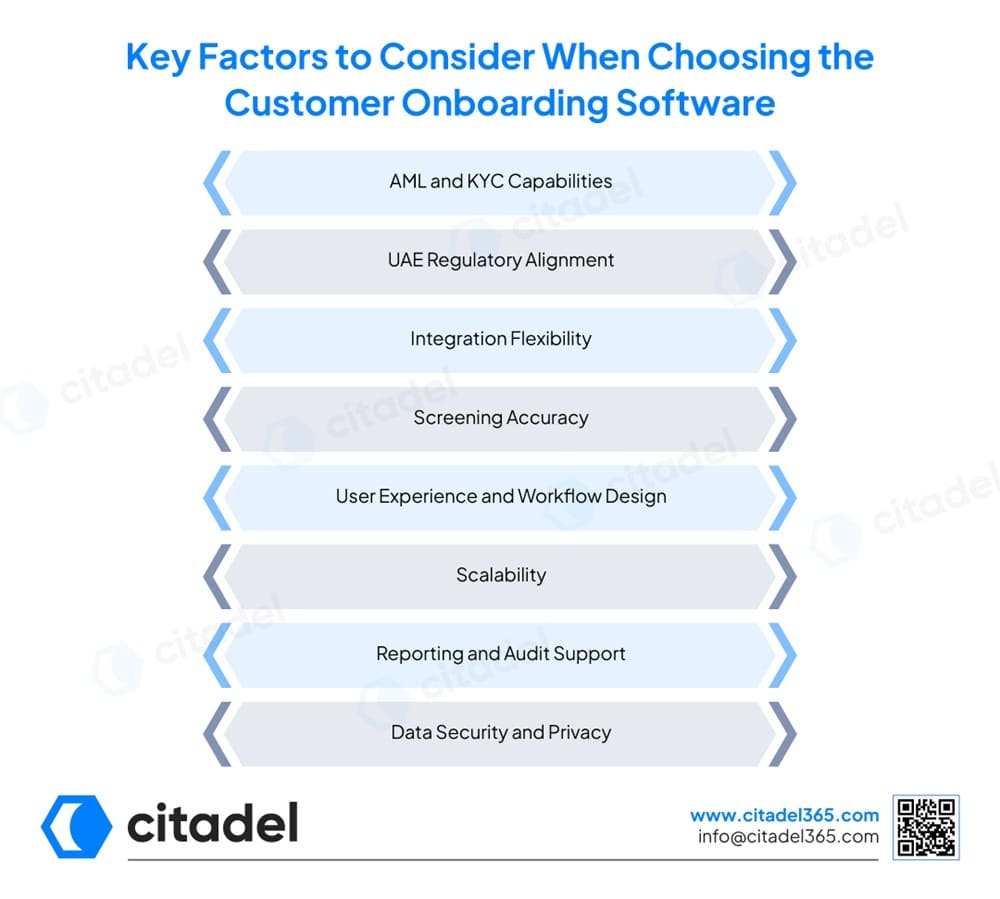
AML and KYC Capabilities
The KYC onboarding software must have automated features like customer verification, screening, adverse media monitoring, UBO identification, ongoing monitoring capabilities, etc. This ensures compliance with AML/CFT regulations throughout the customer lifecycle and enables faster KYC onboarding.
UAE Regulatory Alignment
Organisations must ensure that the software is aligned with the UAE’s AML/CFT regulations and compliance requirements. The system should support a risk-based approach, due diligence, documentation and continuous monitoring obligations that are applicable to REs.
Integration Flexibility
The software must have the capability to integrate with the existing systems of the organisation, including CRM and ERP systems, government databases, etc. This helps businesses maintain centralised operations while reducing fragmentation and duplication.
Screening Accuracy
User Experience and Workflow Design
Customer onboarding software must be user-friendly, simple and intuitive to enhance customer satisfaction. It should provide digital onboarding workflows with a step-by-step guide for users, real-time onboarding updates, digital document uploads, and automated reminders. This increases customer engagement and reduces onboarding abandonment rates.
Scalability
As the business expands, the customer base also increases. Customer onboarding software should be scalable enough to support increased onboarding volumes and ever-evolving regulatory requirements. Scalability helps organisations to maintain operational efficiency while not compromising effectiveness.
Reporting and Audit Support
The AML onboarding software must be able to maintain proper audit trails for all the activities from start to finish. It must also have the capability to generate detailed compliance reports for internal as well as regulatory governance. Strong documentation and reporting capabilities help in demonstrating compliance during audits and regulatory inspections.
Data Security and Privacy
Onboarding involves collecting and verifying sensitive customer information. The customer onboarding software must be able to provide secure data storage, data encryption, controlled access, and strong privacy protection measures. Data protection is crucial for building customer trust as security breaches attract regulatory actions.
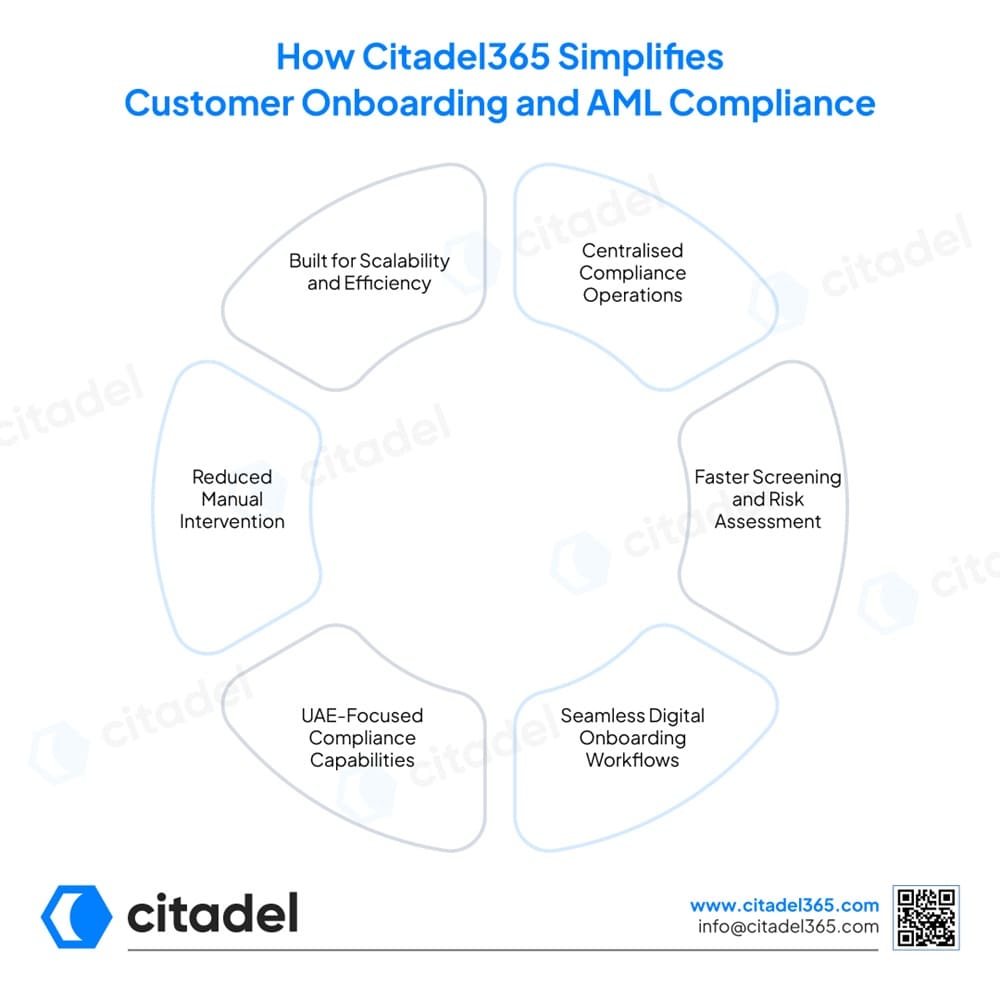
Centralised Compliance Operations
Citadel365 provides data collection, KYC verification, AML screening, risk assessment, document management, and compliance reviews in one centralised platform. This improves visibility, reduces fragmented workflows, and provides more operational control.
Faster Screening and Risk Assessment
Citadel365 uses real-time screening via KYC6 integration and detects sanctions, PEPs (using Tier 1, 2, and 3 classification), and adverse media. It automates customer screening and risk assessment processes and enables early identification of high-risk customers.
Seamless Digital Onboarding Workflows
Citadel365 supports seamless digital onboarding workflows that streamlines document collection, data collection, onboarding risk assessment and onboarding approvals through an automated and user-friendly interface.
UAE-Focused Compliance Capabilities
Citadel365 supports UAE AML/CFT compliance obligations, including Customer Due Diligence (CDD), Enhanced Due Diligence (EDD), ongoing monitoring, documentation & audit trail requirements, and implementing a risk-based approach.
Reduced Manual Intervention
By automating repetitive onboarding and compliance tasks, Citadel365 helps businesses reduce manual intervention, operational inefficiencies, and improve compliance consistency throughout the customer lifecycle.
Built for Scalability and Efficiency
Customer onboarding software is a digital platform that automates customer data collection, identity verification, AML screening, risk assessment, and compliance workflows.
The software collects customer information, verifies identities, performs sanctions and PEP screening, assesses customer risk, provides a data-backed decision whether to approve or reject onboarding, and supports ongoing monitoring through automated workflows.
Key features include digital KYC, integrated AML screening, automated risk assessment, workflow and case management, APIs, audit trails, real-time monitoring, and reporting capabilities.
The software automates manual processes, reduces paperwork, simplifies document submission, and enables faster KYC onboarding.
While customer onboarding software in itself may not always be mandatory, regulated businesses in the UAE must comply with AML/CFT obligations. AML onboarding software helps businesses meet these requirements more efficiently.
KYC onboarding software automates due diligence, sanctions screening, risk assessment, ongoing monitoring, and audit record maintenance to support UAE AML obligations.

Arjun is the Co-founder and CEO of Citadel, where he leads the company’s vision across technology, business, and regulations. He brings over a decade of experience in building and scaling technology ventures. Arjun holds a B.Tech. in Information Technology and a Master’s in Management, supported by his certification as a Financial Crime Specialist, an uncommon combination that allows him to balance innovation with regulatory requirements.
Having advised leading banks and financial institutions on digital solutions and compliance technology, Citadel continues to grow with an ambition.