
AML Training
Master AML Training, Know the Signs and Stop the Risks Before They Grow
Detect Subtle Signals with AML Training Before They Escalate
Anti-money laundering training is like giving your team a magnifying glass and a detective’s hat to identify the unusual patterns and transactions before they turn into serious compliance concerns. It’s a structured program to educate your employees to detect the risks linked with money laundering, terrorist financing, and other related financial crimes.
Citadel365, in association with Vertex Compliance, delivers AML compliance training programs that support organisations to strengthen their internal controls and stay aligned with regulatory requirements, enabling teams to understand their roles and responsibilities within the AML compliance frameworks.
Proper AML training and awareness programs help minimise overlooked risks and enable teams to recognise the small ripples before they grow into tsunamis.
Stop Financial Crime at Its Earliest
AML Training Equips Organisations to Detect and Manage Money Laundering Risks before They Escalate
How We Train Minds to Think Like Compliance Detectives
In AML compliance, risk appears in an unusual transaction, a customer profile that does not quite add up, or a pattern that seems ordinary until someone looks closer. Our anti-money laundering training is designed to cultivate that instinct of looking closer. Employees are trained across the core compliance controls that form the backbone of a strong AML framework.
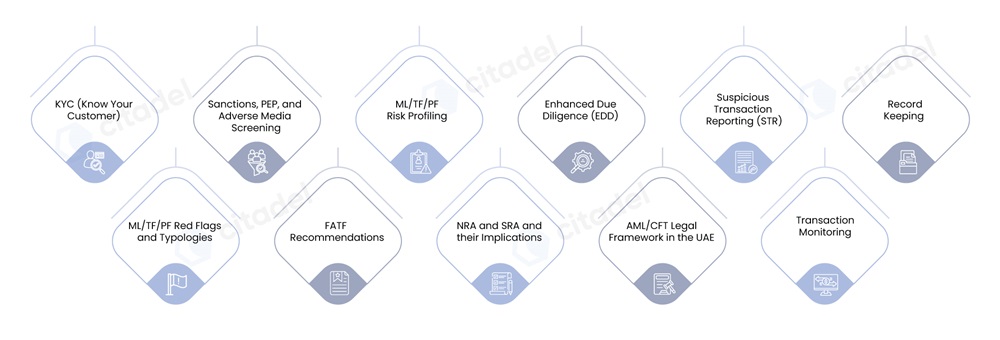
1. KYC(Know Your Customer)
Before risk can be managed, it must first be understood. Employees are trained to identify and verify customer identity, understand onboarding requirements, and recognise indicators that may require further compliance review. Strong KYC practices form the foundation of an effective AML compliance framework.
2. Sanctions, PEP, and Adverse Media Screening
Employees learn how to screen customers against sanctions lists, politically exposed persons (PEP) lists, and adverse media sources. Ongoing screening helps identify relationships with sanctioned entities, politically exposed persons, and high-risk individuals before they create compliance concerns.
3. ML/TF/PF Risk Profiling
Risk is not uniform. Training helps employees understand how customer risk levels are determined and how risk indicators should be escalated to compliance teams. This allows institutions to apply a practical risk-based approach and focus more on high-risk.
4. Enhanced Due Diligence (EDD)
When higher-risk relationships or transactions are identified, employees must apply additional examination. Training explains how enhanced due diligence is conducted, including reviewing beneficial ownership structures, understanding the source of funds or wealth, and examining unusual transaction behaviour associated with high-risk customers.
5. Suspicious Transaction Reporting (STR)
Employees are trained to identify and report suspicious activity and understand the importance of documenting and escalating such concerns internally to the compliance or MLRO function for further review and reporting.
6. Record Keeping
Employees learn how to maintain clear and comprehensive records of customer information, transactions, and compliance activities to support regulatory audits and supervisory reviews.
7. ML/TF/PF Red Flags and Typologies
Financial crime often appears through patterns that do not immediately stand out. We train employees to recognise key red flags and typologies associated with ML, TF, and PF. Employees learn to identify unusual transaction behaviour, complex ownership structures and inconsistencies in customer profiles.
8. FATF Recommendations
The Financial Action Task Force (FATF) Recommendations form the foundation of the AML/CFT framework across jurisdictions. We provide training to teams to connect FATF principles with internal controls, customer due diligence, risk assessments, and reporting obligations, keeping alignment with applicable legal and regulatory standards.
9. NRA and SRA and their Implications
National Risk Assessments (NRA) and Sectoral Risk Assessments (SRA) module explains how these assessments influence regulatory expectations and internal risk management strategies. Employees understand how NRA and SRA findings impact customer risk classification, due diligence measures, and the application of a risk-based approach.
10. AML/CFT Legal Framework in the UAE
We provide an overview of the AML/CFT laws and regulatory expectations in the UAE. We introduce your team to key obligations, including customer due diligence, reporting requirements, and the role of the compliance function, establishing alignment with applicable legal and regulatory standards.
11. Transaction Monitoring
Transaction monitoring training trains you to identify unusual transaction patterns and behavioural anomalies that may indicate potential financial crime. We focus on interpreting alerts and escalating concerns through the appropriate internal channels.
See the Difference with Citadel365
Where AML training meets tangible results and measurable benefits:
Small Doubts Don’t Get Ignored
Financial crime begins with small details, a transaction that looks slightly unusual, a customer profile that raises questions, or behaviour that does not match the story on paper. Good AML training teaches employees to pause at these moments and examine them carefully instead of letting them pass unnoticed.
Insights That Empower
Our training equips employees with practical insights and actionable understanding, which helps them to gain core knowledge of ML/TF risks and reduce the risk exposure by applying effective mitigation techniques.
Confidence in Handling Real-World Compliance Decisions
Frontline teams often encounter practical questions during customer onboarding and transaction reviews. Is the documentation sufficient? Does this customer fall into a higher-risk category? Should additional checks be performed? Anti-money laundering training gives employees the confidence to make these decisions with consistency.
Learning Built for Your Industry
AML risks differ across sectors. What appears routine in one industry may signal risk in another. Our training is always modified to industry-specific patterns, helping employees understand the challenges, behaviours, and compliance expectations relevant to their functioning environment while following internal compliance procedures.
A Strong Compliance Culture Starts Within
Your AML framework is only as strong as the people implementing it. Our training strengthens internal controls by guiding employees on transaction monitoring practices, documentation standards, and reporting responsibilities.
See What Others Miss
Citadel365’s AML Training Ensures That Every Employee Understands Their Role in Detecting and Reducing ML/TF Risks.
Additional Capabilities We Bring to You
Citadel365’s curated services that cover every compliance angle:
AML Compliance Services
AML Independent Assessment
Sanctions Compliance
Proliferation Financing Risk Assessment
Enterprise-Wide Risk Assessment
AML / CFT Policies and Procedures
Financial Crime Risk Assessment
Sanctions Risk Assessment
Customer Risk Assessment
Payment Risk Assessment
External Compliance Officer
Managed KYC Service
ML/TF Risk Assessment Data Collection Process
FAQs on AML Training
Anti-money laundering training is an educational program for staff/ employees that equips them with knowledge to prevent and detect money laundering and terrorist financing risks, and it is required for the staff of regulated organisations involved in customer onboarding, transactions, or compliance activities.
Yes, AML training is mandatory for DNFBPs and VASPs to ensure regulatory compliance.
The key topics that should be covered in an AML training program include KYC, screening, risk profiling, enhanced due diligence, STR filing, and record-keeping.
The AML training should be delivered by internal compliance officers, MLROs, or specialised external AML training providers.
The regulatory consequences include fines, penalties, legal actions, or reputational damage
Yes, AML training can be conducted online or in-person, both while meeting compliance requirements.