
Ready to Defeat Your AML Compliance Obstacles?
Citadel Brings Revolution with Secure Solutions to AML Compliance Problems
Summary
Some countries mint currency. Other mint confidence. And then, there are those who find themselves on a list where neither travels particularly well. In global finance, value is only half the story; the other half is trust. Currency may be printed, regulated, and circulated, but confidence is tested.
A jurisdiction can have liquidity, infrastructure, and a regulatory framework in place, yet still face hesitation if trust begins to erode. Perceptions, in finance, move as quickly as capital.
So when we ask, ‘What is the FATF blacklist?’, we are asking why certain jurisdictions begin to attract a different level of weight in financial conversations. It is the kind of list no jurisdiction wants its name etched into because once it is there, the world does not look away. Over time, this changes how business flows.
The definition is only the starting point. The more relevant consideration is how institutions assess risk, how businesses approach transactions, and how confidence, once reduced, is rebuilt through demonstrable action.
What Is FATF Blacklist and Why Does It Carry Weight?
The FATF blacklist is issued by the Financial Action Task Force (FATF), the global standard-setter for anti-money laundering (AML) and counter-terrorist financing (CFT). Officially, it is referred to as ‘High-Risk Jurisdictions subject to a Call for Action’.
The phrasing may appear formal, even procedural. The implication, however, is far more substantive. When a jurisdiction is placed on the FATF blacklist, it reflects a determination that its AML/CFT framework has serious and persistent deficiencies. More importantly, it indicates that these gaps are significant enough to require heightened attention from the international financial system. This is FATF’s way of communicating that the issue is neither isolated nor temporary. The FATF blacklist, therefore, does not operate as a prohibition. It operates as a signal that must be widely acknowledged.
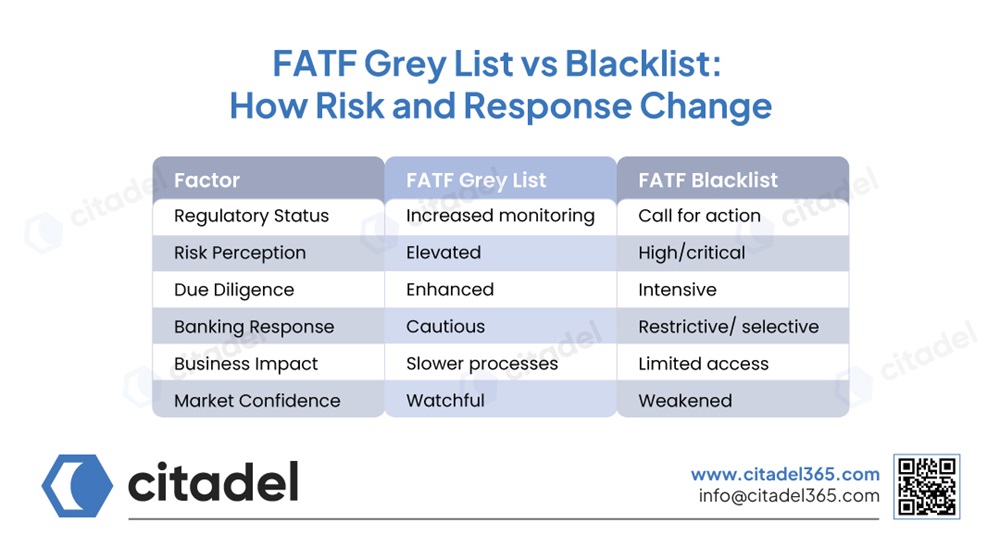
Jurisdictions on the grey list have identified deficiencies in their AML/CFT frameworks, but they have committed to addressing them within agreed timelines. They remain under close observation, and while the risk is acknowledged, there is an underlying expectation of improvement. Financial institutions proceed with caution, but engagement continues.
Jurisdictions on the FATF blacklist have more serious and persistent deficiencies, often coupled with limited progress in addressing them. At this level, the concern is about the effectiveness of the response itself. In this case, enhanced due diligence becomes the baseline, transactions are examined with heightened sensitivity, and in some cases, engagement is restricted altogether.
Do Not Let Risk Go Unchecked
When Jurisdictions and Counterparties Carry Varying Risk Levels, Real-Time Screening Helps You Identify Exposure
The FATF blacklist is, interestingly, a very short list. From the outside, one might think the world has perfected compliance, but the list is reserved for situations where concerns are established. So when we talk about what the FATF blacklist is, the natural follow-up is who has managed to make onto a list everyone is actively trying to stay off?
Historically, jurisdictions such as:
have appeared on the FATF blacklist. Their inclusion reflects their long-standing, well-documented deficiencies in addressing money laundering and terrorist financing risks, combined with limited effectiveness in corrective action.
Now, it is important to know that you are not looking at jurisdictions with a few loose ends. Here, you are looking at one where the framework, the enforcement, or the outcomes or sometimes all three, do not align with global expectations.
At some point, the conversation moves away from frameworks and into outcomes. Now that we know who appears on the FATF blacklist, the more pressing question is, how does a country get there? Here we are talking about what consistently goes wrong for a country to reach that stage.
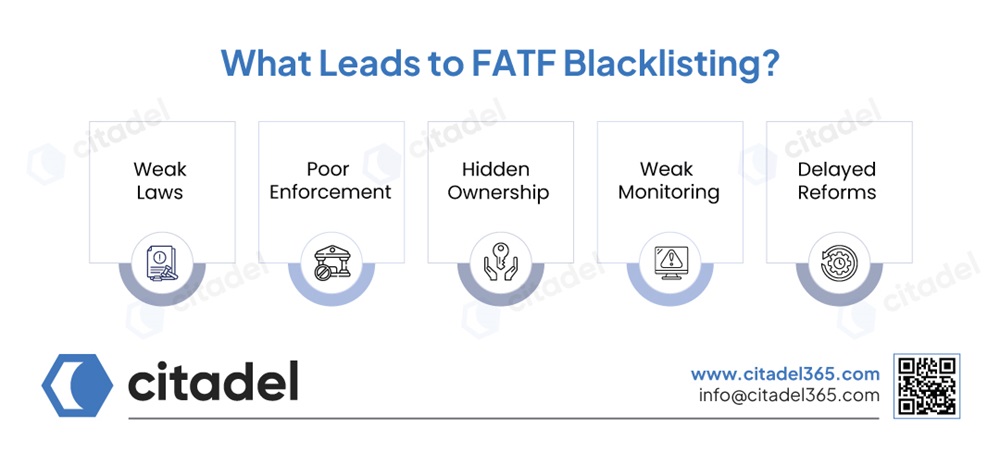
From a compliance standpoint, the signs are familiar and, at times, almost predictable. The key factors leading to blacklisting typically include:
Outdated or inadequate AML/CFT legal frameworks
Weak or inconsistent enforcement
Regulatory and supervisory structures are in place, but investigations, prosecutions, and sanctions are limited or ineffective in practice.
Lack of transparency in beneficial ownership
Inability to clearly identify the natural person behind legal entities increases the risk of misuse for illicit purposes. Opaque ownership structures allow illicit actors to operate behind layers of corporate veils, making detection and accountability more difficult.
Ineffective transaction monitoring and reporting systems
Recording financial activity is only the starting point. The effectiveness of a system is measured by its ability to detect and assess suspicious behaviour. Where monitoring systems fail to identify unusual patterns or reporting mechanisms are underutilised, risks remain unaddressed.
Failure to implement FATF recommendations and agreed action plans
A common trigger for blacklisting is the lack of progress despite these commitments. Reforms may be announced, but implementation remains delayed or inconsistent. Over time, this signals capacity challenges and a lack of effectiveness in translating commitments into outcomes.
Individually, these issues may be manageable. Collectively, over time, the continued lack of effective remediation leads to increased concern at the international level.
At this stage, FATF may classify a jurisdiction as high-risk, placing it on the FATF blacklist and calling for a coordinated global response. In essence, countries are placed on the FATF blacklist due to a lack of demonstrable effectiveness in addressing financial crime risks.
Gaps in Monitoring, Ownership Visibility or Enforcement Start Small
If You Are Unsure Where Your Gaps Lie, It Is Worth Examining Them Early
If the FATF blacklist appears selective, it is because the process behind it is anything but casual. Inclusion in this list is not triggered by a single gap or even a series of isolated issues. FATF follows a 4-stage sequence:
Technical compliance: Are the necessary AML/CFT laws and frameworks in place?
Effectiveness: Are these frameworks working in practice?
Once the deficiencies are identified, jurisdictions are provided with action plans outlining specific measures required to address gaps within defined timelines. At this stage, the system is still collaborative, and the expectation is on improvement.
FATF conducts follow-ups to assess whether reforms are being implemented effectively. This includes reviewing legislative updates, supervisory actions, enforcement outcomes, and overall system performance.
Jurisdictions may first be placed under increased monitoring (grey list). However, where deficiencies are serious and corrective action remains inadequate, FATF may classify the jurisdiction as high-risk, placing it on the FATF blacklist. It is the final stage in a process where multiple opportunities for remediation have not led to the required outcomes.
Once a jurisdiction enters the FATF blacklist, the impact does not arrive all at once. It unfolds gradually across systems, institutions, and decisions. Some institutions reduce exposure, others exit altogether. FATF itself warns that de-risking can push financial activity into less regulated channels and create financial exclusion.
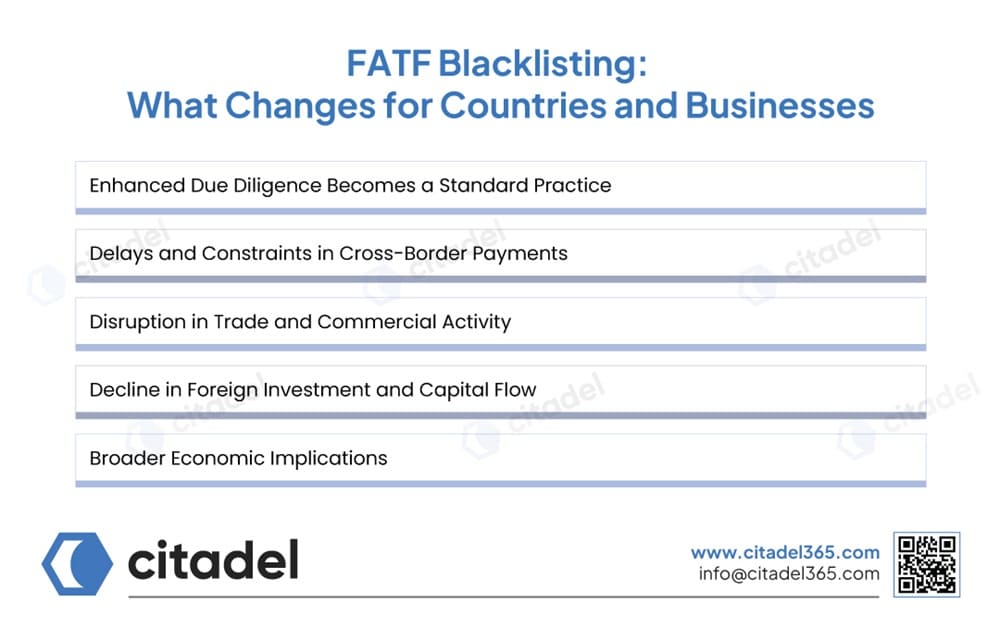
Enhanced due diligence becomes standard practice
Transactions and relationships linked to the blacklisted jurisdiction require additional documentation, deeper verification, and multiple layers of internal review become necessary before any engagement proceeds.
Delays and constraints in cross-border payments
Secondly, cross-border transactions are affected. Payments involving blacklisted jurisdictions are subject to close review, which means delays and additional checks.
Disruption in trade and commercial activity
Trade finance becomes harder to secure. Industry analyses consistently note that backlisted jurisdictions face restrictions on cross-border business activity, payment delays and higher compliance burdens, which then spill into the supply chain and routine commercial dealings.
Decline in foreign investment and capital flows
Foreign investors, lenders, and counterparties reassess exposure. Some step back, while others proceed only with stronger controls, higher pricing, or more exit options than before. Once a jurisdiction is treated as high-risk, that label tends to travel faster than the capital it is trying to attract.
Broader economic implications
The combined effect of restricted financial access, reduced investment, and trade disruption can influence overall economic performance. Growth becomes slow along with currency pressures, and the increased cost of capital is a commonly observed outcome in such environments.
Request a Compliance Consultation
If Your Business Operates Across Jurisdictions or Faces Evolving Compliance Requirements, We Can Help
A Closing Thought
Taken together, the picture is clear. The question, what is FATF blacklist, is not answered by looking at a single designation in isolation. It is answered by following the full chain of events: the gaps that persist, the evaluation that documents them, the time allowed for correction, and the point at which the international system decides that caution is no longer enough. FATF blacklist marks the point at which concerns have moved beyond discussions and into recognition at a global level. And that brings the discussion full circle.

Arjun is the Co-founder and CEO of Citadel, where he leads the company’s vision across technology, business, and regulations. He brings over a decade of experience in building and scaling technology ventures. Arjun holds a B.Tech. in Information Technology and a Master’s in Management, supported by his certification as a Financial Crime Specialist, an uncommon combination that allows him to balance innovation with regulatory requirements.
Having advised leading banks and financial institutions on digital solutions and compliance technology, Citadel continues to grow with an ambition.