
The Role of a Transaction Monitoring Analyst in AML Compliance
Ready to Defeat Your AML Compliance Obstacles?
Citadel Brings Revolution with Secure Solutions to AML Compliance Problems
Key Takeaways: Transaction Monitoring Analyst
- A transaction monitoring analyst monitors customer transactions and detects unusual patterns or suspicious activities that indicate financial crime risks.
- Transaction analysts conduct transaction monitoring, which involves data collection, monitoring rules, alert generation, review, documentation, and escalation.
- Skills required for a transaction monitoring analyst involve attention to detail, analytical skills, investigative skills, and others.
- Outsourced transaction monitoring support helps regulated entities get relevant expertise, scalability, and additional investigation support.
What is a Transaction Monitoring Analyst?
A transaction monitoring analyst reviews customer transactions and identifies unusual patterns, red flags, typologies or anomalies that suggest money laundering, terrorist financing or other financial crime risks. The primary role of the analyst is to detect and escalate suspicious transactions to support regulatory reporting.
A transaction monitoring analyst reviews automated alerts, analyses customer behaviour, discards false positives, and escalates suspicious transactions, serving as the frontline investigator within the AML compliance team.
Role of a Transaction Monitoring Analyst in AML Compliance
A transaction monitoring analyst plays the following role in AML compliance:
Monitoring Customer Transactions
A transaction monitoring analyst monitors customer transactions to ensure they match the customer’s expected profile. The analyst reviews transaction amounts, volume, frequency, counterparties, and locations to detect anomalies or unusual patterns.
Reviewing Transaction Monitoring Alerts
The transaction monitoring analyst reviews and prioritises alerts based on their risk level. Further, the analyst disambiguates false positives or decides whether alerts require further investigation.
Investigating Suspicious Activity
The analyst also reviews the customer’s profile, transaction history, and other factors to identify AML typologies and document suspicious activities with supporting information for further investigation or reporting.
Escalating Suspicious Transactions and Supporting Reporting
The transaction monitoring analyst escalates relevant suspicious cases to senior analysts or the compliance officer and provides evidence, findings and recommendations to support STR/SAR reporting.
The Transaction Monitoring Process
The transaction monitoring process involves data collection, monitoring rules, alert generation and review, investigation, case disposition, escalation, reporting and record-keeping. The transaction monitoring analyst performs the monitoring process in the steps below:
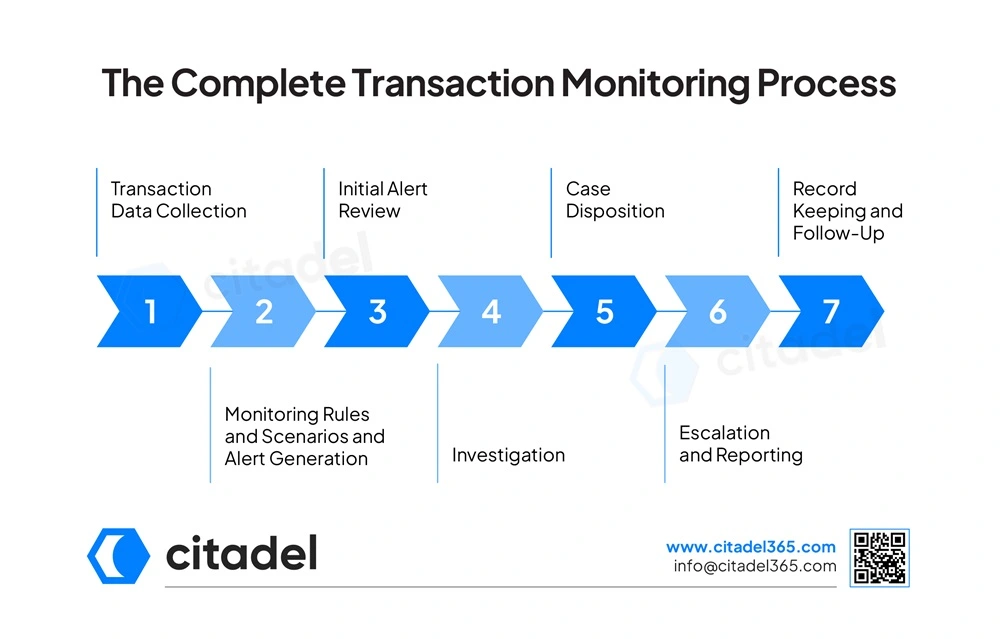
Transaction Data Collection
In the first step, the analyst collects customer transaction data and builds a clear picture of the customer’s activity. The transaction data includes frequency, amounts, dates, counterparties, and locations.
Monitoring Rules and Scenarios and Alert Generation
Further, the transaction monitoring system generates alerts based on predefined rules and scenarios and a risk-based approach. The system identifies unusual transaction patterns or activities for review.
Initial Alert Review
The transaction monitoring analyst reviews the alert, why the system generated it, and matches it with the customer’s risk profile. It helps the analyst determine whether the alert is a false positive or an actual risk.
Investigation
For alerts that are not false positives, the transaction monitoring analyst reviews transaction history, geographies, counterparties and other information to understand the customer activity.
Case Disposition
The analyst closes the case based on the findings, with rationale documentation, or, if suspicious, escalates the case for required action.
Escalation and Reporting
The analyst escalates the case to a senior analyst or compliance officer with supporting documentation to support STR/SAR reporting.
Record Keeping and Follow-Up
Everything related to suspicious activities or transactions is recorded, including evidence, decisions, and investigations. The analyst may also monitor the case further when required.
Don’t Let the Right Alert Go Unnoticed
Strengthen transaction monitoring with the right expertise, processes and investigative support.
Transaction Monitoring Scenarios and Red Flags
A transaction monitoring analyst monitors customer patterns and expected behaviour and identifies red flags or anomalies that require additional checks or further investigation. These scenarios and red flags include:
- A sudden increase in transaction frequency or value that doesn’t match the customer’s usual activity.
- A customer suddenly starts making large or frequent international transfers who usually make local payments.
- Repetitive transactions just below the reporting threshold that represent an attempt to avoid detection.
- Rapid movement of funds between multiple accounts without a clear business rationale.
- Transfers made or received from high-risk jurisdictions.
- Unexpected payments to or from third-party that have no direct relation with the customer.
- Transactions that don’t match the customer’s income, business, or expected behaviour.
Skills Required for a Transaction Monitoring Analyst
A transaction monitoring analyst should have analytical, critical thinking, and data analysis skills to understand transaction patterns and suspicious activities that require further investigation. Further, they should pay attention to detail to detect changes in dates, locations, amounts or counterparties.
The analyst should have investigation skills to review customer information, transaction history, and supporting evidence. With this, AML/CFT knowledge helps analysts understand ML/TF risks, red flags, typologies, and regulatory requirements. The transaction monitoring analyst should have experience in AML, KYC, and financial crime investigations with certifications or AML qualifications, such as CAMS.
Report-writing skills allow analysts to clearly document decisions, findings, and the reasons for reporting. With communication skills, the analyst can explain findings and share relevant information with the compliance teams. Additionally, transaction monitoring analyst should understand transaction monitoring systems to understand alerts, monitoring rules and risk scenarios during investigations.
Transaction Monitoring in the UAE
Under AML/CFT laws, financial institutions, DNFBPs and VASPs are required to identify and report suspicious activity. With this, regulated entities should monitor transactions using a risk-based approach. Entities should consider customer behaviour, transaction patterns, risk profile, and source of funds information to identify anomalies.
Moreover, regulators expect to apply frequent and enhanced monitoring for high-risk customers. Where suspicion is found, entities should report to the UAE Financial Intelligence Unit (FIU) through the goAML portal.
In addition, the MLRO or the compliance officer manages AML/CFT controls, investigates suspicious cases and supports reporting. Transaction monitoring analysts investigate alerts and document findings.
Transaction Monitoring Analyst vs AML Analyst
An AML analyst has a broader job of managing AML controls. This includes KYC reviews, sanctions screening, customer risk assessment, transaction monitoring and investigating suspicious activity. On the other hand, a transaction monitoring analyst reviews transaction activity, investigates alerts and identifies unusual patterns to prevent financial crime.
The key difference between an AML analyst and a transaction monitoring analyst is that the AML analyst handles several AML activities, while the latter focuses only on transaction-related investigations and reviews. Depending on the size and AML framework, one experienced professional can handle both roles; however, in large organisations, responsibilities are divided among specialised teams.
Every Transaction Tells a Story
Make sure your AML team has the tools and expertise to understand it
Challenges Faced by Transaction Monitoring Analysts
Transaction monitoring analysts face the following challenges when reviewing customer transactions and investigating suspicious activities:
- A high volume of alerts makes the review process time-consuming and exhausting.
- Too many false positives increase analysts’ workload and reduce focus on high-risk cases.
- Outdated, incomplete or inaccurate customer and transaction data may affect monitoring and investigation processes.
- Evolving financial crime typologies require updates to transaction monitoring rules to identify new ML/TF risks and patterns.
- Corporate customers with complex ownership structures and customers with international transactions make it harder to identify unusual patterns or suspicious activities.
How Businesses Can Improve Transaction Monitoring
Regulated entities can improve transaction monitoring by maintaining accurate customer data, regularly reviewing monitoring scenarios, tuning rules and thresholds, monitoring emerging AML typologies, strengthening analyst training, using appropriate technology and conducting quality assurance and testing.
Maintain Accurate Customer Data
Customer profiles and transaction data must be accurate and up to date to determine expected behaviour.
Regularly Review Monitoring Scenarios
Transaction monitoring analysts should review monitoring scenarios to ensure the system adapts to evolving financial crime and helps maintain regulatory compliance.
Tune Rules and Thresholds
Check, update and fine-tune automated rules and triggers to detect suspicious activity and reduce false alerts.
Monitor Emerging AML Typologies
Criminals may explore new typologies to engage in ML/TF activities. Transaction monitoring analysts should remain informed about new financial crime methods and update monitoring rules accordingly.
Strengthen Analyst Training
Regulated entities should provide regular training to transaction monitoring analysts on ML/TF risks, typologies, internal procedures, and investigation methods to support informed decision-making.
Use Appropriate Technology
Transaction monitoring analysts should have monitoring and case management tools for real-time detection, collaboration and effective documentation.
Conduct Quality Assurance and Testing
The transaction monitoring analyst should perform regular testing and quality checks to identify gaps in automated monitoring rules.
In-House vs Outsourced Transaction Monitoring
An in-house team is appropriate for organisations with sufficient resources and trained staff. However, outsourcing transaction monitoring support is useful when entities require specialist expertise and support, especially in situations of high alert volumes.
Outsourced transaction monitoring support provides scalability, experienced analysts, and additional investigative capacity to help regulated entities manage alerts and investigations efficiently.
Regulated entities should consider factors such as AML expertise, processes, experience, technology, ability to work, and data security while choosing outsourced transaction analysts.
Turn Transaction Alerts into Informed Decisions
Get specialist support to review activity, investigate, and update the customer risk profile.
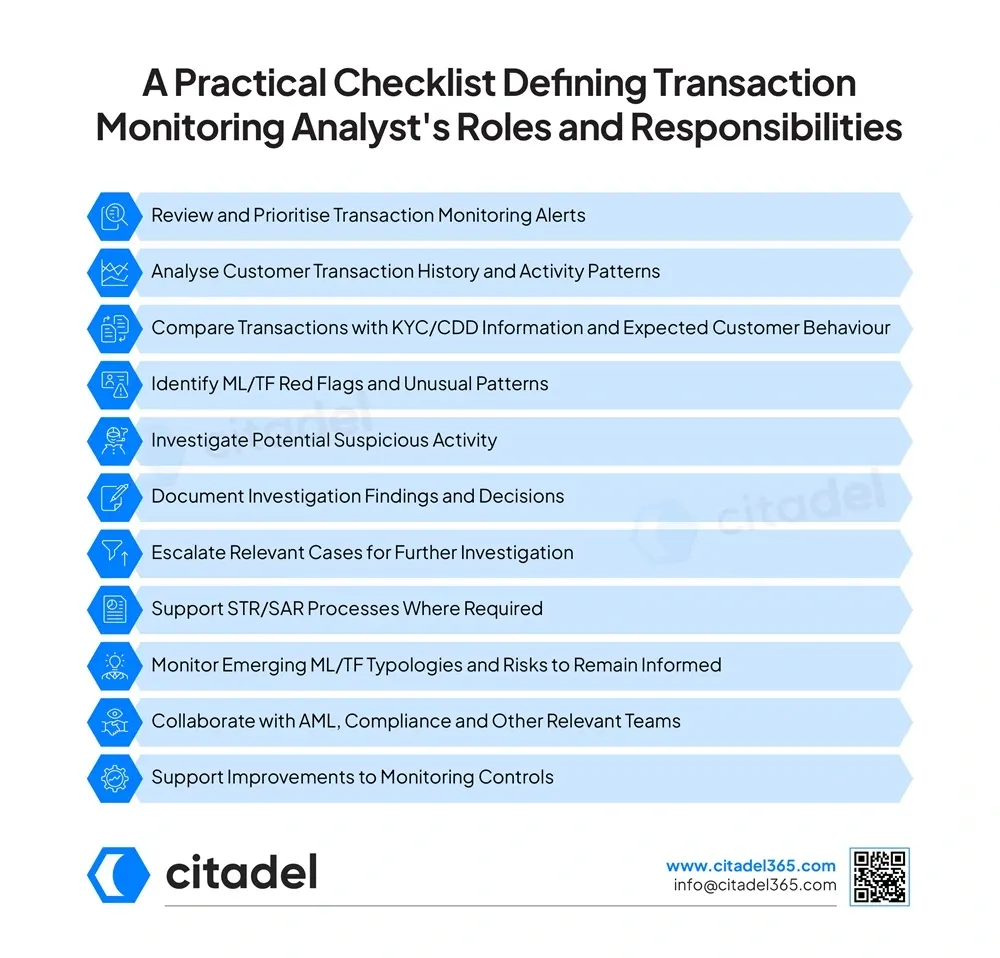
Transaction Monitoring Analyst Checklist
Transaction monitoring analysts should consider the checklist below, which defines their role and responsibilities to ensure AML compliance and prevent financial crime:
Frequently Asked Questions About Transaction Monitoring Analysts
A transaction monitoring analyst monitors customer transactions to detect unusual patterns and red flags. The analyst also documents findings, investigates alerts, and escalates cases that require further review or reporting.
Transaction monitoring in AML involves reviewing customer transactions to detect unusual patterns or suspicious activity indicative of money laundering, terrorist financing and other financial crime risks.
A transaction monitoring analyst requires analytical thinking, investigative skills, attention to detail, AML/CFT knowledge, documentation and good communication skills.
A transaction monitoring analyst looks for unusual transaction patterns, sudden changes in customer behaviour, unexpected counterparties and other ML/TF red flags to prevent financial crime.
Transaction monitoring works by monitoring customer transactions, generating alerts for unusual activity, investigating alerts, documenting findings, and escalating cases for further review and reporting.

Vasantha holds a Master’s in Law specialising in Banking Laws and Anti-Money Laundering and is CAMS and CGSS certified. With over 35 years of experience, she has worked closely with regulators and international financial institutions, building financial crime risk frameworks, sanctions monitoring programmes, and compliance systems across multiple jurisdictions.