
The Complete Guide to Identity Verification: Tools, Best Practices and Compliance
Ready to Defeat Your AML Compliance Obstacles?
Citadel Brings Revolution with Secure Solutions to AML Compliance Problems
Key Takeaways: Identity Verification
- Identity verification helps confirm who a person is during customer onboarding, prevent identity fraud, and strengthen KYC processes.
- It involves multiple checks, including document verification, face matching, liveness checks, biometric checks and others.
- Identity verification is an integral part of AML compliance; regulated entities should adopt a risk-based approach that combines the right technology, human review, data protection, and regular monitoring.
What Is Identity Verification?
Identity verification, or ID verification, is the process of confirming a customer is genuine by matching their details with independent sources. It helps regulated entities validate customers’ identities before establishing a business relationship.
However, identity verification involves facial recognition, biometric checks, and other data that confirm a person’s identity. On the other hand, ID verification involves checking an identity document, such as a passport or Emirates ID, to confirm that the customer is genuine and who they claim to be.
Moreover, identification confirms who a person claims to be, and verification approves that claim. In correspondence, authentication confirms identity when the customer is accessing an account. Here, KYC is a compliance process that includes identification and verification. Identity verification helps regulated entities prevent identity fraud, account takeover, impersonation and other fraud or financial crimes. It also supports regulatory requirements, secure onboarding, and building customer trust.
How Does Identity Verification Work?
The step-by-step process for identity verification is as follows:
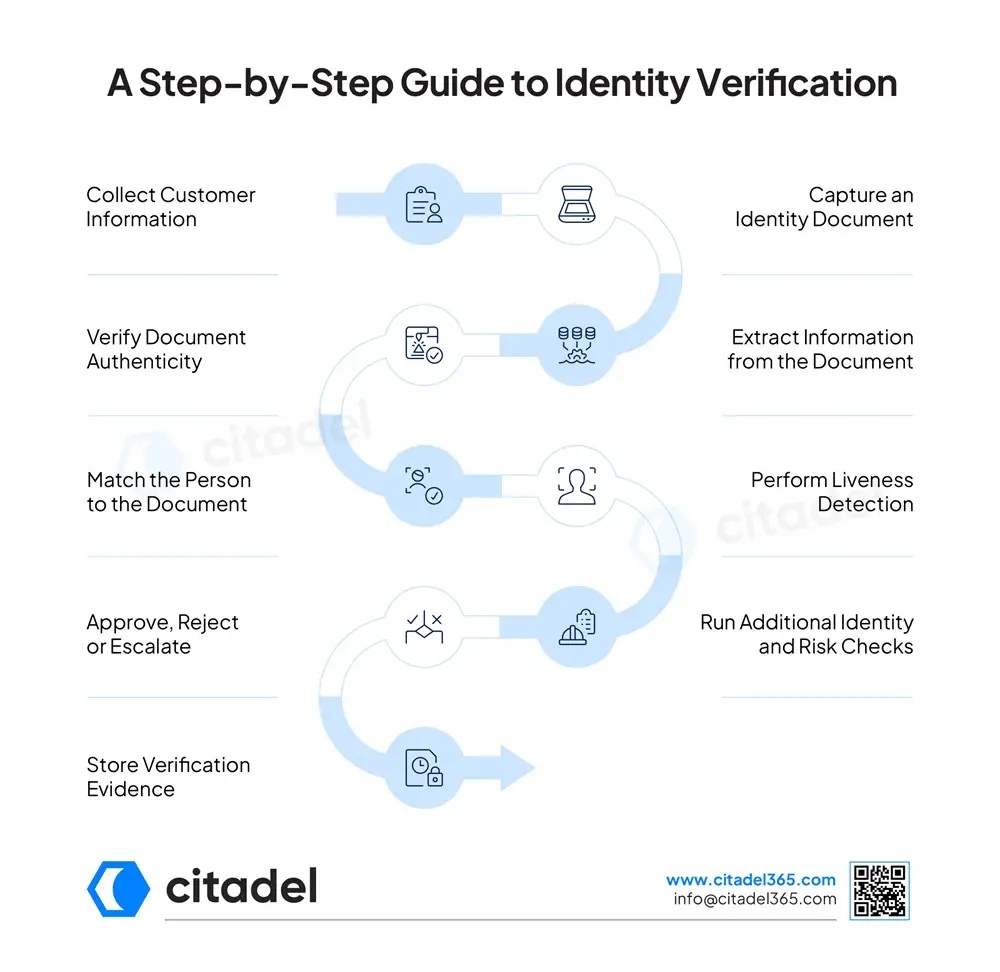
Collect Customer Information
Regulated entities are required to collect customer information such as the customer’s name, address, date of birth, and other necessary information.
Capture an Identity Document
With customer details, regulated entities also require document proof, such as a passport, national ID or driving license.
Extract Information from the Document
ID verification tools use OCR to read information from documents. The tools extract details such as name, date of birth, document number, etc.
Verify Document Authenticity
Regulated entities check the document for signs of alteration, tampering, expiry or other indicators that may suggest fraud or mislead.
Match the Person to the Document
After verifying the authenticity, regulated entities must perform biometric checks or facial recognition checks to confirm the individual matches the identity document.
Perform Liveness Detection
Regulated entities should also perform liveness checks to ensure the presented ID document is real, and the individual is physically present at the time of verification.
Run Additional Identity and Risk Checks
Entities must conduct additional checks depending on the business risk assessment and customer risk factors. It also includes sanctions, PEP and adverse media checks.
Approve, Reject or Escalate
Based on the results, onboard the customer if they seem genuine, or reject or escalate for investigation if they appear suspicious.
Store Verification Evidence
Regulated entities must record customer documents and relevant information & evidence, stored securely.
Know Who You’re Dealing With
Strengthen identity verification with smarter checks for secure and efficient onboarding.
What Are the Different Identity Verification Methods?
Depending on customers, services and risk level, regulated entities use different identity verification methods such as:
- Manual ID verification, where a trained employee checks identity documents and customer information.
- Use of digital tools to verify the identities of customers requiring remote onboarding.
- Ensure ID documents are valid and authentic during customer onboarding.
- Check customer details against trusted databases to verify information.
- Conduct biometric identity verification such as fingerprints and facial features.
- Compare facial image with customer’s identity document photo.
- Conduct a liveness check to verify individuals and avoid deepfake impersonation.
- Conduct knowledge-based verification by asking personal questions to confirm identity.
Why is Identity Verification Important for Businesses?
Identity verification helps regulated entities confirm customers are genuine and ensure safer onboarding. It helps identify false identities and prevent fraud. Further, verifying customer identities reduces impersonation and account fraud. Identity verification also ensures AML/CFT compliance by strengthening KYC/CDD processes and helping regulated entities understand their customers.
Moreover, digital verification enables faster onboarding and improves customer convenience. Automated identity verification tools reduce repetitive manual work and let compliance teams focus on high-risk cases that require investigation. A secure verification process also builds customer trust and helps customers complete onboarding successfully, supporting compliance requirements.
What Are the Best Practices for Identity Verification?
Businesses should apply the following best practices for effective identity verification:
- Adopt a risk-based approach to verify customers by applying stronger checks for high-risk customers and simpler checks for low-risk customers.
- Cross-check customer information against trusted sources or databases to reduce risk from manipulated or inaccurate data.
- Check customer ID documents for expiry, validity, tampering and other signs of fraud.
- Conduct a combination of liveness checks, biometric tests and other checks for stronger verification.
- Keep the onboarding process simple to reduce drop-off while maintaining security.
- Ensure the compliance team is well equipped with the knowledge to detect unusual or unclear cases.
- Maintain complete documentation through effective audit trails that record the verification process, decisions and relevant evidence.
- Monitor every compliance action, including manual review, verification time, fraud detection rates, false acceptance, completion, and drop-off.
- Perform regular checks of customer profiles and update verification controls when new fraud methods emerge.
Identity Verification in the UAE: What Businesses Need to Know
Under UAE AML/CFT compliance requirements, identity verification is mandatory. Regulated entities such as financial institutions, DNFBPs, and VASPs must apply a risk-based approach to customer due diligence (CDD), involving identity verification. Further, it involves verifying customer identities using reliable and independent sources as part of the KYC/CDD process.
Moreover, high-risk customers require enhanced due diligence, including additional checks. Regulated entities should also monitor customer information and update their risk profile regularly to keep it accurate and up to date, ensuring AML compliance and preventing financial crime & fraud.
What Features Should You Look for in an ID Verification Tool?
Regulated entities should choose an ID verification tool that supports compliance, security and ease of use. The key features to look for in an ID verification tool include:
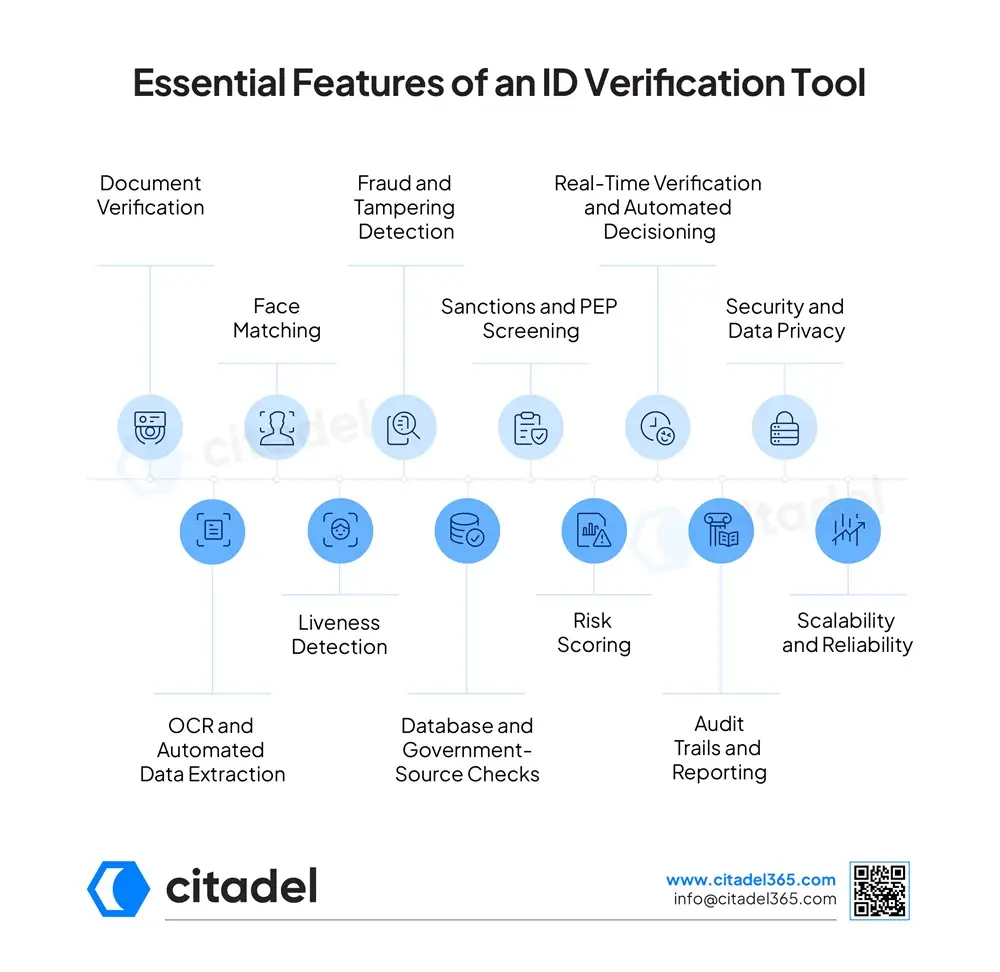
Document Verification
ID verification tool should check whether documents are genuine and valid, which helps prevent expired, fake or altered documents.
OCR and Automated Data Extraction
The chosen software should extract customer details from provided documents automatically to remove manual data entry and speed up onboarding.
Face Matching
ID verification software should help compare a customer’s facial features with the document photo to help detect impersonation and identity misuse.
Liveness Detection
Regulated entities should choose an ID verification tool that conducts liveness checks to detect spoofing attempts by confirming the individual is physically present.
Fraud and Tampering Detection
The ID verification tool should help identify red flags, including document manipulation or fraud.
Database and Government-Source Checks
The system should validate customer information and documents against reliable government sources to strengthen verification.
Sanctions and PEP Screening
Identity verification software should integrate with screening capabilities to identify sanctions and PEP matches.
Risk Scoring
Regulated entities should choose an ID verification tool that helps them identify high-risk customers and apply additional checks.
Real-Time Verification and Automated Decisioning
ID verification tool should reduce wait time with automated rules that approve genuine customers and speed up onboarding.
Audit Trails and Reporting
When verifying customers, the ID verification software should record every detail, including customer information, decisions, and internal reviews.
Security and Data Privacy
To protect customers’ sensitive information, the chosen ID verification tool must have strong encryption, secure transmission, and access controls.
Scalability and Reliability
The ID verification software should handle increasing customer volumes by scaling efficiently and supporting business growth.
Check Before You Onboard
Verify customer identities and spot potential risks from the start.
Manual vs. Digital Identity Verification
Verifying customer identities can be done manually or through using digital tools. The right approach depends on factors such as customer type, verification volume, risk level and business requirements.
Manual Identity Verification
Advantages:
- Involves human judgement where staff can assess unclear documents and unusual situations.
- It is useful for investing complex cases which require human expertise and decisions.
- Staff are already familiar with existing processes to check customer documents.
Limitations:
- Manual checks involve staff in every case, creating backlogs and may stretch onboarding.
- High operational costs as more staff are needed to review cases.
- May lead to errors, as humans may miss altered text or forged documents, which may result in fraud.
- Different employees may apply rules differently, leading to inconsistent results.
- Customers may face a poor experience if they expect instant ID verification during onboarding.
Digital Identity Verification
Advantages:
- It provides faster results with automated checks, resulting in quick onboarding.
- It can process large volumes of customer information efficiently.
- It facilitates consistency by applying the same verification rules across cases.
- It reduces repetitive manual work and supports remote onboarding.
Limitations:
- Digital tools may sometimes result in false positives or negatives.
- Businesses must protect customers’ sensitive and personal information while using these tools.
- Using digital ID verification tools requires integration with existing systems.
Combining manual and digital identity verification can provide the right balance. Regulated entities may use digital tools for routine, low-risk cases, while manual checks are appropriate for complex or high-risk cases.
Common Identity Verification Challenges and How to Solve Them
Compliance teams often face issues during ID verification, including poor-quality ID images, expired or unsupported documents, manipulated documents, identity theft, deepfakes, false positives, customer drop-off and others. These issues and best practices to solve them are listed below:
Poor-Quality ID Images
Customer documents may contain blurry or dark images, which makes it difficult to verify identity. Provide clear instructions to customers for capturing images and use technology to detect poor-quality images.
Expired or Unsupported Documents
Many customers submit expired documents or those that the system cannot recognise. Regulated entities should use ID verification tools that support relevant document types and must communicate acceptable documents to customers.
Fake or Manipulated Documents
Criminals may use fake or altered documents to commit fraud and other financial crime. Compliance teams should use tampering detection tools alongside verification checks.
Identity Theft and Impersonation
Fraudsters may use another person’s identity, which may lead to fraud or financial losses. ID verification should involve document verification, liveness checks, face matching, and other relevant checks.
Deepfakes and Presentation Attacks
Use of photos, videos, or deepfake technology by criminals to bypass facial checks. Compliance teams should perform liveness and anti-spoofing checks to detect deepfake scams.
False Positive and False Rejections
ID verification tool may at times flag genuine customers or may pass suspicious customers, which increases manual work and fraud risk. Regulated entities should review system performance regularly and involve human review for unusual cases.
Customer Drop-Off
Customers often get frustrated with time-consuming or confusing verification processes, which may lead to the loss of genuine customers. Keep onboarding processes simple and minimise unnecessary checks.
Privacy and Data Security
Identity verification involves customers’ sensitive and personal information. Poor data protection can create compliance and security risks. Regulated entities should use encryption, secure transmission, access controls and clear audit logs to protect customer information from breaches.
Identity Verification Use Cases Across Industries
Identity verification is essential for businesses to validate who they are dealing with and helps reduce fraud and financial crime. Major industries that require identity verification include:
Banking and financial services: Helps verify customers during account opening and support KYC requirements.
Fintech and payment service providers: Helps prevent fraud during digital onboarding.
Real estate agents and brokers: Help confirm the identity of buyers, sellers and counterparties involved in property transactions.
Insurance companies: Help understand policyholders and reduce insurance fraud.
Virtual assets and cryptocurrency: Comply with KYC requirements and prevent financial crime risks.
Healthcare industry: Record patient identities and prevent records from being linked to the wrong individual.
E-commerce and marketplaces: Help verify the identities of customers and sellers and reduce marketplace fraud.
Telecom industry: Verify customers while issuing SIM cards or activating mobile services.
Travel and hospitality sector: Confirm the identity of customers during check-in, bookings and other services.
Education sector: Verify students during online learning, admissions and examinations.
Employment and HR: Help verify candidate identities during onboarding or recruitment.
Verify More Than Just an ID
Conduct identity checks, screening and risk assessment in one process.
How Identity Verification Supports KYC and AML Compliance
Identity verification is an integral part of the KYC and AML compliance process. It is the first step in KYC, which involves understanding and verifying customers. Identity verification helps understand who the business is dealing with. When onboarding a corporate customer, identity verification helps check beneficial owners, who ultimately own or control the corporate customer.
Identity verification helps identify high-risk customers who require Enhanced Due Diligence (EDD), including additional checks. Furthermore, it also supports ongoing monitoring that helps identify changes in customer risk profiles. Regulated entities should maintain records with effective audit trails that validate the identity verification process, ensuring AML compliance.
How to Implement an Identity Verification System
Implementing an identity verification system involves understanding customer risks, defining verification requirements, selecting the right technology, integration, configuration, testing, launch, monitoring and optimisation. The process is explained in detail below:
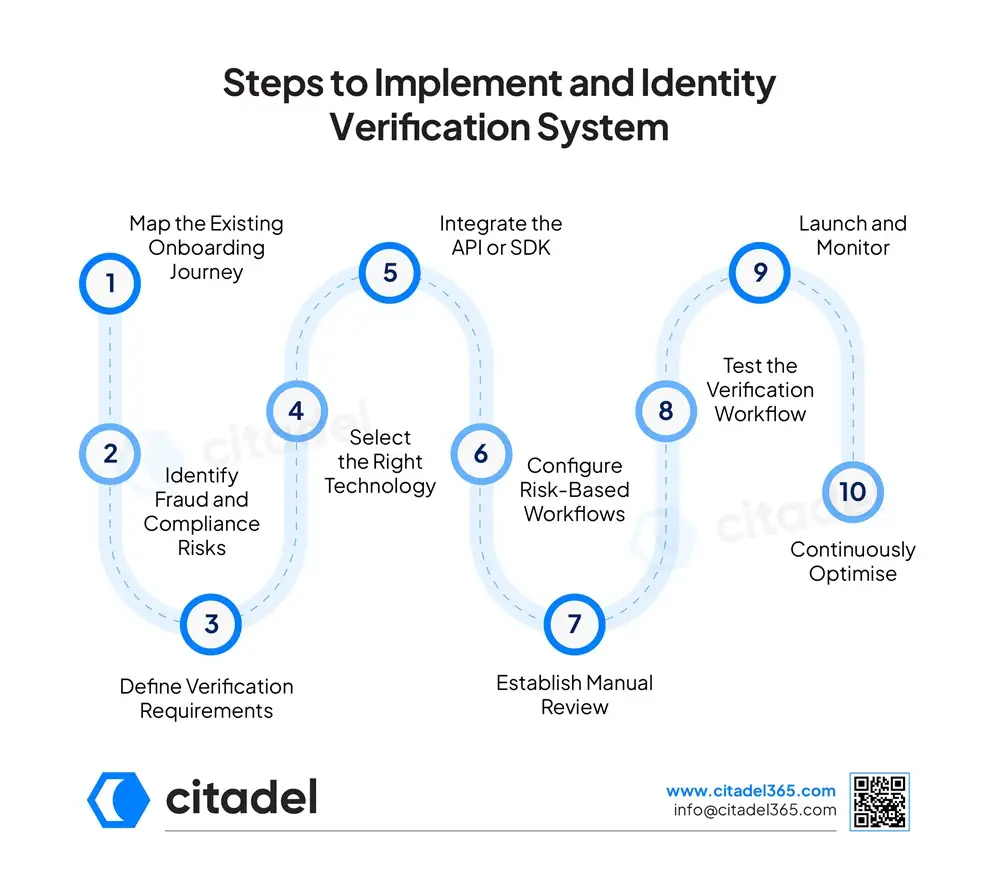
Map the Existing Onboarding Journey
Review the current identity verification process and identify delays, repetitive tasks and manual work.
Identify Fraud and Compliance Risks
Consider risk factors such as identity theft, document manipulation, impersonation and account fraud. Also, identify legal obligations that apply to the business, including KYC and AML requirements.
Define Verification Requirements
Based on customers and their risk levels, determine which documents, methods and risk controls are needed.
Define Verification Requirements
Based on customers and their risk levels, determine which documents, methods and risk controls are needed.
Select the Right Technology
Compare different ID verification tools and choose the right technology based on factors such as fraud detection, document coverage, integration, cost, scalability, accuracy, and security.
Integrate the API or SDK
Connect the identity verification system with existing systems to complete checks at onboarding.
Configure Risk-Based Workflows
Customise verification steps based on customer risk level; for example, add extra checks for high-risk cases.
Establish Manual Review
Complex and unusual cases may require manual review by staff. Develop a process for such high-risk cases.
Test the Verification Workflow
Monitor customer information for expired, forged, or manipulated documents to prevent fraud and financial crime risk.
Launch and Monitor
Start the system and monitor success, rejection, fraud detection, customer drop-off and processing time.
Continuously Optimise
Regularly check system performance and update the software with new verification rules, controls, and customer experience enhancements.
How to Measure Identity Verification Performance
Regulated entities must measure identity verification performance to understand whether the process is working effectively. It helps find the right balance between regulatory compliance, operational efficiency, fraud prevention, and a smooth customer experience. Key performance indicators include verification completion rate, success rate, false acceptance and rejection rates, verification time, customer drop-off rate, fraud detection rate, manual review rate, cost, and conversion rate. Measuring these KPIs helps identify system weaknesses, reduce false rejections, detect fraud, increase onboarding, and control operational costs.
Future Trends in Identity Verification
Identity verification methods are evolving with digitalisation and automation. Future trends include the use of artificial intelligence (AI) to examine identity documents and detect errors, unusual patterns and altered documents quickly. Further, deepfake detection tools help identify AI-generated faces, images and videos and prevent impersonation.
Synthetic identity detection helps detect fake identities that fraudsters create by combining real and false personal information. Moreover, advanced liveness detection checks whether the individual is real and prevents spoofing attacks. The NFC verification reads and validates data from the encrypted chip embedded in the document to confirm identity.
Furthermore, digital identities can be used to verify information stored electronically instead of submitting physical documents. The use of adaptive verification methods provides customisation to the level of identity check based on the customer’s risk and available information.
In addition, automation handles routine and repetitive verification tasks, while professionals review unusual, complex, and high-risk cases. Privacy-preserving verification collects only the personal information needed from documents to confirm identity.
A Faster Way to Verify Customers
Automate ID checks and simplify the first step of the customer journey.
Frequently Asked Questions About Identity Verification
The main identity verification methods include biometric verification, document check, facial recognition, database checks, liveness detection, digital identity verification, NFC verification and manual checks.
Documents such as national identity cards, passports, residence permits, driving licenses, and other government-issued identity documents are required for identity verification.
Digital identity verification confirms an individual’s identity online using electronic means such as biometric matching and digital documents without needing an in-person visit.
Biometric identity verification means confirming an individual’s identity by matching their unique physical characteristics, such as fingerprints, facial features or iris patterns.
Liveness detection checks if a real person is physically present to verify identity, which helps prevent spoofing attempts.

Sridhar is a Certified Anti-Money Laundering Investigator (CAMI) with over 30 years of experience in compliance, risk, and audit, including more than 20 years in AML and financial crime prevention. He has contributed to the development of UAE regulatory standards through the FERG sub-committee and has maintained active engagement with the Central Bank of the UAE on supervisory and compliance matters.