
What Does a KYC Analyst Do? Roles, Responsibilities and Importance in AML
Ready to Defeat Your AML Compliance Obstacles?
Citadel Brings Revolution with Secure Solutions to AML Compliance Problems
What Is a KYC Analyst- Brief Overview
- A Know Your Customer (KYC) analyst supports an organisation’s AML framework by verifying customers, assessing their risk profiles, and identifying potential indicators of ML/TF risk and other financial crime.
- The key skills of a KYC analyst include analytical and Investigative skills, research and communication skills, attention to detail, and regulatory and AML knowledge.
- Citadel365 helps change the KYC analyst role by automating identity verification, screening, risk assessment, and case management to reduce manual errors and false positives.
What Is a KYC Analyst?
A KYC (Know Your Customer) Analyst is a compliance professional who verifies customer identities, evaluates risk levels, and ensures that financial institutions follow anti-money laundering (AML) rules.
KYC means “Know Your Customer”, it refers to the processes organisations use to verify who their customers are, understand their activities and identify potential money laundering and terrorist financing (ML/TF)risks.
The KYC analyst role goes beyond checking documents; key responsibilities include onboarding customers, conducting customer due diligence, performing enhanced due diligence where required, screening against sanctions and PEP lists, identifying and escalating red flags, and conducting ongoing KYC reviews.
What Does a KYC Analyst Do?
A KYC analyst helps organisations verify customers, assess their risk, and meet AML/CFT compliance requirements; their responsibilities also cover due diligence, screening, investigations, documentation, and escalation.
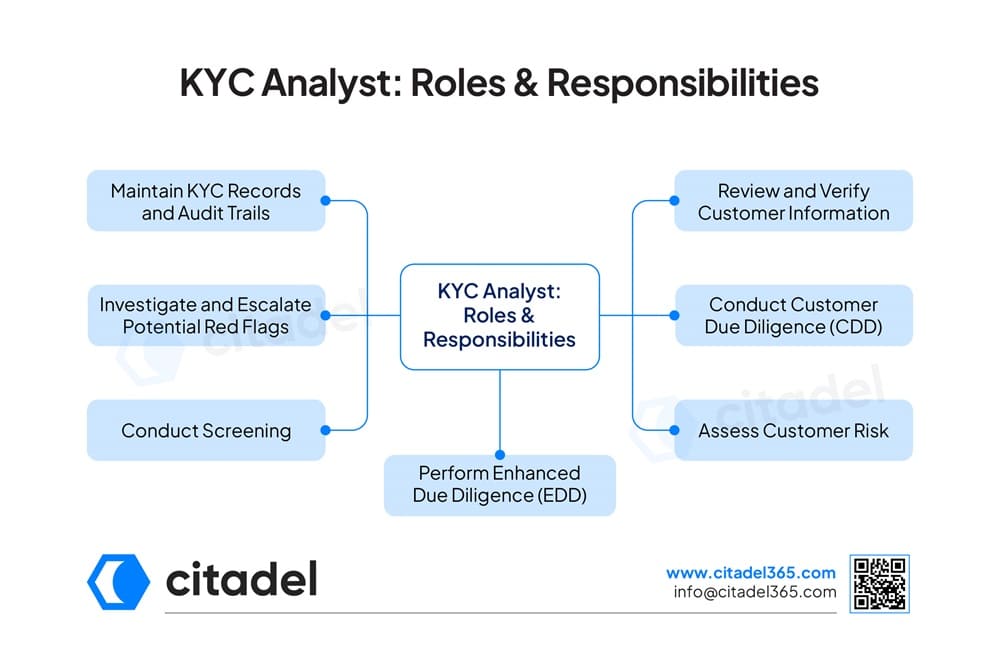
Review and Verify Customer Information
KYC analysts help organisations review identity and business information to determine whether customer information is accurate, complete, and consistent.
Conduct Customer Due Diligence (CDD)
Conducting customer due diligence helps an organisation to understand who the customer is, their business relationship, and the risks involved.
Assess Customer Risk
KYC analysts assess risk based on key factors, including customer type, geography, industry, products/services, ownership structures, and source of funds or wealth to determine the appropriate level of due diligence and monitoring.
Perform Enhanced Due Diligence (EDD)
High-risk customers may require additional investigations; an analyst may need to establish the customer’s true identity, source of wealth, source of funds, and the legitimate business purpose of their transactions.
Conduct Sanctions, PEP and Adverse Media Screening
KYC analysts are also required to screen customers against Sanctions lists to identify restricted individuals and entities, PEP databases to identify politically exposed persons, and adverse media sources to identify information that may indicate potential ML/TF or other financial crime risk.
Investigate and Escalate Potential Red Flags
KYC analysts investigate inconsistencies in customer information, assess available information, document their findings and escalate cases that require further review.
Maintain KYC Records and Audit Trails
Analysts maintain KYC records and audit trails to demonstrate and support decision-making and regulatory investigations.
Simplify your KYC Processes with Automation
Citadel365 automates KYC checks, screening, risk assessment, and case management while allowing the compliance team to focus on high-risk cases.
What Skills Does a KYC Analyst Need?
A successful KYC analyst needs key competencies in regulatory compliance, risk assessment, customer due diligence and document verification to prevent financial fraud.
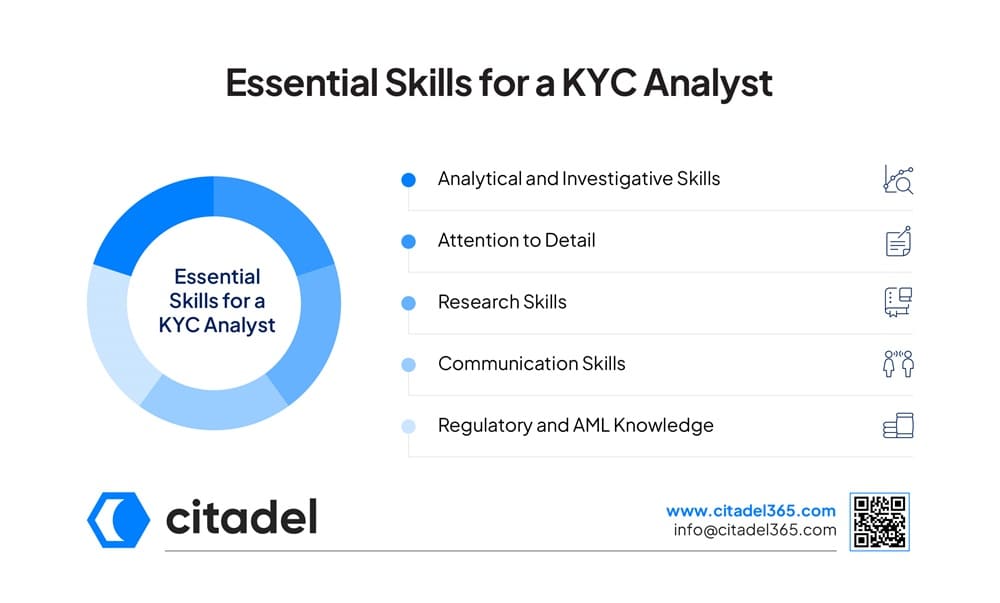
Some of the key skills include:
Analytical and Investigative Skills
KYC analysts need to identify inconsistencies, connect information from various sources and assess whether customer activities or profile present potential risk.
Attention to Detail
The KYC analyst should check for small discrepancies in customer information, ownership structures or supporting documents that may indicate a larger issue, requiring strong attention to detail and helping them identify and investigate gaps efficiently.
Research Skills
Analysts may research companies, individuals, beneficial owners, jurisdictions and business activities, using reliable sources.
Communication Skills
Analysts often need to request missing information, clarify inconsistencies and communicate findings with customers, relationship managers and compliance teams.
Regulatory and AML Knowledge
KYC analysts should have strong knowledge of applicable KYC, CDD, AML, sanctions and financial-crime requirements, playing an important role in making informed risk-based decisions.
KYC Analyst vs AML Analyst: What's the Difference?
A KYC analyst verifies customer identity during onboarding, conducting customer due diligence, risk assessment, beneficial ownership checks, and screening, while an AML analyst monitors ongoing transactions and investigates suspicious financial activity.
Both roles protect financial institutions from regulatory fines, ML/TF risks, and other financial crimes. However, their responsibilities can overlap, particularly in smaller organisations or teams with broader AML/KYC responsibilities.
How to Become a KYC Analyst
Building a career as a KYC analyst typically requires a combination of compliance knowledge, analytical skills, and practical experience. Some of the following key pointers that can help are as follows:
Build a Foundation in Financial Services and Compliance
Develop a basic understanding of banking, financial services, compliance and financial crime.
Learn KYC, CDD, EDD and AML Fundamentals
Learn and understand the fundamentals of Know Your Customer (KYC), Customer Due Diligence (CDD), Enhanced Due Diligence (EDD), AML and sanctions compliance.
Develop Research and Analytical Skills
Practise researching companies, individuals, ownership structures and jurisdictions, and learn how to identify inconsistencies, assess information and recognise potential ML/TF risk indicators.
Gain Relevant Experience
Gaining the required experience in reviewing documents, conducting research, or working with compliance processes can be proven valuable.
Consider Professional Certification
Professional certifications in AML, KYC or financial crime compliance can help demonstrate your knowledge and strengthen your profile.
KYC Analyst Career Path and Progression
A KYC career can develop in several directions, depending on an individual’s experience, skills, organisations, and key areas of specialisation. The typical career path may include:
Junior KYC Analyst
Collects basic customer identification data and handles entry-level administrative tasks, data entry, and document collection.
KYC Analyst
Independently handles KYC reviews, customer risk assessments, CDD and escalations.
Senior KYC Analyst
Focuses on complex or high-risk clients and enhanced due diligence, and supports junior staff as well.
AML Analyst or Financial Crime Analyst
Moves into broader financial-crime investigations, transaction monitoring, and suspicious activity analysis.
KYC/AML Team Lead
Oversees analysts, reviews complex cases, manages workflows and supports quality and performance.
Compliance Manager or Financial Crime Manager
Manages and oversees overall governance, risk frameworks, and regulatory alignment for the institution.
How Citadel365 help in Changing the KYC Analyst Role
Citadel365 is changing how KYC work is performed by automating repetitive tasks, improving operational efficiency and helping analysts manage large volumes of customer information.
Automated Identity Verification
Citadel365 helps automate identity verification by checking customer information and documents against reliable data sources, helping reduce manual processing.
Automated Screening and Matching
Citadel365 automated screening systems enable checking customers against sanctions, PEP, and adverse media sources, protecting organisations from potential ML/TF risks.
Risk-Based Customer Assessment
It also supports risk-based assessments, helping analysts identify customers who may require enhanced due diligence.
Case Management and Workflow Automation
Citadel365 case management software helps automate workflows, assign cases, and maintain proper documentation to support regulatory compliance and make KYC processes more consistent and efficient.
Reducing Manual Reviews and False Positives
Automation can help reduce repetitive manual checks and prioritise potential matches. Screening technology can also help reduce false positives, allowing analysts to focus on cases that require human intervention.
Is Your KYC Process Ready for What’s Next?
See how citadel365 supports automation and helps enable faster, more consistent, and risk-based KYC processes.
Frequently Asked Questions
A KYC analyst verifies customer information, conducts customer due diligence, assesses risk, performs screening and escalates potential compliance concerns.
Key responsibilities include verifying customer identity, conducting customer due diligence, assessing customer risk, and screening against sanctions, PEP, and adverse media lists.
A KYC analyst needs analytical, investigative, research, communication, and attention-to-detail skills, along with knowledge of KYC, CDD, AML, and sanctions requirements.
Yes, KYC is a fundamental part of the broader AML framework, helping organisations identify customers, assess risk and detect potential ML/TF risks.
A KYC analyst primarily focuses on customer identification, due diligence and risk assessment, while an AML analyst typically focuses more on transaction monitoring and alert investigation.

Arjun is the Co-founder and CEO of Citadel, where he leads the company’s vision across technology, business, and regulations. He brings over a decade of experience in building and scaling technology ventures. Arjun holds a B.Tech. in Information Technology and a Master’s in Management, supported by his certification as a Financial Crime Specialist, an uncommon combination that allows him to balance innovation with regulatory requirements.
Having advised leading banks and financial institutions on digital solutions and compliance technology, Citadel continues to grow with an ambition.