
Ready to Defeat Your AML Compliance Obstacles?
Citadel Brings Revolution with Secure Solutions to AML Compliance Problems
KYC stands for Know Your Customer. It is a mandatory verification process to confirm the identity, address, and background of a customer before establishing a business relationship and throughout the customer lifecycle.
The primary purpose of KYC is to verify the customer’s identity and prevent financial crimes, including money laundering and terrorist financing.
Customer identity verification is the foundation of the KYC process as it prevents financial crime and identity fraud, ensures compliance, and builds credibility.
KYC plays an important role because it helps prevent financial crime, such as money laundering, fraud, and terrorist financing, and protects businesses from financial, legal, and reputational risks.
Maintaining a robust KYC framework also ensures compliance with UAE AML regulatory requirements
Businesses must perform KYC checks to verify client identities, prevent ML/TF risks, and ensure regulatory compliance.
The KYC process is a vital framework businesses use to verify customer identities, assess risk, and prevent ML/TF risks. The following key steps outline how the KYC process works:
Step 1- Customer Identification
The first step is to collect basic customer data, including full legal name, date of birth, and residential address.
Step 2- Identity Verification
Verify the customer’s identity using official government-issued documents, databases, or electronic verification methods.
Step 3- KYC Form Verification
Customers fill out the KYC form, and KYC analysts verify it against the documentary evidence.
Step 4- Ongoing Monitoring
Continuously monitor customer profile data and keep it current and relevant.
Simplify AML Compliance With Citadel365
We help in automating identity verification, AML screening, and customer due diligence while meeting UAE regulatory requirements with confidence.
To complete KYC verification, you need key documents to verify identity, address, and ownership, ensuring compliance with AML regulatory requirements. KYC document requirements also vary by individual and business.
Customer ID:
Any one of the following IDs:
Any one of the following Proof of Address
KYC requirements in the UAE require regulated entities to verify client identities, track beneficial owners, and report suspicious activities to prevent ML/TF risk and ensure regulatory compliance with the UAE’s AML/CFT framework
KYC and AML are two distinct but closely related processes that play an interconnected role in maintaining the integrity within the financial system and preventing ML/TF risks.
Criteria | Know Your Customer (KYC) | Anti-Money Laundering (AML) |
Purpose | Prevent fraud, identity theft, and onboarding of risky customers. | Mitigate ML/TF risks and protects institutional and reputational risks. |
Timing | Conducted before and during the customer relationship. | Applied throughout the entire customer lifecycle. |
Activities | Customer identification, identity verification, risk assessment, CDD, and EDD. | Transaction monitoring, sanction screening, suspicious activity reporting. |
KYC and KYB differ because KYC focuses on verifying individual customers’ identities, while KYB verifies business entities.
KYC is used to verify the identity of individual customers by collecting and validating personal information and identification documents, involving assessing the customer’s risk profile and conducting ongoing monitoring where necessary.
KYB verifies the legitimacy of a business by reviewing its legal registrations, identifying UBOs, directors, and business activities, helping to identify shell companies and other high-risk entities.
Businesses often use various types of KYC according to the regulatory requirements, onboarding methods, and the risk level involved.
The following types of KYC include:
Customer identity is verified through in-person interactions by reviewing original identification documents and collecting the required information.
Online identity verification through digital document submission, biometric authentication, and electronic verification for a smoother onboarding process.
Electronic KYC uses digital identity systems and automated verification technologies to authenticate customer identities with less manual intervention.
Complete identity verification of customers through a live video interaction by identifying documents remotely.
Customer information and risk profiles are periodically reviewed and updated throughout the business relationship to identify evolving risk and ensure continued compliance.
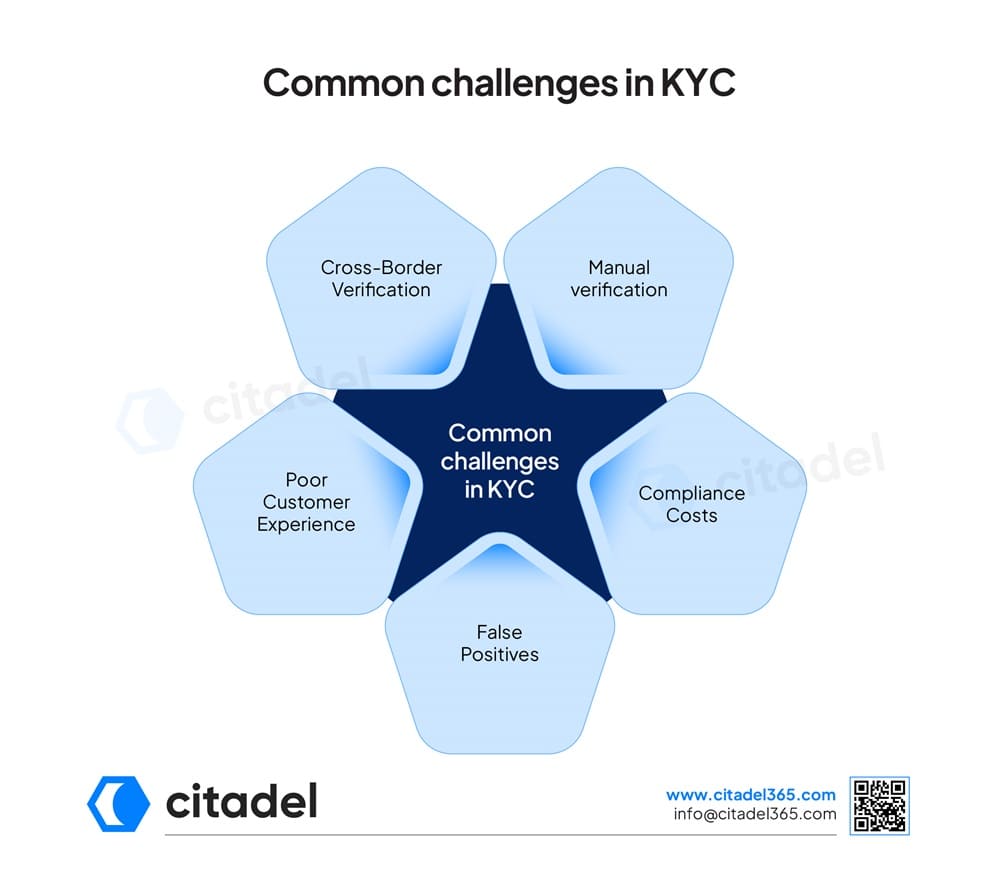
The key common challenges in KYC are as follows:
The best practices to follow for effective KYC include:
Technology is changing KYC processes from slow, manual document checks into instant digital workflows. The key technology drivers in KYC include:
Citadel365 supports KYC compliance requirements through its expertise in UAE AML and regulatory frameworks, helping your business to stay compliant with evolving AML laws and industry standards.
Citadel365 also helps in conducting screening against sanctions, PEP, and adverse media to identify and mitigate potential risks.
Citadel365 supports corporate KYC solutions for businesses, including conducting customer due diligence, enhanced due diligence where required, verifying beneficial owners, and providing ongoing compliance support.
It also enables automated identity verification that improves accuracy while reducing manual effort, ensuring faster customer onboarding, and enabling organisations to enhance operational efficiency while maintaining regulatory compliance.
Effective KYC processes are essential for preventing financial crime, maintaining regulatory compliance, accelerating customer onboarding, and meeting evolving regulatory requirements with confidence.
Citadel365 helps businesses in the UAE simplify KYC compliance through automated verification, AML screening, and provides ongoing regulatory support.
Frequently Asked Questions
Know your customer (KYC) is the process of verifying a customer’s identity to prevent money laundering, terrorist financing, and other financial crime risks.
KYC is a specific process used to verify a customer’s identity, while AML encompasses broader measures to detect and prevent financial crime risk.
Corporate KYC is a process of verifying a company’s legal existence, ownership structure, and beneficial owners before onboarding.
Electronic KYC is a digital identity verification process used to verify a person’s identity and address online using biometric scans and online authentication.

Vasantha holds a Master’s in Law specialising in Banking Laws and Anti-Money Laundering and is CAMS and CGSS certified. With over 35 years of experience, she has worked closely with regulators and international financial institutions, building financial crime risk frameworks, sanctions monitoring programmes, and compliance systems across multiple jurisdictions.