
Sanctions Risk Assessment
Before You Respond to Risk, Learn Its Shape.
Compliance Is Strongest When Exposure Is Understood
A sanctions risk assessment is often treated as a periodic exercise to confirm the screening tool is current and the lists are up to date. But sanctions exposure does not stay inside a screening tool. It moves through ownership layers, payment corridors, and business relationships that a name-match was never built to catch.
Sanctions risks can enter through customers, beneficial owners, jurisdictions, products, payment flows, transactions and third-party relationships. While sanctions screening identifies known matches, it cannot reveal the broader exposure across your organisation.
Citadel365’s Sanctions Risk Assessment helps you identify those entry points, assess the strength of your existing controls, and build a sanctions compliance programme that supports expansion without compromising compliance.
No List Should Ever Catch You Off Guard
Your Risk Exposure Should Not Be a Guessing Game
The Method Behind Our Sanctions Risk Assessment
A name matching a sanctions list is only the first data point. True exposure often sits several layers deeper, in beneficial ownership structures, adverse media patterns, and the transactional relationships a screening tool alone cannot surface. Our method is built to reach that depth to meet Targeted Financial Sanctions (TFS) obligations. It moves beyond list-matching into a sequence of checks to give you an evidence-backed position on your sanctions risk.
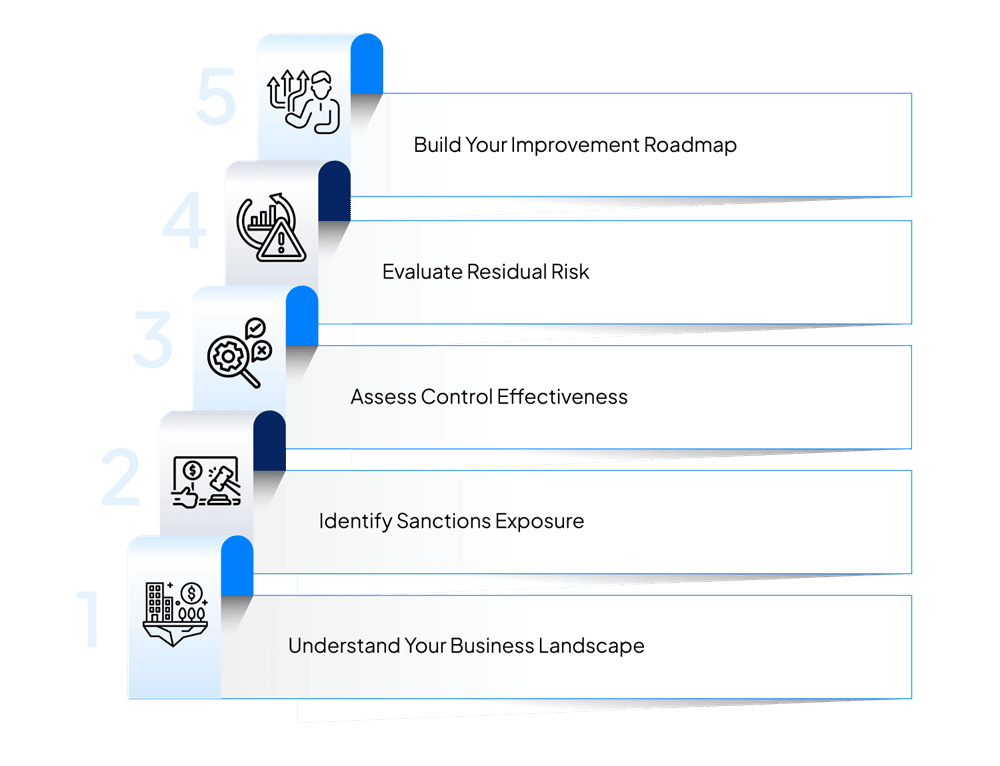
1. Understand Your Business Landscape
Every organisation has a unique sanctions risk profile. We begin by understanding your business model, customer base, products, services, jurisdictions, transaction types, and third-party relationships. This helps establish the context in which sanctions risks may arise and ensures the assessment reflects your reality.
2. Identify Sanctions Exposure
Next, we identify where sanctions risks exist across the organisation. This includes exposure arising from customers, beneficial owners, geographic operations, payment activities, products, services, supply chains, and business partners. The objective here is to understand your inherent sanctions risk before considering any existing controls.
3. Assess Control Effectiveness
Identifying risks is only half the exercise. We evaluate the policies, procedures, governance, screening processes, escalation mechanisms, due diligence measures, and other controls that have been implemented to manage sanctions risks. This helps determine whether the controls are proportionate to your exposure.
4. Evaluate Residual Risk
Once existing controls have been assessed, we determine the level of sanctions risk that remains. Each risk is evaluated based on its likelihood and potential impact, allowing organisations to prioritise areas that require immediate attention and allocate compliance resources more effectively.
5. Build Your Improvement Roadmap
The assessment concludes with a comprehensive report outlining key findings, control gaps, residual risk ratings, identified control gaps, and practical recommendations to support ongoing risk management.
The Strongest Walls Are Inspected from Both Sides
A wall inspected from only one side offers a false sense of security. We build ours to stand strong from both sides, so what protects you also stands up to a regulator’s closer look. Here’s what that looks like in practice.
We Look Beyond the Obvious
Sanctions exposure is not confined to sanctions lists. It can emerge through ownership structures, payment routes, geographic footprints, products, services, and business relationships. We assess the complete picture because risks do not arrive directly through the front door.
Controls Are Meant to Be Challenged
Having controls in place is reassuring. Knowing they are effective is far more valuable. We evaluate whether your controls are proportionate to your actual sanctions exposure, helping you distinguish genuine resilience from a false sense of security. Recent supervisory reviews continue to emphasise the effectiveness of sanctions systems and controls, not simply their existence.
Every Recommendation Has a Reason
A recommendation without context is another task on someone’s to-do list. Every observation we make is linked to the underlying risk, the control gap it addresses, and the outcome it is intended to achieve.
Built Around Your Business, Not Our Template
Your sanctions risks are shaped by your customers, jurisdictions, products, and operations. The assessment should be too. We do not fit your business into a framework. We build the framework around your business.
Ready to Challenge Your Sanctions Framework?
Let’s Build a Clear Picture of Your Risks and the Controls that Manage Them
Continue Your Compliance Journey
A sanctions risk assessment is one step towards stronger compliance. Explore our other services.
Sanctions Compliance
Proliferation Financing Risk Assessment
Financial Crime Risk Assessment
Payment Risk Assessment
External Compliance Officer
ML/TF Risk Assessment Data Collection Process
AML Consulting Services
AML/CFT Gap Assessment
AML AUP
Typology Assessment
Rule Optimisation & Threshold Tuning
AML Periodic Inspection
Counterfeit Currency Detection Training
FAQs
A sanctions risk assessment is an evaluation of your organisation’s exposure to sanctions-related risks. It assesses how customers, jurisdictions, products, services, transactions, and third-party relationships create sanctions risk, evaluates the effectiveness of existing controls, and identifies opportunities to strengthen your sanctions compliance framework.
Screening confirms that a name matches a list. It does not confirm that the risk parameters behind that screening are measured for your business. An assessment checks that the software is pointed at the right risks in the first place, then screening keeps that position current day to day.
A sanctions risk assessment typically reviews your customer base, beneficial ownership, geographic exposure, products and services, transaction types, delivery channels, third-party relationships, governance, sanctions screening process, customer due diligence, policies, and ongoing monitoring controls.
An enterprise-wide AML risk assessment evaluates broader money-laundering and terrorist-financing risks across the organisation. A sanctions risk assessment focuses specifically on exposure to sanctions risks, including customers, jurisdictions, transactions, and products, as well as the effectiveness of sanctions-specific controls such as screening, governance, and escalation processes.