Table of Contents

Ready to Defeat Your AML Compliance Obstacles?

Citadel Brings Revolution with Secure Solutions to AML Compliance Problems

Key Highlights: Shell Company Influence on Customer Risk Rating

  • Shell companies are commonly used by criminals to commit financial crimes by obscuring their identities and sources of funds.
  • Criminals exploit shell companies to launder money, evade sanctions, escape taxes, and finance terrorism.
  • Regulated entities are expected to conduct additional due diligence, including verifying beneficial ownership, source of funds, source of wealth, and purpose of business, to understand the legitimacy of the business.
  • Citadel365 supports risk assessment for complex, layered structures to uncover hidden financial crime risks and ensure compliance.

What Is a Shell Company?

A shell company, also called a ghost company, is a company that has no physical presence, significant assets or active business operations. These are legal and registered corporate entities that are often misused by criminals to engage in money laundering, sanctions evasion, terrorist financing and other financial crimes.


Shell companies facilitate anonymity that enables money launderers to conceal their true identity and obscure the origin of illegal funds. Regulated entities in the UAE must ensure beneficial ownership transparency to prevent criminals from hiding behind shell companies and to combat financial crime.

Why Do Shell Companies Create AML Risk?

Shell companies may result in exposure to ML/TF risks due to the following reasons:
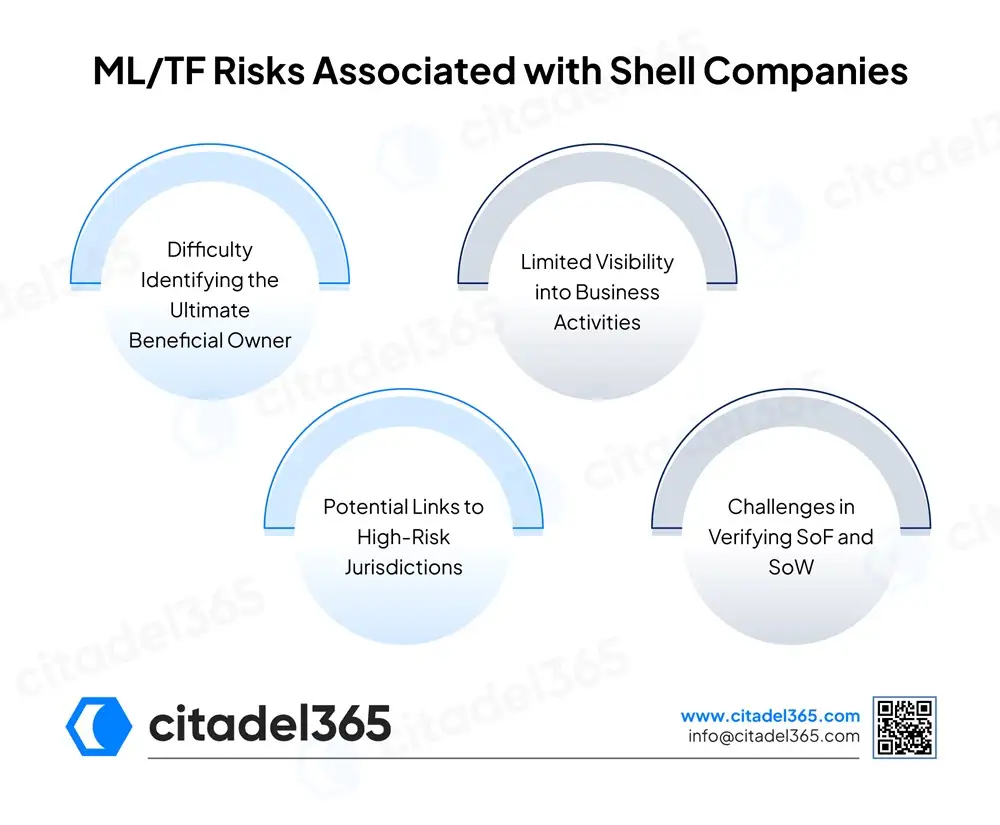
MLTF Risks Associated with Shell Companies

Shell companies facilitate concealed ownership, allowing criminals to hide behind complex, multi-layered ownership structures, making it difficult to identify the ultimate beneficial owner.

Criminals use shell companies to disguise the source of funds as payments for goods or services, benefiting from limited visibility into business activities.

Further, criminals often create shell companies in high-risk jurisdictions to evade taxes, which hinders transparency and exposes regulated entities to sanctions and financial crime risks.

Shell companies have unclear business activities and ownership structures, which make it difficult to verify the sources of funds and wealth and their legitimacy.

How Shell Companies Influence Customer Risk Ratings

Shell companies create opacity and complexity that enable money launderers to engage in financial crime activities. These companies are considered high-risk and require enhanced due diligence to verify the beneficial ownership and source of funds. Some of the other factors that describe how shell companies influence customer risk ratings include:

Shell companies in high-risk jurisdictions or those associated with jurisdictions with weak AML controls, sanctions exposure, or limited transparency influence customer risk ratings.

Transactions such as cross-border wire transfers, large sums through complex networks of multiple shell companies, use of third-party accounts, and nominee directors elevate risk ratings.

Industries with cash-intensive transactions, such as international trade, are often at high risk. Shell companies operating in such an industry require enhanced monitoring.

Shell companies with layered structures, nominee arrangements, and no physical offices make it difficult for compliance teams to verify information with limited documentation, affecting risk assessment.

Are All Shell Companies High Risk?

Shell companies are created for legitimate purposes such as managing investments, holding assets, protecting intellectual property rights, or facilitating mergers. These companies are legal even if they’re inactive. However, shell companies are considered high-risk due to their lack of transparency, active business operations, and physical presence.

Regulated entities are required to conduct customer due diligence and adopt a risk-based approach to protect their business from the risks of shell companies. The other compliance measures include customer risk assessment, transaction monitoring, AML training, ongoing monitoring, and the use of effective technology solutions to minimise exploitation from shell companies and combat financial crime.

In scenarios such as the use of a shell company to hold shares, funds, or intellectual property, with transparent ownership, in low-risk jurisdictions, or with consistent transactions that match the entity’s stated profile, regulated entities may classify a shell company as medium risk.

What Additional Due Diligence Is Required for Shell Companies?

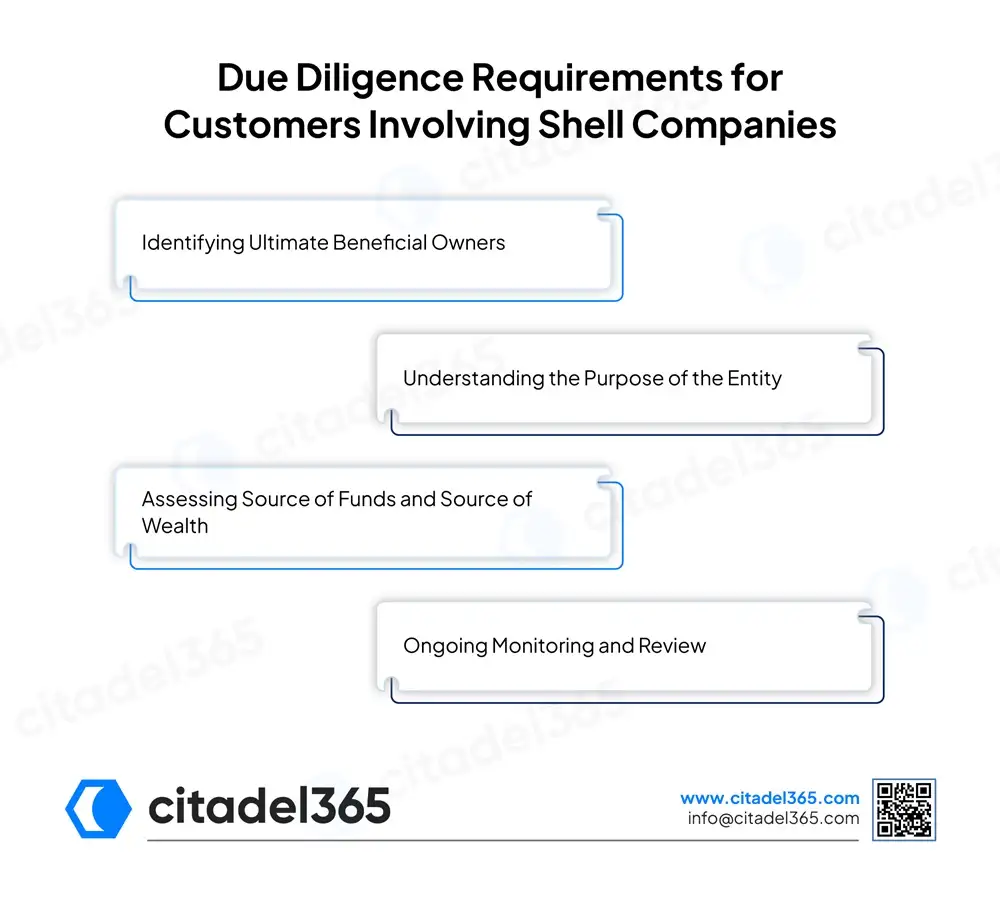
Due Diligence Requirements for Customers Involving Shell Companies

Regulated entities are required to identify and verify the ultimate beneficial owners who truly own and control the shell company.

Further, regulated entities should understand the purpose of the business to establish the legitimacy of business operations and ongoing transactions.

Moreover, entities should assess the source of funds and the source of wealth as part of additional due diligence to verify that funds and wealth are not derived from illicit activities.

Ongoing monitoring and review help detect suspicious activity, ensure transparency and comply with AML/CFT obligations.

The above measures help determine whether the shell company was created for illicit purposes and confirm the authenticity of its business operations.

How Citadel365 Supports Risk Assessment for Complex Corporate Structures

Citadel365 supports regulated entities throughout the customer onboarding process by helping identify and verify beneficial ownership information. The software centralises customer information along with its beneficial owners to screen them against global watchlists and assess their risks. The customer risk assessment software automatically calculates risk during onboarding and provides a consolidated risk rating along with profile risk.

Further, Citadel365 helps manage enhanced due diligence reviews by replacing manual processes with automated high-risk profiling and management on a single platform. It ensures continuous monitoring to counter financial crime, and its risk profile tab displays updated risks.

Moreover, Citadel365, with its effective audit trails, records every activity and transaction and helps maintain proper audit-ready customer records. The centralised platform, therefore, supports ongoing customer risk monitoring to ensure transparency across complex corporate structures, track UBOs and adjust their risk profiles to detect anomalies and ensure regulatory compliance.

Frequently Asked Questions

Picture of Vasantha Mohan
Vasantha Mohan

Vasantha holds a Master’s in Law specialising in Banking Laws and Anti-Money Laundering and is CAMS and CGSS certified. With over 35 years of experience, she has worked closely with regulators and international financial institutions, building financial crime risk frameworks, sanctions monitoring programmes, and compliance systems across multiple jurisdictions.