
Ready to Defeat Your AML Compliance Obstacles?
Citadel Brings Revolution with Secure Solutions to AML Compliance Problems
Summary Box:
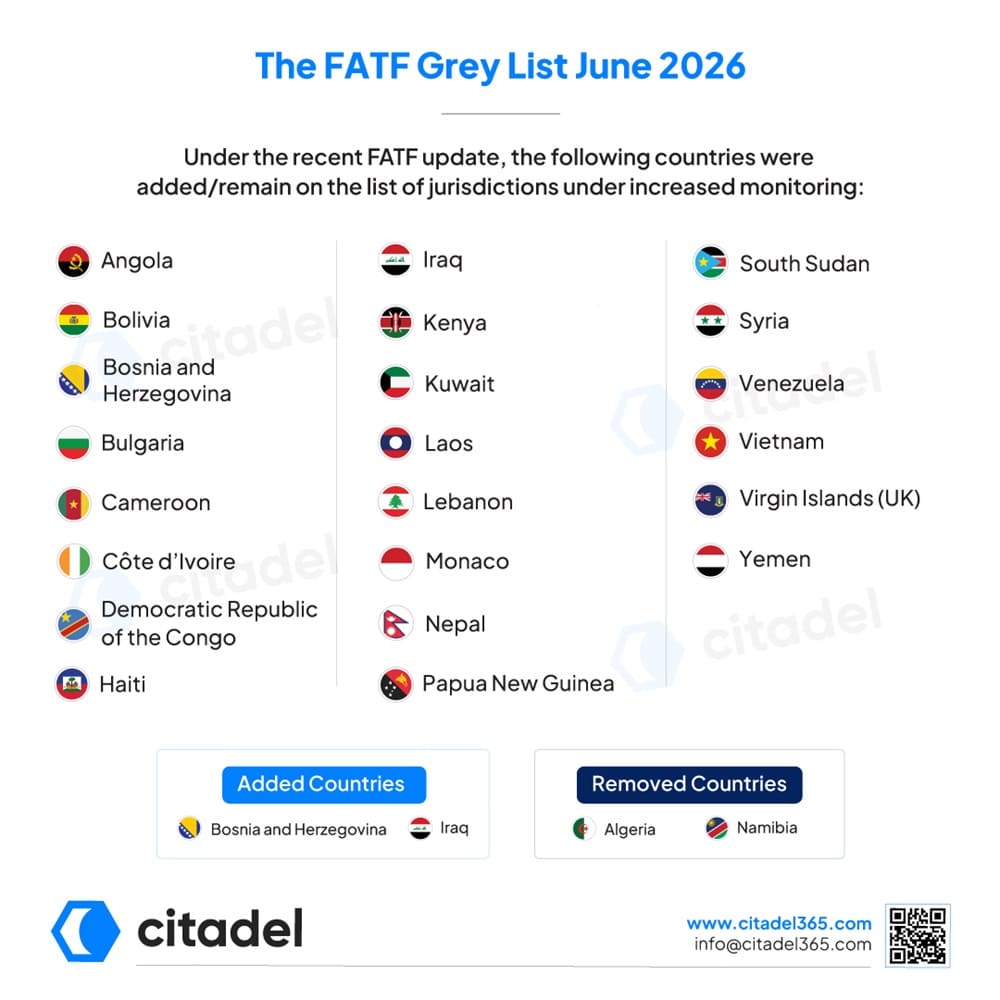
The June 2026 FATF Plenary concluded with several notable developments relating to jurisdictions under increased monitoring and the evolving priorities of the global AML/CFT framework. The meeting marked the final Plenary under the Presidency of Elisa de Anda Madrazo of Mexico and reflected the FATF’s continued emphasis on effectiveness and measurable outcomes.
While additions to and removals from the FATF grey list often attract the most attention, recent evaluation cycles suggest that the criteria underpinning these decisions are evolving. Historically, jurisdictions were largely assessed on technical compliance, with emphasis placed on the existence of laws, regulations, and institutional frameworks. Increasingly, however, the focus has shifted towards effectiveness and measurable outcomes. Recent mutual evaluations and the new round of assessments place greater weight on how successfully jurisdictions implement the FATF Recommendations in practice.
As a result, countries are being judged not only on whether they have AML/CFT frameworks in place, but also on whether those frameworks produce results. Common themes emerging across recent evaluations include:
This shift reflects a broader change in supervisory philosophy.
Beyond changes to the grey list, the June 2026 Plenary also forms part of the FATF’s new round of mutual evaluations, which place greater emphasis on effectiveness and measurable outcomes. Recent assessments have moved beyond technical compliance and increasingly focus on how successfully jurisdictions implement AML/CFT measures in practice. This cycle continues to examine several key areas, including:
Another feature of the fifth round of mutual evaluations is the adoption of more targeted and time-bound remediation plans. Rather than focusing on lengthy lists of recommendations, the FATF is increasingly prioritising strategic actions that jurisdictions are expected to implement within defined timeframes. This reflects a broader shift towards effectiveness and measurable outcomes.
The recent FATF update confirms that the following jurisdictions have been added to the grey list:
According to the June 2026 plenary outcomes, the affected jurisdictions have committed to addressing identified strategic deficiencies in their AML/CFT frameworks within agreed timelines. Recent evaluation cycles continue to place greater emphasis on effectiveness, with common focus including beneficial ownership transparency, sanctions implementation, financial intelligence, and enforcement outcomes.
The June 2026 FATF update confirms that the following jurisdictions have been removed from the grey list:
Their removal reflects the progress made in addressing previously identified deficiencies and demonstrates the FATF’s recognition of sustained improvements in AML/CFT controls. Although exiting the grey list is a significant achievement, maintaining the effectiveness of these reforms remains equally important.
While changes to the FATF lists do not automatically necessitate changes in controls, they should serve as a trigger for firms to reassess their risk exposure and consider whether existing measures remain appropriate. As a matter of good practice, compliance teams should consider:
FATF updates should not necessarily lead to indiscriminate de-risking. Rather, they provide an opportunity for institutions to ensure that their AML/CFT frameworks remain proportionate and aligned with evolving international standards.
The June 2026 Plenary also marks the end of the two-year presidency of Elisa de Anda Madrazo of Mexico and the beginning of a new chapter under the leadership of Giles Thomson of the United Kingdom, who will assume office from July 2026.
Following the June 2026 Plenary, the FATF’s list of jurisdictions under increased monitoring comprises the following countries:
Jurisdictions under increased monitoring are actively working with the FATF and relevant FATF-style regional bodies to address strategic deficiencies in their AML/CFT and proliferation financing frameworks. While these jurisdictions have committed to implementing agreed actions, they remain subject to increased monitoring until sufficient progress has been demonstrated.
As of June 2026, the FATF’s list of High-Risk Jurisdictions Subject to a Call for Action, commonly referred to as the FATF blacklist, comprises:
The June 2026 FATF Plenary added the following jurisdictions to the list of jurisdictions under increased monitoring, commonly known as the FATF grey list:
The following jurisdictions were removed from the FATF grey list following the completion of their action plans and the progress recognised by the FATF:
The FATF grey list, officially known as the list of jurisdictions under increased monitoring, comprises countries that are actively working with the FATF to address strategic deficiencies in their regimes to combat money laundering, terrorist financing, and proliferation financing.
Jurisdictions on the FATF grey list are working with the FATF to address identified deficiencies and remain under increased monitoring. In contrast, jurisdictions on the FATF blacklist, formally known as High-Risk Jurisdictions Subject to Call for Action, are considered to pose more significant risks and are subject to enhanced due diligence measures and, in certain cases, countermeasures.
No. Being placed on the FATF grey list does not constitute sanctions or require indiscriminate de-risking. Instead, it indicated that a jurisdiction has committed to addressing strategic deficiencies and is subject to increased monitoring. FATF advocates a risk-based approach rather than the wholesale termination of customer relationships.
The FATF publishes updates to its lists following each Plenary meeting, which typically takes place three times a year, in February, June, and October. These updates reflect progress made by jurisdictions under review and any changes to the lists of monitored and high-risk jurisdictions.

Arjun is the Co-founder and CEO of Citadel, where he leads the company’s vision across technology, business, and regulations. He brings over a decade of experience in building and scaling technology ventures. Arjun holds a B.Tech. in Information Technology and a Master’s in Management, supported by his certification as a Financial Crime Specialist, an uncommon combination that allows him to balance innovation with regulatory requirements.
Having advised leading banks and financial institutions on digital solutions and compliance technology, Citadel continues to grow with an ambition.