
Ready to Defeat Your AML Compliance Obstacles?
Citadel Brings Revolution with Secure Solutions to AML Compliance Problems
Sanctions screening is a core component of the compliance framework of any regulated business, including a law firm. Screening helps lawyers identify clients who may be subject to sanctions restrictions or pose financial crime risk, enabling them to remain compliant with Anti-Money Laundering and Counter-Terrorist Financing regulations.
Similar to a gatekeeping mechanism, sanctions screening allows law firms to identify potential ML/TF risks at the outset, ensuring that the client relationships are established in accordance with regulatory requirements.
What Are Sanctions Lists?
The Difference Between Sanctions Screening and Customer Due Diligence
Why Screening Must Be Ongoing, Not One-Time
Sanctions screening must be a continuous process as lists are updated regularly, making continuous monitoring essential. Think of it as a snapshot in time; a client who clears the screening at onboarding may later become subject to sanctions. Effective ongoing screening enables firms to manage risk and maintain regulatory compliance.
Sanctions screening is not limited to customer onboarding; to ensure ongoing compliance with AML/CFT obligations, UAE lawyers are required to conduct screening at various stages. The key stages include:
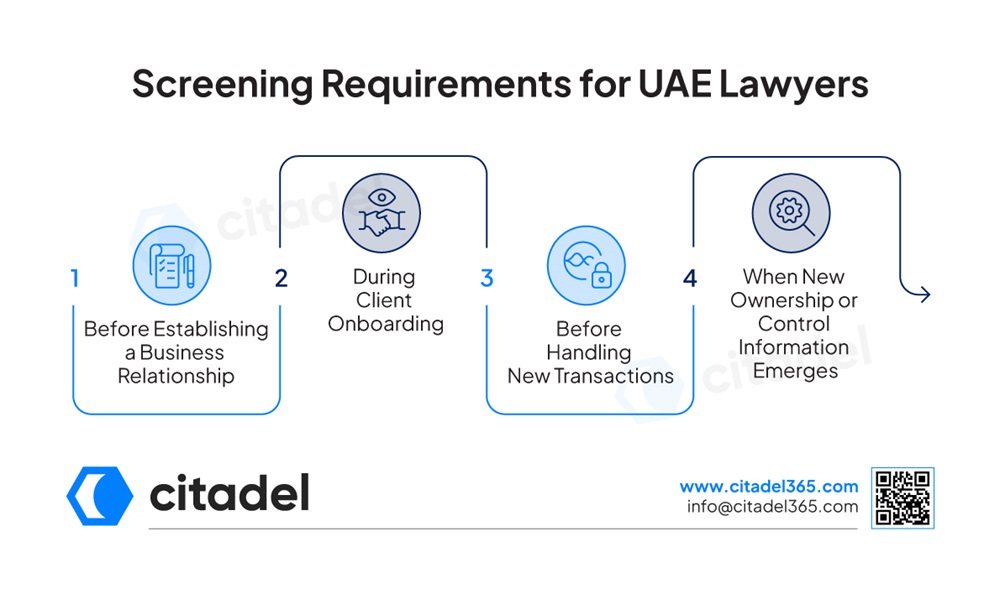
Prior to starting a business relationship, lawyers must ensure that the client does not appear on any sanctions lists.
At the time of onboarding, the screening must be conducted before signing any contract; the firms must also verify ultimate beneficial ownership.
Screening is also required before facilitating new transactions, including those associated with cross-border activity or high-risk jurisdictions, ensuring no sanctioned individuals or parties are involved.
Screening is essential when new ownership emerges, as changes in ownership or control may alter a client’s risk profile and introduce ML/TF risks.
To identify potential sanctions exposure, law firms must screen all the relevant parties associated with the client or transactions, some of which include:
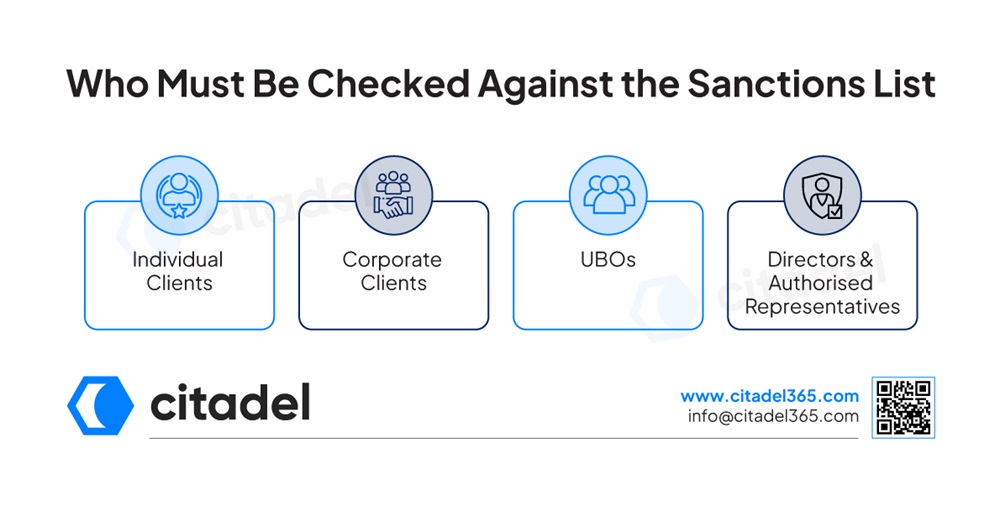
Individual Clients
Firms must screen individual clients against sanctions lists to identify any potential risk associated with them.
Corporate Clients
Corporate clients should also be screened to ensure regulatory compliance and avoid dealings with sanctioned entities.
Ultimate Beneficial Owners (UBOs)
Directors and Authorised Representatives
These individuals should be screened to ensure no relations with sanctioned parties.
Sanctions screening follows a structured process to identify and mitigate potential ML/TF and sanctioned risks. The core process involves:
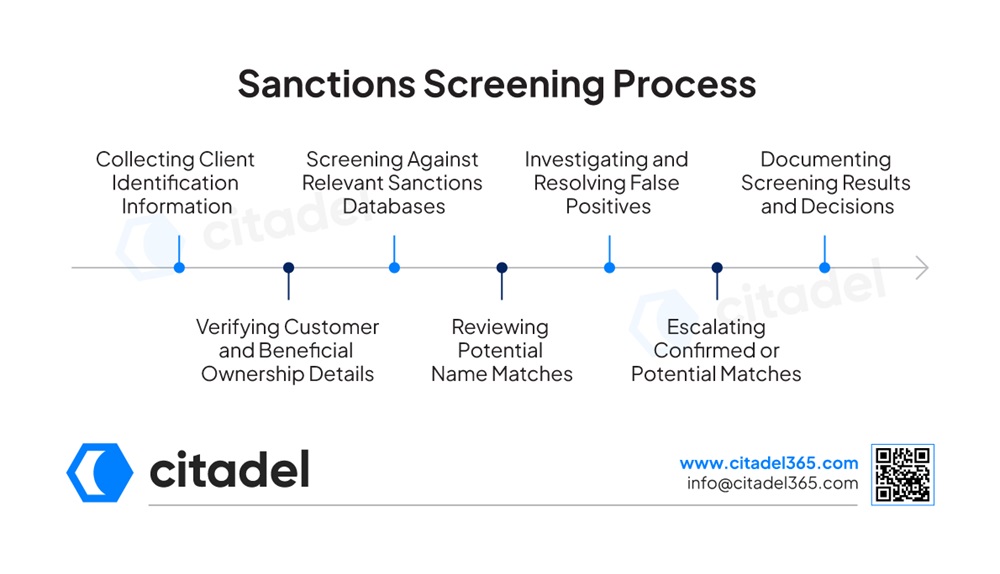
Screening alerts require careful verification to identify the genuine potential match. UAE lawyers use key aspects to verify the sanctions match.
Name Matching and Fuzzy Matching Indicators
Use proactive screening systems to detect spelling variations, aliases, and abbreviations, resulting in effective compliance and reducing operational burden.
Using Date of Birth, Nationality, and Identification Data
Lawyers must validate potential sanctions matches using the key details, which include date of birth, nationality, and place of birth, which help in differentiating the sanctioned persons from unrelated individuals with similar names.
Verifying Beneficial Ownership Connections
Lawyers should also assess the ownership and control structures to identify the links to sanctioned individuals or entities.
Distinguishing True Matches from False Positives
The lawyers are also required to evaluate a potential match against all available information to determine its validity, helping to reduce the false positives.
The common sanctions screening challenges that law firms face include:
Incomplete or outdated client information may hinder the screening accuracy and increase the operational burden.
A complex and hidden ownership structure can obscure beneficial ownership, leading to missing the potential sanctions match.
Reliance on manual systems increases the risk of false positives, results in delayed compliance and increases operational inefficiencies.
Inadequate staff training creates compliance gaps, inconsistent risk assessments, and a failure to identify potential sanctioned matches, resulting in increased regulatory risk for law firms.
When a client matches a sanctions list, the law firm must establish a proper compliance process before commencing any relationship.
Sanctions screening is a critical component of AML compliance, helping firms to identify risky customers and avoid transactions with them. It helps support CDD and allows firms to identify whether clients or associated parties are subject to sanctions. Sanctions screening also enables firms to detect individuals and entities that pose higher ML/TF risks, which require enhanced scrutiny.
The common mistakes made by law firms during sanctions screening include:
Citadel365 simplifies sanctions screening for legal professionals with its automated client and beneficial ownership screening, enabling firms to screen against sanctions lists.
It also supports ongoing monitoring and screening against updated sanctions lists, which helps in identifying new sanctions matches and changes in customer risk profiles.
Citadel365 integrates the screening, risk assessment, and customer due diligence into a single platform, enhancing the overall compliance efficiency.
It also enables centralised screening documentation, making it easier to manage and retrieve data when needed.
Citadel365 ensures audit-ready screening records, supporting the firms during regulatory investigations and enabling regulatory compliance.
Yes, UAE lawyers are required to screen clients against sanctions lists as part of their AML obligations.
The law firms should screen against the UAE Local Terrorist List, the UNSC Consolidated List, and other relevant sanctions lists based on their risk exposure.
The firms should screen customers, potential customers, beneficial owners, directors and authorised representatives against applicable sanctions lists.
Sanctions screening should be conducted at onboarding and continuously to ensure regulatory compliance.
Sanctions screening identifies individuals or entities subject to sanctions restrictions, whereas PEP screening involves identifying a politically exposed person who may present a higher ML/TF risk.

Arjun is the Co-founder and CEO of Citadel, where he leads the company’s vision across technology, business, and regulations. He brings over a decade of experience in building and scaling technology ventures. Arjun holds a B.Tech. in Information Technology and a Master’s in Management, supported by his certification as a Financial Crime Specialist, an uncommon combination that allows him to balance innovation with regulatory requirements.
Having advised leading banks and financial institutions on digital solutions and compliance technology, Citadel continues to grow with an ambition.