
Ready to Defeat Your AML Compliance Obstacles?
Citadel Brings Revolution with Secure Solutions to AML Compliance Problems
FATF Update February 2026 Plenary: Key Highlights
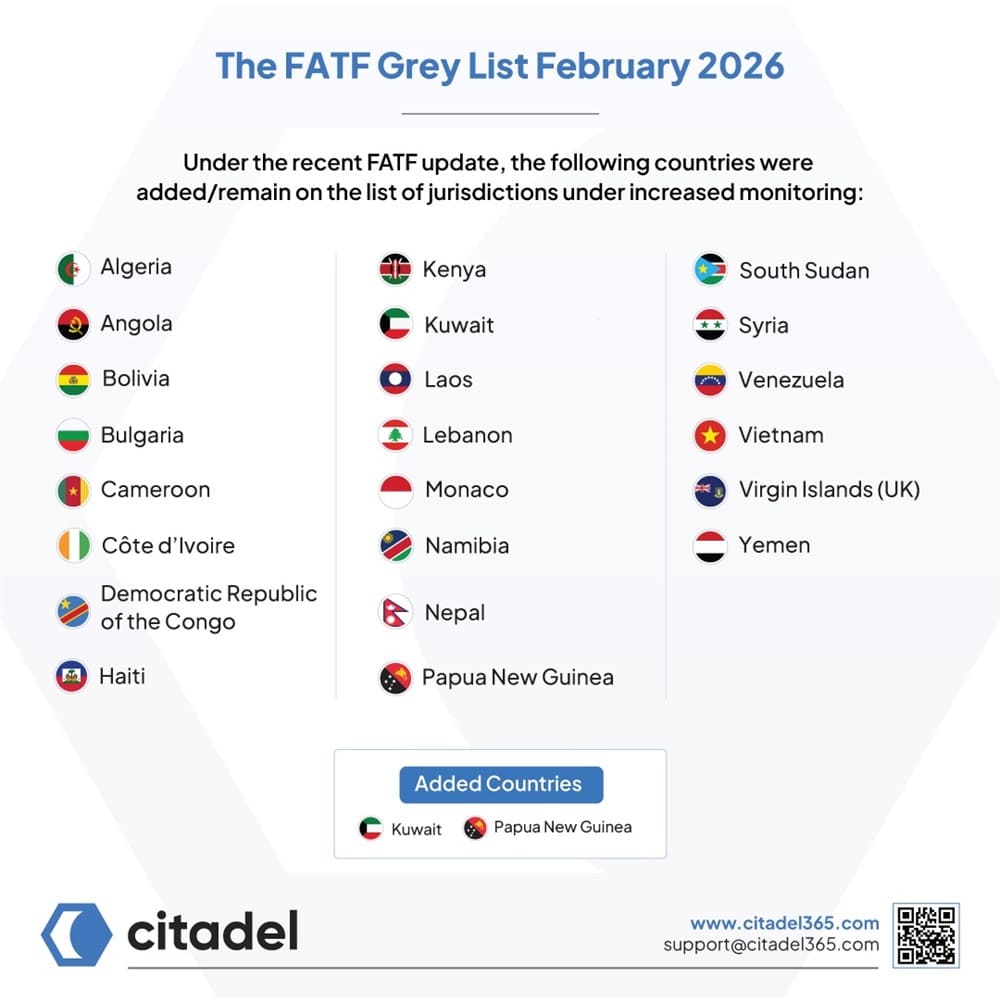
On 13th February, the Financial Action Task Force published the outcomes of its February 2026 Plenary, including updates to jurisdictions under increased monitoring, commonly referred to as the grey list. The FATF update follows the October 2025 review cycle and reflects FATF’s latest assessment of technical compliance and effectiveness across AML and CFT frameworks.
As of February 2026:
The following developments emerged as the most consequential outcomes of the Plenary discussions:
In the article below, we break down what has changed and the action steps regulated firms must take immediately:
FATF’s International Cooperation Review Group evaluates jurisdictions based on:
The recent FATF update confirms that the following jurisdictions have been added to the grey list:
According to the February 2026 Plenary outcomes, FATF identified deficiencies in areas such as beneficial ownership transparency, supervisory effectiveness, sanctions implementation, financial intelligence unit capability, and enforcement metrics. In recent years, many jurisdictions have undertaken significant legislative reform, and these developments are visible and often commendable.
Under the recent FATF update, the following countries were added/remain on the list of jurisdictions under increased monitoring:
February 2026 outcomes reinforce a direction that has been building for several evaluation cycles. In this cycle, the FATF appears to be emphasising:
The release of an updated grey list should trigger a structured internal review.
Within the first 30 days, regulated firms should:
Anyone who has followed the FATF cycles over the past decade will recognise the pattern. The language is careful, but expectations are not. This FATF update reinforces a supervisory climate that is increasingly empirical. The global AML framework has moved beyond policy declarations. Sanctions controls must function consistently. Investigators must progress beyond initial announcements. Institutions, with support from citadel365, that treat FATF updates as important events will be better positioned to demonstrate governance maturity and regulatory compliance.
The FATF grey list, formally known as “Jurisdictions under Increased Monitoring,” includes countries with identified AML/CFT deficiencies that have committed to addressing them within defined timelines. FATF monitors their progress through agreed action plans and periodic reviews.
In February 2026, Kuwait and Papua New Guinea were added to the FATF grey list following the identification of strategic gaps in their AML/CFT frameworks.
As of early 2026, there are around 22 jurisdictions on the FATF grey list, subject to change based on FATF review cycles and progress assessments.
A compliance team should reassess country risk ratings, apply or strengthen enhanced due diligence measures, review customer and transaction exposure to the listed jurisdictions, and ensure internal policies reflect the updated FATF position.
Enhanced Due Diligence (EDD) refers to additional verification and monitoring measures applied to higher-risk relationships. It is required for grey-listed countries where the risk level is elevated, particularly for complex transactions, high-risk customers, or where regulatory expectations mandate stricter controls.

Arjun is the Co-founder and CEO of Citadel, where he leads the company’s vision across technology, business, and regulations. He brings over a decade of experience in building and scaling technology ventures. Arjun holds a B.Tech. in Information Technology and a Master’s in Management, supported by his certification as a Financial Crime Specialist, an uncommon combination that allows him to balance innovation with regulatory requirements.
Having advised leading banks and financial institutions on digital solutions and compliance technology, Citadel continues to grow with an ambition.