
Ready to Defeat Your AML Compliance Obstacles?
Citadel Brings Revolution with Secure Solutions to AML Compliance Problems
Summary
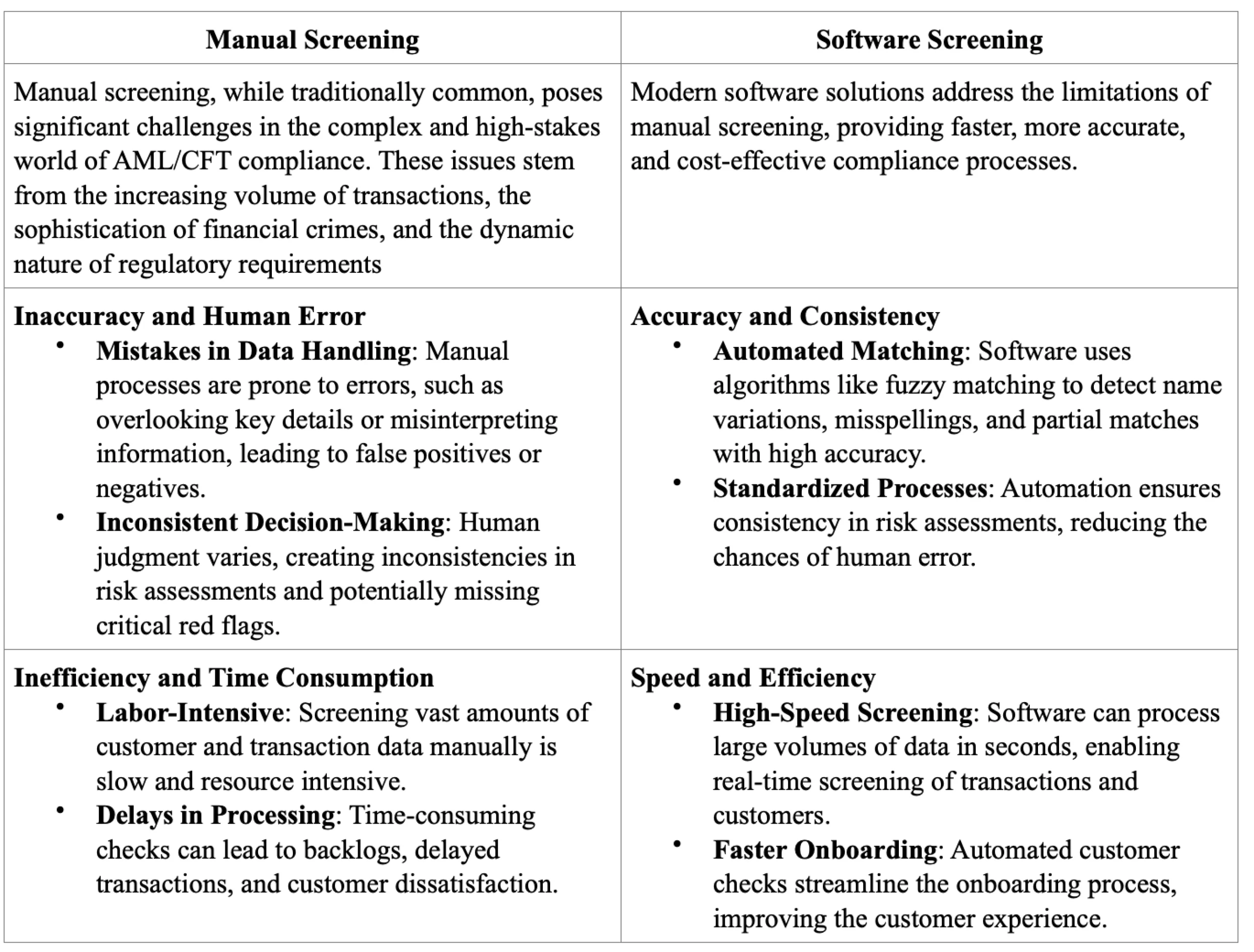
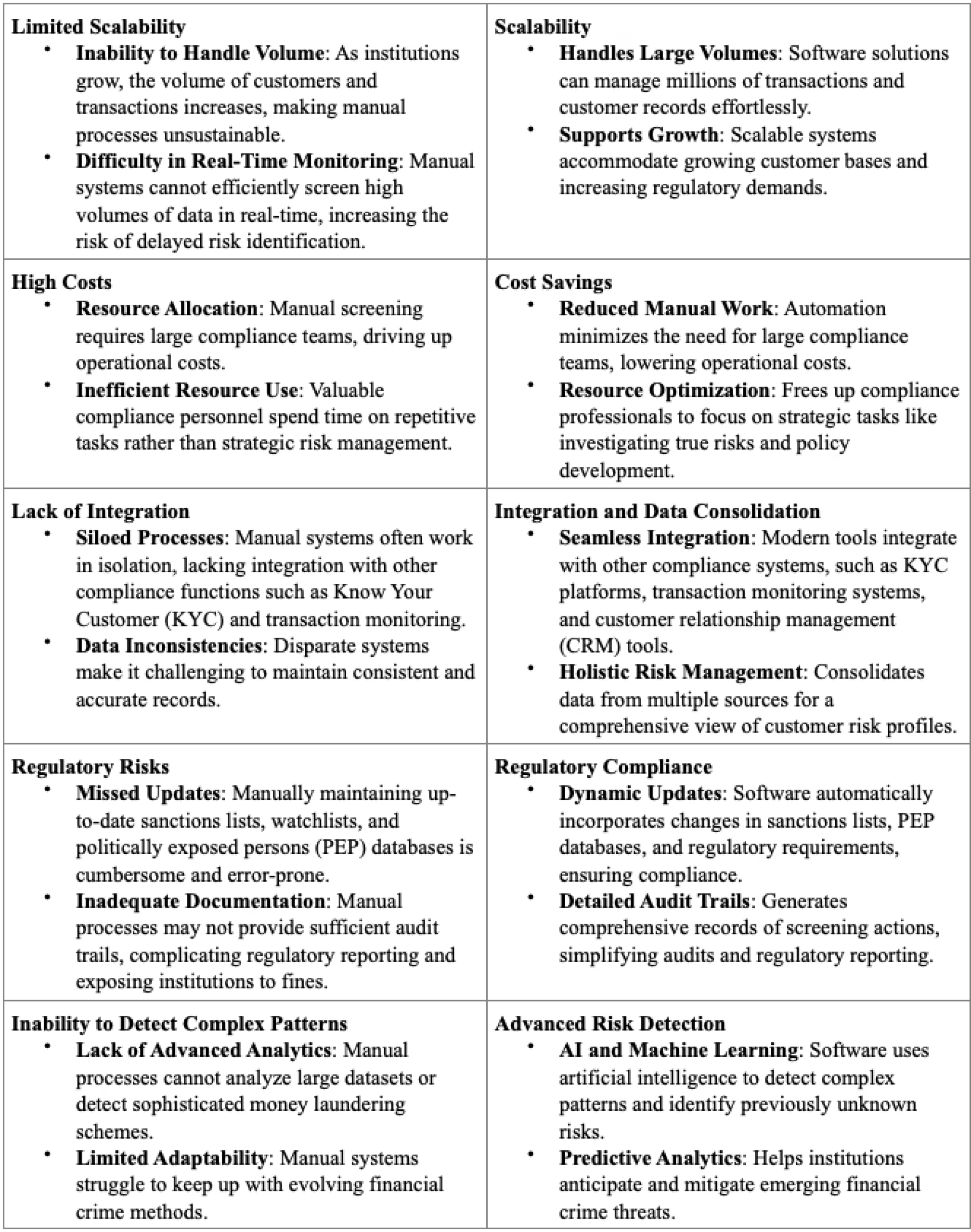
To save money or the effort of looking for a compliance software that will help in screening, various companies resort to manual screening which can be harmful in many ways. The differences between the obsolete manual screening and the new-age software screening are:
Selecting the right software for screening in Anti-Money Laundering (AML) and Countering the Financing of Terrorism (CFT) compliance is a critical decision for institutions. It impacts the effectiveness, efficiency, and reliability of an organization’s efforts to detect and mitigate financial crime risks. Choosing the wrong software can lead to operational inefficiencies, regulatory penalties, and reputational damage, while the right solution enhances compliance, reduces costs, and protects against emerging threats. This article highlights the importance of choosing the correct software for screening and the factors that make this decision vital.
Ensuring Compliance with Regulations
Software that fails to meet regulatory standards can expose institutions to significant fines, legal action, and reputational harm.
Improving Screening Accuracy
Effective AML/CFT screening requires a balance between detecting true risks and avoiding unnecessary alerts. The right software achieves this balance through:
Choosing subpar software increases the risk of missing true matches (false negatives) or overwhelming teams with irrelevant alerts (false positives).
Scalability and Performance
As businesses grow, their customer bases and transaction volumes expand, requiring scalable solutions. The correct software can handle:
Real-Time Risk Mitigation
Financial crimes like money laundering and terrorism financing occur in real time, making timely detection essential. The correct software:
Using outdated or inefficient software may delay risk detection, allowing illicit activities to go unnoticed and increasing institutional vulnerability.
Adapting to Emerging Threats
Financial crime tactics are constantly evolving. The correct software adapts to these changes by:
Integration with Other Systems
Regulatory Reporting and Audit Preparedness
Regulators often require detailed reports and audits to ensure compliance. The correct software simplifies this by:
Reputation and Customer Trust
Non-compliance with AML/CFT regulations or association with financial crimes can damage an institution’s reputation irreparably. The right software:
Support and Vendor Reliability
The reliability of the software vendor is as important as the software itself. Choosing a solution from a trusted vendor ensures:
Selecting unreliable software or vendors can lead to frequent downtime, limited support, and outdated features.
Choosing the correct software for AML/CFT screening is not merely a technical decision but a strategic one that affects an institution’s ability to comply with regulations, manage risks, and operate efficiently. The right software ensures accurate and timely risk detection, reduces operational costs, and adapts to evolving threats, ultimately safeguarding the institution’s reputation and financial stability.

Arjun is the Co-founder and CEO of Citadel, where he leads the company’s vision across technology, business, and regulations. He brings over a decade of experience in building and scaling technology ventures. Arjun holds a B.Tech. in Information Technology and a Master’s in Management, supported by his certification as a Financial Crime Specialist, an uncommon combination that allows him to balance innovation with regulatory requirements.
Having advised leading banks and financial institutions on digital solutions and compliance technology, Citadel continues to grow with an ambition.